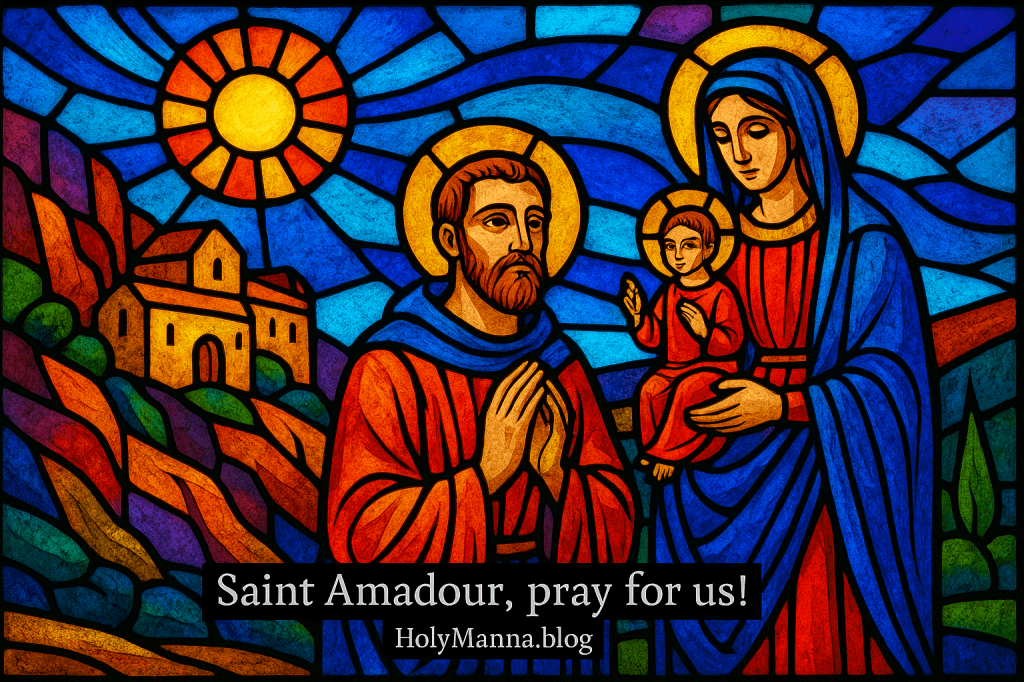
From Shadows to Sanctuary
Saint Amadour remains a tender mystery nestled within Catholic tradition, his memory intimately bound to the heights of Rocamadour. Though the details of his life remain veiled, his enduring legacy lies in the path of devotion he forged—a devotional pathway attesting to an unwavering attachment to God and the Blessed Virgin. His title, Amadour, meaning “lover,” whispers of the spiritual fire that ignited a pilgrimage site where the hearts of countless pilgrims have found solace, healing, and renewed faith. Even without a detailed biography, his presence is felt through the holiness that took root on that rocky promontory.
A Hermit’s Whisper in Time
Legends surround Saint Amadour’s origins, painting him alternately as Zacchaeus of Jericho or the faithful husband of Saint Veronica. Though these stories emerge centuries after the fact and rest on the edges of historical certainty, they reflect the hope of early Christians to link their spiritual forebears with tangible figures of the Gospel. What emerges more confidently from the tapestry is the image of a solitary man, drawn away from worldliness, choosing a life of contemplative seclusion. Perhaps he was a sinner seeking mercy, or a heart enamored with divine love—whichever the case, his retreat into the cliffs of Quercy sparked the devotional flame that would become Rocamadour.
A Liturgy of Stones and Shadows
Amadour’s story remains largely hidden from the usual annals of miracles or dramatic evangelization. Yet it is precisely in that silence that the miracle lies: a human life surrendered, a chapel built in trust, a guidepost that drew the weary and the penitent. This humble hermit kindled a spark that, through the centuries, transformed into a flame of grace. His life’s quiet miracle echoes in the hearts of pilgrims who sense that something sacred happened in that grotto, that their footsteps tread in the presence of a once-living soul wholly consecrated to God.
Tested by Time, Not Blood
Though Amadour did not suffer martyrdom or outward suffering, his legacy has certainly weathered the storms of time. The shrine built in his wake has been vandalized, relics have been desecrated, yet devotion has always returned. The discovery of his incorrupt remains centuries after his earthly departure filled souls with wonder. Later, during tumultuous times of iconoclasm and religious conflict, the shrine endured destruction and the loss of sacred objects. Still, these trials hardened the site’s spiritual foundations, reinforcing its identity as a place of resilience and divine protection, a sanctuary that outlasts persecution and the erosion of time.
When Stone Speaks of Grace
The miracles associated with Rocamadour—and by extension, with Saint Amadour—bloomed most vividly after his death. Monastic scribes recorded healings among pilgrims, miraculous rescues at sea marked by ringing bells and ex-votos in the shape of ships. These testimonies spread through medieval Europe, drawing kings and commoners alike to seek mercy at the cliff’s face. In time, miraculous healings, answered prayers, and fervent devotion layered the shrine with sacred resonance. On pilgrimage routes, Rocamadour became a landmark of hope, a living testament that even unseen saints continue to intercede powerfully for the faithful.
Pilgrimage as Prayer, Relics as Reminders
Saint Amadour invites us into a spiritual journey shaped more by intimacy than spectacle. His legacy urges us to cultivate hidden corners of prayer and silent devotion in our daily lives. As the Catechism reminds us, pilgrimages and veneration of relics are meaningful when they deepen our union with Christ, rather than replace our sacramental life. In the seeds of Amadour’s unknown life, we discern that holiness often grows beneath the threshold of recognition. This hermit teaches us that outward notice may never come, yet love offered quietly to God can channel streams of grace—if only we listen and respond.
Engage with Us!
Share your thoughts and your own “little Rocamadour” practices in the comments—how has Mary led you closer to Jesus through silence, pilgrimage, or sacred images?
- Where is Christ inviting me to build a “hermit’s corner” of daily silence so His voice can be heard?
- How can I honor Jesus more faithfully through veneration of His Mother and the saints while keeping the Eucharist at the center, as the Catechism teaches?
- Who needs my intercession today—and which saint will I ask to pray with me for that person’s healing or conversion?
Let’s support each other on the way and strive to do everything with love—just as our Lord Jesus did.
Saint Amadour, pray for us! ⛰️
Follow us on Instagram and Facebook for more insights and reflections on living a faith-filled life.

 Holy Manna!
Leave a comment