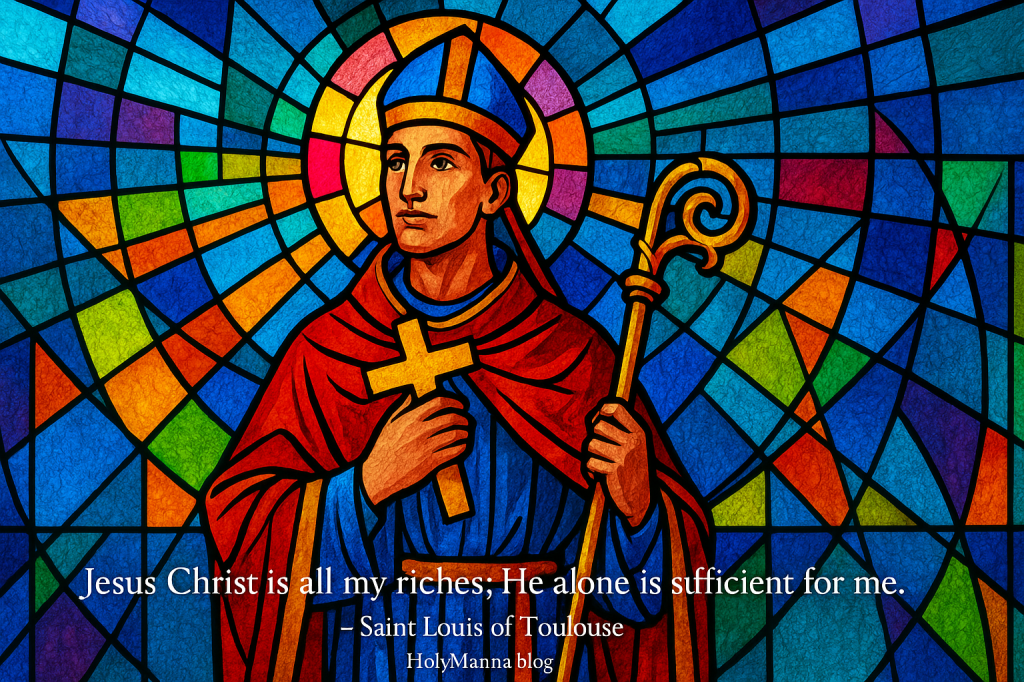
The Crown of Mercy
Louis of Toulouse (1274–1297) shines like a brief, brilliant comet in the clouded sky of medieval Christendom. A prince who laid aside royal ambition, embraced Gospel poverty, and answered the call to rule not over kingdoms but over souls in humble service, he was canonized in 1317. Revered for his extraordinary generosity, Franciscan simplicity, and profound devotion, Saint Louis of Toulouse remains an enduring model for those seeking to live faith with radical love and humility.
Princedom to Prison to Piety
Born amid the glories of Provence, Louis entered this world in 1274 as the second son of Charles II of Anjou and Mary of Hungary, part of a distinguished royal line connected to Saint Louis IX of France and Saint Elizabeth of Hungary. Politics soon shaped his youth: taken hostage to Aragon at age fourteen, he lived as a captive prince. Yet among his jailers walked Franciscan friars whose gentle witness awakened in him a desire for something greater than a throne—a life given entirely to Christ’s poor. When illness laid him low, that desire crystallized into a vow: he would join the Franciscans. On release, he renounced any claim to his hereditary crown, accepting instead the crown of servanthood in Christ—choosing to shepherd the flock, not lord over kingdoms.
Franciscan Crown, Episcopal Staff
Once appointed Bishop of Toulouse, Louis remained in simple habit, fasting and praying in the spirit of Saint Francis. He discarded opulence, feeding the hungry at his own table, lavishing his episcopal revenues upon the poor, treating lepers as brothers, and administering the sacraments with fatherly tenderness. People spoke of healings attributed to his prayers—people restored, hearts comforted, souls lifted, though recorded accounts focus more on his saintly presence than dramatic wonders. His life was itself a living miracle: a prince of world’s esteem who chose communion with the lowly, embodying Gospel mercy and turning every gesture into an act of grace.
White Martyrdom of Charity
Louis’s challenges were internal and quiet, not marked by swords but by self-emptying love. Years of captivity aged his body and taught him surrender. His fragile health groaned under the demands of governing Toulouse and giving his life away to others. There is no violent end, no bloodshed—only the soft yielding of a saint who, through relentless compassion and exhaustion, surrendered his life peacefully at twenty-three. He suffered the white martyrdom of charity, a testament that holiness does not always cry out in suffering but often whispers in selfless endurance.
Echoes of Grace
After his passing, a whisper became a chorus: devotion to Louis flourished. Art and popular memory grew into vibrant veneration. Altarpieces and frescoes depicted miracles said to have occurred through his intercession: travelers saved, sickness lifted, hope restored. His relics, enshrined in Valencia, became a magnet for pilgrims seeking solace and supernatural consolation. In every humble place where his memory is honored, his life continues to do good, stirring hearts to prayer and pointing them to the tender love of Our Lord.
Reflection
Saint Louis of Toulouse calls us to examine where our hearts are anchored. Are we protecting comfort, status, or control when Christ asks us to let go? His radical choice invites us to align our priorities with the Gospel—to let possessions, popularity, and security be tools for others rather than shields for ourselves. In everyday life that might mean offering time to listen, wallet to the poor, status to the ignored—and trusting Christ to hold what we release. Rooted in Church teaching, this call to sacrificial love echoes the Catechism’s teaching that we are called to prefer Christ above all, let go of worldly attachments, and carry out our Christian duty through love-filled service.
Engage with Us!
I’d love to hear your reflections in the comments—how does Saint Louis speak to your story today?
- Where is Christ inviting me to “prefer Him to everything and everyone” right now?
- How can I practice concrete charity—today—so that my love for the poor is real?
- What “crown” (status, comfort, habit) might Jesus be asking me to lay down for love of Him and His Church?
Let’s support one another on the way—praying, encouraging, and doing everything with love, as our Lord Jesus did.
Saint Louis of Toulouse, pray for us! 👑
Follow us on Instagram and Facebook for more insights and reflections on living a faith-filled life.

 Holy Manna!
Leave a comment