Tuesday of the Twentieth Week in Ordinary Time – Lectionary: 420
The Impossible from the Insignificant
Have you ever felt too small, too unqualified, or too burdened by your past to do anything great for God? Today’s readings speak directly into that doubt, reminding us that the Lord delights in calling the unlikely, stripping away earthly securities, and accomplishing through them what seems impossible. In Judges 6:11-24, Gideon is hiding in fear, convinced of his insignificance, when the Lord greets him as a “mighty warrior” and sends him to deliver Israel. In Psalm 85, we hear the assurance that when God acts, “love and truth will meet; justice and peace will kiss”—His presence transforms weakness into fruitfulness. Then, in Matthew 19:23-30, Jesus confronts the rich young ruler’s attachment to wealth and tells His disciples that entering the kingdom is humanly impossible—“but for God all things are possible”. Historically, both Gideon’s mission and the disciples’ call came in moments of great challenge: Israel was under oppression in Gideon’s day, and in Jesus’ time, wealth was often seen as a sign of divine favor. Yet God overturns human expectations, showing that His saving power doesn’t depend on strength, status, or possessions, but on total trust and surrender. Will we let go of our excuses and attachments so that the God of the impossible can work through us?
First Reading – Judges 6:11-24
The Call of a Reluctant Warrior
In the days of Gideon, Israel was under the heavy oppression of the Midianites, a nomadic people who would raid the land, destroy crops, and leave the Israelites in poverty and fear. The Book of Judges records this as a cycle: Israel falls into sin, God allows oppression, the people cry out, and the Lord raises up a deliverer. Historically, Gideon’s call takes place during one of these low points—when survival was the daily focus, and faith in God’s saving power was dim. Beating out wheat in a winepress, hidden from enemy eyes, Gideon hardly seemed the heroic type. Yet this is precisely the point: God chooses the unlikely to make His power known. In today’s theme of trusting God to do the impossible, Gideon’s call is a vivid picture—one man, convinced of his insignificance, invited to take part in God’s mighty deliverance.
Judges 6:11-24
New American Bible (Revised Edition)
11 Then the messenger of the Lord came and sat under the terebinth in Ophrah that belonged to Joash the Abiezrite. Joash’s son Gideon was beating out wheat in the wine press to save it from the Midianites, 12 and the messenger of the Lord appeared to him and said: The Lord is with you, you mighty warrior! 13 “My lord,” Gideon said to him, “if the Lord is with us, why has all this happened to us? Where are his wondrous deeds about which our ancestors told us when they said, ‘Did not the Lord bring us up from Egypt?’ For now the Lord has abandoned us and has delivered us into the power of Midian.” 14 The Lord turned to him and said: Go with the strength you have, and save Israel from the power of Midian. Is it not I who send you? 15 But he answered him, “Please, my Lord, how can I save Israel? My family is the poorest in Manasseh, and I am the most insignificant in my father’s house.” 16 The Lord said to him: I will be with you, and you will cut down Midian to the last man. 17 He answered him, “If you look on me with favor, give me a sign that you are the one speaking with me. 18 Please do not depart from here until I come to you and bring out my offering and set it before you.” He answered: I will await your return.
19 So Gideon went off and prepared a young goat and an ephah of flour in the form of unleavened cakes. Putting the meat in a basket and the broth in a pot, he brought them out to him under the terebinth and presented them. 20 The messenger of God said to him: Take the meat and unleavened cakes and lay them on this rock; then pour out the broth. When he had done so, 21 the messenger of the Lord stretched out the tip of the staff he held. When he touched the meat and unleavened cakes, a fire came up from the rock and consumed the meat and unleavened cakes. Then the messenger of the Lord disappeared from sight. 22 Gideon, now aware that it had been the messenger of the Lord, said, “Alas, Lord God, that I have seen the messenger of the Lord face to face!” 23 The Lord answered him: You are safe. Do not fear. You shall not die. 24 So Gideon built there an altar to the Lord and called it Yahweh-shalom. To this day it is still in Ophrah of the Abiezrites.
Detailed Exegesis
Verse 11 – “Then the messenger of the Lord came and sat under the terebinth in Ophrah that belonged to Joash the Abiezrite. Joash’s son Gideon was beating out wheat in the wine press to save it from the Midianites.”
This sets the scene: a humble, almost pitiful image of a man hiding from danger, trying to eke out enough grain to survive. A winepress was meant for crushing grapes, not threshing wheat—Gideon’s location symbolizes the fear and desperation of Israel. The “messenger of the Lord” is often interpreted as a theophany—God Himself in angelic form—showing the divine initiative in calling His servants.
Verse 12 – “The Lord is with you, you mighty warrior!”
God’s greeting names Gideon not as he sees himself, but as God sees him. This reflects the transformative power of God’s word—He speaks identity and mission before the reality is visible. The Catechism teaches that “With God all things are possible” (CCC 273), reminding us that vocation begins with God’s choice, not human capability.
Verse 13 – “My lord, if the Lord is with us, why has all this happened to us? Where are his wondrous deeds about which our ancestors told us…? For now the Lord has abandoned us and has delivered us into the power of Midian.”
Gideon’s doubt is raw and honest—he cannot reconcile God’s supposed presence with Israel’s suffering. This mirrors the cry of many believers in times of trial. Scripture shows that God does not rebuke Gideon for questioning, but redirects him to the mission at hand.
Verse 14 – “Go with the strength you have, and save Israel from the power of Midian. Is it not I who send you?”
God calls Gideon to act, not in imagined power, but in the “strength you have.” The key is not the amount of strength, but the divine commission—“Is it not I who send you?” This is a reminder that God’s presence transforms the mission from impossible to certain.
Verse 15 – “Please, my Lord, how can I save Israel? My family is the poorest in Manasseh, and I am the most insignificant in my father’s house.”
Here we see the heart of Gideon’s resistance—his identity is shaped by poverty and insignificance. Like Moses in Exodus 3–4, Gideon protests his inadequacy, forgetting that God’s choice overrides human limitations.
Verse 16 – “I will be with you, and you will cut down Midian to the last man.”
The promise “I will be with you” echoes throughout salvation history, from Moses to the Apostles in Matthew 28:20. The victory is guaranteed not because of Gideon’s might, but because of God’s presence.
Verse 17 – “If you look on me with favor, give me a sign that you are the one speaking with me.”
Gideon requests a sign, revealing both his desire to believe and his lingering doubt. This anticipates later moments in his story, where signs confirm God’s promise (e.g., the fleece in Judges 6:36-40).
Verse 18 – “Please do not depart from here until I come to you and bring out my offering and set it before you.” He answered: “I will await your return.”
The offering is a gesture of worship and hospitality, deeply ingrained in ancient Near Eastern culture. God’s willingness to “wait” is a sign of His patience with those He calls.
Verse 19 – “So Gideon went off and prepared a young goat and an ephah of flour in the form of unleavened cakes…”
The large quantity of food offered, despite scarcity, shows Gideon’s reverence and sacrifice. Unleavened bread recalls the Passover, symbolizing deliverance.
Verse 20 – “Take the meat and unleavened cakes and lay them on this rock; then pour out the broth.”
The rock becomes the altar—another biblical motif that God can sanctify the ordinary for His purposes.
Verse 21 – “The messenger of the Lord… touched the meat and unleavened cakes, a fire came up from the rock and consumed them. Then the messenger of the Lord disappeared from sight.”
The fire signifies divine acceptance of Gideon’s offering, affirming the authenticity of the call. In biblical tradition, fire from heaven often accompanies God’s approval (e.g., Elijah on Mount Carmel in 1 Kings 18).
Verse 22 – “Alas, Lord God, that I have seen the messenger of the Lord face to face!”
Gideon fears death, as seeing God’s messenger was believed to be fatal (Exodus 33:20). His reaction shows reverence and awareness of divine holiness.
Verse 23 – “You are safe. Do not fear. You shall not die.”
God reassures Gideon with peace—His mission begins not with battle, but with the removal of fear.
Verse 24 – “So Gideon built there an altar to the Lord and called it Yahweh-shalom.”
The name “The Lord is Peace” (“Yahweh-shalom”) anchors the mission in God’s character. Before Gideon can fight, he must know God’s peace.
Teachings
This passage illustrates the truth in CCC 2570: “When God calls him, Abraham goes forth ‘as the Lord had told him’; Abraham’s heart is entirely submissive to the Word and so he obeys. Such attentiveness of the heart, whose decisions are made according to God’s will, is essential to prayer.” Like Abraham, Gideon is called into the unknown, relying on God’s promise rather than his own resources. Saint Paul echoes this principle in 2 Corinthians 12:9: “My grace is sufficient for you, for power is made perfect in weakness.” Historically, the Church Fathers often pointed to Gideon as a type of Christ—seemingly lowly, yet raised up to deliver His people, armed not with human strength, but with divine authority.
Reflection
Gideon’s call reminds us that God is not waiting for us to be strong before He sends us—He sends us and then makes us strong. Our excuses, like Gideon’s, may sound reasonable, but they crumble in the light of God’s promise, “I will be with you.” In daily life, this means stepping into service, evangelization, or acts of charity even when we feel unprepared. It means trusting that God’s peace precedes His mission. Where in your life do you feel too small for the task ahead? Will you let God’s presence be your strength, even when the outcome seems impossible?
Responsorial Psalm – Psalm 85:9, 11-14
When Heaven and Earth Embrace
Psalm 85 is a song of restoration, believed to have been written after Israel’s return from the Babylonian exile. The people, though back in their land, still longed for God’s full blessing—peace, prosperity, and His abiding presence. In Israel’s covenantal understanding, peace (shalom) was not merely the absence of conflict but the fullness of life under God’s favor. This psalm captures the hope of a reconciled relationship between God and His people, where righteousness and faithfulness flourish. In the context of today’s theme, these verses echo the promise given to Gideon: when God is with His people, the impossible becomes reality, and His presence brings not only victory but deep, lasting peace.
Psalm 85:9, 11-14
New American Bible (Revised Edition)
9 I will listen for what God, the Lord, has to say;
surely he will speak of peace
To his people and to his faithful.
May they not turn to foolishness!
11 Love and truth will meet;
justice and peace will kiss.
12 Truth will spring from the earth;
justice will look down from heaven.
13 Yes, the Lord will grant his bounty;
our land will yield its produce.
14 Justice will march before him,
and make a way for his footsteps.
Detailed Exegesis
Verse 9 – “I will listen for what God, the Lord, has to say; surely he will speak of peace to his people and to his faithful. May they not turn to foolishness!”
The psalmist adopts the posture of a prophet or watchman, attentive to God’s voice. Listening is an act of faith—believing that God does speak and that His word brings peace. The prayer that the people “not turn to foolishness” warns against falling back into sin after God’s deliverance, much like Israel’s repeated cycle in the Book of Judges.
Verse 11 – “Love and truth will meet; justice and peace will kiss.”
This poetic image depicts divine harmony. Love (hesed, covenantal mercy) and truth (emet, reliability and faithfulness) are united, as are justice and peace. This meeting is ultimately fulfilled in Christ, in whom mercy and truth converge perfectly. The Church sees this as a glimpse of the Kingdom of God, where God’s attributes are not in tension but in perfect unity.
Verse 12 – “Truth will spring from the earth; justice will look down from heaven.”
The imagery suggests a meeting between heaven and earth. Truth springing from the earth evokes the fruitfulness of God’s people when they live in faithfulness, while justice looking down from heaven signifies God’s righteous oversight and blessing.
Verse 13 – “Yes, the Lord will grant his bounty; our land will yield its produce.”
This verse ties spiritual faithfulness to tangible blessing. In the Old Covenant, material prosperity was often linked to covenant fidelity (Deuteronomy 28). While in the New Covenant God’s blessings are not always material, the principle remains: obedience to God opens the door to His abundance—whether spiritual, relational, or material.
Verse 14 – “Justice will march before him, and make a way for his footsteps.”
Justice is personified as going ahead of God, preparing the way for His reign. This recalls the role of John the Baptist, who prepared the way for Christ through a call to repentance. It also speaks to the believer’s role in creating a path for God’s presence through a life of righteousness.
Teachings
The Catechism affirms in CCC 1807 that “Justice is the moral virtue that consists in the constant and firm will to give their due to God and neighbor.” This psalm shows that justice is inseparable from peace and love—it is not merely legal fairness but right relationship. Saint Augustine, in his Confessions, reflects on the union of justice and peace as a foretaste of heaven, noting that such harmony cannot exist apart from God’s grace. The imagery of “love and truth” meeting finds ultimate expression in Christ, described in John 1:14 as “full of grace and truth”. Historically, this psalm was prayed by Israel in times of national repentance and renewal, often during liturgical festivals that recalled God’s past deliverance and anticipated His future salvation.
Reflection
This psalm invites us to be listeners—to quiet our hearts and truly wait for God’s word of peace. But it also challenges us to live in a way that welcomes His presence: to practice justice, to be people of truth, and to hold love and peace together. In a world that often separates these virtues, Psalm 85 reminds us that in God they are inseparable. Are we attentive to the voice of the Lord in our daily life, or are we more attuned to the noise of the world? How can we embody the meeting of love and truth, justice and peace, in our families, workplaces, and communities?
Holy Gospel – Matthew 19:23-30
The Reward of Radical Surrender
In first-century Jewish culture, wealth was often interpreted as a sign of divine blessing, rooted in Old Testament promises where material prosperity was linked to covenant faithfulness (Deuteronomy 28). Jesus’ words in this Gospel would have shocked His listeners: if even the wealthy—those seemingly favored by God—found it hard to enter the Kingdom, then who could be saved? This exchange takes place right after the encounter with the rich young man, who walked away sorrowful because he could not part with his possessions. Here, Jesus deepens the teaching for His disciples, revealing that entering eternal life is not about human achievement or social standing, but about God’s grace and our willingness to give up everything for His sake. In light of today’s theme, the Gospel reminds us that just as Gideon had to trust God despite his own weakness, we must trust God enough to surrender what we hold most tightly, believing He can accomplish the impossible in us.
Matthew 19:23-30
New American Bible (Revised Edition)
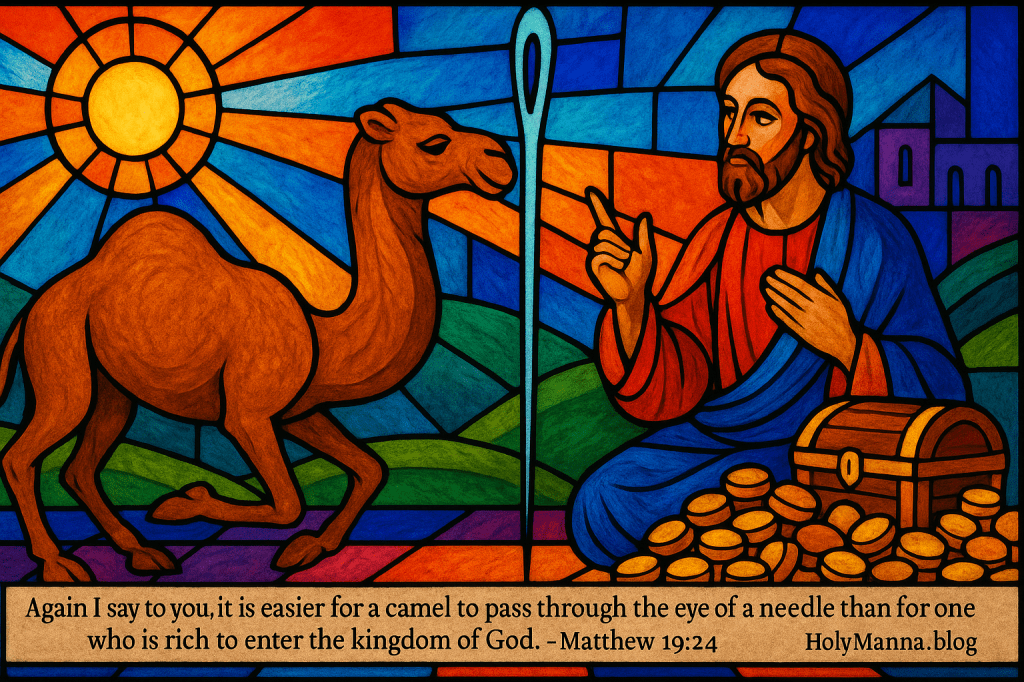
23 Then Jesus said to his disciples, “Amen, I say to you, it will be hard for one who is rich to enter the kingdom of heaven. 24 Again I say to you, it is easier for a camel to pass through the eye of a needle than for one who is rich to enter the kingdom of God.” 25 When the disciples heard this, they were greatly astonished and said, “Who then can be saved?” 26 Jesus looked at them and said, “For human beings this is impossible, but for God all things are possible.” 27 Then Peter said to him in reply, “We have given up everything and followed you. What will there be for us?” 28 Jesus said to them, “Amen, I say to you that you who have followed me, in the new age, when the Son of Man is seated on his throne of glory, will yourselves sit on twelve thrones, judging the twelve tribes of Israel. 29 And everyone who has given up houses or brothers or sisters or father or mother or children or lands for the sake of my name will receive a hundred times more, and will inherit eternal life. 30 But many who are first will be last, and the last will be first.
Detailed Exegesis
Verse 23 – “Amen, I say to you, it will be hard for one who is rich to enter the kingdom of heaven.”
Jesus begins with a solemn declaration (Amen, I say to you), signaling the importance of what follows. The difficulty for the rich lies not in wealth itself, but in the temptation to rely on possessions instead of God. Wealth can create a false sense of security, making radical dependence on God seem unnecessary.
Verse 24 – “Again I say to you, it is easier for a camel to pass through the eye of a needle than for one who is rich to enter the kingdom of God.”
The image is hyperbolic—deliberately extreme—to drive home the impossibility of salvation by human means. Some interpretations point to a small city gate nicknamed “the needle’s eye,” which a camel could only pass through by kneeling and being unloaded, symbolizing humility and detachment. However, whether literal or metaphorical, the meaning is the same: without surrender, entry into the Kingdom is impossible.
Verse 25 – “When the disciples heard this, they were greatly astonished and said, ‘Who then can be saved?’”
The disciples’ shock reflects their cultural assumption that wealth was a sign of divine approval. If the “favored” cannot enter easily, who can? Their question reveals the need to rethink salvation entirely.
Verse 26 – “For human beings this is impossible, but for God all things are possible.”
This is the heart of the passage—salvation is God’s work. Our part is to cooperate with His grace through faith and surrender. This verse ties directly to CCC 169 which teaches that “Salvation comes from God alone; but because we receive the life of faith through the Church, she is our mother: ‘We believe the Church as the mother of our new birth, and not in the Church as if she were the author of our salvation.’”
Verse 27 – “We have given up everything and followed you. What will there be for us?”
Peter voices what the others are surely thinking: having made sacrifices for Christ, what reward can they expect? This is not selfishness, but a human desire for assurance.
Verse 28 – “Amen, I say to you that you who have followed me, in the new age, when the Son of Man is seated on his throne of glory, will yourselves sit on twelve thrones, judging the twelve tribes of Israel.”
Jesus promises the Apostles a share in His authority in the coming Kingdom, an image drawn from Jewish eschatological expectation. The “new age” refers to the final fulfillment of God’s plan when Christ reigns in glory.
Verse 29 – “And everyone who has given up houses or brothers or sisters or father or mother or children or lands for the sake of my name will receive a hundred times more, and will inherit eternal life.”
This radical promise extends beyond the Apostles to all disciples. The “hundredfold” is not merely material—though the early Church’s communal life (cf. Acts 2:44-47) reflected it—but primarily spiritual: the communion of the Church, the joy of discipleship, and eternal life.
Verse 30 – “But many who are first will be last, and the last will be first.”
Jesus overturns worldly expectations. Status, wealth, and position do not determine one’s standing in the Kingdom; humility, faith, and obedience do.
Teachings
The Catechism warns in CCC 2544: “Jesus enjoins his disciples to prefer him to everything and everyone, and bids them ‘renounce all that [they have]’ for his sake and that of the Gospel. Shortly before his passion he gave them the example of the poor widow of Jerusalem who, out of her poverty, gave all that she had to live on. The precept of detachment from riches is obligatory for entrance into the Kingdom of heaven.” Saint John Chrysostom explained that this detachment is not only about physical possessions but about freeing the heart from anything that takes the place of God. The early Christians lived this reality, sharing resources so that no one was in need, embodying the “hundredfold” promised by Christ. Historically, this teaching challenged both Roman and Jewish cultural values, where wealth was often a measure of honor and divine favor.
Reflection
This Gospel calls each of us to examine what we hold onto so tightly that it might hinder our following of Christ. It might be wealth, comfort, control, or even relationships. The promise of Jesus is not that we will lack in this life, but that in surrendering all for Him, we will receive far more than we could imagine—chiefly eternal life. What would it look like for you to trust God enough to let go of your greatest attachment? Do you believe that He can replace what you give up with something infinitely better?
Stepping Into the Impossible With God
Today’s readings weave together a powerful truth: God delights in using the weak, the unlikely, and the surrendered to accomplish what no human effort could achieve. In Judges 6:11-24, Gideon’s story shows us that God’s call is not dependent on our perceived strength but on His presence—“I will be with you” is enough to transform fear into courage. Psalm 85 reminds us that when God moves, “love and truth will meet; justice and peace will kiss”, and our lives will bear fruit as heaven’s blessings touch the earth. In Matthew 19:23-30, Jesus teaches that salvation is impossible on human terms, but gloriously possible for God, inviting us to let go of every attachment and trust in His promise of a “hundredfold” reward and eternal life.
God’s message today is both challenging and comforting: challenging because He calls us to step out of our comfort zones, surrendering the very things we cling to; comforting because He assures us that the outcome does not rest on our ability but on His power. The same Lord who called Gideon and the Apostles is calling you—by name—into deeper trust, greater surrender, and fearless discipleship. Will you step forward, even if you feel small? Will you believe that with God, the impossible becomes your reality? Trust Him, and let today be the day you say yes to His call.
Engage with Us!
We’d love to hear how today’s readings have touched your heart. Share your thoughts, prayers, or personal stories in the comments so we can grow together as a faith-filled community, encouraging one another on the journey toward Christ.
Reflection Questions:
First Reading – Judges 6:11-24: When have you felt too small or unworthy for a task God placed before you? How did you respond to His call?
Responsorial Psalm – Psalm 85:9, 11-14: In what ways can you help “love and truth meet” and “justice and peace kiss” in your daily interactions?
Holy Gospel – Matthew 19:23-30: What is the greatest attachment you struggle to let go of for Christ’s sake? How might surrendering it draw you closer to Him?
Let us continue to live boldly in our faith, trusting God’s power over our limitations, and doing all things with the love, mercy, and humility that Jesus taught us.
Follow us on Instagram and Facebook for more insights and reflections on living a faith-filled life.

 Holy Manna!
Leave a comment