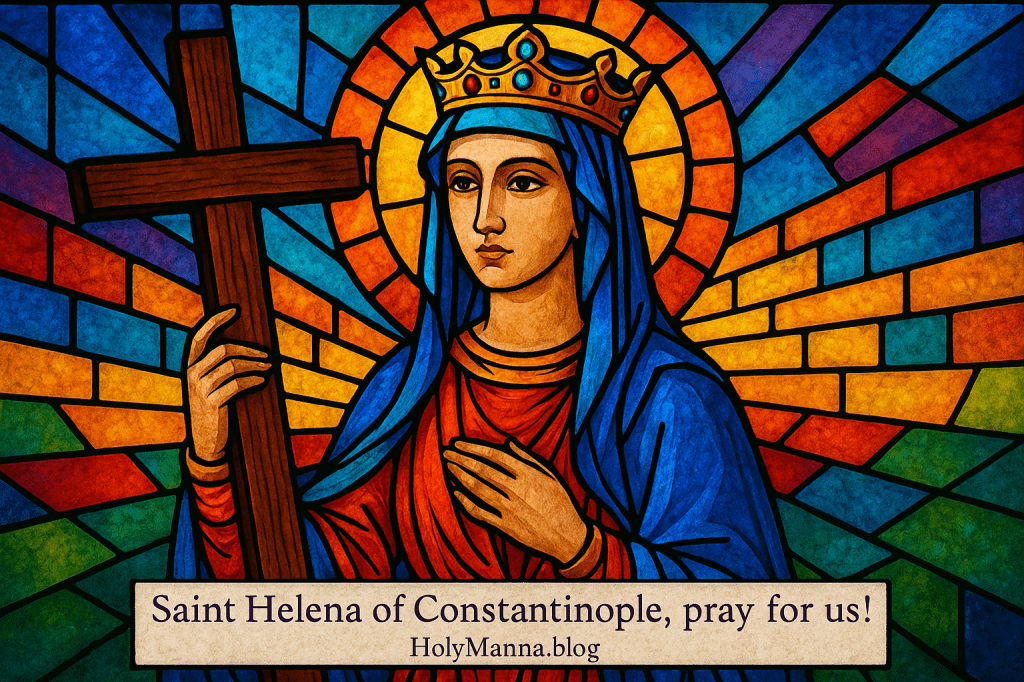
Where Love Found the Cross
Saint Helena (c. 246–330), mother of Emperor Constantine the Great, holds a unique place in Christian history as both an empress and a pilgrim. She is remembered not only for her royal position but for the humility and devotion that marked her later years. Known as the “Empress of the Cross,” she is closely associated with the Christian tradition of the discovery of the True Cross, the very instrument of Christ’s crucifixion. Her influence shaped the landscape of the Holy Land—literally—through the construction of monumental churches at sites central to the life, death, and resurrection of Jesus. As the Catechism of the Catholic Church teaches, “The religious sense of the Christian people has always found expression in various forms of piety… such as the veneration of relics.” (CCC 1674), a devotion Helena’s work profoundly advanced. Her life invites us to see how love for Christ overflows into action, charity, and preservation of the faith for generations to come.
From Humble Hearth to Imperial Purple
Although ancient accounts differ, Helena is widely believed to have been born in Drepanum in Bithynia, a small town later renamed Helenopolis in her honor. Of humble origins, she entered into a relationship with the future Emperor Constantius Chlorus and gave birth to Constantine around 272. When imperial politics demanded Constantius marry for political alliance, he set Helena aside, a personal sorrow that would later be transformed into a deeper dependence on God. Years later, after Constantine’s rise to power and his victory at the Battle of the Milvian Bridge—fought under the sign of the cross—he publicly restored his mother to a position of honor, granting her the title Augusta in 325. This restored dignity came at a time when Christianity was emerging from centuries of persecution, and Helena embraced the faith wholeheartedly, using her influence and resources to serve Christ’s Church. Eusebius, an eyewitness to her later life, portrays her as a woman of extraordinary devotion and active charity.
The Pilgrim Empress
In her late seventies or early eighties, Helena undertook one of the most significant pilgrimages in Christian history, traveling to the Holy Land around 325–327. Eusebius records that she visited the sacred sites connected with the life of Jesus, showing reverence and providing lavish gifts for the churches built there. She ordered the construction of the Church of the Nativity in Bethlehem over the cave believed to be the place of Christ’s birth, and the Eleona Church on the Mount of Olives, marking the site of His Ascension. Later historians—Rufinus, Socrates Scholasticus, and Sozomen—expanded the tradition by telling of her role in finding the True Cross. According to these accounts, during excavations in Jerusalem, three crosses were discovered. The Cross of Christ was identified when it was placed upon a dying woman (or, in some accounts, a dead man) who was instantly restored to health. Helena also reportedly found nails from the Crucifixion, which Constantine had incorporated into his military gear—bridle-bits and a helmet—as a sign of Christ’s protection. This pilgrimage was not a royal sightseeing tour; it was a mission of faith, guided by humility, generosity, and a deep desire to glorify God.
Crosses We Carry
Though she lived in an age when martyrdom was no longer a daily threat in the Roman Empire, Helena still bore her own crosses. Her early life was marked by loss, separation, and the political maneuverings of imperial power. Even as Augusta, she chose a life of modesty, traveling without ostentation, dressing simply, and devoting herself to the service of the poor and the Church. Eusebius noted her extraordinary almsgiving, freeing prisoners, and aiding the destitute. Her perseverance through personal trials reflects the Catechism’s teaching that “the cross is the unique sacrifice of Christ… [who] offers all the possibility of being made partners in the Paschal mystery.” (CCC 618). Helena’s life shows that the “cross” each of us carries—be it hardship, rejection, or personal sacrifice—can become a source of grace when united to Christ’s own Passion.
When Pilgrims Keep Coming
Helena’s impact did not end with her death around 330. The relics and churches she established became focal points of Christian devotion for centuries. St. Cyril of Jerusalem attested to the veneration of the True Cross and how fragments were distributed across the world, bringing healing and strengthening faith wherever they went. In Rome, Helena’s Sessorian palace was transformed into the Basilica of Santa Croce in Gerusalemme, housing relics of the Passion, including fragments of the True Cross and, according to tradition, earth brought from Calvary. This made the experience of pilgrimage accessible to those who could not journey to the Holy Land. In Trier, a relic of her skull is still venerated in the cathedral treasury. Pilgrims continue to visit these sites today, drawn by the same faith that led Helena to travel across the empire in search of the places sanctified by the footsteps of Christ. Her work ensured that future generations could encounter the tangible history of salvation in stone, wood, and soil.
Take Up the Cross with a Mother’s Love
Saint Helena’s example is not simply historical—it is deeply practical for our own walk with Christ. She teaches that faith is not passive; it is active, generous, and courageous. Her life urges us to honor the Lord not only in word but in deed: to care for the poor, to preserve what is holy, to travel—physically or spiritually—toward the places where we can encounter Him more fully. The Catechism reminds us: “Being more closely united to Christ, those who dwell in heaven… do not cease to intercede for us.” (CCC 956). In venerating the Cross and remembering Helena’s faith, our hearts are directed to the one she served: Jesus Christ, our Lord. How might you “go on pilgrimage” this week—perhaps to a local church or crucifix—bringing your own burdens to the wood of the Cross?
Try this today: make a simple pilgrimage of love. Visit a crucifix at your parish or home and pray the Anima Christi. Offer alms to someone in need. Read a passage of the Passion. And if possible, set a time to visit a shrine or a cathedral soon—let Helena’s footsteps stir yours.
Engage with Us!
I’d love to hear what stirred your heart in Saint Helena’s story. Share your thoughts and any graces or challenges you’re bringing to the Cross today.
What holy place—near or far—has helped you meet Jesus more personally?
How does Helena’s humility and generosity challenge the way you carry your own “crosses”?
When you venerate a crucifix or relic, how does it deepen your faith in Christ’s saving love?
Let’s keep praying for one another. May we support each other in the journey and strive to do everything with love, as our Lord Jesus did.
Saint Helena of Constantinople, pray for us! ✝️
Follow us on Instagram and Facebook for more insights and reflections on living a faith-filled life.

 Holy Manna!
Leave a comment