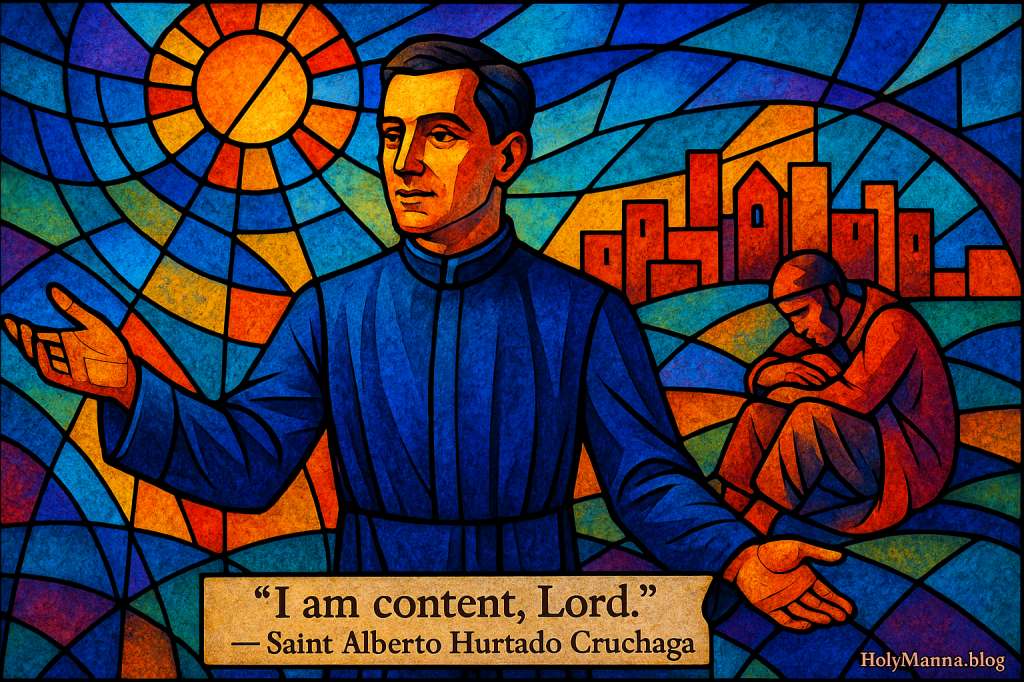
“Contento, Señor, contento”
Saint Alberto Hurtado Cruchaga (1901–1952) stands as one of Latin America’s most vibrant witnesses to Catholic social teaching. A Jesuit priest from Chile, he refused to let the Gospel remain abstract—he embodied it in concrete action, tirelessly serving the homeless, abandoned children, and laborers. His most famous work, Hogar de Cristo (“Home of Christ”), became a nationwide network of shelters that still thrives today, offering dignity and refuge to the most forgotten. Canonized by Pope Benedict XVI in 2005, Alberto’s life was a radiant witness to Christ’s command to see Him in “the least of these” (Matthew 25:40). His spiritual trademark, “I am content, Lord” (“Contento, Señor, contento”), was not a statement of comfort, but of total surrender to God’s will, even amid suffering.
Fire in the Bones
Alberto was born in Viña del Mar, Chile, on January 22, 1901. His father died when he was only four years old, plunging the family into financial hardship. They moved from place to place, dependent on relatives’ hospitality. Despite these difficulties, Alberto’s strong Catholic upbringing and personal resilience helped him secure a scholarship to the Jesuit school of San Ignacio in Santiago. Working evenings to help support his mother and younger brother, he excelled academically and later entered the University of Chile to study law. It was there that his legal mind began to wrestle with the reality of social injustice.
In 1923, feeling an irresistible call to give his whole life to God, he entered the Society of Jesus. His formation took him to Spain and then Belgium, where he was ordained in 1933 and earned a doctorate in pedagogy and psychology. Returning to Chile in 1936, he taught religion and served as spiritual director for young people, especially through Catholic Action. His 1941 book, ¿Es Chile un país católico?, challenged Chileans to examine whether their culture truly reflected the faith they professed—a provocative question that stirred national debate.
Christ in the Alleyways
In October 1944, during a retreat, Fr. Hurtado was struck by the plight of homeless children he saw daily in Santiago’s streets. His impassioned appeal to a congregation led to immediate donations, enabling him to rent a small house that became the first Hogar de Cristo. The home quickly expanded, offering food, shelter, and education for children and adults alike. Within a few years, the initiative grew into one of Chile’s most respected charitable networks.
Fr. Hurtado was not content with simple charity—he sought long-term transformation. In 1947, he founded the Chilean Trade Union Association (ASICH) to form Christian labor leaders grounded in Catholic social doctrine, emphasizing the dignity of work and the rights of workers. In 1951, he launched Mensaje, a Jesuit magazine that would become a key voice in Chile for discussing theology, culture, and social responsibility. One of the most enduring images of his ministry was his battered green pickup truck. Late at night, he would drive through Santiago’s cold streets, searching for men, women, and children sleeping in doorways or under bridges. He would invite them into the truck with warmth and humor, bringing them to Hogar de Cristo for shelter, food, and care. That truck became a symbol of the Gospel in motion—a steering wheel in his hands, but Christ guiding his route.
While he did not perform recorded miracles in life, the rapid transformation of countless lives through his work was often described as miraculous in itself. By 1951, Hogar de Cristo had already sheltered hundreds of thousands and served millions of meals.
Trials, Calumny, and a Joyful Surrender
Fr. Hurtado’s bold advocacy for workers and the poor often placed him at odds with political and social elites. He was accused—without cause—of sympathizing with Marxism, simply because he called for justice and systemic reform in accordance with Catholic teaching. These misunderstandings and criticisms never deterred him; he remained rooted in Christ, drawing strength from prayer, the Eucharist, and his Jesuit brothers.
In 1952, he was diagnosed with advanced pancreatic cancer. The illness spread quickly, causing excruciating pain. Yet in his suffering, he became an even greater witness to Christian hope. To visitors who expressed sorrow at his condition, he would respond with his luminous refrain: “I am content, Lord.” His acceptance of suffering was not passive resignation, but a deep participation in the Cross of Christ. He died in Santiago on August 18, 1952, at the age of 51, leaving behind a living legacy of mercy and justice.
Signs from Heaven
Following his death, devotion to Fr. Hurtado grew rapidly. Reports of favors and healings through his intercession multiplied. For his beatification in 1994, the Church recognized the miraculous recovery of María Alicia Cabezas Urrutia, who had suffered massive cerebral hemorrhages and a coma but recovered fully after prayers invoking his aid.
For his canonization, the miracle approved was the healing of Vivian Marcela Galleguillos Fuentes, a young woman gravely injured in a car accident and left in a coma. Her recovery, with no medical explanation, was attributed to his intercession. These miracles affirmed what so many Chileans already knew—that Fr. Hurtado was a friend in heaven, eager to help those in need.
Today, pilgrims flock to the Santuario Padre Hurtado in Santiago, which houses his tomb and a museum of his life. The site is not only a place of prayer but also a hub for continuing his mission to the poor. Pope Francis’ 2018 visit to the sanctuary highlighted St. Alberto’s enduring relevance in a Church that must always go out to the peripheries.
The Catechism, the Poor, and a Saint’s Steering Wheel
The Catechism of the Catholic Church reminds us that “the works of mercy are charitable actions” and that the Church’s love for the poor “is a part of her constant tradition” (CCC 2447–2448). St. Alberto Hurtado lived this with radical availability—giving his time, talents, and heart until his last breath. His example invites us to examine whether our faith is visible in how we treat those in need.
Imitating St. Alberto begins with seeing Christ in others, especially in those who cannot repay us. It means putting the Gospel into action in our workplaces, parishes, and neighborhoods. It means forming ourselves in Catholic social teaching so that our acts of mercy address both immediate needs and the deeper causes of injustice. Above all, it means surrendering our lives to God’s will, confident enough to say—even in trial—“I am content, Lord.”
Engage with Us!
Share your thoughts and testimonies in the comments—how has St. Alberto’s life challenged or encouraged you to see Christ in the poor?
Where is Jesus inviting you to “get behind the wheel” for someone who is suffering this week?
How could your family or parish practice one specific Work of Mercy more intentionally this month?
Which fear or comfort keeps you from loving the poor, and how might Jesus be asking you to surrender it today?
Let’s pray for one another, support each other’s efforts, and strive to do everything with love—just as our Lord Jesus did.
Saint Alberto Hurtado Cruchaga, pray for us! 💚
Follow us on Instagram and Facebook for more insights and reflections on living a faith-filled life.

 Holy Manna!
Leave a comment