Monday of the Twentieth Week in Ordinary Time – Lectionary: 419
Total Fidelity to God
There is a restlessness in the human heart when it tries to serve two masters. Today’s readings invite us to confront this tension head-on, revealing that God does not simply ask for a portion of our love—He calls for our entire heart. In Judges 2:11-19 and Psalm 106, we see Israel’s tragic cycle: receiving God’s blessings, drifting into idolatry, suffering the consequences, crying out for help, and being rescued—only to fall again. Their greatest downfall was not ignorance of God’s law but a divided allegiance, mingling with pagan nations and “serving their idols” instead of the Lord who had delivered them from Egypt. Historically, this was not merely a matter of personal sin but a breach of covenant faithfulness—the sacred bond that defined Israel’s identity and mission among the nations.
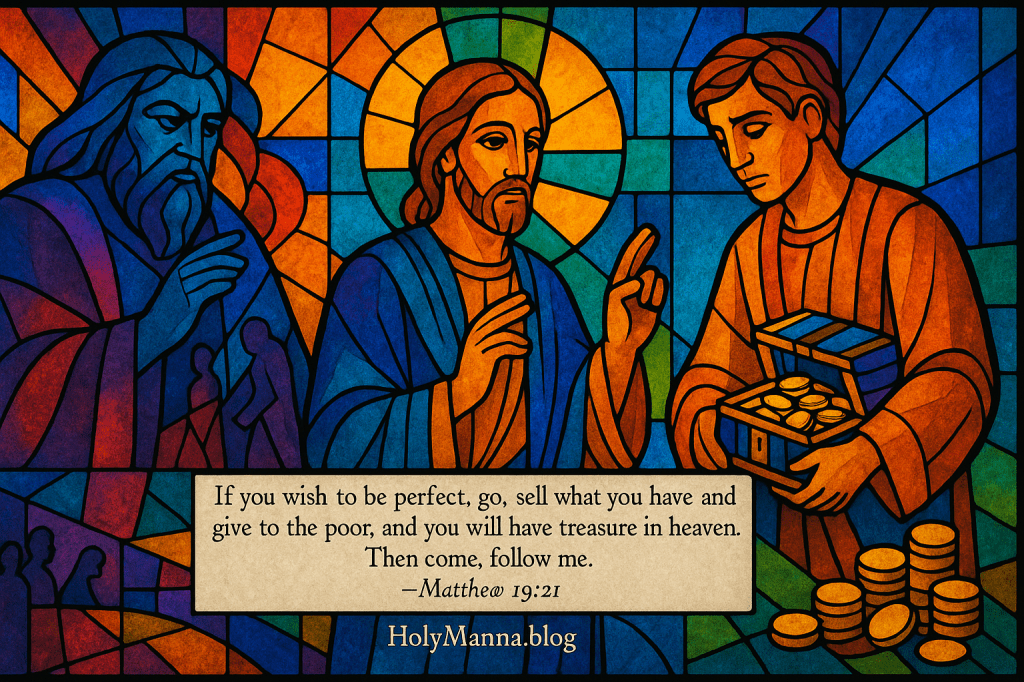
Matthew 19:16-22 offers a deeply personal example of this same struggle. The rich young man sincerely seeks eternal life, has kept the commandments, and stands face to face with Jesus Himself. Yet when called to give up his possessions and “follow me”, he turns away in sadness. His heart, like Israel’s, is tethered to something other than God. In both the Old and New Testament accounts, the obstacle is not ignorance of what is good, but the unwillingness to surrender completely.
This theme strikes at the core of our spiritual life today. What are the “idols” or attachments that keep us from following Christ without hesitation? God’s mercy is constant—He hears our cries as He heard Israel’s—but He also invites us to break the cycle of half-hearted obedience. The readings remind us that eternal life is not simply about avoiding sin; it is about radical trust, sacrificial love, and an undivided heart wholly given to Him.
First Reading – Judges 2:11-19
The Peril of a Divided Heart
The Book of Judges recounts a turbulent period in Israel’s history after the death of Joshua and before the establishment of the monarchy. Without a central leader, the people repeatedly turned from the Lord to worship the gods of surrounding nations. The culture of the time was steeped in polytheism, and the worship of Baal and Astarte (goddess of fertility) was not just religiously offensive to God—it was spiritually destructive, involving ritual prostitution, child sacrifice, and the rejection of God’s covenant. In this passage, the sacred writer outlines a tragic cycle: Israel abandons the Lord, suffers oppression, cries out in distress, and is rescued by God through judges—only to fall back into sin once the judge dies. This cycle perfectly mirrors today’s theme: the danger of partial obedience and the need for a whole-hearted return to God. Israel’s problem was not that they did not know God’s commandments; it was that they refused to give Him their exclusive loyalty, preferring to mix His worship with their own desires and worldly influences.
Judges 2:11-19
New American Bible (Revised Edition)
11 the Israelites did what was evil in the sight of the Lord. They served the Baals, 12 and abandoned the Lord, the God of their ancestors, the one who had brought them out of the land of Egypt. They followed other gods, the gods of the peoples around them, and bowed down to them, and provoked the Lord.
13 Because they had abandoned the Lord and served Baal and the Astartes, 14 the anger of the Lord flared up against Israel, and he delivered them into the power of plunderers who despoiled them. He sold them into the power of the enemies around them, and they were no longer able to withstand their enemies. 15 Whenever they marched out, the hand of the Lord turned against them, as the Lord had said, and as the Lord had sworn to them; and they were in great distress. 16 But the Lord raised up judges to save them from the power of their plunderers; 17 but they did not listen to their judges either, for they prostituted themselves by following other gods, bowing down to them. They were quick to stray from the way their ancestors had taken, who obeyed the commandments of the Lord; but these did not. 18 When the Lord raised up judges for them, he would be with the judge and save them from the power of their enemies as long as the judge lived. The Lord would change his mind when they groaned in their affliction under their oppressors. 19 But when the judge died, they would again do worse than their ancestors, following other gods, serving and bowing down to them, relinquishing none of their evil practices or stubborn ways.
Detailed Exegesis
Verse 11 – “The Israelites did what was evil in the sight of the Lord. They served the Baals”
Here, “evil” refers specifically to idolatry, the violation of the first commandment. Serving the Baals means that Israel actively participated in pagan worship, adopting practices utterly opposed to the worship of the one true God. This was more than personal sin—it was national betrayal.
Verse 12 – “They abandoned the Lord, the God of their ancestors, the one who had brought them out of the land of Egypt. They followed other gods, the gods of the peoples around them, and bowed down to them, and provoked the Lord”
The author invokes the Exodus to highlight God’s saving power and faithfulness. Abandoning the Lord is a deliberate choice against a covenant relationship. “Bowing down” to other gods signifies total submission to false powers, rejecting God’s love.
Verse 13 – “Because they had abandoned the Lord and served Baal and the Astartes”
This verse links idolatry directly to covenant unfaithfulness. The Astartes (plural for Ashtoreth/Astarte) were fertility goddesses, and their cult often included immoral and violent rituals, an open rejection of God’s holiness.
Verse 14 – “The anger of the Lord flared up against Israel, and he delivered them into the power of plunderers who despoiled them”
God’s “anger” is not capricious rage but the righteous response of a loving covenant partner whose people have betrayed Him. By withdrawing His protection, He allows the natural consequences of sin—oppression and loss—to overtake them.
Verse 15 – “Whenever they marched out, the hand of the Lord turned against them… and they were in great distress”
God’s “hand” here symbolizes His active role in justice. Their “distress” is a direct result of covenant violation; disobedience leads to spiritual and even physical downfall.
Verse 16 – “But the Lord raised up judges to save them from the power of their plunderers”
God’s mercy shines through—despite their betrayal, He provides deliverers (judges) to rescue His people. These judges were charismatic leaders chosen by God to restore justice and lead in times of crisis.
Verse 17 – “But they did not listen to their judges either… They were quick to stray from the way their ancestors had taken”
Even with God’s intervention, Israel refused to follow the path of their faithful ancestors. The phrase “prostituted themselves” vividly conveys spiritual adultery against God.
Verse 18 – “When the Lord raised up judges for them, he would be with the judge… The Lord would change his mind when they groaned in their affliction”
God’s compassion responds to genuine cries for help. His “changing of mind” expresses His readiness to relent from punishment when repentance arises, a foreshadowing of His infinite mercy in Christ.
Verse 19 – “But when the judge died, they would again do worse than their ancestors”
This relapse shows that without constant conversion of heart, reforms are temporary. Sin becomes more entrenched over generations when not rooted out.
Teachings
The Catechism of the Catholic Church teaches in CCC 2113: “Idolatry not only refers to false pagan worship. It remains a constant temptation to faith. Idolatry consists in divinizing what is not God… Man commits idolatry whenever he honors and reveres a creature in place of God”. This applies directly to Israel’s behavior in Judges, but also to us today, as our “idols” may be wealth, pleasure, success, or comfort.
Saint Augustine warns in City of God that “For what is it to serve God except to love Him, to seek Him, to cleave to Him with all the heart, with all the soul, with all the mind?” Israel’s failure was not ignorance—it was the refusal to cling to God with an undivided heart.
Historically, the period of the Judges demonstrates the consequences of syncretism—mixing true worship with false practices. For Israel, this meant not only spiritual decline but also political instability and vulnerability to enemies.
Reflection
This passage challenges us to examine our own spiritual cycles. Do we only turn to God when we are in trouble, only to drift away once life feels secure? Israel’s repeated falling away warns us that without a deep, personal, daily conversion, we are prone to repeat the same mistakes. Today, the “Baal” might be the pursuit of material gain, the obsession with social image, or the idol of self-reliance. Breaking free requires more than occasional repentance; it demands total surrender and steadfast faithfulness. The first step is daily examination—naming our idols, confessing them before God, and actively removing them from our lives. Only then can we remain faithful to the One who rescues us again and again.
Responsorial Psalm – Psalm 106:34-37, 39-40, 43-44
God’s Faithfulness Amid Our Rebellion
Psalm 106 is a communal confession of Israel’s sins, recalling how God’s chosen people repeatedly turned away from Him despite His mighty works and covenant love. Historically, this psalm was likely composed during or after the Babylonian exile, when the nation reflected on its failures and God’s enduring mercy. The verses in today’s liturgy focus on the nation’s moral compromise—failing to destroy the pagan nations as commanded, adopting their corrupt practices, and even committing the horror of child sacrifice. In its historical and religious context, these were not just cultural missteps; they were covenant violations that severed the people’s relationship with the Lord. Yet, the psalm also reveals God’s unwavering compassion: though angered by their unfaithfulness, He still responds to their cries for help. This message fits perfectly with today’s theme of divided hearts and the urgent call to wholehearted fidelity—God’s mercy is constant, but our response must be total, not partial.
Psalm 106:34-37, 39-40, 43-44
New American Bible (Revised Edition)
34 They did not destroy the peoples
as the Lord had commanded them,
35 But mingled with the nations
and imitated their ways.
36 They served their idols
and were ensnared by them.
37 They sacrificed to demons
their own sons and daughters,
39 They defiled themselves by their actions,
became adulterers by their conduct.
40 So the Lord grew angry with his people,
abhorred his own heritage.
43 Many times did he rescue them,
but they kept rebelling and scheming
and were brought low by their own guilt.
44 Still God had regard for their affliction
when he heard their wailing.
Detailed Exegesis
Verse 34 – “They did not destroy the peoples as the Lord had commanded them”
God’s command to remove pagan nations from the land (see Deuteronomy 7:1-5) was meant to protect Israel from adopting false worship. Disobedience here was not about cruelty but about safeguarding their spiritual identity.
Verse 35 – “But mingled with the nations and imitated their ways”
Rather than remaining distinct as God’s holy people, Israel blended into the surrounding cultures, losing their distinct witness. The danger of “mingling” here is moral and spiritual compromise.
Verse 36 – “They served their idols and were ensnared by them”
Idols are not harmless symbols—they enslave the heart. The image of being “ensnared” reflects how sin traps the will, making it harder to return to God.
Verse 37 – “They sacrificed to demons their own sons and daughters”
This shocking indictment refers to child sacrifice in pagan rituals, particularly to Molech. The psalmist makes clear that idols are not neutral—they are aligned with demonic powers (cf. 1 Corinthians 10:20).
Verse 39 – “They defiled themselves by their actions, became adulterers by their conduct”
“Adultery” here is spiritual, describing unfaithfulness to God. In biblical imagery, Israel is the bride of the Lord, and idolatry is akin to marital betrayal.
Verse 40 – “So the Lord grew angry with his people, abhorred his own heritage”
God’s anger is the just response of a covenant partner betrayed. To “abhor” in this context means to reject their sinful behavior, not to cease loving them.
Verse 43 – “Many times did he rescue them, but they kept rebelling and scheming and were brought low by their own guilt”
This recalls the cycle of sin and deliverance seen throughout Judges. God’s repeated rescue highlights His mercy; their repeated rebellion highlights human stubbornness.
Verse 44 – “Still God had regard for their affliction when he heard their wailing”
Here the psalm turns to hope—God’s mercy is greater than our sin. His compassion responds to our repentance, even when we have failed Him many times before.
Teachings
The Catechism of the Catholic Church warns in CCC 2114: “Human life finds its unity in the adoration of the one God. The commandment to worship the Lord alone integrates man and saves him from an endless disintegration. Idolatry is a perversion of man’s innate religious sense.” This psalm vividly illustrates that “disintegration”—morally, spiritually, and even nationally—when worship is given to false gods.
Saint John Chrysostom, reflecting on God’s patience, wrote: “There is nothing God hates more than sin, yet nothing He desires more than the conversion of the sinner.” The psalm embodies this paradox: God’s holiness demands justice, but His heart is always ready to show mercy to the repentant.
Historically, Israel’s mingling with pagan nations and eventual exile serve as a warning that compromise in worship leads to collapse in every other area of life—social, political, and personal.
Reflection
This psalm invites us to look honestly at our own compromises. Where have we “mingled” with the values of the world to the point that they have shaped us more than God’s Word? Our idols today may not be statues of Baal, but they can be just as consuming—status, career, pleasure, comfort, control. God calls us to destroy these idols, not manage them. The way forward begins with naming them in prayer, renouncing them, and returning daily to the Lord with a whole heart. Even when we fall, He hears our cries and rescues us—not so we can return to the same sins, but so we can walk in the freedom of His love.
Holy Gospel – Matthew 19:16-22
The Test of a Whole Heart
In this passage, Jesus encounters a man who earnestly seeks eternal life yet walks away sorrowful when invited to deeper discipleship. The exchange occurs in a Jewish context where obedience to the Law was seen as the foundation for righteousness, and the man’s question reflects a sincere desire to know what more is required. Wealth, in first-century Jewish culture, was often considered a sign of God’s favor; thus, the man may have assumed that his possessions were compatible with perfect holiness. Yet Jesus challenges this assumption, revealing that the heart must be completely free from attachment to anything that could rival love for God. In the flow of today’s theme, the rich young man mirrors Israel in Judges and Psalm 106—obedient in part, yet unable to surrender fully. The real question before us is not merely What must I do? but What am I willing to give up for the sake of Christ?
Matthew 19:16-22
New American Bible (Revised Edition)
16 Now someone approached him and said, “Teacher, what good must I do to gain eternal life?” 17 He answered him, “Why do you ask me about the good? There is only One who is good. If you wish to enter into life, keep the commandments.” 18 He asked him, “Which ones?” And Jesus replied, “ ‘You shall not kill; you shall not commit adultery; you shall not steal; you shall not bear false witness; 19 honor your father and your mother’; and ‘you shall love your neighbor as yourself.’” 20 The young man said to him, “All of these I have observed. What do I still lack?” 21 Jesus said to him, “If you wish to be perfect, go, sell what you have and give to [the] poor, and you will have treasure in heaven. Then come, follow me.” 22 When the young man heard this statement, he went away sad, for he had many possessions.
Detailed Exegesis
Verse 16 – “Now someone approached him and said, ‘Teacher, what good must I do to gain eternal life?’”
The man addresses Jesus respectfully, recognizing Him as a moral teacher, but frames salvation in terms of “doing” good works. His question reflects the mindset that eternal life can be earned through external compliance.
Verse 17 – “He answered him, ‘Why do you ask me about the good? There is only One who is good. If you wish to enter into life, keep the commandments.’”
Jesus redirects the man’s focus from human effort to God as the source of all goodness. The call to keep the commandments affirms their enduring value as the foundation for a relationship with God.
Verse 18 – “He asked him, ‘Which ones?’ And Jesus replied, ‘You shall not kill; you shall not commit adultery; you shall not steal; you shall not bear false witness’”
The Lord begins with commandments from the second table of the Law—those concerning love of neighbor. He emphasizes moral conduct rooted in justice and respect for others.
Verse 19 – “Honor your father and your mother’; and ‘you shall love your neighbor as yourself.’”
Here Jesus includes both the fourth commandment and the summary of the Law from Leviticus 19:18. Love of neighbor is inseparable from love of God and is a concrete expression of faithfulness.
Verse 20 – “The young man said to him, ‘All of these I have observed. What do I still lack?’”
His sincerity is evident, yet so is his awareness that mere external obedience leaves something missing. This question opens the door for Jesus to invite him into radical discipleship.
Verse 21 – “Jesus said to him, ‘If you wish to be perfect, go, sell what you have and give to the poor, and you will have treasure in heaven. Then come, follow me.’”
Perfection here means completeness in love. Selling his possessions is not a universal command for all disciples but a personal challenge to remove the one thing holding him back—his attachment to wealth. Jesus offers him not just moral goodness but intimate companionship: “Follow me.”
Verse 22 – “When the young man heard this statement, he went away sad, for he had many possessions.”
His sadness reveals the costliness of discipleship. His possessions have become his idol; like Israel in the first reading and psalm, he is unwilling to let go of what competes with God for his heart.
Teachings
The Catechism of the Catholic Church states in CCC 2544: “Jesus enjoins his disciples to prefer him to everything and everyone, and bids them ‘renounce all that [they have]’ for his sake and that of the Gospel.” The rich young man is a living example of someone who desires eternal life yet cannot meet this condition because his treasure lies elsewhere.
Saint John Paul II, in Veritatis Splendor, reflects on this encounter: “Jesus’ conversation with the young man helps us to understand the conditions for eternal life: not only to keep the commandments, but also to follow Christ by giving up whatever hinders us from loving Him fully.”
Historically, the call to “sell what you have” has inspired countless saints—such as Saint Anthony of the Desert and Saint Francis of Assisi—who took these words literally and embraced radical poverty as a means of undivided devotion to God.
Reflection
This Gospel compels us to ask: What is the one thing I am unwilling to surrender for the sake of Christ? It may not be material wealth—it could be a relationship, an ambition, a habit, or an area of pride. Like the rich young man, we may keep the commandments yet fall short of wholehearted surrender. Following Jesus means not only avoiding sin but also removing anything that competes with Him for first place in our hearts. The invitation is personal and urgent: to loosen our grip on what we think we cannot live without, and to discover the treasure of life with Christ. The question remains—will we walk away sad, or will we follow Him?
An Undivided Heart for an Eternal Treasure
Across all three readings today, the message is strikingly clear: God is not satisfied with partial devotion—He calls for our whole heart. In Judges 2:11-19, Israel’s history shows the devastating cycle of divided loyalty, where faithfulness gives way to idolatry and sin, bringing sorrow and loss. Psalm 106 echoes this truth, confessing that mingling with the ways of the world and clinging to false gods leads only to spiritual enslavement. Yet, in both cases, God’s mercy shines through—He hears the cries of His people and rescues them. In Matthew 19:16-22, Jesus makes this call personal, inviting the rich young man to move beyond mere rule-keeping into total surrender, but the man walks away, bound by his attachments.
The thread tying these readings together is the truth that eternal life cannot be gained by half-measures. “You shall love the Lord, your God, with all your heart, with all your soul, and with all your mind” (Matthew 22:37) is not a suggestion but the essence of discipleship. God is patient, but He will not compete for our love. He offers us Himself, the greatest treasure, but asks us to lay down whatever chains our hearts to lesser things.
Today, we are invited to take an honest inventory of our lives. What are the possessions, habits, or ambitions that keep us from following Christ without hesitation? The God who delivered Israel and who looked with love on the rich young man looks upon us now, ready to give us the grace to let go. His call is not to loss, but to freedom—freedom to live in His love, freedom to store up treasure in heaven, freedom to be wholly His. Let us respond with courage, choosing Him above all else, so that when He says, “Follow me”, we rise and walk with Him into the fullness of life.
Engage with Us!
We would love to hear how today’s Scriptures spoke to your heart. Share your reflections in the comments below and let this be a space where we encourage one another to grow in love and faith. Your thoughts may inspire someone else to take a step closer to God today.
First Reading – Judges 2:11-19: Where do you see patterns of “spiritual cycles” in your life, and how can you break them through deeper daily conversion?
Responsorial Psalm – Psalm 106:34-37, 39-40, 43, 44: What “idols” in your life are competing for your love and attention? How can you actively remove them and give that space back to God?
Holy Gospel – Matthew 19:16-22: If Jesus asked you to give up one thing to follow Him more fully, what would it be? How ready are you to surrender it today?
Let us walk together in faith, striving to live each moment with the love, mercy, and courage that Jesus taught us. May our hearts be undivided, our trust unshaken, and our joy complete in Him.
Follow us on Instagram and Facebook for more insights and reflections on living a faith-filled life.

 Holy Manna!
Leave a comment