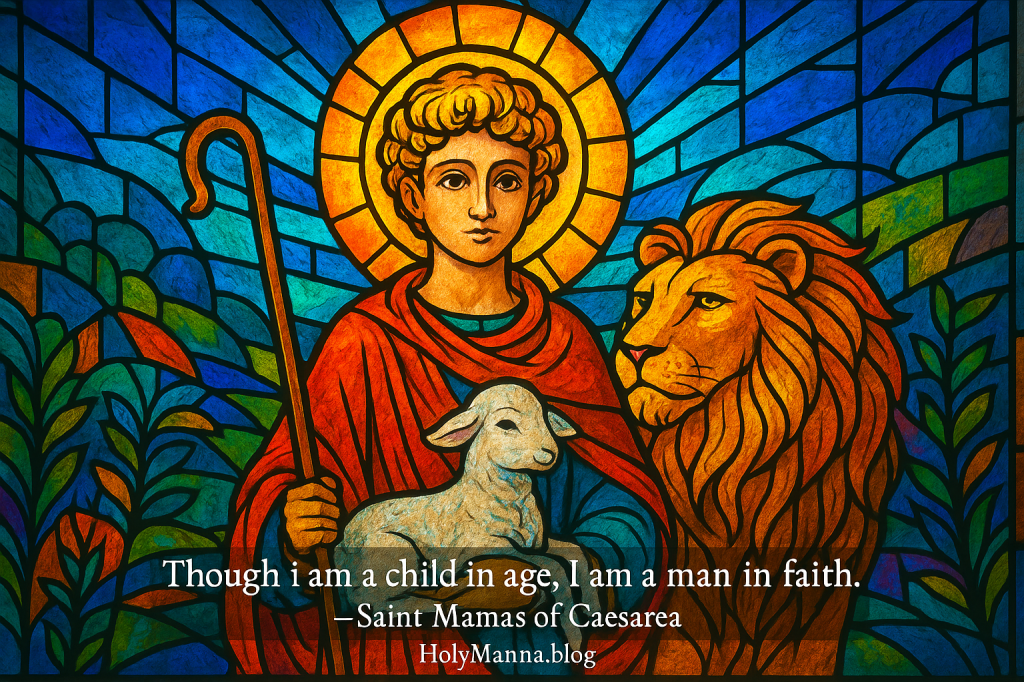
The Boy Who Preached with Lions
Saint Mamas of Caesarea, also known as Mammas or Mammes, stands among the Church’s most beloved early Christian martyrs. His life, though brief, became a powerful testimony of unwavering faith in Christ—so powerful, in fact, that for centuries, his name echoed in liturgical calendars, churches, and Christian households across the East and West. Martyred as a young boy in the 3rd century during one of the Roman Empire’s intense persecutions of Christians, Saint Mamas became a symbol of childlike trust in God, purity of heart, and courage beyond years. He is often invoked as a protector of children and animals, and his veneration spread from Cappadocia to Constantinople, Rome, and even France. But behind the saintly image is a truly astonishing story of grace, suffering, and divine intervention.
Orphaned at Birth, Adopted by Grace
According to early Christian tradition, Saint Mamas was born in Caesarea of Cappadocia, modern-day Turkey, sometime in the mid-3rd century. His story begins dramatically: his parents, Theodotus and Rufina, were devout Christians imprisoned for their faith under Emperor Aurelian. It was in prison that Rufina gave birth to Mamas and, soon after, both parents died as martyrs, leaving the newborn an orphan before he ever saw the light of day outside the prison walls. He was taken in and raised by a wealthy Christian widow named Ammia, who gave him the name Mamas—reportedly derived from his first baby sounds.
From his earliest years, Mamas was known for his holiness, gentle spirit, and deep piety. He studied Scripture and lived a life of prayer, simplicity, and humility. Despite his youth, he boldly confessed his Christian faith, refusing to offer sacrifices to pagan gods. This commitment made him a target of imperial persecution and eventually led to his arrest.
Shepherd of the Wild and Tamer of Hearts
After escaping from his first arrest by divine intervention, Saint Mamas lived in the wilderness, where tradition tells us he became a shepherd. But this was no ordinary shepherd boy—he preached the Gospel to everyone he encountered and reportedly tamed wild animals, living peacefully among them. One story recounts how he would lead the beasts to the city to display God’s glory, which astonished both believers and pagans. He lived as a hermit, fed by the providence of God, and became a beacon of Christian life and evangelization even in solitude.
In some traditions, it is said that Saint Mamas once struck a rock and caused a stream to flow to provide water for his flock, much like Moses in the desert. His care for both animals and humans, and his fearless witness to the truth, made him a beloved figure. He is especially remembered as a patron of shepherds and protector of animals, and many miracles are attributed to him even during his life.
Faith That Could Not Be Broken
Eventually, Saint Mamas was captured again and brought before the Roman authorities. At his trial, though just a teenager, he remained calm and resolute. When asked to renounce Christ and offer sacrifice to pagan gods, he refused. The governor, seeing Mamas’ youth, tried persuasion, bribery, and threats—but nothing swayed him. When all else failed, he was ordered to be tortured. Though beaten and pierced with a trident, he remained steadfast.
According to some traditions, after enduring severe torture, Mamas was thrown to wild beasts in the arena. Miraculously, the animals did not harm him. Instead, they lay peacefully at his feet—a sign that even creation recognized his sanctity. Eventually, he was killed by a spear or trident, becoming a martyr around the year 275 A.D.
His body, it is said, was carried away and buried by Christians in secret. His witness inspired countless conversions and emboldened the Church during an age of violent persecution.
Heaven’s Shepherd Still Watches Over Us
The veneration of Saint Mamas began almost immediately after his death. His tomb in Caesarea became a place of pilgrimage, and numerous miracles were attributed to his intercession—especially healings of children and animals. Pilgrims would bring their sick to the site of his relics and leave with renewed hope, healed bodies, and strengthened souls.
The fame of his sanctity spread throughout the Eastern and Western Church. The Emperor Constantine the Great is said to have built a church in his honor in Constantinople. The Menologion of Basil II, an 11th-century illuminated manuscript, contains one of the oldest depictions of his life. His relics were transferred to various churches, and towns and villages across Europe bear his name.
To this day, he remains one of the most venerated child martyrs in both the Roman Catholic and Eastern Orthodox traditions. His feast is celebrated on September 2nd in the Roman Martyrology.
What a Child Can Teach the World
Saint Mamas invites us to a radical simplicity of heart and faith. His life challenges us to believe that even the youngest and most vulnerable among us can be heroes of the faith. In an age where strength is often measured in influence and power, Saint Mamas reminds us that true strength lies in trusting God entirely, even in suffering.
How can we, like Mamas, live courageously when we are mocked or challenged for our faith?
What would it look like for us to “tame the wild beasts” in our lives—whether they are fears, sins, or external pressures?
Do we trust God with the same childlike confidence that led a teenage boy to die rather than deny his Savior?
Saint Mamas’ story also teaches us the beauty of a hidden life. His miracles in the wilderness, his love for animals, and his gentle strength all point to a life of contemplative action—a life that speaks even when words are few.
May we, like Saint Mamas, grow in purity, courage, and unwavering love for Christ.
Engage with Us!
What part of Saint Mamas’ story resonates most with you? Have you ever experienced God’s peace in the midst of fear or persecution? Let us know in the comments—your testimony could inspire others on their path!
Reflection Questions:
- How does Saint Mamas’ youthful courage challenge the way I approach my own struggles and fears?
- What can I do this week to grow in childlike trust in God, even when it’s difficult?
- Are there “wild beasts” in my life that I need to surrender to the Lord, trusting in His peace?
Let us continue to support each other in faith and strive to live each day with love, as our Lord Jesus did. You are not alone—together, we walk this path to holiness.
Saint Mamas of Caesarea, pray for us! 🦁
Follow us on Instagram and Facebook for more insights and reflections on living a faith-filled life.

 Holy Manna!
Leave a comment