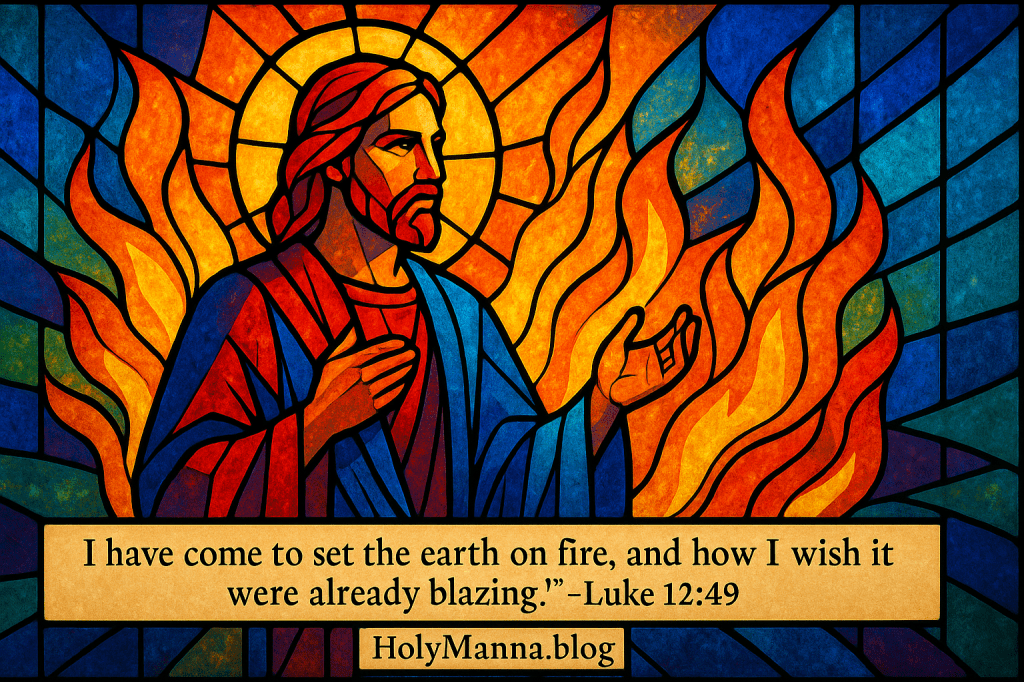
Twentieth Sunday in Ordinary Time – Lectionary: 120
The Cost of Fidelity to God
Have you ever felt like doing the right thing made everything harder? Like telling the truth or standing up for your faith only led to rejection, tension, or even suffering? Today’s readings take us deep into that uncomfortable but holy place where fidelity to God collides with human resistance, fear, and division. In a world that often prizes comfort and consensus, the Word of God confronts us with a sobering reality: following Christ means walking the narrow road, one marked not only by joy, but by opposition and even fire.
From the mud-soaked pit where Jeremiah is left to die, to the fire that Jesus yearns to kindle on the earth, we are shown a spiritual pattern that stretches across salvation history: those who speak God’s truth often suffer for it. In Jeremiah 38, the prophet is cast into a cistern by his own people for proclaiming an unpopular word. The Responsorial Psalm (Ps 40) becomes a spiritual echo of Jeremiah’s plight, crying out: “Draws me up from the pit of destruction, out of the muddy clay”—a cry of trust from someone who knows what it means to be abandoned, yet never alone. Hebrews 12 exhorts us to endurance, reminding us of the “great cloud of witnesses” who have persevered before us, and calling us to fix our eyes on Jesus, who endured shame and suffering for our sake. Then, in Luke 12:49-53, Jesus speaks bluntly: “I have come to set the earth on fire”, unveiling the inevitable divisions His presence causes—even among families—when the fire of divine truth burns through human resistance.
What unites these readings is the reality that God’s truth is never neutral—it demands a response. Sometimes, that response will divide, unsettle, and cost us dearly. Yet in that fire of fidelity, we are purified, strengthened, and ultimately conformed to Christ Himself. These readings invite us to sit with the hard truth that being a disciple means not only running the race with perseverance but enduring the opposition that comes with it. Are you ready to stand firm in the mud, carry your cross, and let the fire of Christ burn in your heart—even when it costs you everything?
First Reading – Jeremiah 38:4–6, 8–10
Thrown into the Mud for Speaking the Truth
The prophet Jeremiah stands as a striking symbol of what it means to suffer for proclaiming God’s word. By the time we arrive at Jeremiah 38, the city of Jerusalem is besieged by Babylon. Morale is low, and the king’s advisors are desperate to preserve control and hope. Into this tension, Jeremiah speaks God’s truth: surrender to Babylon or face destruction. Rather than being welcomed, his message is seen as treasonous. In the minds of Judah’s leaders, Jeremiah is not a prophet, but a problem. This reading brings us into a moment of raw injustice and abandonment, where truth is punished, and righteousness is literally sunk into the mud. It prepares our hearts to receive the theme echoed in today’s Gospel—that fidelity to God’s word will bring division, suffering, and purification, but also divine vindication.
Jeremiah 38:4-6, 8-10
New American Bible (Revised Edition)
4 Then the princes said to the king, “This man ought to be put to death. He is weakening the resolve of the soldiers left in this city and of all the people, by saying such things to them; he is not seeking the welfare of our people, but their ruin.” 5 King Zedekiah answered: “He is in your hands,” for the king could do nothing with them. 6 And so they took Jeremiah and threw him into the cistern of Prince Malchiah, in the court of the guard, letting him down by rope. There was no water in the cistern, only mud, and Jeremiah sank down into the mud.
8 and Ebed-melech went there from the house of the king and said to him, 9 “My lord king, these men have done wrong in all their treatment of Jeremiah the prophet, throwing him into the cistern. He will starve to death on the spot, for there is no more bread in the city.” 10 Then the king ordered Ebed-melech the Ethiopian: “Take three men with you, and get Jeremiah the prophet out of the cistern before he dies.”
Detailed Exegesis
Verse 4 – “Then the princes said to the king, ‘This man ought to be put to death. He is weakening the resolve of the soldiers left in this city and of all the people, by saying such things to them; he is not seeking the welfare of our people, but their ruin.’”
This accusation reveals the blindness of those in power. Jeremiah’s prophetic call was to announce God’s will—not political expedience. Yet the truth he speaks is interpreted as harmful, because it disrupts the status quo. The leaders confuse patriotism with obedience to God, echoing a pattern we see throughout salvation history: when people reject divine correction, they often cloak it in the language of safety, unity, or political loyalty.
Verse 5 – “King Zedekiah answered: ‘He is in your hands,’ for the king could do nothing with them.”
Zedekiah’s response is one of cowardice. Though the king had heard and even privately respected Jeremiah (cf. Jeremiah 37:17), he ultimately yields to pressure. This verse exposes the danger of weak leadership that prioritizes consensus over conscience. Zedekiah’s abdication of responsibility prefigures Pilate’s similar washing of hands before Christ’s Passion. Both men knew the truth—but did nothing to protect it.
Verse 6 – “And so they took Jeremiah and threw him into the cistern of Prince Malchiah, in the court of the guard, letting him down by rope. There was no water in the cistern, only mud, and Jeremiah sank down into the mud.”
The imagery here is vivid and devastating. Jeremiah is thrown into a pit not only physically, but symbolically—abandoned, silenced, and buried beneath the weight of rejection. The “mud” recalls the “miry clay” of Psalm 40, reinforcing the connection between prophetic suffering and divine deliverance. This moment is Jeremiah’s own descent into the tomb, a foreshadowing of Christ’s Passion.
Verse 8 – “And Ebed-melech went there from the house of the king and said to him…”
Here enters a surprising hero: Ebed-melech, an Ethiopian court official. He is a foreigner, an outsider, yet he recognizes the injustice and acts with courage. His presence reminds us that God often raises up unexpected defenders of the truth—those who fear God more than men.
Verse 9 – “‘My lord king, these men have done wrong in all their treatment of Jeremiah the prophet, throwing him into the cistern. He will starve to death on the spot, for there is no more bread in the city.’”
Ebed-melech speaks plainly and righteously. He calls out evil for what it is: “they have done wrong.” This clarity of moral vision contrasts sharply with the moral ambiguity of the king and his advisors. It takes integrity to speak against wrongdoing when it is supported by the majority.
Verse 10 – “Then the king ordered Ebed-melech the Ethiopian: ‘Take three men with you, and get Jeremiah the prophet out of the cistern before he dies.’”
Though Zedekiah is weak, he relents to Ebed-melech’s appeal. Jeremiah is lifted out of the pit—not through political reform, but through the faith and courage of one servant. God preserves His prophet through the hidden fidelity of the just.
Teachings
In the Catechism of the Catholic Church, the prophetic mission is described as one that “awakens and deepens faith” but also involves persecution: “The mission of the prophets was both to call the people to conversion and to console them in times of trial. Their mission looked forward to the coming of the Messiah” (CCC 64). Jeremiah is a Christlike figure, unjustly condemned by his own, yet delivered by God. Saint John Chrysostom said, “It is not the suffering that glorifies us, but the cause for which we suffer.” Like Jeremiah, we are not called to be successful in worldly terms, but to be faithful—especially when the world cannot see.
Jeremiah’s descent into the cistern calls to mind not only Christ’s burial but also the many ways Christians today are “buried” in silence, marginalization, or spiritual isolation for living and proclaiming the Gospel. The Church has always honored her prophets—canonized saints, martyrs, and confessors—because they bore the truth at great personal cost. The witness of Jeremiah reminds us that God uses even muddy cisterns as places of purification and testing.
Reflection
This reading is a call to courage. In our workplaces, families, parishes, or friendships, we may be tempted to silence the truth to keep peace or avoid conflict. But God asks us to speak and live the truth in love, even when it’s unpopular. Like Jeremiah, we might feel thrown into the mud. Have you ever been rejected for standing up for your faith? Have you kept quiet when you were called to speak? The good news is that God sees and sends help. Are you willing to be an Ebed-melech to someone else—to speak up for the forgotten, the silenced, or the faithful who suffer for righteousness? Let us remember: God lifts us from the cistern, but He also asks us to help lift others.
Responsorial Psalm – Psalm 40:2–4, 18
A Song of Trust and Deliverance
Psalm 40 is a powerful prayer of rescue and restoration. It echoes the experience of Jeremiah—sinking into the mud of the cistern—and transforms it into a universal cry of the human heart for salvation. This psalm belongs to the category of thanksgiving psalms, in which the speaker recalls how the Lord has acted to deliver him from distress, and responds with praise and trust. It’s no accident that this psalm appears in today’s liturgy: it mirrors Jeremiah’s plight and foreshadows Christ’s own descent into suffering and triumph over death. In the context of today’s theme, the psalm becomes a voice for all who feel buried in trials, misunderstood for their fidelity, or spiritually stuck in the mud. But it also offers hope: God bends down, lifts us up, and puts a new song in our mouth.
Psalm 40:2-4, 18
New American Bible (Revised Edition)
2 Surely, I wait for the Lord;
who bends down to me and hears my cry,
3 Draws me up from the pit of destruction,
out of the muddy clay,
Sets my feet upon rock,
steadies my steps,
4 And puts a new song in my mouth,
a hymn to our God.
Many shall look on in fear
and they shall trust in the Lord.
18 Though I am afflicted and poor,
my Lord keeps me in mind.
You are my help and deliverer;
my God, do not delay!
Detailed Exegesis
Verse 2 – “Surely, I wait for the Lord; who bends down to me and hears my cry,”
The psalmist begins not with complaint but with confident waiting. This act of waiting is not passive—it is active trust. God is not distant or deaf to our pain; He “bends down” to hear us. This is the same divine stooping we see in the Incarnation: Christ comes down into our brokenness. The Hebrew verb here connotes tenderness, like a parent stooping to lift a child. In suffering, God is near.
Verse 3 – “Draws me up from the pit of destruction, out of the muddy clay, sets my feet upon rock, steadies my steps,”
This verse is a poetic depiction of salvation. The “pit” and “muddy clay” symbolize danger, despair, and sin—exactly what Jeremiah experienced physically and what every believer experiences spiritually at times. Yet the Lord does not leave us there. He draws us out and places us on stable ground, a biblical image of divine providence. The “rock” evokes Psalm 18:3, where the Lord is called “my rock, my fortress, my deliverer.” God gives us firm footing when the world around us collapses.
Verse 4 – “And puts a new song in my mouth, a hymn to our God. Many shall look on in fear and they shall trust in the Lord.”
The result of rescue is worship. The “new song” is not just a change in words—it’s a transformed heart. Praise becomes testimony, and that testimony draws others to faith. The psalmist’s personal deliverance becomes communal evangelization. His story of salvation inspires others to revere and trust in the Lord. This reminds us that our suffering, when surrendered to God, becomes a powerful witness.
Verse 18 – “Though I am afflicted and poor, my Lord keeps me in mind. You are my help and deliverer; my God, do not delay!”
The psalm ends with humility and dependence. Even after deliverance, the psalmist remains “afflicted and poor.” Yet he is not forgotten. God is mindful of His people, and this divine attentiveness is our greatest consolation. The plea—“do not delay”—is a heartfelt reminder that, even when we trust, we still long for God’s timely intervention.
Teachings
The Catechism of the Catholic Church teaches us that prayer, especially in the Psalms, unites human emotion with divine truth: “In the Psalms, the Word of God becomes man’s prayer. In the Holy Spirit, the children of God sing the words of God. Their prayer is inseparably personal and communal” (CCC 2587). This psalm is deeply personal—it reflects Jeremiah’s situation—but also becomes our communal song in the liturgy. It models how to pray from a place of pain and yet be filled with faith.
Saint Augustine frequently preached on this psalm, interpreting the “pit of destruction” as the fallen state of humanity, and the “rock” as Christ Himself. He writes: “Christ descended into the pit of our misery so that He might raise us up with Himself upon the rock of His resurrection.” This patristic interpretation reminds us that the psalms are not just ancient poetry but windows into the Paschal Mystery.
The Church has long used Psalm 40 in liturgical prayer, particularly in the Liturgy of the Hours, to help the faithful remember that no suffering is wasted and that praise can rise from even the darkest depths. It is a song for martyrs and mystics, for prophets and penitents alike.
Reflection
This psalm offers us a spiritual map: from waiting, to crying out, to rescue, to praise. It shows us how to respond when we feel stuck—whether in sin, fear, exhaustion, or conflict. Do you believe that God bends down to hear your cry? Are you willing to wait on Him with hope, even when you see no immediate change? Perhaps you feel like you’re in the “muddy clay” of a strained relationship, financial burden, habitual sin, or emotional weariness. This psalm reminds us that God lifts, restores, and steadies us. Have you shared your testimony—your “new song”—with others? You never know who might look on and come to trust in the Lord because of your witness. Let us become psalmists in our own generation, proclaiming that our God does not delay, and that even in affliction, He keeps us in mind.
Second Reading – Hebrews 12:1–4
Eyes on the Prize, Feet in the Fire
The Letter to the Hebrews was written to a community of Jewish Christians facing trials, temptations, and persecution—many were discouraged and considering abandoning the faith. In this powerful exhortation near the end of the letter, the author reminds believers that they are part of something much greater than their immediate struggles. Surrounded by the witness of saints and martyrs (referenced in Hebrews 11), they are called to endurance, like athletes running a race. The model of this endurance is none other than Jesus Christ, who suffered shame, opposition, and death, but triumphed through the cross. This passage ties perfectly into today’s central theme: faithful endurance in the face of division, suffering, and opposition. The Christian journey is not for the faint of heart—it is for those who run with their eyes fixed on the Crucified and Risen One.
Hebrews 12:1-4
New American Bible (Revised Edition)
God Our Father. 1 Therefore, since we are surrounded by so great a cloud of witnesses, let us rid ourselves of every burden and sin that clings to us and persevere in running the race that lies before us 2 while keeping our eyes fixed on Jesus, the leader and perfecter of faith. For the sake of the joy that lay before him he endured the cross, despising its shame, and has taken his seat at the right of the throne of God. 3 Consider how he endured such opposition from sinners, in order that you may not grow weary and lose heart. 4 In your struggle against sin you have not yet resisted to the point of shedding blood.
Detailed Exegesis
Verse 1 – “Therefore, since we are surrounded by so great a cloud of witnesses, let us rid ourselves of every burden and sin that clings to us and persevere in running the race that lies before us”
The “cloud of witnesses” refers to the faithful men and women of Hebrews 11—Abraham, Moses, Rahab, the prophets—those who lived by faith despite immense trials. Their lives testify to God’s faithfulness and spur us on. The metaphor shifts to an athletic race: just as runners strip off anything that slows them down, Christians must lay aside sin and distractions. The focus is not just on avoiding sin but on persevering. This is not a sprint—it is a long, grueling marathon toward heaven.
Verse 2 – “while keeping our eyes fixed on Jesus, the leader and perfecter of faith. For the sake of the joy that lay before him he endured the cross, despising its shame, and has taken his seat at the right of the throne of God.”
Christ is both our example and enabler—He is the “leader” (archegos) and “perfecter” (teleiotes) of our faith. He blazes the trail and brings it to completion. Jesus endured the cross not for pain’s sake, but for joy—the joy of redeeming us and returning to the Father. The phrase “despising its shame” is especially poignant; crucifixion was considered the most shameful death, yet Jesus willingly embraced it. Now glorified, He sits enthroned. This verse shifts our focus from our suffering to His victory, giving us strength to press on.
Verse 3 – “Consider how he endured such opposition from sinners, in order that you may not grow weary and lose heart.”
This verse moves from inspiration to imitation. When we are mocked, rejected, or misunderstood for our faith, we are invited to look at Jesus and consider—meditate deeply—on His endurance. The goal is to prevent weariness, to stir up holy courage. Just as Jeremiah was thrown into a cistern and just as Jesus faced the crowd’s rejection, we too may endure opposition. But we are not alone.
Verse 4 – “In your struggle against sin you have not yet resisted to the point of shedding blood.”
This gentle rebuke reminds the readers that, while their trials are real, they have not yet reached the level of martyrdom. It’s a call to perspective: if Christ suffered unto death, can we not endure hardship without losing faith? The verse affirms the seriousness of spiritual struggle—sin is not a trivial matter—but also encourages perseverance by holding up the martyrs as examples.
Teachings
The Catechism of the Catholic Church teaches us that perseverance in faith is a work of grace and human cooperation: “The disciple of Christ must not only keep the faith and live on it, but also profess it, confidently bear witness to it, and spread it: ‘All however must be prepared to confess Christ before men and to follow him along the way of the Cross, amidst the persecutions which the Church never lacks.’” (CCC 1816). Hebrews 12 puts this into action. To confess Christ, we must first look at Him, imitate Him, and lean on Him.
Saint John Paul II spoke often about the “spirituality of the athlete,” and this reading reflects that spirituality well. In his apostolic letter Dies Domini, he wrote: “The Christian life is a demanding race towards holiness and heaven. The faithful must be encouraged to persevere even when they fall.” Likewise, the early Church often saw martyrs as runners who had reached the finish line. The “cloud of witnesses” includes these saints, and their presence strengthens us.
The image of Jesus as the “pioneer and perfecter of faith” also connects to the Eucharist. In the liturgy, we are surrounded by that cloud of witnesses—heaven and earth united—and Christ is both the offering and the priest. The Mass is the moment when we are strengthened to keep running the race.
Reflection
This passage speaks directly to the weary, the discouraged, and the tempted. Are you feeling tired in your faith? Have you faced criticism, isolation, or even division in your family because you follow Christ? This reading assures you: you are not alone. You are surrounded by saints cheering you on. Christ has already run ahead of you. What sins or burdens are weighing you down right now? What distractions need to be cast off so you can run freely? God is not asking you to sprint, but to endure—to keep showing up, to keep choosing Him.
Let this passage be your battle cry this week. When the world tempts you to quit, fix your eyes on Jesus. When your fidelity causes friction, remember the joy set before you. When you feel alone, remember the great cloud of witnesses. You were not made for comfort. You were made for the finish line.
Holy Gospel – Luke 12:49–53
The Fire That Divides and Purifies
In this short but powerful Gospel passage, Jesus shatters any illusion that His coming would bring earthly peace and comfort. Speaking to His disciples as He journeys toward Jerusalem—and ultimately, toward His Passion—Jesus uses fiery and unsettling language to prepare them for the inevitable conflict that comes with following Him. His words are not meant to discourage, but to awaken. First-century Jews longed for a Messiah who would establish national peace and prosperity, but Jesus makes it clear that the peace He brings is of a different kind: a peace that comes only through truth, and truth often causes division before it brings healing. This Gospel directly echoes the lived experiences of Jeremiah, the Psalmist, and the early Christian community addressed in Hebrews. It confronts us with the reality that discipleship demands not only faith, but the willingness to endure the fire of purification and the pain of being misunderstood—even by those closest to us.
Luke 12:49-53
New American Bible (Revised Edition)
49 “I have come to set the earth on fire, and how I wish it were already blazing! 50 There is a baptism with which I must be baptized, and how great is my anguish until it is accomplished! 51 Do you think that I have come to establish peace on the earth? No, I tell you, but rather division. 52 From now on a household of five will be divided, three against two and two against three; 53 a father will be divided against his son and a son against his father, a mother against her daughter and a daughter against her mother, a mother-in-law against her daughter-in-law and a daughter-in-law against her mother-in-law.”
Detailed Exegesis
Verse 49 – “I have come to set the earth on fire, and how I wish it were already blazing!”
Fire, in biblical imagery, is both destructive and purifying. In this context, Jesus expresses His burning desire for the earth to be set aflame—not with worldly chaos, but with the fire of divine love, truth, and the Holy Spirit. His mission is not lukewarm reform but radical transformation. This verse also foreshadows Pentecost, when the Holy Spirit descends as tongues of fire (Acts 2:3). The urgency in Jesus’ voice—“how I wish it were already blazing”—is a rare glimpse into His passionate heart for the conversion of souls and the reign of God’s justice.
Verse 50 – “There is a baptism with which I must be baptized, and how great is my anguish until it is accomplished!”
Here, “baptism” refers to Jesus’ upcoming Passion and death—a total immersion into suffering. Though He had already been baptized in the Jordan, this “baptism” is the cross. The Greek word used, baptizō, means to plunge or submerge. Jesus is anticipating the weight of the sacrifice that awaits Him and reveals the anguish in His heart. Yet this anguish is not fear—it is the ache of love willing to suffer for the sake of salvation.
Verse 51 – “Do you think that I have come to establish peace on the earth? No, I tell you, but rather division.”
This statement is shocking. Isn’t Jesus the “Prince of Peace” (Isaiah 9:6)? Yes—but His peace is not compromise or superficial harmony. It is the peace that flows from truth, repentance, and right relationship with God. Wherever truth enters a world of lies, division naturally follows. Jesus does not desire division for its own sake, but He knows that His message will force people to choose—either for or against Him.
Verse 52 – “From now on a household of five will be divided, three against two and two against three;”
This verse draws from Micah 7:6, where the prophet laments the collapse of familial loyalty due to widespread corruption. Jesus shows that even the most intimate bonds—family—will be tested by the Gospel. The division He speaks of is not caused by hatred, but by differing responses to truth. When one member of a household follows Christ and another does not, tension often arises.
Verse 53 – “a father will be divided against his son and a son against his father, a mother against her daughter and a daughter against her mother, a mother-in-law against her daughter-in-law and a daughter-in-law against her mother-in-law.”
Jesus lists specific relationships that were traditionally held sacred in Jewish culture. The repetition underscores how deeply the Gospel cuts. Following Jesus may mean enduring alienation from one’s own family, just as He Himself experienced from His hometown (Mark 6:3-4). His words remind us that truth is more fundamental than blood, and that loyalty to God must come before all else.
Teachings
The Catechism of the Catholic Church recognizes that the Gospel can bring both peace and disruption. It states: “Jesus invites sinners to the table of the Kingdom… But it presupposes, in order to enter, a heart attuned to the suffering of others. It is in this that the Kingdom of God consists, the Kingdom of justice, love, and peace. It is, above all, the triumph of truth over the lie that enslaves man.” (CCC 543–544). Christ’s peace is inseparable from truth. Because sin resists the truth, division follows until hearts are converted.
Saint Catherine of Siena once wrote, “Proclaim the truth and do not be silent through fear.” This Gospel embodies that call. Early Christians lived these verses when they were disowned, persecuted, or killed for their conversion. Even today, many believers experience the reality of division when they choose Christ over comfort or truth over social acceptance.
Fire is also a symbol of the Holy Spirit and divine purification. In Lumen Gentium, the Church affirms that Christ “by His resurrection, He was constituted in glory as Lord and Christ and sent the Holy Spirit upon the apostles and the Church” (LG 5). The fire Jesus longs to see ignited is the fire of the Spirit in our hearts, burning away sin and empowering witness, even at great cost.
Reflection
This Gospel pierces. It forces us to ask: Am I willing to follow Christ even when it causes division? Even when it brings discomfort in my relationships, my family, or my workplace? In a culture that values tolerance above truth, Jesus calls us to fidelity over popularity. Where in your life have you been tempted to put peace above truth? Where are you avoiding the fire of purification because it feels too costly?
The fire Christ speaks of is not meant to destroy us—it is meant to burn away everything that keeps us from Him. Are you ready to be baptized in that fire? Perhaps today is a time to recommit to living boldly, speaking truthfully, and loving sacrificially—even when it divides. Let us echo Jesus’ words not with dread but with longing: “How I wish it were already blazing!” May that fire begin in us.
Kindled by Truth, Steadied by Grace
Today’s readings ignite a fire within the soul—a fire that doesn’t simply warm, but purifies, challenges, and calls us higher. From the muddy pit of Jeremiah 38, to the cry for deliverance in Psalm 40, to the race marked by perseverance in Hebrews 12, and finally to the burning urgency of Luke 12, we are reminded that the journey of faith is anything but passive. It is a radical path of endurance, courage, and often, holy conflict. When we walk in truth, we will face resistance. When we love like Christ, we will be misunderstood. But when we endure with Him, we will also rise with Him.
At the center of all this is the Person of Jesus, who endured the cross and set the world ablaze with the fire of divine love. He does not promise us a smooth path, but He gives us the strength to walk it. He surrounds us with a cloud of witnesses, sends us prophets, raises up unexpected defenders, and gives us the psalms to cry out when our steps feel unsteady. And through it all, He calls us—not just to believe, but to burn with holy zeal, to live unashamedly, and to speak truth with love, even when it divides.
What mud is clinging to your feet today? What fire is God trying to kindle in your heart? Perhaps this week is the time to step out more boldly, pray more fervently, and love more fiercely. Let the fire of Christ consume all that holds you back. Run the race. Sing the new song. Speak the truth. And trust—deep in your bones—that even when the world pushes back, your God does not delay. He is your help and deliverer. Keep your eyes on Him, and keep going.
Engage with Us!
We’d love to hear how today’s readings spoke to your heart. What stirred you? What challenged you? Share your thoughts, prayers, or personal experiences in the comments below. This is a space for encouragement, learning, and growing together as we follow Christ more deeply each day.
Reflection Questions:
First Reading – Jeremiah 38:4–6, 8–10
Have you ever felt like Jeremiah—misunderstood or rejected for standing firm in your faith? Who in your life needs you to be an “Ebed-melech” and speak up for what’s right, even when it’s uncomfortable?
Responsorial Psalm – Psalm 40:2–4, 18
Are you waiting for the Lord in a particular area of your life? Can you recall a time when God lifted you from a spiritual or emotional pit and gave you a “new song” to sing?
Second Reading – Hebrews 12:1–4
What burdens or sins are weighing you down as you run the race of faith? How can you fix your eyes more intentionally on Jesus this week, especially in moments of discouragement?
Holy Gospel – Luke 12:49–53
Where is God calling you to embrace the fire of truth, even if it causes division or discomfort? Are there relationships in your life where your faith is causing tension—and how might Jesus be asking you to love and witness in those spaces with boldness and charity?
Let us walk this path with courage, trusting in the One who walks beside us and within us. Let everything we do be rooted in the love, mercy, and truth that Jesus has poured into our hearts. Set your eyes on the cross, your feet on the path, and your heart on fire.
Follow us on Instagram and Facebook for more insights and reflections on living a faith-filled life.

 Holy Manna!
Leave a comment