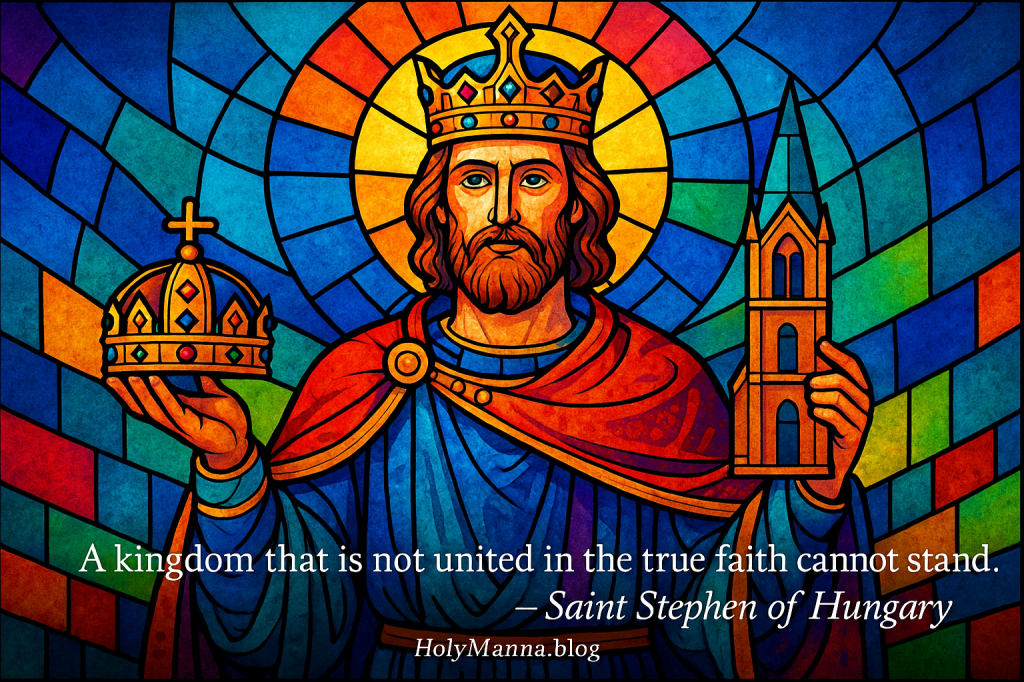
The King Who Crowned His Nation for Christ
In the annals of Christian history, Saint Stephen of Hungary stands out as a monarch who not only ruled with wisdom and strength but also sanctified his reign with deep devotion to Christ. Revered as the first King of Hungary and its primary apostle, Stephen’s leadership transformed a once-pagan territory into a Catholic kingdom, laying the spiritual and cultural foundation of Hungary for centuries to come. His vision for a Christian Hungary, rooted in justice, humility, and the Gospel, continues to inspire generations of Catholics around the world. Canonized in 1083 by Pope Saint Gregory VII, he is honored as a model of Catholic kingship—one whose authority served God above all. Saint Stephen’s feast day, celebrated on August 16, reminds the faithful not just of a political unifier, but of a holy man who gave his life for the salvation of his people.
From Pagan Prince to Defender of the Faith
Stephen was born around 975 A.D. in Esztergom, a city that would later become the ecclesiastical heart of Hungary. At birth, he was named Vajk, reflecting his origins in the Magyar tribal culture, which still clung to pagan traditions. His father, Duke Géza, was a powerful chieftain who ruled much of Hungary and had already taken steps toward Christianity, though his court remained heavily influenced by pagan beliefs. His mother, Sarolt, was a devout Christian and played a vital role in raising Stephen in the faith.
Stephen’s baptism likely occurred in his youth, and he took the Christian name Stephen, possibly in honor of Saint Stephen the Protomartyr, the first martyr of the Church (Acts 7). The young prince grew in both faith and virtue under the influence of Saint Adalbert of Prague, who mentored him and likely instilled in him the missionary spirit that would later define his reign.
When Duke Géza died in 997, Stephen faced a dangerous power struggle against Koppány, a relative who followed pagan succession customs. Relying on divine guidance, Stephen defeated Koppány in battle, securing his claim not just as duke, but as a Christian leader destined to crown his people with the light of the Gospel. In the year 1000, on Christmas Day, Stephen received a royal crown—sent by Pope Sylvester II and blessed by the pope himself—and was anointed King of Hungary. From that moment on, Stephen ruled not merely as a sovereign, but as a servant of Christ, pledging his nation to the Lord and dedicating his kingship to the Blessed Virgin Mary.
Shepherd of a Kingdom and Apostle of a Nation
Saint Stephen’s reign was marked by a profound zeal for spreading the Catholic faith throughout Hungary. Understanding the necessity of a solid ecclesial foundation, he built numerous churches and monasteries and established ten dioceses, creating a national ecclesiastical structure. He invited Benedictine monks from Western Europe to evangelize his people, promote education, and deepen sacramental life.
One of the most striking aspects of his leadership was his commitment to aligning his civil laws with Catholic morality. His legal code emphasized justice, protected the rights of widows and orphans (cf. Psalm 82:3), and forbade pagan practices. He exhorted his nobles and citizens to keep Sunday holy, to support the Church, and to practice Christian charity (cf. CCC 2042–2043).
Stephen’s Admonitions to Emeric, a set of spiritual and political instructions written for his son and heir, has become a spiritual classic of Catholic kingship. In it, he wrote: “Be humble in all things, for humility exalts men before God and before men.” He also warned, “A kingdom that is not united in the true faith cannot stand.” His teachings reflected a rare fusion of kingly authority and saintly virtue.
Although he was not known for working spectacular miracles during his life, the fruit of Stephen’s holiness was seen in the transformation of a violent, fragmented land into a thriving Christian kingdom. This, perhaps, was his greatest miracle: turning an entire people from idols to the living God (cf. 1 Thessalonians 1:9).
Battles, Betrayals, and a Crown of Suffering
Stephen’s path was not free from suffering. From the very beginning of his rule, he faced political opposition from pagan nobles who resisted conversion and Christian reforms. The most serious challenge came from Koppány, who believed he had a legitimate right to succeed Géza under pagan law. The confrontation between Stephen and Koppány was not only a political battle but a spiritual one—between the old pagan world and the dawning light of Christ. With faith and strategic alliances, Stephen defeated Koppány, reportedly having him quartered and sending his remains to the four corners of Hungary to symbolize the end of pagan fragmentation. While this act was harsh, it demonstrated the lengths to which Stephen went to secure the Christian future of his people.
Later in life, Stephen endured even greater personal hardship: the untimely death of his son, Prince Emeric, a young man known for his sanctity and chastity. Stephen had prepared Emeric to succeed him, not just politically but spiritually, raising him in virtue and faith. Emeric’s death in a hunting accident around 1031 devastated Stephen. In the words of tradition, the king’s heart was broken—but not his faith.
In the final years of his life, Stephen suffered from a long illness, enduring great physical pain. Yet he did not abandon his duties or his prayers. On August 15, 1038, the feast of the Assumption of the Blessed Virgin Mary—whom he had named the patroness and Queen of Hungary—Stephen breathed his last, surrendering his soul to the Queen he loved and the King he served.
A Holy Right Hand and Heavenly Intercession
Stephen’s canonization in 1083 was accompanied by reports of miracles at his tomb, particularly healings and protection during times of national crisis. One of the most striking miracles was the discovery of his incorrupt right hand, which was found fully preserved when his tomb was opened. This relic, now known as the Holy Dexter, became an object of national veneration and is still preserved in the Basilica of Saint Stephen in Budapest. It is carried in procession each year on his feast day and is seen as a sign of his enduring presence and protection over Hungary.
Miracles attributed to Saint Stephen after his death include healings from blindness, paralysis, and fevers, as well as protection of the Hungarian people during invasions and times of war. Pilgrimages to his relics became common, and his reputation as a saintly intercessor grew rapidly throughout medieval Europe. Many rulers, soldiers, and commoners visited his shrine, asking for wisdom, healing, and courage in the face of trial.
Today, his name is revered not only in Hungary but around the world. Schools, churches, cities, and Catholic institutions carry the name Saint Stephen, invoking his memory as a king who ruled with the heart of a saint and the humility of a servant.
Lessons from King Stephen
Saint Stephen challenges us today to see leadership—whether in families, communities, or careers—as a vocation of service. He reminds us that power is not for self-glory but for the good of others, and that true authority is rooted in humility and obedience to God (cf. CCC 2234–2235). His life shows us that we don’t need to perform dramatic miracles to become saints; we simply need to bring Christ into every corner of our lives and lead others to Him by our words and deeds.
When we’re faced with opposition or spiritual hardship, Stephen teaches us perseverance. When we experience personal loss, he models trust in God’s providence (cf. Psalm 34:19). And when we feel called to something greater than ourselves, his legacy urges us to answer, even if it means sacrificing comfort, power, or popularity.
What kind of spiritual “kingdom” are you building in your life? Are you preparing the next generation, as Stephen did with Emeric, to walk in holiness? Do you offer your daily responsibilities as acts of service to Christ the King?
Let us ask Saint Stephen to help us become builders of the Kingdom of God—brick by brick, with faith, love, and courage.
Engage with Us!
What part of Saint Stephen’s life resonated most with you? Share your thoughts or experiences in the comments—we would love to hear how this saint speaks to your journey.
Reflection Questions:
- In what areas of your life are you being called to lead others toward Christ?
- How do you integrate your faith into your decisions and relationships, especially when it’s challenging?
- What “crown” are you seeking in this life—and is it leading you closer to God’s Kingdom?
Let us pray for one another and ask Saint Stephen of Hungary to intercede for us, that we may live with courage, serve with humility, and love with a heart fully given to Christ, our true King.
Saint Stephen of Hungary, pray for us! 👑
Follow us on Instagram and Facebook for more insights and reflections on living a faith-filled life.

 Holy Manna!
Leave a comment