Fire in the North
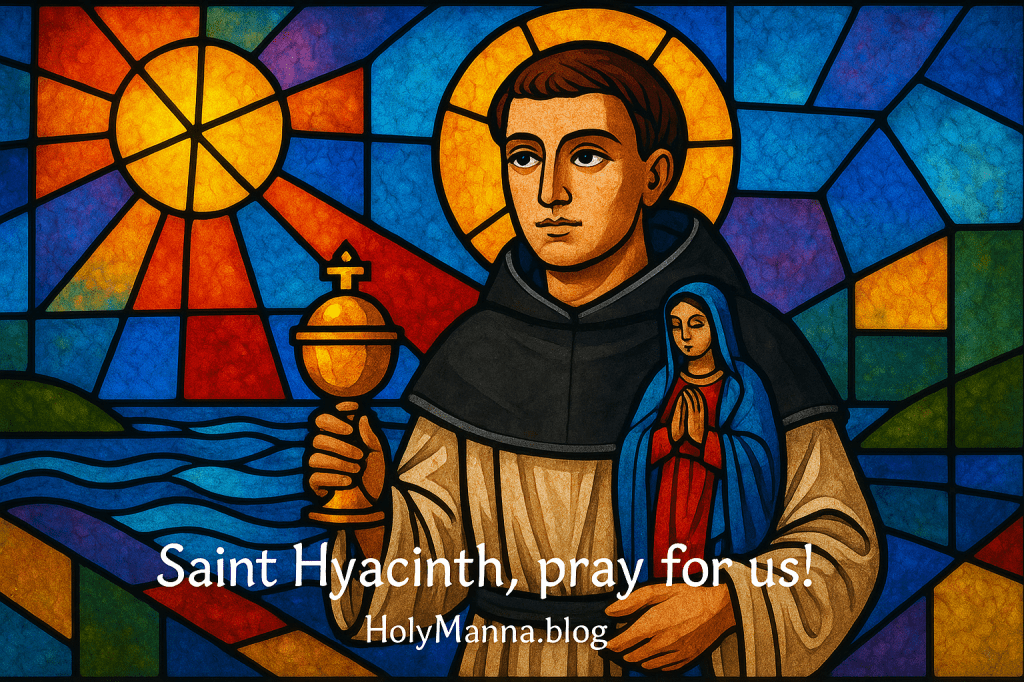
Saint Hyacinth of Poland, also known as Sanctus Hyacinthus or Jacek Odrowąż, stands among the most dynamic missionary saints of the 13th century. Known as the “Apostle of the North,” he traveled extensively to evangelize the regions of Northern and Eastern Europe. A beloved son of Saint Dominic and one of the first members of the Dominican Order, Hyacinth is revered for his zeal, courage, and miraculous deeds. His missionary work brought thousands to the Catholic faith across Poland, Prussia, Lithuania, Russia, Sweden, and even parts of China according to tradition. He is often depicted holding a ciborium and a statue of the Blessed Virgin Mary, reminding us of his miraculous faith during a time of danger. He is a model of courageous evangelization and trust in divine providence.
From Noble Roots to Radical Discipleship
Hyacinth was born around 1185 into the noble Odrowąż family in Kamień Śląski, in what is now modern-day Poland. Raised with wealth and education, he studied in Kraków, Prague, Bologna, and possibly Paris, immersing himself in philosophy, theology, and canon law. His refined intellect was matched by a deep spiritual hunger, which led him to Rome around 1218, where he encountered the newly founded Order of Preachers.
There, Hyacinth met Saint Dominic himself, and the encounter changed the course of his life. Inspired by Dominic’s fiery love for Christ and apostolic poverty, Hyacinth received the Dominican habit at Santa Sabina and was among the first friars trained by the founder. This profound conversion to a life of radical poverty, preaching, and missionary work would define the rest of his days.
Signs That Followed the Preacher
After returning to Poland, Saint Hyacinth established the Dominican Order in Kraków and became a relentless missionary. He traveled barefoot and often with only his breviary and the Eucharist. Numerous miracles followed him—signs of God’s power working through his obedient and humble heart.
One of the most famous miracles occurred during a Tartar invasion of Kiev. As the invaders approached, Hyacinth rushed to save the Blessed Sacrament from the tabernacle. As he turned to flee, he heard the voice of Our Lady say, “Hyacinth, are you going to leave me behind?” Looking upon her statue, he miraculously lifted both the heavy ciborium and the life-sized marble statue of Mary, carrying them effortlessly as he walked across the Dnieper River, which God allowed him to cross without a boat—walking on water as Peter once did.
Other miracles during his lifetime include the healing of the sick, multiplying of food, raising of the dead, and calming of storms during his missions. His very presence was known to inspire conversions, soften hardened hearts, and bring peace to turbulent regions.
A Martyr’s Spirit Without the Sword
Though not a martyr in the traditional sense, Hyacinth’s life was filled with hardships. He endured long journeys through hostile territories, faced violent opposition from pagans and heretics, and suffered famine, extreme weather, and personal deprivation for the sake of the Gospel. His steadfastness amid adversity echoed the words of Christ: “If any man would come after me, let him deny himself and take up his cross and follow me” (Matthew 16:24).
Through all these trials, he remained joyful, humble, and obedient to the call of the Lord. His perseverance reminds us that sanctity often comes not through dramatic martyrdom, but through the daily martyrdom of faithful endurance.
Heaven Keeps Working
Saint Hyacinth died on August 15, 1257—the Solemnity of the Assumption of the Blessed Virgin Mary—in Kraków, after having preached and celebrated Mass that same day. His final words were reported as “Into Your hands, O Lord, I commend my spirit”. Almost immediately, miracles began to pour forth through his intercession.
His tomb in the Basilica of the Holy Trinity in Kraków became a site of pilgrimage, veneration, and miraculous healings. Devotion to him spread quickly throughout Poland and across Europe. He was canonized by Pope Clement VIII in 1594.
Even today, many faithful turn to Saint Hyacinth in times of need, particularly for protection, healing, and courage. His relics are still venerated in Kraków, and his legacy continues through Dominican missions around the world.
Carrying Christ and Mary
Saint Hyacinth’s life teaches us to boldly proclaim Christ in both word and deed. His example encourages us to be missionaries in our own families, workplaces, and communities. His deep trust in the Real Presence and Our Lady challenges us to grow in Eucharistic devotion and Marian confidence.
Are we willing to carry Christ and His Mother with us, no matter the cost? Do we trust that God can work miracles when we step out in faith? Saint Hyacinth shows us that evangelization is not merely for priests or religious—it is for every baptized Catholic who believes that Jesus saves.
When we feel overwhelmed, intimidated, or unworthy of sharing our faith, let us remember this barefoot Polish friar who crossed rivers, healed bodies, and conquered hearts—not by his own strength, but by the power of the Holy Spirit.
Engage with Us!
We’d love to hear your thoughts and reflections in the comments. Has Saint Hyacinth inspired you today? How is God calling you to be a missionary in your own life?
Reflection Questions:
- In what ways can I carry Christ and Our Lady into the “invaded cities” of my own life—places of fear, chaos, or discouragement?
- Do I trust that God can work through me, even if I feel small or inadequate?
- How can I become a more courageous, joyful, and sacrificial witness to the Gospel in my daily life?
Let us pray for one another and strive to do everything with love, as our Lord Jesus did—no matter the cost, no matter the road.
Saint Hyacinth, pray for us! ✨
Follow us on Instagram and Facebook for more insights and reflections on living a faith-filled life.

 Holy Manna!
Leave a comment