Saturday of the Nineteenth Week in Ordinary Time – Lectionary: 418
Choose Today with a Childlike Heart
We all reach moments in life when a decision must be made—one that reveals what we truly value, trust, and worship. Today’s Mass readings place us squarely in such a moment. They don’t just invite us to choose God—they confront us with the urgency and cost of that choice. Are we willing to reject all that competes for our hearts and cling to the Lord with a childlike trust? In a world full of noise, idols, and endless distractions, these passages whisper the same eternal call: return to the simplicity of belonging wholly to God.
In Joshua 24, we stand with the Israelites at Shechem as they are called to renew their covenant. Joshua’s bold declaration—“As for me and my household, we will serve the Lord”—echoes through the centuries, challenging us to tear down modern idols and recommit to the living God. It’s a dramatic moment of national and personal consecration, rooted in memory: the Exodus, the wilderness, the victories gifted by God’s hand. Psalm 16 then becomes the voice of the one who has made that choice—a heart that finds refuge, guidance, and joy in the Lord alone: “You are my only good… you have made my destiny secure.” This trustful surrender reaches its purest expression in The Gospel of Matthew, where Jesus proclaims that the Kingdom of Heaven belongs to children. Their simple, wholehearted trust is not just a model—it’s a requirement for entering the Kingdom.
Together, these readings show us that choosing God is not a one-time statement but a daily, lived reality. It’s covenantal and communal, like the commitment made at Shechem. It’s personal and interior, like the psalmist’s whispered prayer in the night. And it’s childlike, as Jesus reminds us, marked by vulnerability, humility, and openness. What keeps you from choosing the Lord completely today? What foreign gods still claim your time, energy, or identity? Through these Scriptures, God calls us—not just to believe in Him, but to belong to Him with the joyful trust of a child and the unwavering resolve of a disciple.
First Reading – Joshua 24:14–29
Choose Whom You Will Serve
The Book of Joshua ends with a powerful covenant renewal scene that echoes through salvation history. The Israelites have entered the Promised Land after years of wandering and warfare. Now gathered at Shechem—a sacred site where God first promised the land to Abraham (Genesis 12:6–7)—Joshua addresses the people with urgency and clarity. He knows his death is near, and like Moses before him, he urges the people to remain faithful to the God who delivered them from slavery. But his challenge is not merely about national loyalty; it is about personal commitment to the living God. This reading mirrors today’s theme: choosing the Lord completely and sincerely, like a child who trusts without reserve. Here, covenant faith is not assumed—it must be chosen, declared, and lived.
Joshua 24:14-29
New American Bible (Revised Edition)
14 “Now, therefore, fear the Lord and serve him completely and sincerely. Cast out the gods your ancestors served beyond the River and in Egypt, and serve the Lord. 15 If it is displeasing to you to serve the Lord, choose today whom you will serve, the gods your ancestors served beyond the River or the gods of the Amorites in whose country you are dwelling. As for me and my household, we will serve the Lord.”
16 But the people answered, “Far be it from us to forsake the Lord to serve other gods. 17 For it was the Lord, our God, who brought us and our ancestors up out of the land of Egypt, out of the house of slavery. He performed those great signs before our very eyes and protected us along our entire journey and among all the peoples through whom we passed. 18 At our approach the Lord drove out all the peoples, including the Amorites who dwelt in the land. Therefore we also will serve the Lord, for he is our God.”
19 Joshua in turn said to the people, “You may not be able to serve the Lord, for he is a holy God; he is a passionate God who will not forgive your transgressions or your sins. 20 If you forsake the Lord and serve strange gods, he will then do evil to you and destroy you, after having done you good.”
21 But the people answered Joshua, “No! We will serve the Lord.” 22 Joshua therefore said to the people, “You are witnesses against yourselves that you have chosen to serve the Lord.” They replied, “We are witnesses!” 23 “Now, therefore, put away the foreign gods that are among you and turn your hearts to the Lord, the God of Israel.” 24 Then the people promised Joshua, “We will serve the Lord, our God, and will listen to his voice.”
25 So Joshua made a covenant with the people that day and made statutes and ordinances for them at Shechem. 26 Joshua wrote these words in the book of the law of God. Then he took a large stone and set it up there under the terebinth that was in the sanctuary of the Lord. 27 And Joshua said to all the people, “This stone shall be our witness, for it has heard all the words which the Lord spoke to us. It shall be a witness against you, should you wish to deny your God.” 28 Then Joshua dismissed the people, each to their own heritage.
Death of Joshua. 29 After these events, Joshua, son of Nun, servant of the Lord, died at the age of a hundred and ten,
Detailed Exegesis
Verse 14 – “Now, therefore, fear the Lord and serve him completely and sincerely. Cast out the gods your ancestors served beyond the River and in Egypt, and serve the Lord.”
Joshua begins with a call to authentic worship. The command to “fear the Lord” invites reverent awe, not paralyzing fear. “Completely and sincerely” points to the integrity of heart God desires. Even after the Exodus, remnants of foreign gods remain in their midst—an image of divided hearts. CCC 2113 warns: “Idolatry not only refers to false pagan worship. It remains a constant temptation. Idolatry consists in divinizing what is not God.”
Verse 15 – “If it is displeasing to you to serve the Lord, choose today whom you will serve… As for me and my household, we will serve the Lord.”
Joshua places before the people a decisive choice. “Choose today”—this is not theoretical, it’s immediate. His personal declaration—“As for me and my household, we will serve the Lord”—models the spiritual authority of a father who leads his household in faith. CCC 1656 affirms: “The home is the first school of Christian life… here one learns endurance and the joy of work, fraternal love, generous—even repeated—forgiveness, and above all divine worship in prayer and the offering of one’s life.”
Verse 16 – “Far be it from us to forsake the Lord to serve other gods.”
The people respond with conviction, though their understanding is still developing. Their loyalty is grounded in memory of what God has done.
Verse 17 – “For it was the Lord, our God, who brought us and our ancestors up out of the land of Egypt, out of the house of slavery.”
Their faith is rightly rooted in the saving acts of God. The Exodus is the foundational story of identity, just as the Paschal Mystery is for Christians. CCC 1094 notes: “The Paschal catechesis of the Lord… illuminated the unity of the divine plan in the two Testaments through typology.”
Verse 18 – “At our approach the Lord drove out all the peoples… Therefore we also will serve the Lord, for he is our God.”
The people connect God’s power with their loyalty. But the motivation—“Therefore”—reveals a conditional element: their service is still dependent on what God does for them.
Verse 19 – “You may not be able to serve the Lord, for he is a holy God… he will not forgive your transgressions or your sins.”
Joshua warns them not to make vows lightly. God is not to be trifled with. His holiness demands sincerity. CCC 2090 explains that Christian hope must be grounded in both reverence and trust: “It responds to the aspiration to happiness which God has placed in the heart of every man… it is also a fear of offending God’s love.”
Verse 20 – “If you forsake the Lord and serve strange gods, he will then do evil to you and destroy you, after having done you good.”
This is not a threat but a covenantal warning. God respects human freedom—even when it leads to destruction. Like any covenant, there are blessings for fidelity and consequences for betrayal.
Verse 21 – “No! We will serve the Lord.”
Now their answer is more deliberate. They understand the weight of their yes.
Verse 22 – “You are witnesses against yourselves that you have chosen to serve the Lord.”
Joshua invokes legal language. Their own words bear witness against future disobedience.
Verse 23 – “Now, therefore, put away the foreign gods that are among you and turn your hearts to the Lord, the God of Israel.”
This verse reveals a sobering truth: even after all the miracles, idols still linger in their tents. Conversion must go deeper than lip service. It must reach the heart.
Verse 24 – “We will serve the Lord, our God, and will listen to his voice.”
“Listening” in the biblical sense means obeying. Like the Shema of Deuteronomy 6:4, this is a promise to live in covenantal obedience.
Verse 25 – “So Joshua made a covenant with the people that day and made statutes and ordinances for them at Shechem.”
Joshua formalizes their commitment. It is not just emotional—it’s legal, binding, and communal.
Verse 26 – “Then he took a large stone and set it up there under the terebinth that was in the sanctuary of the Lord.”
The stone serves as a physical reminder. In biblical tradition, stones often marked sacred encounters. So too, the Church gives us visible signs—Sacraments—that remind us of grace.
Verse 27 – “This stone shall be our witness, for it has heard all the words which the Lord spoke to us. It shall be a witness against you, should you wish to deny your God.”
A poetic image—the stone “has heard” their vows and stands as witness. CCC 2150 teaches: “A false oath calls on God to be witness to a lie.” Joshua underscores the sacred weight of their words.
Verse 28 – “Then Joshua dismissed the people, each to their own heritage.”
After renewing their covenant, they return to their lives, now shaped by their choice. Faith is not a one-time event—it is a lived journey.
Verse 29 – “After these events, Joshua, son of Nun, servant of the Lord, died at the age of a hundred and ten.”
Joshua’s life ends, but the covenant lives on. His death marks the end of an era, but not the end of God’s faithfulness.
Teachings of the Church
This passage reflects the Church’s understanding of covenant as both grace and responsibility. CCC 2093 teaches: “Faith in God leads us to turn to Him alone as our first origin and our ultimate goal, and neither to prefer anything to Him nor to substitute anything for Him.” The Catechism also reminds us in CCC 2062 that “The Commandments… are connected to the covenant… moral existence is a response to the Lord’s loving initiative.” Like the Israelites, we are invited into a covenant of love that requires our whole heart.
Saint Ignatius of Loyola captures this truth in his Spiritual Exercises: “Man is created to praise, reverence, and serve God our Lord, and by this means to save his soul.” That foundational principle reflects Joshua’s challenge: to live not for idols, but for God alone. Saint Augustine also writes, “You have made us for Yourself, O Lord, and our hearts are restless until they rest in You.” (Confessions, I.1)
Reflection
What idols am I still holding onto in my heart? Have I truly made the Lord the center of my life, or do I still bargain with Him, offering partial loyalty? Joshua’s challenge echoes into every generation. God doesn’t want a sliver of our attention—He desires all of us. To serve the Lord with sincerity means surrendering not only our actions but also our desires, schedules, relationships, and plans.
Today, can I echo Joshua’s words with truth? Can I say, “As for me and my household, we will serve the Lord”? If so, that means practical steps: daily prayer, honoring the Sabbath, rejecting sin, forgiving quickly, and teaching our children to love the Lord. Like children running into their Father’s arms, we are called to turn away from false security and toward the God who is our only good. Let this be the day you choose again—with conviction and trust—to serve the Lord.
Responsorial Psalm – Psalm 16:1–2, 5, 7–8, 11
The Joy of Belonging to God
This psalm, attributed to David, is classified as a miktam, a term possibly denoting a prayer of quiet confidence, often composed in moments of danger or deep contemplation. Psalm 16 expresses the interior life of someone who has consciously chosen the Lord as their only refuge and treasure. In the context of today’s readings—particularly Joshua’s call to reject false gods—this psalm becomes a deeply personal echo of that choice. Where Joshua publicly declares, “As for me and my household, we will serve the Lord”, the psalmist quietly affirms, “You are my only good.” This is a heart that no longer flirts with idols or double-mindedness, but rests securely in God’s presence. It embodies the childlike trust Jesus praises in The Gospel of Matthew, and reveals the emotional and spiritual fruit of total surrender.
Psalm 16:1-2, 5, 7-8, 11
New American Bible (Revised Edition)
God the Supreme Good
1 A miktam of David.
Keep me safe, O God;
in you I take refuge.
2 I say to the Lord,
you are my Lord,
you are my only good.
5 Lord, my allotted portion and my cup,
you have made my destiny secure.
7 I bless the Lord who counsels me;
even at night my heart exhorts me.
8 I keep the Lord always before me;
with him at my right hand, I shall never be shaken.
11 You will show me the path to life,
abounding joy in your presence,
the delights at your right hand forever.
Detailed Exegesis
Verse 1 – “Keep me safe, O God; in you I take refuge.”
This opening line sets the tone of vulnerability and dependence. The psalmist does not claim strength or autonomy but turns to God as protector. This is the first mark of true covenant relationship: not self-reliance, but surrender. CCC 2090 teaches that Christian hope includes “confidence in God’s grace and in His promise of eternal life”—a hope echoed in this plea for refuge.
Verse 2 – “I say to the Lord, you are my Lord, you are my only good.”
Here the psalmist makes a bold declaration of exclusive loyalty. In Hebrew, the repetition emphasizes intimacy and possession—“my Lord… my only good”. This verse directly challenges our divided desires. What do we treat as our “good” apart from God—comfort, success, control, pleasure?
Verse 5 – “Lord, my allotted portion and my cup, you have made my destiny secure.”
In the Old Testament, “portion” and “cup” refer to inheritance and blessing. Unlike the tribes who received physical territory, the Levites were told that “the Lord himself is their portion” (Numbers 18:20). This verse reflects that Levitical spirituality: to belong entirely to God. The assurance of a secure destiny reveals the peace that comes from total trust in the Lord.
Verse 7 – “I bless the Lord who counsels me; even at night my heart exhorts me.”
This line unveils a continuous relationship with God—day and night, waking and sleeping. The Lord’s counsel is internalized to such a degree that the heart becomes an instrument of divine exhortation. Psalm 119:11 says, “I treasure your word in my heart, that I may not sin against you.” Here, too, we are reminded that holiness is cultivated through quiet, prayerful attentiveness.
Verse 8 – “I keep the Lord always before me; with him at my right hand, I shall never be shaken.”
This verse reveals the secret of spiritual stability: continual awareness of God’s presence. To “keep the Lord always before me” is a spiritual discipline—a habit of heart. The right hand, a symbol of strength and action, becomes unshakable when God is present. CCC 2607 tells us: “When Jesus prays, He is already teaching us how to pray. His prayer to the Father is the path for our hearts to follow.”
Verse 11 – “You will show me the path to life, abounding joy in your presence, the delights at your right hand forever.”
The psalm culminates in a vision of eternal joy. The “path to life” is not only about earthly guidance but eschatological hope. This verse points ahead to resurrection and eternal communion with God. Saint Peter, in his Pentecost sermon (Acts 2:25–28), applies this very psalm to the resurrection of Christ. In the Risen Lord, the psalmist’s hope is fulfilled.
Teachings of the Church
The Catechism of the Catholic Church teaches that true happiness is only found in God. CCC 1721 states: “God put us in the world to know, to love, and to serve Him, and so to come to paradise. Beatitude makes us ‘partakers of the divine nature’ and of eternal life.” Psalm 16 captures this theological truth with poetic beauty: only in God’s presence is fullness of joy. Additionally, CCC 2092 warns against presumption—assuming salvation without striving for holiness. The psalmist avoids this danger by continually invoking God’s counsel, presence, and path.
Saint Augustine writes about this psalm in Expositions on the Psalms, saying: “This is the voice of Christ himself speaking in prophecy… It is He who trusted in God, who was not abandoned to the grave, who saw no corruption.” Thus, Psalm 16 becomes not only a personal prayer of the believer but also a foreshadowing of Jesus’ trust in the Father through His Passion and Resurrection.
Reflection
Do I believe that God is my only good? Or do I still cling to other “portions” to feel secure—money, attention, control, pleasure? This psalm invites us into a deeper interior conversion, one where God is not just first, but everything. Like a child resting in a parent’s arms, the psalmist reveals what it means to live in total trust, grounded in God’s counsel and presence.
What would change if I kept the Lord always before me? Would I make different choices? Would I treat others more gently? Would I worry less? Would I trust more? The psalm offers us a roadmap: take refuge in the Lord, declare Him as your only good, and allow His presence to reframe your whole life. Then you will discover what the psalmist promises: “abounding joy in your presence, the delights at your right hand forever.”
Holy Gospel – Matthew 19:13–15
Let the Children Come to Me
In this short but powerful Gospel passage, Jesus offers one of the most profound revelations of the nature of the Kingdom of Heaven. Set within The Gospel of Matthew’s teachings on discipleship, humility, and detachment, this scene interrupts an adult-centric narrative with the arrival of children—those who, in the cultural context of first-century Judaism, were considered the least significant. In a society where religious authority and status often defined one’s value, children had no legal or social standing. Yet it is precisely these little ones that Jesus calls to Himself. By rebuking His disciples and blessing the children, Jesus flips the expectations of His time and reveals the disposition necessary to enter His Kingdom: childlike trust, humility, and dependence. This moment beautifully ties into today’s theme—a call to wholehearted and sincere service to God. Just as Joshua demanded an undivided choice and the psalmist declared total reliance on the Lord, Jesus now shows that the path to the Kingdom is not through power or perfection, but through childlike openness.
Matthew 19:13-15
New American Bible (Revised Edition)
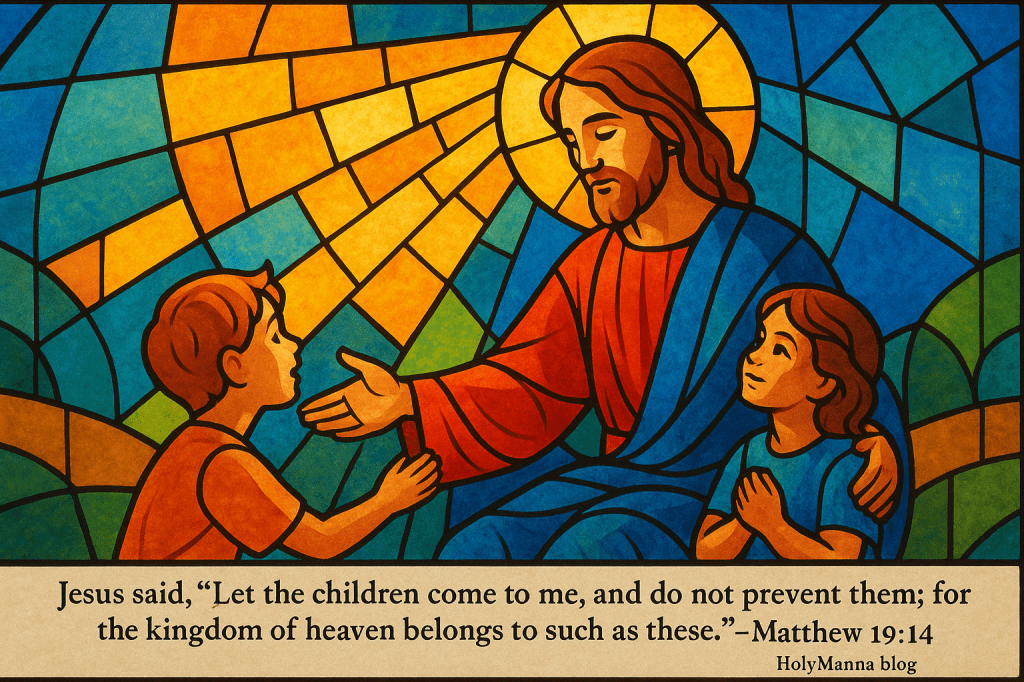
13 Then children were brought to him that he might lay his hands on them and pray. The disciples rebuked them, 14 but Jesus said, “Let the children come to me, and do not prevent them; for the kingdom of heaven belongs to such as these.” 15 After he placed his hands on them, he went away.
Detailed Exegesis
Verse 13 – “Then children were brought to him that he might lay his hands on them and pray. The disciples rebuked them.”
This verse begins with a familiar scene in ancient Jewish tradition—bringing children to a rabbi for blessing. Parents desired their children to receive not just affection but a spiritual transmission of grace. The action of “laying hands and praying” was common in blessings, especially from holy men or leaders. However, the disciples, perhaps thinking they were protecting Jesus from distraction or trying to preserve a sense of formality, rebuke the people. This reveals a common human error: assuming that the Kingdom is only for the strong, the mature, or the important. But Jesus’ vision is radically different.
Verse 14 – “But Jesus said, ‘Let the children come to me, and do not prevent them; for the kingdom of heaven belongs to such as these.’”
Jesus responds not with irritation, but with a gentle command. “Let the children come to me” is not just a permission—it’s a mandate. His rebuke of the disciples reorients the priorities of the Kingdom. The phrase “for the kingdom of heaven belongs to such as these” does not mean only literal children, but those who are childlike in spirit—those who trust, receive, and love freely. CCC 526 reflects this when it teaches: “To become a child in relation to God is the condition for entering the kingdom. For this, we must humble ourselves and become little.” Jesus reminds us that childlikeness is not a stage to grow out of but a disposition to grow into.
Verse 15 – “After he placed his hands on them, he went away.”
This final verse affirms the completion of the blessing. Jesus does not just speak about childlikeness—He acts. His laying on of hands is a visible sign of divine favor. The gesture affirms that children are not an interruption to His mission—they are integral to it. Then, quietly, He departs, leaving behind the image of a Savior who stops everything to bless the small and overlooked.
Teachings of the Church
The Catechism of the Catholic Church affirms the sacredness of children and the necessity of spiritual childhood. CCC 2785 teaches: “By giving us the Spirit of His Son, the Father makes us His children… the humility of our hearts brings us back to the childlike disposition of the poor.” This teaching builds on Jesus’ own words in Matthew 18:3: “Unless you turn and become like children, you will not enter the kingdom of heaven.” Spiritual childhood is not immaturity—it is trustful surrender. Saint Thérèse of Lisieux, Doctor of the Church, famously embraced the “Little Way,” writing, “I choose all! I will be a saint by becoming small.” Her entire spirituality was rooted in the truth that childlike dependence on God is the highest path to holiness.
Pope Benedict XVI, in Jesus of Nazareth, reflects on this Gospel passage by stating: “Children are by nature dependent and receptive; they are open to love. And so they show us the right attitude for approaching God.” In this light, the Gospel is not a sentimental vignette—it is a radical call to conversion.
Reflection
Do I come to God like a child—open, trusting, unafraid of being weak? Or do I try to earn His love by appearing strong, competent, or self-sufficient? This Gospel shatters the illusion that discipleship is about impressing God. It’s about letting Him love us. It’s about choosing, like a child, to run into His arms with empty hands.
When was the last time I let God bless me without resistance? What parts of me do I still try to keep guarded from His touch? The call to childlikeness is not a lowering of standards—it is a lifting of our eyes. Today, as we reflect on choosing the Lord with sincerity (Joshua 24) and delighting in Him as our portion (Psalm 16), Jesus gives us the key to the Kingdom: become small. Trust. Come close. Be blessed. And then go forth with the freedom of a child who knows he is deeply loved.
Called to Choose, Formed to Trust
Today’s readings form a beautiful arc—from decision, to devotion, to childlike dependence. In Joshua 24, we witnessed a dramatic covenant renewal: “As for me and my household, we will serve the Lord.” This was no casual promise, but a solemn choice to reject false gods and walk in fidelity. Psalm 16 responded with the voice of one who has made that choice and found refuge, joy, and purpose in God alone: “You are my only good.” Then, in Matthew 19, Jesus completes the picture—not with a grand proclamation, but with a gentle gesture: “Let the children come to me… for the kingdom of heaven belongs to such as these.”
The invitation is clear and urgent. God doesn’t want half our hearts—He desires all of us. But He doesn’t ask for perfection. He asks for surrender. Like the Israelites, we are called to cast out our modern idols and commit again to the living God. Like the psalmist, we’re invited to delight in God’s presence as our portion and our cup. And like the children in the Gospel, we’re called to come freely to Jesus—trusting, open, and unafraid.
What will you choose today? Will you serve the Lord with sincerity, listen for His voice, and rest in His blessing? Let today be a moment of renewal. Not just a fleeting inspiration, but a return—a childlike return—to the God who calls you by name, who lays His hand upon you, and who promises “the path to life, abounding joy in His presence” (Psalm 16:11). Choose Him. Trust Him. Let yourself be held.
Engage with Us!
We’d love to hear how God is speaking to you through today’s readings. What stirred your heart? What challenged you? What gave you hope? Share your reflections in the comments and join the conversation as we walk this journey of faith together.
Reflection Questions
First Reading – Joshua 24:14–29:
What “foreign gods” might still have a hold on your life—habits, priorities, or attachments? What does it mean for you to say, “As for me and my household, we will serve the Lord”?
Responsorial Psalm – Psalm 16:1–2, 5, 7–8, 11:
What does it look like in your daily life to say, “You are my only good”? How can you more intentionally keep the Lord “always before you”?
Holy Gospel – Matthew 19:13–15:
In what ways do you resist coming to Jesus like a child? How can you cultivate childlike trust in your relationship with God this week?
May you go forth today with renewed courage to choose the Lord with sincerity, to take refuge in Him with joy, and to approach Him with the loving trust of a child. Let everything you do be done with the love, humility, and mercy that Jesus Himself has shown us. You are deeply loved—now live like it.
Follow us on Instagram and Facebook for more insights and reflections on living a faith-filled life.

 Holy Manna!
Leave a comment