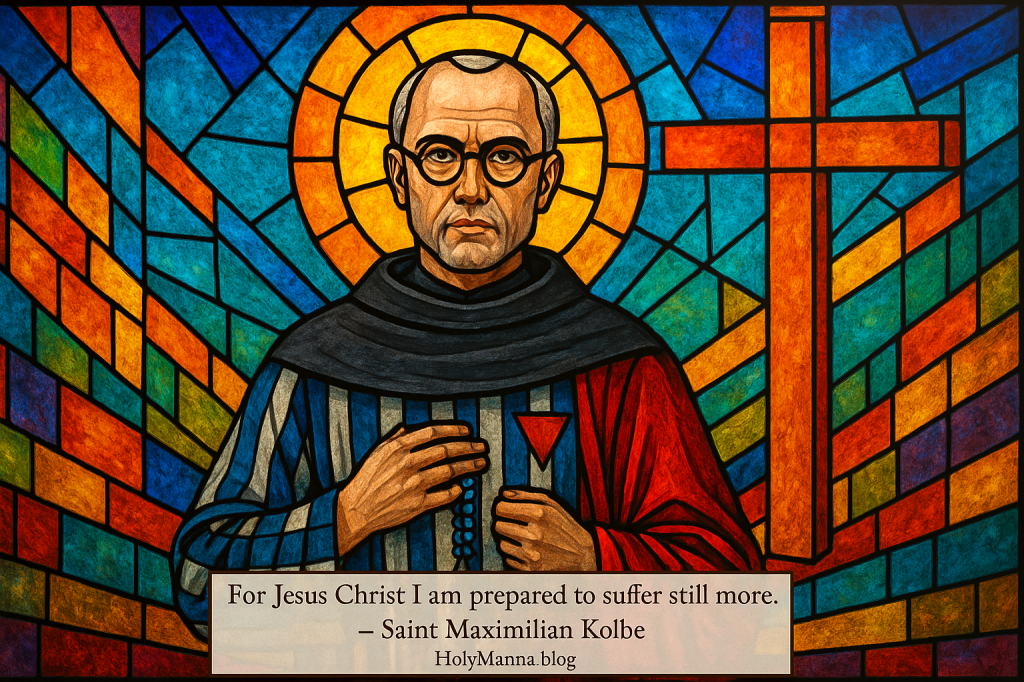
A Saint for the Modern World
In the shadow of one of the darkest periods of human history, the light of Saint Maximilian Kolbe shines with extraordinary clarity. A Polish Franciscan friar, missionary, writer, and martyr, Kolbe gave his life at Auschwitz in an extraordinary act of Christian love—offering himself in place of a fellow prisoner. But his greatness does not rest only in his heroic death. His entire life was a testament to the Gospel. A fierce devotee of the Immaculate Virgin Mary and founder of one of the most dynamic evangelistic movements of the 20th century, Kolbe tirelessly used every form of media available to bring souls to Christ through Mary. He is remembered not only as a martyr of war, but as a prophet of modern evangelization and a true knight of the Immaculata. Canonized as a martyr of charity in 1982 by Pope Saint John Paul II, Saint Maximilian Kolbe is the patron of journalists, prisoners, families, and the pro-life movement—reminding us all that love is stronger than death.
Two Crowns
Born on January 8, 1894, in the small Polish town of Zduńska Wola, Rajmund Kolbe was the second of five sons in a devout Catholic family. His parents, Julius and Maria, were hardworking and deeply religious. His father would later join the fight for Polish independence, and his mother became a Benedictine oblate. The Kolbe home was modest, but it overflowed with prayer and faith.
From a young age, Rajmund displayed remarkable intelligence and spiritual sensitivity. At the age of 12, he experienced a vision that would define his life’s trajectory. As he knelt in prayer before a statue of the Blessed Virgin Mary, she appeared to him holding two crowns—one white, representing purity, and one red, symbolizing martyrdom. She asked him which he wanted. The boy’s response was swift and resolute: “I choose both.” This mystical moment was not a fleeting childhood dream, but a divine invitation that Maximilian took seriously. From that point forward, he dedicated himself with fierce determination to a life of holiness and sacrifice.
He entered the Conventual Franciscans in 1910, taking the name Maximilian, and was sent to Rome for studies, earning doctorates in philosophy and theology. Even amid academic rigor, his heart burned with missionary zeal. Alarmed by the growing influence of Freemasonry, atheism, and secularism—especially during his time in Rome—he founded the Militia Immaculatae (Army of the Immaculata) in 1917. Its mission was simple but radical: to win all souls for Christ through total consecration to the Blessed Virgin Mary.
The Immaculata’s Knight
Maximilian Kolbe was not content with cloistered life or mere intellectual study. He was a man of action, strategy, and vision. Understanding the power of media in the modern world, he used the printing press, radio, and magazines to spread devotion to the Immaculate Virgin and to evangelize a culture growing increasingly hostile to the faith. His monthly magazine, Rycerz Niepokalanej (Knight of the Immaculata), quickly grew in circulation and eventually surpassed one million subscribers.
In 1927, he established Niepokalanów—the “City of the Immaculata”—just outside of Warsaw. This friary became a powerhouse of spiritual formation, publishing, and missionary activity. At its peak, Niepokalanów housed over 800 friars, making it the largest monastery in the world at the time. Kolbe implemented strict spiritual discipline, daily Eucharist and Marian devotions, and constant work aimed at sanctifying the world through media.
His missionary zeal took him to Japan in 1930, where he established a second City of the Immaculata in Nagasaki. Remarkably, he chose to build the friary on the side of a mountain contrary to the advice of local experts. Years later, when the atomic bomb devastated Nagasaki in 1945, the friary was one of the few structures left standing—a testament many believe to be a miracle of divine protection.
Though not associated with sensational miracles during his life, Kolbe’s ability to inspire vocations, launch massive evangelistic initiatives, and guide souls to Christ through Mary was itself miraculous. His life bore spiritual fruit far beyond human capability.
The Holocaust and the Hero
As the Nazi regime swept through Poland, Catholic institutions and clergy were systematically targeted. In 1939, following the German invasion, Kolbe was arrested by the Gestapo. Though released after three months, he continued publishing religious materials condemning Nazi ideology. In 1941, he was arrested again and transferred to Auschwitz, where he was labeled prisoner #16670.
In the midst of the inhumane conditions of the concentration camp, Kolbe became a beacon of hope and peace. He shared his food, offered counsel and prayers, and heard confessions whenever possible. Fellow inmates described him as calm, radiant, and selfless—utterly detached from hatred or despair.
The event that would immortalize him occurred in July 1941. After a prisoner escaped, the SS selected ten men at random to die by starvation as retribution. One of the chosen men, Franciszek Gajowniczek, cried out, “My wife! My children!” Moved with divine compassion, Father Kolbe stepped forward and said to the commandant, “I am a Catholic priest. I want to die for that man. I am old; he has a wife and children.” The stunned Nazi officer accepted the exchange.
Kolbe and the other condemned men were thrown into a starvation cell. While the others died one by one, Kolbe led them in prayer, hymns, and meditations on the Passion of Christ. After two weeks, he was the last remaining. Because the guards wanted the cell emptied, he was injected with carbolic acid on August 14, 1941. He died with serenity on his face, arms raised in prayer. It was the vigil of the Feast of the Assumption of Mary.
From Death to Glory
Even before the war ended, stories of Kolbe’s sacrifice began to circulate among survivors. His reputation for holiness spread quickly throughout Poland and beyond. Franciszek Gajowniczek, the man whose life he saved, survived Auschwitz and spent the rest of his life sharing the story of Kolbe’s heroic love.
The miracles attributed to Kolbe’s intercession began to surface in the decades following his death. The healing that led to his canonization was that of Angela Testoni, an Italian woman suffering from incurable tuberculosis. After prayers to Kolbe and the application of a relic, she experienced a complete and unexplainable healing, which was formally investigated and approved by the Church.
Another modern sign of his intercession is the powerful influence his story has had on conversions. Countless prisoners, addicts, and skeptics have returned to the faith after encountering his life and death. His relics—mostly hair and beard clippings preserved by his fellow friars—are now housed in reliquaries across the globe. Pilgrimage sites include Niepokalanów and the starvation cell in Auschwitz, now a chapel where thousands pray each year.
Saint John Paul II, who canonized him, declared that Kolbe’s act of love was “a victory won over all the systems of contempt and hatred that defile the dignity of man.” His feast day is celebrated on August 14.
Total Love
Saint Maximilian Kolbe offers the world a blueprint for radical holiness. He teaches us that sanctity does not require visions or great power—but a deep, daily ‘yes’ to God. His devotion to Mary was not emotional sentimentality, but a complete entrustment to her maternal care, modeled after Christ Himself at the foot of the Cross.
How can we live Kolbe’s legacy? First, by being instruments of peace in a world of division. Second, by offering daily sacrifices with love, especially for others. Third, by embracing our vocations—whatever they may be—with zeal and courage. Kolbe also reminds us of the power of consecration to Mary. He once wrote, “Never be afraid of loving the Blessed Virgin too much. You can never love her more than Jesus did.”
In our ordinary lives, we can “take someone’s place” through acts of forgiveness, charity, and presence. Whether we care for a sick parent, forgive a betrayal, or serve without recognition, we imitate Kolbe’s martyrdom in daily life.
His death was not simply the end of a good life—it was the crowning of a life spent pouring himself out for others, always through the Immaculata, always for Jesus. May his life embolden us to love radically and live generously.
Engage with Us!
What part of Saint Maximilian Kolbe’s life touched you the most? Have you ever felt called to a deeper kind of sacrifice? We’d love to hear your thoughts in the comments!
Reflection Questions:
- How can I practice “martyrdom of the heart” in my daily life through small acts of self-giving love?
- What is one area where I need to trust Our Lady more, as Saint Maximilian did so radically?
- Is there someone in my life whom God is calling me to serve more fully or even suffer for?
Let’s continue to support each other on this journey of faith. May we love like Saint Maximilian Kolbe, with courage, clarity, and total surrender to Jesus through Mary.
Saint Maximilian Kolbe, pray for us! ✝️
Follow us on Instagram and Facebook for more insights and reflections on living a faith-filled life.

 Holy Manna!
Leave a comment