Memorial of Saint Maximilian Kolbe, Priest and Martyr – Lectionary: 416
Crossing the Waters of Mercy
Have you ever found yourself standing at the edge of something impossible—something that demands either a step of faith or a retreat into fear? Today’s readings lead us straight to that threshold, where God’s power meets our brokenness, and His mercy carves a way forward through impossible waters. From the Israelites’ awe-filled crossing of the Jordan in Joshua 3, to Jesus’ command to forgive “seventy-seven times” in The Gospel of Matthew, and culminating in the radical love of Saint Maximilian Kolbe, we are invited to ponder this question: Will we allow God’s mercy to shape how we live, love, and forgive—even when it costs everything?
The historical and spiritual weight of today’s Scriptures cannot be overstated. The Israelites, after forty years of wandering, stand before the flooded Jordan River—the final barrier to the Promised Land. As soon as the priests step into the water carrying the ark, the river halts, and the people walk through on dry land. This miraculous crossing mirrors the Exodus and points forward to Baptism—a sign that God is not just a deliverer of the past but is ever-present, capable of transforming obstacles into holy ground. The psalmist in Psalm 114 echoes this wonder: “The sea saw and fled; the Jordan turned back.” Nature itself yields to the living God. In this light, Jesus’ command to forgive without limit isn’t just moral instruction; it’s a call to spiritual crossing—a movement from justice to mercy, from debt to release, from hardness to love.
And what better witness to this divine mercy than Saint Maximilian Kolbe? On this memorial, we remember a priest who quite literally crossed into another man’s death to save his life in Auschwitz. Where hatred reigned, Kolbe became a vessel of Christ’s love, offering himself in place of a stranger. His sacrifice wasn’t just heroic—it was Eucharistic, forged in the pattern of Jesus, who forgave even from the Cross. Today’s readings, then, are not abstract or distant; they are alive in the witness of a saint who chose to walk the hard road of forgiveness and love. As we reflect on them, what river are you being called to step into? Whose debt are you being invited to release?
First Reading – Joshua 3:7–11, 13–17
When God Leads, the Waters Part
Before the walls of Jericho ever came crashing down, before the battles of Canaan had begun, the Israelites faced one last overwhelming barrier: the swollen Jordan River. Today’s passage from Joshua 3 takes us to the banks of this river during flood season—a time when the waters would have been violent and impassable. The Israelites had wandered for forty years in the wilderness because of their lack of trust in God. Now, a new generation stands ready to enter the Promised Land, not by their own strength, but through God’s miraculous power and presence. The Ark of the Covenant—the visible sign of God’s dwelling among His people—goes before them, carried by the priests as the waters part. This moment is rich in religious significance. It recalls the Red Sea crossing, prefigures Christian Baptism (see CCC 1221), and affirms that God still makes a way through what seems impossible. As we reflect on this passage, we are reminded of Saint Maximilian Kolbe’s own act of trust and self-offering. He stepped into the floodwaters of hatred and death at Auschwitz, following the Ark of the New Covenant—Jesus Christ—into sacrificial love.
Joshua 3:7-11, 13-17
New American Bible (Revised Edition)
7 Then the Lord said to Joshua: Today I will begin to exalt you in the sight of all Israel, that they may know that, as I was with Moses, so I will be with you. 8 Now command the priests carrying the ark of the covenant, “When you come to the edge of the waters of the Jordan, there take your stand.”
9 So Joshua said to the Israelites, “Come here and listen to the words of the Lord, your God.” 10 He continued: “By this you will know that there is a living God in your midst: he will certainly dispossess before you the Canaanites, Hittites, Hivites, Perizzites, Girgashites, Amorites, and Jebusites. 11 The ark of the covenant of the Lord of the whole earth will cross the Jordan before you.
13 When the soles of the feet of the priests carrying the ark of the Lord, the Lord of the whole earth, touch the waters of the Jordan, it will cease to flow; the water flowing down from upstream will halt in a single heap.”
The Crossing Begun. 14 The people set out from their tents to cross the Jordan, with the priests carrying the ark of the covenant ahead of them. 15 When those bearing the ark came to the Jordan and the feet of the priests bearing the ark were immersed in the waters of the Jordan—which overflows all its banks during the entire season of the harvest— 16 the waters flowing from upstream halted, standing up in a single heap for a very great distance indeed, from Adam, a city in the direction of Zarethan; those flowing downstream toward the Salt Sea of the Arabah disappeared entirely. Thus the people crossed over opposite Jericho. 17 The priests carrying the ark of the covenant of the Lord stood on dry ground in the Jordan riverbed while all Israel crossed on dry ground, until the whole nation had completed the crossing of the Jordan.
Detailed Exegesis
Verse 7 – “Then the Lord said to Joshua: Today I will begin to exalt you in the sight of all Israel, that they may know that, as I was with Moses, so I will be with you.”
God affirms Joshua’s leadership by linking him to Moses, the great deliverer of Israel. Just as the Red Sea parted under Moses, now the Jordan will part under Joshua. This act is not about Joshua’s power but God’s promise—He is the true leader of Israel.
Verse 8 – “Now command the priests carrying the ark of the covenant, ‘When you come to the edge of the waters of the Jordan, there take your stand.’”
The priests are called to act in faith, stepping into the waters while carrying the Ark. Their obedience is a sign of reverence and courage. God’s glory goes before the people, and their leaders are the first to get their feet wet.
Verse 9 – “So Joshua said to the Israelites, ‘Come here and listen to the words of the Lord, your God.’”
Joshua invites the people to pause and listen. Before the miracle, there is proclamation—faith is stirred by hearing the Word of God, as Saint Paul would later write in Romans 10:17.
Verse 10 – “He continued: ‘By this you will know that there is a living God in your midst: he will certainly dispossess before you the Canaanites, Hittites, Hivites, Perizzites, Girgashites, Amorites, and Jebusites.’”
This is not merely about military conquest. The miracle of the Jordan is meant to confirm the living presence of God. The Lord is not a distant deity; He is active, mighty, and committed to fulfilling His promises.
Verse 11 – “The ark of the covenant of the Lord of the whole earth will cross the Jordan before you.”
This is a theological claim with cosmic weight: the Lord is not only Israel’s God but “the Lord of the whole earth.” The Ark symbolizes His dominion, His holiness, and His promise to guide His people.
Verse 13 – “When the soles of the feet of the priests carrying the ark of the Lord, the Lord of the whole earth, touch the waters of the Jordan, it will cease to flow; the water flowing down from upstream will halt in a single heap.”
The miracle will occur after the priests step into the water—faith precedes the sign. Like Peter stepping out of the boat in Matthew 14, or like Kolbe stepping forward in the starvation bunker, God responds to trust with supernatural grace.
Verse 14 – “The people set out from their tents to cross the Jordan, with the priests carrying the ark of the covenant ahead of them.”
The community moves in unity. The priests lead, the people follow—just as Christ, our High Priest, leads us through trials, and the Church follows.
Verse 15 – “When those bearing the ark came to the Jordan and the feet of the priests bearing the ark were immersed in the waters of the Jordan—which overflows all its banks during the entire season of the harvest—”
The writer emphasizes the impossibility of the crossing. This isn’t a shallow stream; it’s a flood. God’s intervention will leave no room for doubt.
Verse 16 – “The waters flowing from upstream halted, standing up in a single heap for a very great distance indeed, from Adam, a city in the direction of Zarethan; those flowing downstream toward the Salt Sea of the Arabah disappeared entirely. Thus the people crossed over opposite Jericho.”
The precision of this miracle is striking. God halts the waters “in a heap”, a phrase used also in Exodus 15:8 during the Red Sea crossing. This isn’t mere poetry—it’s a sign of God’s mastery over creation and His fidelity to covenant promises.
Verse 17 – “The priests carrying the ark of the covenant of the Lord stood on dry ground in the Jordan riverbed while all Israel crossed on dry ground, until the whole nation had completed the crossing of the Jordan.”
This verse mirrors Exodus 14:29—God brings His people safely through water into freedom. The dry ground evokes not only deliverance but also a new beginning, a rebirth that anticipates Christian baptism.
Teachings of the Church
The Catechism of the Catholic Church deepens our understanding of this event by connecting it to our sacramental life: “Crossing the Red Sea, a type of Baptism, announced the liberation wrought by Baptism” (CCC 1221). This passage from Joshua shares in that typology. The Church Fathers saw these events as more than historical; they were sacramental foreshadowings of the Christian journey. Saint Ambrose of Milan famously taught: “The Lord was baptized, not to be cleansed Himself but to cleanse the waters, so that those waters, having been purified by the flesh of Christ… might possess the power of Baptism” (On the Mysteries, 3.14). The Ark of the Covenant foreshadows Mary, the true Ark, who bore the living presence of God in her womb. Just as the Ark went before the Israelites, Mary’s fiat prepared the way for Christ’s entrance into our world, making her, as the Church teaches, the “preeminent and wholly unique member of the Church” (CCC 967). And Saint Maximilian Kolbe, whose deep Marian devotion led him to establish the Militia Immaculatae, teaches us that following Mary leads us to courageously imitate Christ.
Reflection
What is the Jordan River in your life right now? Is there a place God is calling you to step forward, even if you’re afraid? This reading reminds us that miracles begin at the water’s edge—but only when we trust Him enough to get our feet wet. Maybe it’s forgiving someone who has hurt you deeply, or risking your comfort for the good of another. Maybe it’s letting go of an old identity to step into the one God has prepared. Like the Israelites, and like Saint Maximilian Kolbe, we are called to walk in faith even when the way seems impossible. Will you let God part the waters for you? Will you carry His presence boldly into the flood?
Responsorial Psalm – Psalm 114:1–6
When Creation Stands in Awe
Few passages in the Psalms are as majestic and compact in their imagery as Psalm 114, a hymn that recalls the great Exodus and God’s awe-inspiring power over nature. Set within the historical memory of Israel’s liberation from slavery in Egypt, this psalm turns the natural world into a chorus of wonder and trembling. It commemorates the Red Sea parting, the Jordan River halting, and even the mountains “skipping” like lambs—all signs that creation itself responds to the presence of the living God. This psalm was traditionally sung during Passover, aligning it closely with themes of deliverance, covenant, and divine intervention. In today’s liturgy, it stands in perfect harmony with Joshua 3, where the Jordan again obeys God’s command, and with Matthew 18, where the moral landscape of mercy also shifts at the presence of Christ. The God who parts rivers is the same God who softens hardened hearts. Saint Maximilian Kolbe, who entered the valley of death with unwavering peace, mirrors the response of creation—he stood still before God’s will and let grace move through him.
Psalm 114:1-6
New American Bible (Revised Edition)
The Lord’s Wonders at the Exodus
1 When Israel came forth from Egypt,
the house of Jacob from an alien people,
2 Judah became God’s sanctuary,
Israel, God’s domain.
3 The sea saw and fled;
the Jordan turned back.
4 The mountains skipped like rams;
the hills, like lambs.
5 Why was it, sea, that you fled?
Jordan, that you turned back?
6 Mountains, that you skipped like rams?
You hills, like lambs?
Detailed Exegesis
Verse 1 – “When Israel came forth from Egypt, the house of Jacob from an alien people,”
This line sets the historical backdrop: the Exodus. Israel’s identity is forged through God’s liberating act. To “come forth” is not only geographic—it is spiritual, a release from bondage and a movement toward covenant.
Verse 2 – “Judah became God’s sanctuary, Israel, God’s domain.”
The liberated people become sacred space. The tribes of Judah and Israel are not merely political entities—they are now a living temple. The Church echoes this in CCC 803: “The Church is the Body of Christ. Through the Spirit and his action in the sacraments, above all the Eucharist, Christ… forms the Church and gives her life.”
Verse 3 – “The sea saw and fled; the Jordan turned back.”
Nature responds to the Creator with reverence and obedience. These are not mere metaphors but theological claims: God’s dominion extends over both nations and nature. This verse poetically links both the Red Sea and Jordan crossings, uniting past and present acts of salvation.
Verse 4 – “The mountains skipped like rams; the hills, like lambs.”
The earth itself dances before God. This language echoes Exodus 19:18, where Mount Sinai trembles at the presence of the Lord. The skipping of mountains and hills suggests not chaos, but joy and reverent movement in the face of divine glory.
Verse 5 – “Why was it, sea, that you fled? Jordan, that you turned back?”
The psalmist turns to rhetorical questioning. These aren’t literal questions but prompts for reflection—what could cause such power and awe? The implied answer: the presence of the Lord.
Verse 6 – “Mountains, that you skipped like rams? You hills, like lambs?”
The repetition invites meditation. The psalm is not only about history—it is a call to contemplate how we, too, react to God’s presence. Do we tremble, rejoice, obey, or resist?
Teachings of the Church
The Church teaches that all of creation is subject to and reveals God’s glory. CCC 288 affirms: “The revelation of creation is inseparable from the revelation and forging of the covenant of the one God with his people.” In other words, creation is not passive in salvation history; it is active, responsive, and symbolic. Saint Ephrem the Syrian saw in nature a second book of divine revelation: “The heavens are silent preachers; they shout aloud though they never speak” (Hymns on Paradise, 5.2). The liturgy of the Church, especially in the Psalms, often personifies nature to express spiritual realities. The Jordan’s retreat becomes an image of God’s mercy making a path forward, just as the Sacraments do for us today. In the life of Saint Maximilian Kolbe, we see creation’s order restored—not through spectacle, but through self-sacrifice. His willingness to die for another was a supernatural act that made the world “skip like a lamb”—because in that death, love triumphed.
Reflection
Do you recognize the ways God has made the earth move for you? When have the floodwaters stopped in your life, and did you give Him glory? This psalm reminds us that everything—from rivers to mountains—bears witness to God’s presence. And so should we. In moments of fear, awe, or deliverance, we are invited to respond with trust and praise. What would it look like for you to live as part of God’s sanctuary today? Maybe it means offering forgiveness, like Jesus teaches in the Gospel. Maybe it means stepping forward in faith, like the Israelites. Or maybe it means, like Saint Maximilian, standing still and letting love speak louder than fear. Let the hills rejoice—and let your life echo their song.
Holy Gospel – Matthew 18:21–19:1
The River of Mercy Has No Shore
Few teachings of Jesus strike the heart with such clarity and challenge as His command to forgive. In today’s Gospel from Matthew 18, Jesus responds to Peter’s question about the limits of forgiveness by obliterating the notion of limits altogether. Set within the broader context of Jesus’ teachings on community life and reconciliation, this passage invites the disciples—and all of us—to enter into a radical practice of mercy. The parable of the unforgiving servant lays bare the stakes: if we have been forgiven by God, we must forgive others from the heart. In ancient Jewish tradition, forgiving up to three times was considered generous. Peter, perhaps hoping to impress the Lord, doubles that and adds one: “As many as seven times?” Jesus responds with a number not meant to be counted but lived: “Seventy-seven times.” This number echoes Genesis 4:24, where Lamech boasts of vengeance. Jesus turns vengeance on its head, replacing it with limitless mercy. The Gospel thus forms the moral and spiritual climax of today’s readings. As God parts the Jordan and stills the sea, so He now asks us to part the waters of bitterness in our hearts. Saint Maximilian Kolbe embodied this Gospel when he chose to forgive and offer his life for a fellow prisoner. He crossed into the impossible—into the death of another—and revealed the mercy of Christ in its purest form.
Matthew 18:21-19:1
New American Bible (Revised Edition)
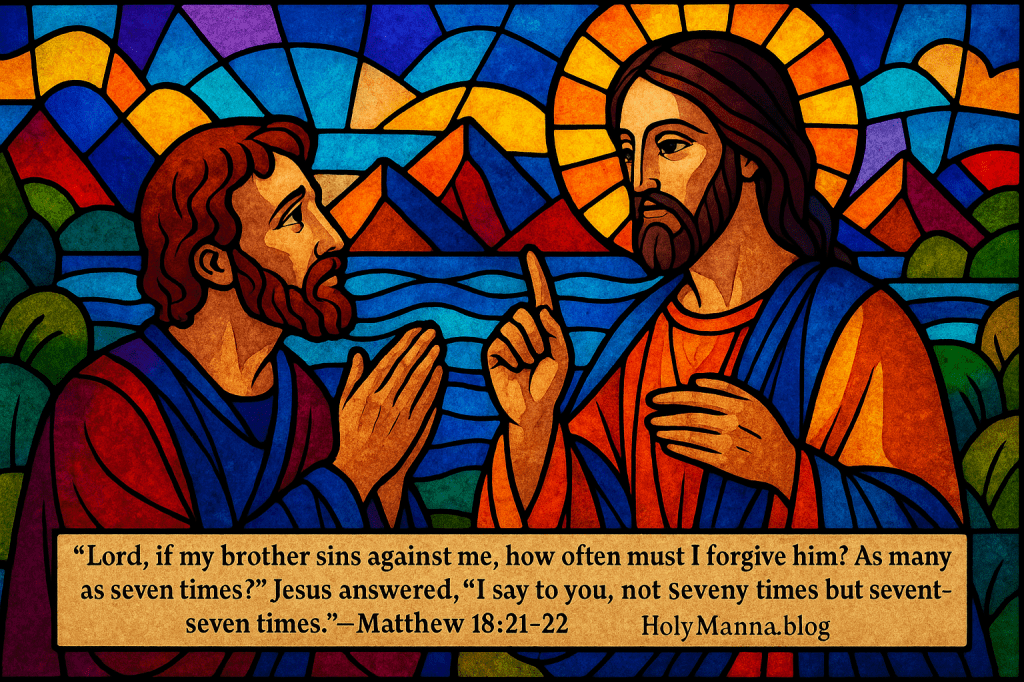
18:21 Then Peter approaching asked him, “Lord, if my brother sins against me, how often must I forgive him? As many as seven times?” 22 Jesus answered, “I say to you, not seven times but seventy-seven times. 23 That is why the kingdom of heaven may be likened to a king who decided to settle accounts with his servants. 24 When he began the accounting, a debtor was brought before him who owed him a huge amount. 25 Since he had no way of paying it back, his master ordered him to be sold, along with his wife, his children, and all his property, in payment of the debt. 26 At that, the servant fell down, did him homage, and said, ‘Be patient with me, and I will pay you back in full.’ 27 Moved with compassion the master of that servant let him go and forgave him the loan. 28 When that servant had left, he found one of his fellow servants who owed him a much smaller amount. He seized him and started to choke him, demanding, ‘Pay back what you owe.’ 29 Falling to his knees, his fellow servant begged him, ‘Be patient with me, and I will pay you back.’ 30 But he refused. Instead, he had him put in prison until he paid back the debt. 31 Now when his fellow servants saw what had happened, they were deeply disturbed, and went to their master and reported the whole affair. 32 His master summoned him and said to him, ‘You wicked servant! I forgave you your entire debt because you begged me to. 33 Should you not have had pity on your fellow servant, as I had pity on you?’ 34 Then in anger his master handed him over to the torturers until he should pay back the whole debt. 35 So will my heavenly Father do to you, unless each of you forgives his brother from his heart.”
19:1 When Jesus finished these words, he left Galilee and went to the district of Judea across the Jordan.
Detailed Exegesis
Verse 18:21 – “Then Peter approaching asked him, ‘Lord, if my brother sins against me, how often must I forgive him? As many as seven times?’”
Peter’s question reveals both a sincere desire to follow Jesus and a limited understanding of mercy. The number seven in Jewish tradition often symbolizes completeness, so Peter likely thinks he’s being generous. But Jesus is about to blow the roof off that expectation.
Verse 22 – “Jesus answered, ‘I say to you, not seven times but seventy-seven times.’”
Jesus alludes to Genesis 4:24, where Lamech declares, “If Cain is avenged sevenfold, then Lamech seventy-sevenfold.” Jesus flips this on its head, proclaiming that in His kingdom, mercy—not vengeance—is infinite. Forgiveness is not a transaction; it’s a way of life.
Verse 23 – “That is why the kingdom of heaven may be likened to a king who decided to settle accounts with his servants.”
Jesus introduces a parable to illustrate the divine economy of mercy. The king represents God, and the servant symbolizes each of us, burdened with unpayable debt.
Verse 24 – “When he began the accounting, a debtor was brought before him who owed him a huge amount.”
The “huge amount” here is literally 10,000 talents—an astronomical, almost comedic sum. It’s Jesus’ way of emphasizing that we owe God a debt we can never repay on our own.
Verse 25 – “Since he had no way of paying it back, his master ordered him to be sold, along with his wife, his children, and all his property, in payment of the debt.”
This reflects the legal practice of the time, though harsh. It shows how hopeless the servant’s situation is—until mercy enters.
Verse 26 – “At that, the servant fell down, did him homage, and said, ‘Be patient with me, and I will pay you back in full.’”
The servant pleads for time, not for forgiveness. Ironically, he still thinks he can manage the debt. His words are sincere but naive—he cannot save himself.
Verse 27 – “Moved with compassion the master of that servant let him go and forgave him the loan.”
This is the heart of the Gospel: God doesn’t just give us time—He gives us freedom. Compassion (in Greek, splagchnizomai) refers to deep, gut-level mercy. The king erases the impossible debt.
Verse 28 – “When that servant had left, he found one of his fellow servants who owed him a much smaller amount. He seized him and started to choke him, demanding, ‘Pay back what you owe.’”
The contrast is intentional and painful. The forgiven servant becomes a merciless creditor. The word “seized” and “choke” show violence and hypocrisy. He has not let mercy shape his heart.
Verse 29 – “Falling to his knees, his fellow servant begged him, ‘Be patient with me, and I will pay you back.’”
These are the exact same words the first servant had used—but now, he refuses to hear them. This repetition drives home the injustice.
Verse 30 – “But he refused. Instead, he had him put in prison until he paid back the debt.”
The tragedy here is spiritual. The one who had been freed chooses bondage—not only for his fellow servant, but for himself. Unforgiveness is a prison of the soul.
Verse 31 – “Now when his fellow servants saw what had happened, they were deeply disturbed, and went to their master and reported the whole affair.”
The community sees the scandal of unforgiveness. Mercy, or the lack thereof, always affects the Church. We are not isolated; our witness matters.
Verse 32 – “His master summoned him and said to him, ‘You wicked servant! I forgave you your entire debt because you begged me to.’”
The master now calls out the servant’s hypocrisy. The problem isn’t that he owed—it’s that he failed to let mercy change him.
Verse 33 – “Should you not have had pity on your fellow servant, as I had pity on you?”
This is the moral core of the parable. Divine mercy is meant to reproduce itself in us. As Saint John Chrysostom wrote: “Nothing makes us so like God as our willingness to forgive.”
Verse 34 – “Then in anger his master handed him over to the torturers until he should pay back the whole debt.”
This isn’t about God being cruel—it’s about justice. The servant chose law over love. If we reject mercy, we fall back under the weight of our own sin.
Verse 35 – “So will my heavenly Father do to you, unless each of you forgives his brother from his heart.”
This warning is not vindictive—it is purifying. The heart is where real forgiveness happens. Outward actions are not enough; the Gospel calls us to a transformed interior life.
Verse 19:1 – “When Jesus finished these words, he left Galilee and went to the district of Judea across the Jordan.”
This closing detail is not random. Jesus physically moves across the Jordan—a deliberate echo of the Israelite crossing. He is leading a new exodus, one of mercy, calling His followers to leave behind hardness of heart.
Teachings of the Church
The Church is unequivocal in its call to forgiveness. CCC 2838 teaches: “This petition is astonishing. If it consisted only of the first phrase, ‘And forgive us our trespasses,’ it might have been included implicitly in the first three petitions of the Lord’s Prayer… But the second phrase is explicit: ‘as we forgive those who trespass against us.’ This… is not unique in Jesus’ teaching: ‘If you do not forgive men their trespasses, neither will your Father forgive your trespasses.’” This echoes Matthew 6:15 and is exemplified in today’s Gospel. Forgiveness is not optional for Christians—it is essential. Saint Augustine wrote: “No man’s sin is so great that it cannot be loosed by the mercy of God. But he who does not forgive shuts the door of mercy on himself.” Saint Maximilian Kolbe exemplified this in the most extreme conditions imaginable. His forgiving heart and voluntary martyrdom were not just heroic—they were sacramental. He entered into the mystery of Christ’s suffering love, fulfilling Colossians 1:24: “I rejoice in my sufferings for your sake… and in my flesh I am filling up what is lacking in the afflictions of Christ.”
Reflection
Who do you need to forgive today—from your heart, not just your lips? Forgiveness is one of the most difficult acts of discipleship, but it is also one of the most transformative. To forgive is not to ignore injustice or minimize pain; it is to place those wounds into the hands of the Divine Physician. Is there someone you’ve written off as beyond mercy? Is that person… you? Today’s Gospel invites us to become rivers of mercy, not reservoirs of resentment. Like the Jordan at flood stage, forgiveness can seem impossible—until we step into it with trust. Let the King settle accounts with mercy, not vengeance. Let love be the last word.
Stepping Into the Flood of Love
Today’s readings flow together like a mighty river of grace, each one inviting us to trust in God’s power to part the waters of our fear, sin, and bitterness. In Joshua 3, we witness the miraculous moment when God stops the Jordan River so His people can walk forward into the Promised Land—an outward sign of an inward trust. Psalm 114 poetically echoes that wonder, reminding us that creation itself trembles in joyful awe before the Lord. And in Matthew 18, Jesus teaches that the true miracle isn’t just external—it’s interior: the miracle of a heart transformed by mercy, capable of forgiving seventy-seven times. Then, like a living exegesis, Saint Maximilian Kolbe steps forward from the pages of history as a modern Joshua, a spiritual psalm, and a living Gospel. He doesn’t just cross into danger—he offers himself in place of another, choosing love over fear, and mercy over survival.
The readings remind us that the Christian life is not stagnant; it is a pilgrimage, a crossing. But we do not walk alone. The Ark of the New Covenant—Christ Himself—goes before us, and the waters of death and hatred will yield when we follow Him. Saint Maximilian Kolbe followed this path faithfully, trusting that even Auschwitz could not drown the love of God. His sacrifice calls us to step into our own “Jordan Rivers,” trusting that God still leads, still forgives, and still works wonders through those who give their yes. The question is not whether the floodwaters are real—they are. The question is whether we believe the One who walks on them is real too.
What is God asking you to cross today? Who is He asking you to forgive—maybe even yourself? Don’t wait for the water to part. Step in. Trust Him. Love without limit. Forgive without counting. And walk forward in the footsteps of saints who show us that true power is found not in conquering others, but in surrendering to love.
Engage with Us!
We’d love to hear how today’s readings spoke to your heart. What stood out to you? Where did you feel challenged, comforted, or inspired? Share your thoughts, prayers, and insights in the comments below—your reflection may be just what someone else needs today.
Reflection Questions:
First Reading – Joshua 3:7–11, 13–17
What is the “Jordan River” in your life right now? Where is God asking you to step out in faith before you see the waters part? How can you be like the priests who carried the Ark—leading others forward by your trust in God’s presence?
Responsorial Psalm – Psalm 114:1–6
How have you seen God “make the earth move” in your own life? When did He bring you through something you thought was impossible? Do you allow yourself to stand in awe before God’s power and presence—or have you grown too familiar with the miraculous?
Holy Gospel – Matthew 18:21–19:1
Is there someone in your life you’re struggling to forgive “from the heart”? What’s holding you back from releasing that debt? How does remembering God’s mercy toward you help you offer mercy to others?
As you go forth today, may you step boldly into God’s love, trust Him to carry you through every flood, and live a life that radiates forgiveness and compassion. Let everything you do be marked by the mercy, humility, and love that Jesus has shown you—seventy-seven times and more.
Follow us on Instagram and Facebook for more insights and reflections on living a faith-filled life.

 Holy Manna!
Leave a comment