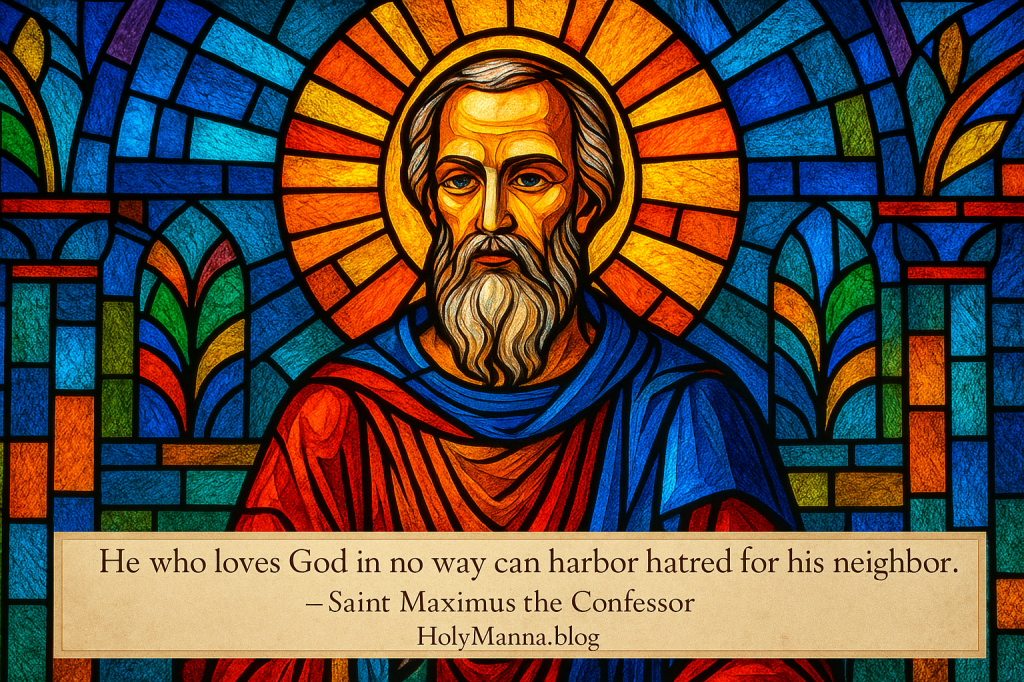
A Flame for Orthodoxy
Saint Maximus the Confessor stands as a monumental figure in the history of the Church—one of the greatest defenders of Christological orthodoxy in the face of imperial pressure and heresy. A theologian, mystic, and monk, Maximus is revered for his unwavering commitment to the truth of Christ’s dual natures—divine and human—which he upheld at great personal cost. His profound writings on the Incarnation, spiritual life, and divine love have made him one of the most influential Fathers of the Eastern Church and highly venerated by the Church in the West. Through his suffering and brilliance, Maximus reminds us that true love of Christ requires both intellect and sacrifice.
Born for a Battle of Truth
Saint Maximus was born around 580 AD in Constantinople to an aristocratic and devout Christian family. Exceptionally gifted from a young age, he was educated in philosophy, rhetoric, and theology, eventually becoming a high-ranking civil servant—possibly the imperial secretary—to Emperor Heraclius. However, around the year 613, Maximus experienced a deep spiritual conversion that compelled him to renounce political life and enter the monastery of Chrysopolis, across the Bosphorus from Constantinople.
There, he gave himself entirely to the monastic life, embracing poverty, contemplation, and study. His mind and soul were inflamed with the truths of the faith, particularly the mystery of the Incarnation. Maximus became most known for his defense of the doctrine that Christ possesses two wills—one divine and one human—in response to the heresy of Monothelitism, which falsely claimed Christ had only one will. His life would become a living testament to the price of defending the fullness of the Gospel.
The Fire of Holiness and Wisdom
Saint Maximus’ life was marked by both his deep holiness and profound theological insight. He wrote extensively on Scripture, asceticism, and the divine liturgy. His most famous work, the Ambigua, explores the mysterious unity between God and creation through Christ. He also wrote The Ascetical Life, a dialogue that remains a treasured guide for monks and laypersons alike seeking spiritual transformation.
Though he lived a monastic life, his spiritual influence stretched across the empire. His words inspired other defenders of orthodoxy, and his deep understanding of divine love moved hearts toward union with God. Many testified to his spiritual gifts, including prophecy and healing, though he was always humble, pointing to Christ alone.
His teachings emphasized that salvation was not just a legal acquittal but a real transformation—a divinization of the human person made possible through Christ’s full humanity and divinity. As he once wrote: “God became man so that man might become god.”
Chains for the Confessor
Maximus’ deep commitment to truth brought him into fierce conflict with both ecclesial and imperial powers. When the Byzantine emperors and certain patriarchs began to support Monothelitism for political unity with non-Chalcedonian Christians, Maximus refused to remain silent. He knew this teaching undermined the full reality of the Incarnation and threatened the salvation of souls.
Because of his refusal to compromise, Maximus was arrested, exiled, and brought to trial multiple times. At his final trial in 662, after being falsely accused of treason, he boldly proclaimed the truth: “I desire to live according to the faith of the Apostles and the Fathers.” For this, his tongue and right hand—his instruments of teaching and writing—were cut off. He was then exiled to Lazica (modern-day Georgia), where he died a few months later, worn out by suffering, at the age of 82.
His martyrdom was not by sword but by torture and exile for the sake of the truth—a true white martyrdom that gained him the title “Confessor.”
Glory in the Silence
After his death, miracles were reported at Maximus’ tomb, and his writings began to spread more widely throughout both East and West. Over time, the heresy he fought was condemned at the Third Council of Constantinople in 681, which affirmed that Christ had two wills, aligning with Maximus’ heroic defense. The Church recognized his teachings as not only orthodox but inspired.
Saint Maximus became widely venerated in the East as one of the great theologians of the Church. His relics were honored, and pilgrims traveled to his place of exile, where healings and conversions were attributed to his intercession. His feast day is celebrated on August 13.
What the Confessor Teaches Us Today
Saint Maximus the Confessor’s life speaks powerfully to us in an age that often values comfort over truth. He reminds us that fidelity to Christ may cost us everything—but that such a sacrifice is worth it. He did not seek fame, nor did he desire controversy. Yet when the truth of Christ was threatened, he spoke, wrote, suffered, and endured for love of the Lord.
We, too, are called to courageously defend the truth—not with pride or arrogance, but with love, clarity, and humility. In a world that often blurs moral lines or redefines Christ to fit personal agendas, Saint Maximus calls us to fidelity: to the Scriptures, to the teachings of the Church, and to Christ Himself.
His spiritual writings also offer a rich treasury for anyone seeking deeper union with God. He shows us that theology and prayer are not opposites, but companions. As Saint Maximus teaches, “Theology without practice is the theology of demons.”
Let us imitate his courage, his love for truth, and his deep humility. Let us allow Christ to transform our hearts and minds as He did for Maximus, so that we may one day share in His divine life.
Engage with Us!
What part of Saint Maximus’ life inspired you most? Have you ever had to stand for truth in a difficult situation? Share your thoughts and reflections in the comments below—we’d love to hear from you!
- How can I be more courageous in speaking the truth today, even if it’s unpopular?
- In what areas of my life am I tempted to remain silent when I should defend Christ or His Church?
- How can I grow in both knowledge and love of Christ like Saint Maximus did?
Let us encourage one another, pray for one another, and above all—strive to do everything with love, just as our Lord Jesus did.
Saint Maximus the Confessor, pray for us!
Follow us on Instagram and Facebook for more insights and reflections on living a faith-filled life.

 Holy Manna!
Leave a comment