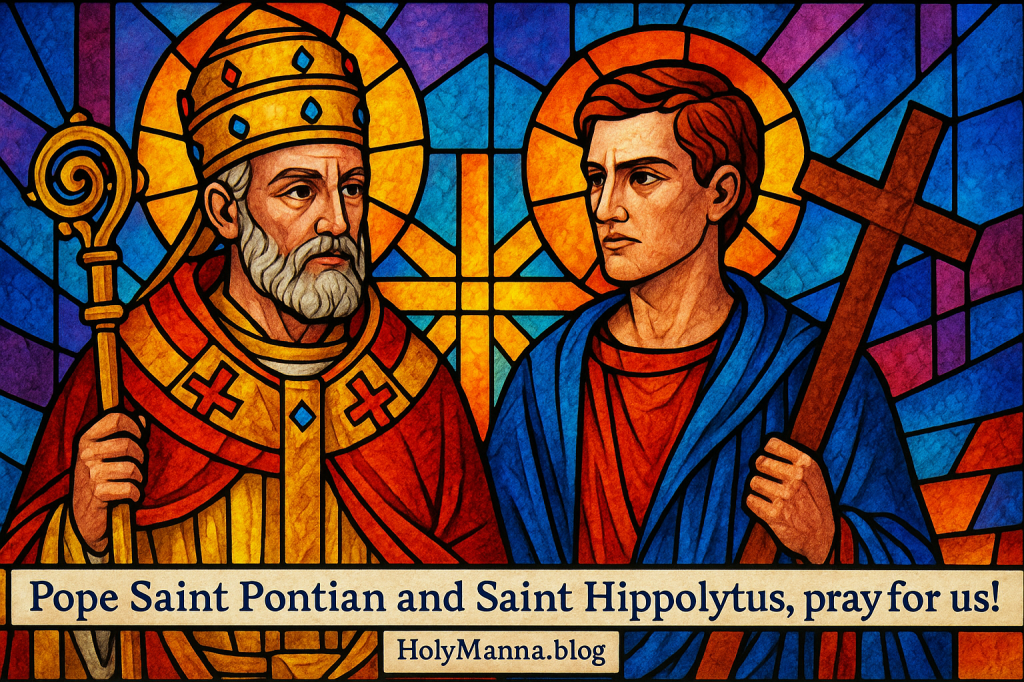
The Shepherd and the Scholar
On August 13, the Church remembers two towering yet contrasting figures of the third century: Pope Saint Pontian and Saint Hippolytus. Their lives tell the story of conflict transformed into communion, division healed by suffering, and pride humbled by the grace of martyrdom. Pontian, the bishop of Rome, was a steady and gentle leader during a time of persecution. Hippolytus, on the other hand, was a brilliant theologian, known for his zeal and rigor—but also for his opposition to several popes whom he deemed too lenient on heretics and penitents. At one point, he permitted a dissenting faction to elect him pope in opposition to the reigning pontiff, becoming the first recorded antipope in Church history. Yet despite their opposing paths, both men were exiled together under Emperor Maximinus Thrax and ultimately reconciled in the harsh mines of Sardinia, where they died as martyrs for Christ. Their joint commemoration offers a moving testament to God’s power to heal division, unite enemies, and sanctify suffering.
From Rome’s Shadows to Sardinia’s Exile
Pope Saint Pontian was born in Rome sometime in the late second century, likely into a noble or senatorial family, and was elected as the 18th pope in 230 A.D. His pontificate followed a period of relative calm under Emperor Severus Alexander, but this peace was short-lived. When Emperor Maximinus Thrax rose to power, he unleashed a brutal persecution against the Church. Pontian’s leadership during this crisis was marked by quiet strength. He convened a synod that formally condemned the heresies of Origenism, and upheld the unity and orthodoxy of the Church.
Saint Hippolytus, meanwhile, was already well known in the Roman Church before Pontian’s election. He was a presbyter under Pope Zephyrinus and became a prominent theologian, writing works such as Refutation of All Heresies, Apostolic Tradition, and commentaries on Daniel and the Song of Songs. His rigorous views on Church discipline led him into conflict with Pope Callistus I, whom he accused of laxity in reconciling sinners. When Callistus was elected pope, Hippolytus allowed himself to be elected by a faction that supported his stricter theological vision, thus creating the first major schism in the Roman Church.
Though at odds in their lifetime, both Pontian and Hippolytus were driven by a passion for preserving the faith. It was that very passion that led to their shared exile in 235 A.D. Maximinus Thrax, suspicious of the Church’s influence, ordered the deportation of both leaders to the labor mines of Sardinia—effectively a death sentence.
Reconciled by Grace in the Crucible of Suffering
In the desolate mines of Sardinia, something miraculous happened—not the healing of a leper or the raising of the dead, but a healing of hearts. Stripped of worldly titles and facing a slow death in harsh conditions, Pope Pontian and Hippolytus found common ground in their shared suffering and love for Christ. They reconciled, a moment of profound grace that echoed Christ’s own call for unity in the Body. Hippolytus, once an opponent of papal authority, submitted to the pope and encouraged his followers to do the same. Pontian, in turn, resigned the papacy to allow the Church in Rome to elect a new leader, recognizing the necessity of continuity during a time of persecution.
Though no dramatic miracles were recorded during their lives, the real miracle was interior: the breaking down of pride, the healing of division, and the powerful witness of Christian fraternity. Hippolytus’s Apostolic Tradition, which outlines early liturgical practices and moral discipline, would later influence the development of Church liturgy, especially in the East. Pontian’s administrative decisions ensured the Church could survive under hostile rule. Both contributed to the life of the Church in distinct but complementary ways: one as shepherd, the other as scholar.
From Earthly Mines to Heavenly Crowns
Life in Sardinia’s mines was agonizing. Prisoners labored in suffocating heat, with little food, plagued by disease and beatings. Pontian, already weakened by age, likely died of mistreatment or starvation. Hippolytus, though younger and more robust, also succumbed to the brutal conditions. The Church venerates both men as martyrs, not because they died by sword or fire, but because they remained faithful to Christ unto death, enduring unspeakable torment for His name.
Their deaths mark a powerful end to a story once marked by discord. The former antipope became a martyr in communion with the true pope, and the reigning pope became the first pontiff in history to abdicate—an act of humility that would not be repeated until Pope Benedict XVI in 2013. Their relics were later brought back to Rome: Pontian was buried in the Catacombs of Callixtus alongside other popes, and Hippolytus was buried on the Via Tiburtina. The Church’s act of commemorating them together is not only an honor but a declaration that God’s mercy is stronger than any division.
Grace Beyond the Grave
Although no specific posthumous miracles are recorded in traditional hagiographies, the veneration of Pontian and Hippolytus began very early. Their tombs became pilgrimage sites, especially in the fourth and fifth centuries, when Christian freedom under Constantine allowed public honor of the martyrs. Pilgrims came to pray at their tombs not just for intercession but for unity, courage, and reconciliation—virtues deeply needed then and now.
Over time, the Church recognized the powerful symbolism of their joint witness. Their story was preserved in the Depositio Martyrum, a Roman calendar of saints, which recorded their martyrdom and burial. Liturgical readings and prayers on their feast day often focus on unity, humility, and perseverance. Their relics, while not associated with specific healings or apparitions, serve as silent but potent testimonies to the sanctifying power of suffering offered to God.
Lessons from Two Saints Who Became One in Christ
What can we learn from Pope Pontian and Saint Hippolytus today? First, that no disagreement or schism, however deep, is beyond the healing touch of God. Hippolytus, once consumed by zeal to the point of division, ultimately laid down his pride. Pontian, entrusted with the keys of Peter, exercised them not with power but with sacrificial humility. Their story shows us that the Church is not held together by personalities, but by the grace of Christ and the willingness of its members to suffer, forgive, and serve.
Second, they remind us that suffering—whether from within the Church or from the outside world—can be redemptive. Their labor in the Sardinian mines was not wasted. It purified them, united them, and bore witness to the truth that the Church is one, holy, catholic, and apostolic.
Lastly, they encourage us to never give up on reconciliation. Whether with family, fellow parishioners, or even within ourselves, God always invites us into healing. Their shared martyrdom is a call to live lives marked by forgiveness and fidelity.
“If a kingdom is divided against itself, that kingdom cannot stand” (Mark 3:24). Let us, like Pontian and Hippolytus, stand united—not by agreement in everything, but by our shared love for Christ, our fidelity to His Church, and our hope in His resurrection.
Engage with Us!
What part of today’s reflection stirred your heart? What spoke to your own journey of faith? Share your thoughts and prayers with us in the comments.
- Have you ever experienced a reconciliation that only God could make possible?
- What does it mean to forgive someone who has hurt you deeply, especially within the Church?
- How can you live out greater humility and unity in your daily walk with Christ?
May we always strive to love one another as Christ has loved us. Let us support each other in our walk of faith and strive to do everything with love, as our Lord Jesus did.
Pope Saint Pontian & Saint Hippolytus, pray for us! ✝️
Follow us on Instagram and Facebook for more insights and reflections on living a faith-filled life.

 Holy Manna!
Leave a comment