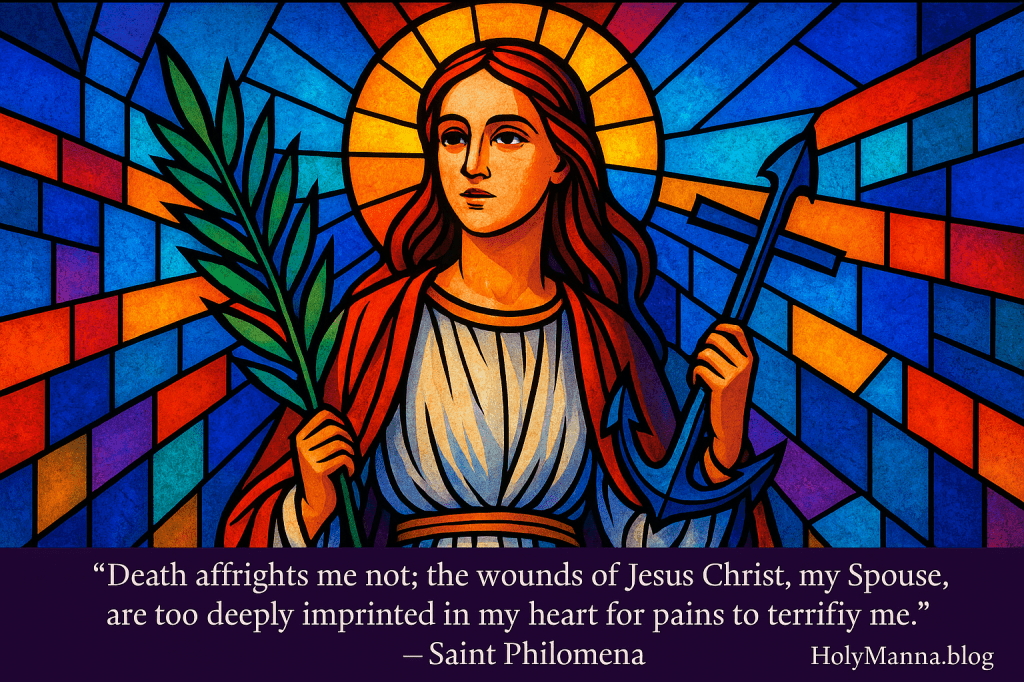
The Hidden Princess of Heaven
Tucked away in the catacombs of ancient Rome for over 1,500 years, the name Philomena was once a mystery to the world. But when her relics were discovered in 1802, a wave of miracles, conversions, and devotions poured forth like sunlight through a long-closed tomb. Today, Saint Philomena is venerated as the Patroness of Infants, Babies, and Youth—a powerful intercessor whose radiant purity and steadfast courage in the face of death have captured the hearts of the faithful across centuries. Despite having no contemporary written biography, the Church has honored her as a saint not only because of her martyrdom, but because of the countless miracles worked through her intercession. Her legacy is a reminder that God chooses the little and the hidden to accomplish great things. Saint Philomena’s story speaks especially to young people: that holiness is not about age or status, but about love—love that holds nothing back from Christ.
Unearthing a Saint
On May 24, 1802, workers clearing the ancient Catacomb of Priscilla along the Via Salaria in Rome made a remarkable find. They uncovered a small tomb sealed with three terra cotta tiles inscribed with the words: “PAX TECUM FILUMENA”—“Peace be with you, Philomena.” Alongside the name were symbols etched into the tiles: an anchor, a palm branch, a scourge, and three arrows—classic imagery associated with Christian martyrdom.
Inside the tomb, they found the remains of a young girl, around 13 to 15 years old, with remnants of blood-stained clothes and a small vial of dried blood. Though no historical documents existed about her life, the iconography on her tomb and the condition of her bones clearly indicated that she had been martyred for her faith. The Church, with reverence and caution, recognized this extraordinary find as the relics of a holy martyr.
Her remains were eventually gifted to a small village in southern Italy called Mugnano del Cardinale. It was there, in 1805, that the first astonishing miracles began to unfold. These miracles and healings—so numerous and dramatic—would propel the young martyr into global devotion, despite having no written history. Could a long-forgotten saint become one of the most beloved intercessors in modern times? Saint Philomena’s story proves the answer is a resounding yes.
A Royal Heart Bound to Christ
According to private revelations received by Mother Maria Luisa di Gesù, a Dominican tertiary in the 19th century, Philomena was born in the 3rd century to a Greek royal family. Her parents, childless for many years, prayed to the Christian God and promised to convert if He granted them a child. Their prayers were answered, and Philomena—whose name means “daughter of light”—was born. True to their promise, the family was baptized, and young Philomena grew up in the light of the Gospel.
From a young age, she was known for her innocence, prayerfulness, and desire to remain consecrated to Jesus alone. At the age of thirteen, she made a private vow of virginity, choosing to belong solely to Christ. When political tensions brought her family to Rome in hopes of making peace with the emperor Diocletian, things took a drastic turn. The emperor was struck by Philomena’s beauty and demanded her in marriage. Her parents were torn, but Philomena refused to betray her vow. She told Diocletian that she belonged to Jesus Christ and could never be the bride of a pagan ruler. Her resistance was not only bold—it was revolutionary. In a time when young girls had little voice, she spoke with divine authority, standing firm in her consecration to God.
A Life Hidden, a Light Revealed
There are no accounts of Saint Philomena’s public ministry or apostolic works, yet the power of her life lies precisely in its hiddenness and its offering. She didn’t found communities, preach to nations, or write spiritual classics. What she did was give everything to Christ. And that, in God’s eyes, is everything.
Her miracles began not during her earthly life but after her death—yet her courage, revealed through mystical visions and authenticated by the Church, paints the picture of a soul ablaze with divine love. In her silence and surrender, she became a conduit of God’s power. While we may not read sermons by Philomena, her life was a sermon—one that spoke loudly of chastity, bravery, and supernatural trust. She reminds us that holiness can take root in the simple soil of faithfulness, even at the cost of comfort, reputation, or life itself. Her life is especially dear to young girls discerning their identity in Christ, and to all who feel small and unseen in a noisy, performance-driven world.
Tried by Fire, Crowned with Glory
Philomena’s steadfast refusal to marry Diocletian enraged the emperor. What followed was a horrifying series of tortures meant to break her spirit and force her submission. She was imprisoned, scourged, and subjected to starvation. When she would not recant, she was bound and thrown into the Tiber River with an anchor tied around her neck—but angels came to her rescue, lifting her from the water unharmed. Infuriated, Diocletian ordered her shot with arrows. Even this failed, as the arrows miraculously turned back on the archers themselves. Ultimately, she was beheaded, and it was in that final sacrifice that her martyrdom was sealed.
Her death was not just an ending—it was a wedding. She became the bride of Christ, crowned not with jewels but with the eternal glory of the martyrs. Her sufferings were not in vain. They became the fertile ground for countless conversions and miracles to follow. As Tertullian famously said, “The blood of the martyrs is the seed of the Church.” Saint Philomena’s blood was the seed of a new springtime of faith, especially in the 19th century, when her rediscovery ignited devotion around the world.
The Wonder-Worker of the 19th Century
From the moment her relics were placed in the Sanctuary of Mugnano del Cardinale in southern Italy, the miracles began. Children with fevers were healed overnight. Crippled pilgrims walked. Countless souls received physical, emotional, and spiritual healing. Word spread like wildfire.
One of her most devoted champions was Saint John Vianney, the Curé of Ars, who attributed numerous healings in his parish to her intercession. He kept a relic of her in his confessional and built a shrine in her honor, often saying: “I have never asked for anything through the intercession of Saint Philomena without receiving it.” The French priest wasn’t alone—Popes, bishops, and faithful from every walk of life experienced her heavenly assistance. Pope Leo XII called her “a great saint.” Pope Pius IX granted her the title Patroness of the Children of Mary, and Pope Gregory XVI formally approved her public cult in 1837 after personally verifying her miracles.
Her devotion even reached the Americas, where shrines and chapels sprang up in her name, especially in areas with large Catholic immigrant populations. Though doubts arose in the 20th century regarding her historical record, the Church continues to uphold her cult, and the faithful continue to receive graces through her prayers. The fruits speak for themselves. As Our Lord said, “You will know them by their fruits” (Matthew 7:16).
A Saint for the Young and the Brave
Saint Philomena is a saint for our times. In a world where purity is mocked, where truth is relative, and where youth is often wasted on shallow pursuits, Philomena calls us back to the eternal. She didn’t compromise. She didn’t water down the Gospel to make it more acceptable. She loved radically, and that love cost her everything—but gained her heaven.
Her courage was not her own. It was Christ in her. And that same Christ lives in us through baptism. How often do we forget the power we’ve been given? Saint Philomena reminds us to claim that power—not for ourselves, but to live as witnesses to the truth, to love, and to eternity.
Do you long for purity in a culture obsessed with indulgence? Are you trying to remain faithful in a time of spiritual confusion? Are you praying for a child or a loved one to return to the faith? Bring it all to Saint Philomena. Her name may have been hidden in the darkness of the catacombs for centuries, but today she shines as a star of hope, especially for the youth who are bombarded with noise but thirsty for truth.
Engage with Us!
What part of Saint Philomena’s story inspired you the most? Do you have a personal devotion to her? Share your thoughts and experiences in the comments—we would love to hear from you!
Reflection Questions:
- How can I model Saint Philomena’s courage in my own life when faced with moral pressure or ridicule?
- What does it mean to offer my life fully to Christ like Saint Philomena did, even in youth?
- Am I willing to suffer for my faith, trusting that God will bring glory from every trial?
Let us continue to walk together in holiness, support one another in prayer, and do all things with love, as our Lord Jesus did.
Saint Philomena, pray for us! ✝️
Follow us on Instagram and Facebook for more insights and reflections on living a faith-filled life.

 Holy Manna!
Leave a comment