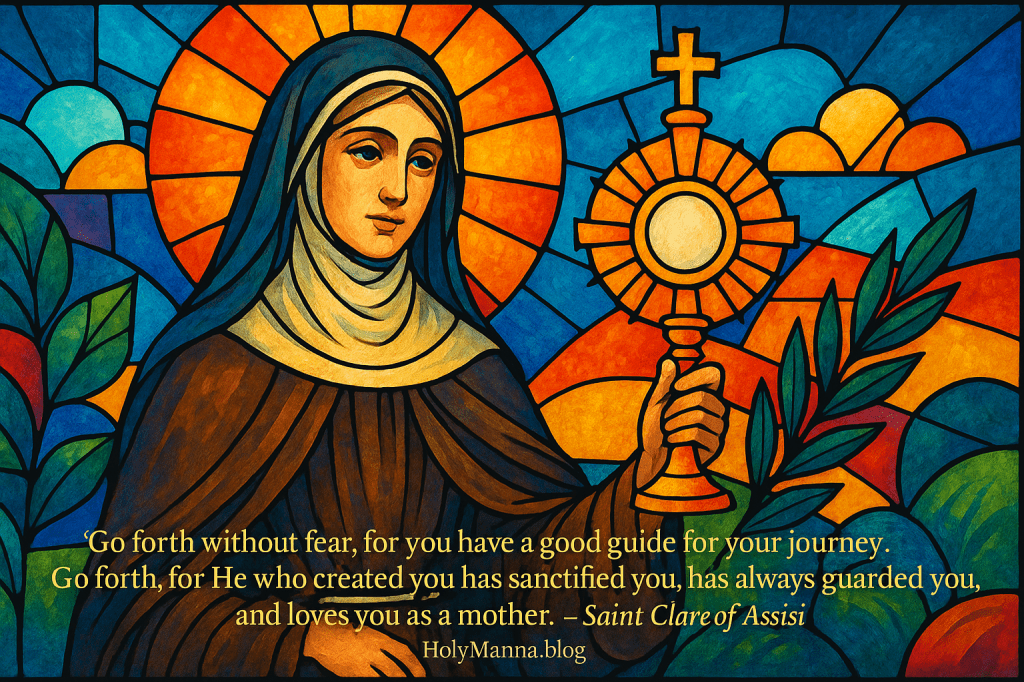
Radiance Behind the Walls
Saint Clare of Assisi was more than a noblewoman turned nun—she was a woman set ablaze by love for Christ. Founder of the Poor Clares and spiritual sister to Saint Francis of Assisi, Clare’s entire life was one continual offering of humility, purity, and Eucharistic devotion. She is one of the earliest women in Church history to write a monastic Rule, and she remains a shining example of contemplative power and courageous love. The Church celebrates her feast on August 11. Though cloistered behind the walls of San Damiano, Clare’s influence reverberates across the centuries, inspiring countless souls to seek God in simplicity and in silence. Her life was hidden, but her holiness was not. Canonized just two years after her death, Clare is the patron saint of television, eye disease, and those seeking spiritual vision—because even from her small cell, she saw eternity clearly.
From Silk to Sackcloth
Born in 1194 in Assisi, Italy, Clare was the eldest daughter of the wealthy Offreduccio family. Her father was a count, and her mother, Ortolana, came from a line of noble knights but was also known for her devout Christian faith. Clare was raised in luxury, with fine clothes, education, and all the social privileges afforded to a girl of her rank. But even from a young age, Clare was drawn to the things of heaven rather than the trappings of this world. She fasted, prayed, and showed compassion to the poor in secret. Her heart ached for more than wealth or noble marriage.
Everything changed when she encountered Saint Francis of Assisi, the poor man who had renounced his wealth and taken on the poverty of Christ. His radical love for God and his joyful spirit touched Clare deeply. At the age of 18, she made a bold and irreversible decision: she fled her home in the dead of night on Palm Sunday in 1212, escaping the life of privilege to join Francis and his brothers at the Portiuncula. There, she renounced her worldly inheritance and embraced the humility of Christ. Saint Francis cut her long golden hair, clothed her in a rough tunic, and placed her in the care of Benedictine nuns until a more permanent dwelling could be arranged.
Eventually, Francis established the community at San Damiano—the very church where he had heard Christ say, “Rebuild my Church” (The Life of Saint Francis). This would become Clare’s lifelong home and sanctuary, where she would live, pray, and guide a growing group of women drawn by her sanctity and Francis’s vision. Thus was born the Second Order of Saint Francis: the Poor Ladies of San Damiano, later known as the Poor Clares.
A Light in the Monastery
Clare never left her convent after entering it, yet her spiritual authority and influence extended far beyond its stone walls. She lived a life of radical poverty, refusing to own anything personally or communally—choosing instead to rely completely on God’s providence. Her Rule, the first monastic Rule written by a woman and approved by the Church, emphasized total dependence on God, humility, and enclosure. This life of poverty was not grim—it was filled with joy, charity, and freedom.
Though often physically weak and confined to bed due to illness, Clare radiated interior strength. She governed her sisters with love and wisdom and was sought after by popes and bishops for her counsel. Miracles accompanied her life, bearing witness to her deep union with Christ.
One of the most famous miracles occurred in 1240, when an army of Saracen mercenaries threatened to sack Assisi and invade the convent. Though she was gravely ill, Clare rose from her bed, took the Blessed Sacrament in a monstrance, and brought it to the window facing the advancing soldiers. Kneeling in prayer before the Real Presence of Christ, she begged Him to protect her sisters. In answer, the attackers were overcome with fear and fled. Clare turned to her sisters and calmly said, “I will always protect you.” That moment would forever define her identity as a Eucharistic warrior, and it later inspired her to be named the patroness of television, for her spiritual vision saw far beyond her physical location.
Another miracle occurred when Clare blessed a small amount of bread during a time of scarcity, and it miraculously multiplied, feeding the entire community. She also healed the sick by making the Sign of the Cross over them, and many sought her prayers for healing and consolation. Yet Clare would have pointed to Christ, not herself, as the source of these wonders. Her life was a living monstrance, holding and pointing to Jesus at all times.
Faith Under Fire
Clare’s path to sainthood was lined with suffering, not least of which was physical. For most of her adult life, she was afflicted by chronic illness, often confined to her simple bed made of branches and straw. But her suffering was never wasted. Clare offered it up for her sisters, for the Church, and for the glory of Christ crucified. Her endurance bore the sweetness of one who saw suffering not as punishment but as a sacred offering (cf. Colossians 1:24).
Her greatest spiritual trial, however, was her prolonged struggle with Church authorities over the “privilege of poverty.” While many tried to persuade her to accept some income or property to ease the hardships of her monastery, Clare resisted with iron resolve. Her vision of total Gospel poverty matched that of Saint Francis, and she believed that nothing should come between the soul and its radical trust in God. She famously told Pope Gregory IX, “Holy Father, I crave absolution from my sins, but I desire not to be absolved from the obligation of following Christ.”
She would live to see that dream fulfilled. Just two days before her death, Pope Innocent IV approved her Rule, affirming her life’s mission and recognizing her spiritual authority. This was a rare, extraordinary acknowledgment of a woman’s voice in ecclesial matters in the 13th century. Her death on August 11, 1253, was as luminous as her life. Surrounded by her sisters and with her face radiant, she whispered her final prayer: “Go forth without fear, for you have a good guide for your journey. Go forth, for He who created you has sanctified you, has always guarded you, and loves you as a mother.”
Heaven Rejoices
Clare’s sanctity did not cease with her earthly death. Immediately after her passing, miracles were reported by those who visited her tomb. The blind received sight, the crippled walked, and those burdened by spiritual darkness found peace. Her reputation for holiness grew rapidly, and Pope Alexander IV canonized her just two years later in 1255.
Her body, found incorrupt centuries later, rests in the Basilica of Saint Clare in Assisi, built in her honor. Pilgrims from all over the world visit her shrine, many seeking healing—whether physical, emotional, or spiritual. She is invoked by those seeking purity of heart, clarity of purpose, and deeper devotion to Christ in the Eucharist (cf. Psalm 34:5).
The Poor Clares, her spiritual daughters, continue her legacy to this day in monasteries around the globe. In their silence, simplicity, and prayer, they echo the life of their foundress, offering their lives as a fragrant offering to God. Clare’s spirit lives on, a testament that one hidden soul, aflame with divine love, can illuminate the whole Church.
Eyes Fixed on the Host
Saint Clare’s life teaches us that holiness is not dependent on external action but on interior surrender. She didn’t travel the world or preach from pulpits—she knelt before the Eucharist, and the world was changed. She shows us that strength is born in silence, that beauty blooms in poverty, and that true power lies in surrender. In an age obsessed with visibility, productivity, and noise, Clare invites us to gaze upon Christ and find our true treasure in Him alone.
Are we willing to trust God completely, even when it means letting go of control? Are we willing to simplify our lives so that nothing comes between our hearts and the love of Jesus?
Saint Clare challenges us to love the poor Christ—not as an abstract idea but as a Person who calls us to live differently. Her life is a prophetic call to return to the essentials: prayer, trust, community, and the Eucharist.
May we follow her example, finding joy not in possession but in presence—not in comfort but in communion with Christ. May we, like Clare, become mirrors of divine light in a world aching for truth and love.
Engage with Us!
We’d love to hear your thoughts. How has Saint Clare’s story touched you today? What part of her life speaks most deeply to your journey?
Reflection Questions:
- In what ways am I being called to simplify my life and trust more radically in God’s providence?
- How can I incorporate more silence and adoration into my daily routine, following Saint Clare’s example?
- What areas of fear or vulnerability might I bring before the Eucharist with faith, as Clare did during the Saracen attack?
Let’s continue to support one another in this journey of faith. May we do everything with love, as Saint Clare and our Lord Jesus Christ have taught us.
Saint Clare of Assisi, pray for us! 🕊️
Follow us on Instagram and Facebook for more insights and reflections on living a faith-filled life.

 Holy Manna!
Leave a comment