Memorial of Saint Clare, Virgin – Lectionary: 413
Hearts Unclenched
What does God truly want from us? Not just our obedience, not merely our worship, but our whole hearts. Today’s readings draw us into this invitation—a summons to surrender fully to the God who is not only mighty and majestic, but tender and just. From Moses’ exhortation to the Israelites, to the psalmist’s praise for God’s intimate care, to Jesus’ quiet lesson about divine freedom and humility, we are being asked to live with hearts unbound by fear, entitlement, or pride. On this Memorial of Saint Clare, a virgin of radical poverty and burning love, the Word of God invites us to live a life that is not transactional, but transformative—rooted not in who we owe, but in who we belong to.
In Deuteronomy 10, Moses pleads with a once-rebellious people to “circumcise the foreskins of your hearts”—to remove the layers of hardness that keep them from truly loving and serving God. In the ancient Near Eastern world, laws and covenants were essential for societal order, but God’s covenant went deeper: it called for inner transformation. Psalm 147 celebrates the uniqueness of Israel’s relationship with God—He has revealed His word to them, unlike any other nation. But revelation is not enough; it requires a response of love, praise, and trust. This is not a God who demands tribute like a pagan king, but one who “executes justice for the orphan and the widow, and loves the resident alien”. The law is not about legalism—it’s about becoming like the One who gave it.
Then comes The Gospel of Matthew, where Jesus, the Son of God, reveals once more the upside-down nature of the Kingdom. Though He is exempt from paying the temple tax, He instructs Peter to pay it “so that we may not offend”. It’s a quiet gesture of humility, but it also reveals divine sovereignty—Jesus provides the coin miraculously, showing He is both Lord of the Temple and servant of all. Saint Clare’s life echoes this Gospel paradox. Born into nobility, she chose a life of poverty—not to escape the world, but to be fully united with Christ. Her heart was free because it was wholly His. Are our hearts still stiff with resistance, or soft with trust? Are we living as children of the King or as hired servants just doing our duty? Today, we are called to respond not out of obligation, but out of love.
First Reading – Deuteronomy 10:12–22
Hearts That Tremble and Love
In the Book of Deuteronomy, Moses is speaking to the Israelites at a pivotal moment. They are standing at the threshold of the Promised Land, about to enter a new chapter in their history. But before they can take possession of the land, they must take possession of their hearts. This passage falls within a broader section known as Moses’ second discourse, where he recalls the covenant at Sinai and urges the people not just to obey God’s laws outwardly, but to internalize them. This was radical in the ancient world. Pagan gods demanded ritual and tribute; Israel’s God, by contrast, wants the heart. Today’s reading is especially powerful in light of Saint Clare, whose love for God led her to abandon earthly privilege and embrace a life of holy poverty. Like the Israelites, she was called to choose: the comforts of this world, or the covenant of love. This reading prepares us to reflect on what it means to belong entirely to God—to serve Him with every fiber of our being, and to mirror His justice and compassion in the world.
Deuteronomy 10:12-22
New American Bible (Revised Edition)
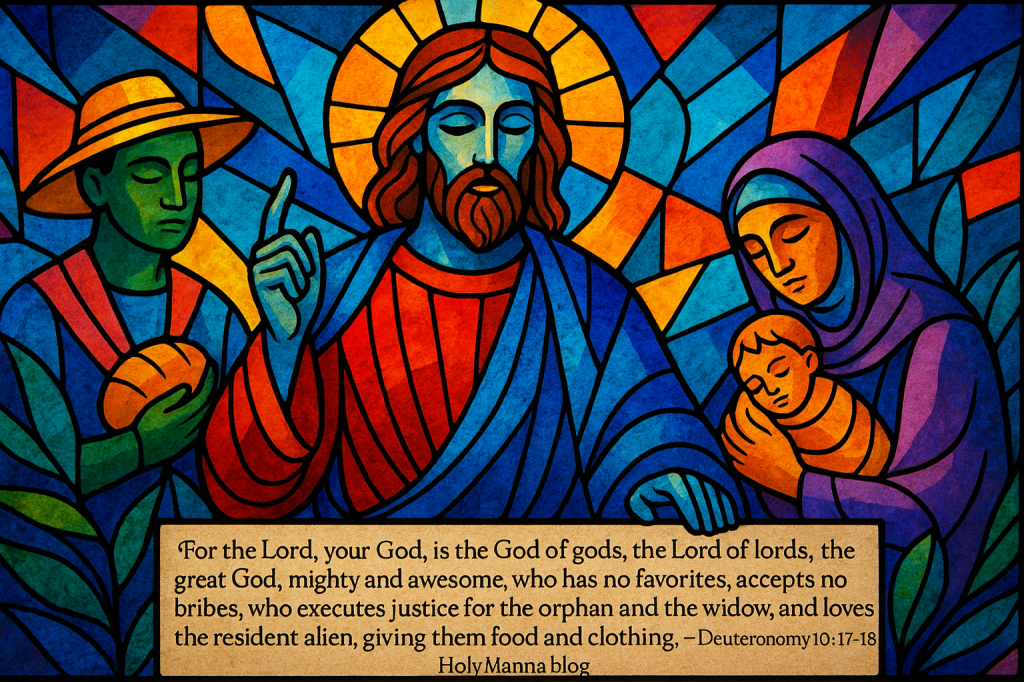
The Lord’s Majesty and Compassion. 12 Now, therefore, Israel, what does the Lord, your God, ask of you but to fear the Lord, your God, to follow in all his ways, to love and serve the Lord, your God, with your whole heart and with your whole being, 13 to keep the commandments and statutes of the Lord that I am commanding you today for your own well-being? 14 Look, the heavens, even the highest heavens, belong to the Lord, your God, as well as the earth and everything on it. 15 Yet only on your ancestors did the Lord set his heart to love them. He chose you, their descendants, from all the peoples, as it is today. 16 Circumcise therefore the foreskins of your hearts, and be stiff-necked no longer. 17 For the Lord, your God, is the God of gods, the Lord of lords, the great God, mighty and awesome, who has no favorites, accepts no bribes, 18 who executes justice for the orphan and the widow, and loves the resident alien, giving them food and clothing. 19 So you too should love the resident alien, for that is what you were in the land of Egypt. 20 The Lord, your God, shall you fear, and him shall you serve; to him hold fast and by his name shall you swear. 21 He is your praise; he is your God, who has done for you those great and awesome things that your own eyes have seen. 22 Seventy strong your ancestors went down to Egypt, and now the Lord, your God, has made you as numerous as the stars of heaven.
Detailed Exegesis
Verse 12 – “Now, therefore, Israel, what does the Lord, your God, ask of you but to fear the Lord, your God, to follow in all his ways, to love and serve the Lord, your God, with your whole heart and with your whole being.”
This is not a list of separate tasks but an integrated call to relationship. The fear of the Lord is not terror, but awe—reverent wonder at God’s holiness. To follow His ways and love Him means to align our entire lives with His will. The phrase “with your whole heart and with your whole being” is deeply covenantal—it calls for undivided devotion, a complete offering of the self, not partial compliance.
Verse 13 – “To keep the commandments and statutes of the Lord that I am commanding you today for your own well-being?”
God’s laws are not burdens but blessings. The commandments serve as a path to human flourishing. Echoing Psalm 119, we are reminded that to walk in God’s law is to walk in freedom. The moral law, as CCC 1950 teaches, is “a work of divine Wisdom”, guiding man toward his final end—eternal beatitude.
Verse 14 – “Look, the heavens, even the highest heavens, belong to the Lord, your God, as well as the earth and everything on it.”
This verse highlights God’s absolute sovereignty. All of creation belongs to Him, yet He stoops to love one people intimately. This contrast sets the stage for divine condescension—a concept later fulfilled in the Incarnation. The God of the cosmos desires covenant with us.
Verse 15 – “Yet only on your ancestors did the Lord set his heart to love them. He chose you, their descendants, from all the peoples, as it is today.”
This is divine election, not earned but gifted. Israel’s chosenness is not a reward but a responsibility. God’s preferential love initiates the relationship, and their history with Him is a testament to grace. The Catechism affirms in CCC 218 that “God’s love for Israel is compared to a father’s love for his son… God loved the people even in their infidelities.”
Verse 16 – “Circumcise therefore the foreskins of your hearts, and be stiff-necked no longer.”
Here, Moses calls for interior conversion. Physical circumcision was a sign of the covenant, but now the heart must bear the sign. This foreshadows the prophetic call in Jeremiah 4:4 and Paul’s teaching in Romans 2:29, where true covenant membership is described as spiritual, not merely external.
Verse 17 – “For the Lord, your God, is the God of gods, the Lord of lords, the great God, mighty and awesome, who has no favorites, accepts no bribes.”
God is not swayed by status or wealth. This would be a sharp contrast to ancient Near Eastern gods, whose favors were bought through offerings. Our God is just and incorruptible. He cannot be manipulated; He sees the truth of every heart.
Verse 18 – “Who executes justice for the orphan and the widow, and loves the resident alien, giving them food and clothing.”
Justice, in biblical terms, is always deeply social. God’s holiness is revealed in His concern for the vulnerable. These three—widow, orphan, and stranger—were the most defenseless in ancient society. To love God is to love as He does, especially those without power.
Verse 19 – “So you too should love the resident alien, for that is what you were in the land of Egypt.”
Empathy is commanded by memory. Israel’s own history of oppression becomes the basis for their ethical treatment of others. This is a divine pedagogy: remembrance of suffering should breed compassion, not hardness. Saint Clare lived this out in her monastery, where even the lowest servant was treated with dignity.
Verse 20 – “The Lord, your God, shall you fear, and him shall you serve; to him hold fast and by his name shall you swear.”
Fear, service, fidelity, and trust—this is the language of covenantal intimacy. To “hold fast” recalls the language of Genesis about marital union. Our relationship with God is meant to be one of total cleaving, total trust.
Verse 21 – “He is your praise; he is your God, who has done for you those great and awesome things that your own eyes have seen.”
Israel is reminded of God’s mighty deeds—the Exodus, the manna, the Red Sea. These visible signs are meant to provoke not just gratitude, but praise. God is not only the source of blessings; He Himself is the blessing.
Verse 22 – “Seventy strong your ancestors went down to Egypt, and now the Lord, your God, has made you as numerous as the stars of heaven.”
A direct fulfillment of the promise to Abraham in Genesis 15:5. God is faithful. From a small band of migrants, He has forged a people. This growth is not merely demographic—it is covenantal. The people exist because of God’s love and fidelity.
Teachings from the Church
The Church teaches that God’s commandments are meant not to enslave us, but to set us free. CCC 2063 affirms: “The commandments… constitute the fundamental expression of the natural law. They reveal man to himself and bring to light the essential duties.” Furthermore, CCC 1975 explains that the moral law “provides the needed foundation for the building of the human community.” Saint Basil the Great once said, “The love of God is not born of compulsion, but of free choice.” Saint Clare embodied this freely chosen love. She responded not to duty, but to desire—a desire to belong totally to the God who had already chosen her.
Reflection: A Love That Asks for Everything
What part of your heart have you not yet circumcised? This reading challenges us to ask: Am I giving God lip service or whole-hearted service? Like Israel, we may be tempted to live in fear, complaint, or entitlement. But God is not a master demanding labor—He is a Father inviting love. To serve Him with joy is not slavery, but liberation. When we remember what He has done—how He’s rescued us, fed us, healed us—our hearts begin to unclench. We realize we are not orphans, but chosen ones. Saint Clare gave up riches and security for the poverty of love. What might we need to let go of to follow God more freely? Where is He asking us to love the alien, defend the widow, or serve without favoritism today? If God is indeed our praise, then our lives should become a song of trust, justice, and mercy.
Responsorial Psalm – Psalm 147:12–15, 19–20
The God Who Draws Near
Psalm 147 is a hymn of praise celebrating God’s intimate involvement with His people. Set in the context of post-exilic Jerusalem, this psalm would have been sung by a community newly returned from Babylonian captivity—a people who had seen ruin, but also restoration. In a time of rebuilding both temple and trust, this psalm reminded Israel that their God was not distant or indifferent, but actively present—strengthening, feeding, revealing. Today’s selection aligns beautifully with the theme of wholehearted love and humble obedience. While Deuteronomy called for a circumcised heart, Psalm 147 shows us what such a heart looks like: a soul that praises, trusts, and receives. Saint Clare’s life of contemplative poverty mirrors this beautifully—she sought not great things, but the nearness of God, who satisfies the soul with His word and His peace.
Psalm 147:12-15, 19-20
New American Bible (Revised Edition)
12 Glorify the Lord, Jerusalem;
Zion, offer praise to your God,
13 For he has strengthened the bars of your gates,
blessed your children within you.
14 He brings peace to your borders,
and satisfies you with finest wheat.
15 He sends his command to earth;
his word runs swiftly!
19 He proclaims his word to Jacob,
his statutes and laws to Israel.
20 He has not done this for any other nation;
of such laws they know nothing.
Hallelujah!
Detailed Exegesis
Verse 12 – “Glorify the Lord, Jerusalem; Zion, offer praise to your God.”
This is a summons to praise. The names “Jerusalem” and “Zion” are both personal and symbolic—they refer to the holy city, but also to the people of God. Glorifying the Lord is not mere flattery; it’s the natural response to the One who has drawn near and restored them. This verse invites us to a liturgical and communal act of love.
Verse 13 – “For he has strengthened the bars of your gates, blessed your children within you.”
This speaks to divine protection and fruitfulness. After exile, Jerusalem’s walls were in ruins; God Himself strengthens their gates—a metaphor for divine security and restoration. He doesn’t just defend; He blesses. The children represent hope and legacy. God’s love is generational.
Verse 14 – “He brings peace to your borders, and satisfies you with finest wheat.”
Here we see the dual gifts of shalom (peace) and provision. Peace in Scripture is more than the absence of war—it’s wholeness, stability, and right relationship with God and neighbor. The “finest wheat” alludes to abundance and Eucharistic overtones. Saint Clare, who had only the Bread of Angels to nourish her, understood that divine satisfaction far surpasses earthly riches.
Verse 15 – “He sends his command to earth; his word runs swiftly!”
This verse celebrates God’s sovereignty and immediacy. Unlike the gods of the pagans, who were thought to dwell in inaccessible heavens, Israel’s God speaks—and His word acts. It does not delay, nor is it hindered. Isaiah 55:11 echoes this: “My word… shall not return to me void”. God’s word is alive and powerful.
Verse 19 – “He proclaims his word to Jacob, his statutes and laws to Israel.”
This verse centers Israel’s unique identity: God has revealed His will to them directly. The Law is not a burden but a blessing—it forms, frees, and guides. This continues the message from Deuteronomy 10, where Moses emphasized that the commandments are for Israel’s own good.
Verse 20 – “He has not done this for any other nation; of such laws they know nothing. Hallelujah!”
A bold declaration of privilege—Israel alone has received the revealed word of God. Not to boast, but to steward. This verse recalls Amos 3:2: “You only have I known of all the families of the earth; therefore I will punish you for all your iniquities.” Divine intimacy brings both favor and responsibility.
Teachings from the Church
The Church teaches that divine revelation is a gift and a calling. CCC 50 states: “By natural reason man can know God with certainty… But there is another order of knowledge, which man cannot possibly arrive at by his own powers: the order of Divine Revelation.” Psalm 147 rejoices in this revealed word. Furthermore, CCC 65 reminds us: “In many and various ways God spoke of old… but now He has spoken to us by a Son.” Just as Israel was uniquely blessed with the Law, the Church is now uniquely entrusted with the fullness of divine truth in Christ. Saint Clare bore witness to this Word not through speech, but through silence, fasting, and worship. Her life was a psalm—simple, devoted, and radiant with praise.
Reflection: Praising Through Trust
What is your response to a God who strengthens, satisfies, and speaks? Today’s psalm calls us to praise—not out of obligation, but out of wonder. In a world where we often feel scattered, insecure, or famished, God offers strength, peace, and the finest wheat. But do we notice? Are we listening when His word runs swiftly across the earth? Like Saint Clare, we are invited to live in quiet amazement at a God who draws near and provides. Are we praising Him in our gates—our homes, our hearts, our relationships? Are we passing on His statutes to our children? Perhaps today we can begin with gratitude: naming the ways God has brought peace to our borders and provision to our souls. And with each breath of praise, our hearts open a little more, becoming the dwelling place God desires.
Holy Gospel – Matthew 17:22–27
The Humble King and the Hidden Coin
In this brief but rich Gospel passage, Jesus reveals both the sorrowful path ahead and His divine mastery over creation. We find ourselves in Galilee, a familiar place of miracles and teachings, but now shadowed by the looming Passion. Jesus prepares His disciples for His death and resurrection—a teaching they cannot yet fully grasp. Then, in a surprising turn, the narrative moves to a question about the temple tax. Though seemingly mundane, this moment becomes a theological goldmine. Jesus asserts His royal freedom yet chooses humility and accommodation for the sake of peace. This scene captures today’s theme with subtle brilliance: wholehearted love is not loud; it is obedient, trusting, and free. Saint Clare, like Christ, lived this quiet paradox—though she had the right to wealth and status, she chose a hidden life of detachment and love. Her trust in divine providence mirrors the miraculous provision of the coin in the fish’s mouth.
Matthew 17:22-27
New American Bible (Revised Edition)
22 As they were gathering in Galilee, Jesus said to them, “The Son of Man is to be handed over to men, 23 and they will kill him, and he will be raised on the third day.” And they were overwhelmed with grief.
Payment of the Temple Tax. 24 When they came to Capernaum, the collectors of the temple tax approached Peter and said, “Doesn’t your teacher pay the temple tax?” 25 “Yes,” he said. When he came into the house, before he had time to speak, Jesus asked him, “What is your opinion, Simon? From whom do the kings of the earth take tolls or census tax? From their subjects or from foreigners?” 26 When he said, “From foreigners,” Jesus said to him, “Then the subjects are exempt. 27 But that we may not offend them, go to the sea, drop in a hook, and take the first fish that comes up. Open its mouth and you will find a coin worth twice the temple tax. Give that to them for me and for you.”
Detailed Exegesis
Verse 22 – “As they were gathering in Galilee, Jesus said to them, ‘The Son of Man is to be handed over to men,’”
This is the second Passion prediction in Matthew. The phrase “handed over” (Greek: paradidotai) is a technical term indicating betrayal and divine handing-over. Jesus is not a victim of fate but a willing sacrifice. Galilee, once the scene of joyful ministry, now becomes the place where sorrow begins to unfold.
Verse 23 – “And they will kill him, and he will be raised on the third day.” And they were overwhelmed with grief.”
Jesus speaks plainly of both His death and resurrection, yet the disciples focus only on the grief. Their hearts, like ours, often cannot yet hold the paradox of suffering and glory. The Resurrection is the key to understanding this prophecy, but it is not yet within their reach. Like Moses’ call to love with our whole heart, this too demands faith beyond comprehension.
Verse 24 – “When they came to Capernaum, the collectors of the temple tax approached Peter and said, ‘Doesn’t your teacher pay the temple tax?’”
The temple tax, rooted in Exodus 30:13, was a religious obligation used for temple upkeep. It was expected of all Jewish males over twenty. The question is both legal and reputational: Will Jesus comply? The tax was technically for God’s house—yet Jesus is the Son of God. Should the Son pay to maintain His own dwelling?
Verse 25 – “Yes,” he said. When he came into the house, before he had time to speak, Jesus asked him, ‘What is your opinion, Simon? From whom do the kings of the earth take tolls or census tax? From their subjects or from foreigners?’”
Peter, perhaps instinctively, answers in the affirmative. But Jesus, anticipating his concern, poses a question about royal taxation. Kings don’t tax their children—only others. The implication is clear: Jesus, as the Son, is exempt. And so are His disciples, who are now sons in Him.
Verse 26 – “When he said, ‘From foreigners,’ Jesus said to him, ‘Then the subjects are exempt.’”
This gentle but profound statement reveals the identity of the disciples: they are not outsiders to God’s household. They are children of the Kingdom. Jesus reveals a deeper truth—covenant relationship brings freedom. The law was not given to enslave but to form sons and daughters.
Verse 27 – “But that we may not offend them, go to the sea, drop in a hook, and take the first fish that comes up. Open its mouth and you will find a coin worth twice the temple tax. Give that to them for me and for you.”
In a stunning act of humility and miraculous provision, Jesus chooses not to assert His right but to avoid scandal. The miracle—a coin in a fish’s mouth—is a hidden sign of divine control and care. He provides what is needed without fanfare. This is the heart of Christ: free yet obedient, divine yet lowly. Saint Clare lived by this same paradox—her cloistered life, though invisible to the world, was luminous with supernatural trust.
Teachings from the Church
The Catechism teaches that Christ’s Passion was freely chosen: CCC 606 states, “The desire to embrace his Father’s plan of redeeming love inspired Jesus’ whole life.” His obedience, even in small gestures like the temple tax, reflects a deeper humility. CCC 2447 also reminds us that “the works of mercy are charitable actions by which we come to the aid of our neighbor.” Avoiding offense—even when He was not obliged—was a subtle form of mercy. Saint John Chrysostom comments on this passage, saying: “See how He manifests both His freedom and His love: He pays, yet from the mouth of a fish!” Jesus teaches us not to cling to our rights, but to embrace the way of peace and provision. Saint Clare did this in her rule of life—eschewing privilege not because she had to, but because love compelled her.
Reflection: Living as Sons, Not Servants
Do you live like a beloved child of the King, or like a servant just trying to fulfill duty? This Gospel reminds us that Christ has made us free—not to rebel, but to love fully. There will be moments when we are right, yet called to yield. Situations when we’re exempt, but invited to serve. Jesus doesn’t flaunt His divinity; He walks in quiet generosity. Where is God calling you to yield for the sake of peace? What “temple tax” are you being asked to pay—not because you must, but because love asks it? In the hidden corners of daily life, there are coins waiting—provisions for the path of obedience. Like Saint Clare, may we walk that path with joyful surrender, trusting that the One who calls will also provide.
A Heart Made Whole
Today’s readings form a tapestry woven from trust, humility, and divine love. In Deuteronomy, we are called to love and serve the Lord “with your whole heart and with your whole being”, not out of fear or obligation, but because He is our praise, our God, and our Provider. Psalm 147 shows us the fruit of such love—a life filled with peace, protection, and the nourishing Word of God. Then, in The Gospel of Matthew, Jesus gently reveals the mystery of His mission: though He is the Son and therefore free, He willingly pays the temple tax to avoid causing scandal. His humility and miraculous provision show us what it means to love with total freedom—a freedom rooted not in asserting rights, but in offering oneself.
Saint Clare of Assisi lived this message with startling clarity. She gave up nobility, comfort, and the safety of convention to become poor with Christ and rich in the things of Heaven. Like the Israelites called to remember their deliverance, Clare remembered the One who loved her first and shaped her life around Him. Like Jerusalem in the psalm, she was fortified by God’s peace and fed by His Word. And like Jesus in the Gospel, she gave freely, lived humbly, and trusted completely in divine providence—even when it came in the form of a fish with a coin, or a cloistered life that changed the world.
Where is God asking you to unclench your heart today? What “coin” are you holding back—your time, your trust, your surrender? The God who calls us is also the One who strengthens our gates and satisfies our hunger. Today, let us pray for the grace to love with undivided hearts, to serve without fear, and to follow Jesus and the saints into the beautiful paradox of freedom through surrender. Like Saint Clare, may our lives become a quiet flame of praise, burning only for the One who is our everything.
Engage with Us!
We’d love to hear how God is speaking to you through today’s readings and the witness of Saint Clare. Share your thoughts in the comments—your insights might be just what someone else needs to hear today. Let’s grow together in faith, hope, and love.
Reflection Questions:
First Reading – Deuteronomy 10:12–22
What areas of your life need “circumcision of the heart”? Are there ways you can imitate God’s justice by caring for the orphan, widow, or stranger in your own community?
Responsorial Psalm – Psalm 147:12–15, 19–20
Where have you experienced God strengthening your life or bringing you peace? How do you respond to the gift of God’s Word and guidance in your daily life?
Holy Gospel – Matthew 17:22–27
Are you willing to surrender your “rights” for the sake of love and unity? Where is God asking you to trust Him for quiet provision—like a coin in the mouth of a fish?
As you go forth today, may you walk in the humility of Jesus, the courage of Saint Clare, and the joy of one who is deeply loved by God. Let every word, every action, and every choice be infused with the mercy and love that Christ Himself has poured into your heart. Live boldly, serve joyfully, and love with your whole being.
Follow us on Instagram and Facebook for more insights and reflections on living a faith-filled life.

 Holy Manna!
Leave a comment