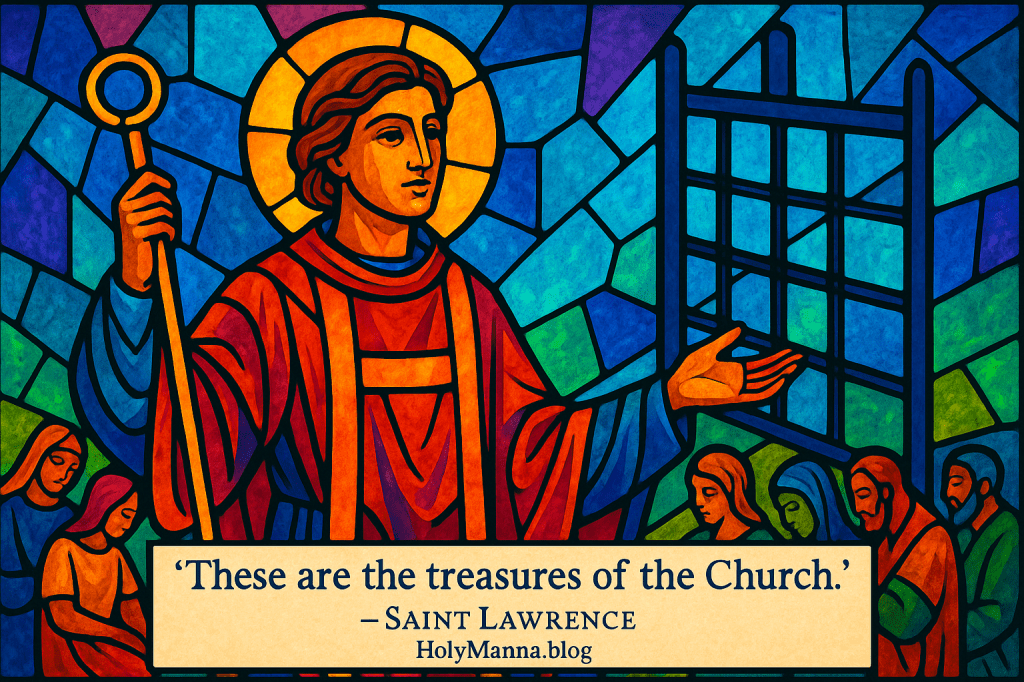
A Flame That Could Not Be Quenched
Among the many martyrs of the early Church, few are as boldly radiant as Saint Lawrence, deacon of Rome and champion of the poor. Known for his profound charity, courage under fire, and his unforgettable martyrdom, Saint Lawrence continues to inspire Christians worldwide with his example of joyful suffering and heroic faith. Celebrated on August 10th, he is one of the most venerated martyrs of the early Church, honored in both East and West. Pope Saint Leo the Great once said of him: “The Lord has desired to exalt his glorious name in the whole world”, and indeed, Saint Lawrence’s witness continues to echo across centuries.
Chosen for Service
Saint Lawrence was born in the early 3rd century in Huesca, Spain, during a time when the Christian faith was under constant threat in the Roman Empire. He came from a noble and pious family, and from an early age, he was formed in the Christian faith, likely influenced by the teachings of Saint Sixtus II, who would later become pope.
When Pope Sixtus II ascended to the papacy in 257, he recognized in Lawrence a remarkable spirit of humility, prudence, and charity. He called him to Rome and appointed him archdeacon, placing him in charge of the Church’s treasury and its ministry to the poor. This role would become central to Lawrence’s sanctity and legacy.
Lawrence became known for his love of the poor and his stewardship of the Church’s material goods, which he distributed generously to widows, orphans, and the sick. But it wasn’t just his acts of charity that made him stand out—it was the joy with which he served, embodying Saint Paul’s words: “God loves a cheerful giver” (2 Corinthians 9:7).
A Living Gospel
Saint Lawrence’s entire life was a testament to the Gospel in action. He saw the face of Christ in the poor, the sick, and the marginalized. He performed no documented miracles during his life in the dramatic sense—no raising of the dead or healing of the blind—but his everyday ministry was miraculous in itself.
When the Roman prefect demanded that Lawrence turn over the treasures of the Church, the deacon returned not with gold or silver but with a crowd of the poor, the lame, the blind, and the outcast. He declared: “These are the treasures of the Church.” In that simple yet bold gesture, he overturned the Roman world’s understanding of wealth and worth.
That act of defiance sealed his fate—but it also sealed his sainthood.
The Gridiron of Glory
In 258 A.D., during the Valerian persecution, Pope Sixtus II was captured and executed. Lawrence, aware that his time was near, sold all remaining Church treasures and gave the proceeds to the poor. Three days later, he too was arrested.
The Roman authorities, furious at his “mockery,” sentenced him to a slow and cruel death: he was roasted alive on a gridiron over hot coals. Yet, in the midst of his agony, Lawrence displayed incredible peace and even humor. Eyewitnesses report him saying: “Turn me over, I’m done on this side.”
Such holy boldness made Lawrence not only a martyr but a symbol of joyful suffering and unshakable faith. The Church has honored him ever since as a patron of deacons, the poor, cooks, and comedians—yes, even humor can be holy when it springs from grace.
Echoes of Glory
After his death, Saint Lawrence’s tomb in Rome became a site of miracles and pilgrimage. The Basilica of San Lorenzo fuori le Mura, built over his burial site, is one of the seven major basilicas of Rome and remains a powerful place of prayer and healing.
Many early Christians testified to healings at his tomb. According to tradition, Emperor Constantine experienced a miraculous healing through Lawrence’s intercession, which deepened the emperor’s openness to Christianity. The veneration of Saint Lawrence spread quickly, and churches bearing his name rose throughout Europe.
His relics, especially those enshrined in Rome and in places like El Escorial in Spain, continue to draw faithful pilgrims seeking hope, healing, and inspiration.
A Reflection in the Fire
Saint Lawrence teaches us that true treasure lies in love, in service, and in joyful sacrifice. He reminds us that courage and charity are not opposed but deeply connected—when we know we are loved by God, we can lay down our lives for others.
He challenges us to ask: Do I see Christ in the poor, the overlooked, and the burdensome? Am I willing to give joyfully, even when it costs me something? How do I handle suffering—can I offer it up, trusting God will bring fruit from my pain?
We live in a world where comfort is idolized and suffering avoided. Saint Lawrence reminds us that the Christian life is not about avoiding the cross—but carrying it with love, for the sake of Christ and His people. And if we do that, like him, we will be refined not destroyed by fire.
Let us go forth to love and serve the Lord—not reluctantly, but cheerfully. For as Saint Lawrence shows us, “those who sow in tears shall reap with shouts of joy” (Psalm 126:5).
Engage with Us!
We’d love to hear from you! How does Saint Lawrence’s bold witness speak to your heart today? Share your thoughts and reflections in the comments below—your words may be the encouragement someone else needs.
Reflection Questions:
- What “treasures” in your life might you offer to God in service of the poor and forgotten?
- Have you ever experienced joy in suffering? How did that change your faith?
- How can you embrace your daily responsibilities as opportunities for cheerful giving, like Saint Lawrence did?
Let’s keep lifting each other up on this journey of faith, and strive always to live with love—just as our Lord Jesus did.
Saint Lawrence, pray for us!
Follow us on Instagram and Facebook for more insights and reflections on living a faith-filled life.

 Holy Manna!
Leave a comment