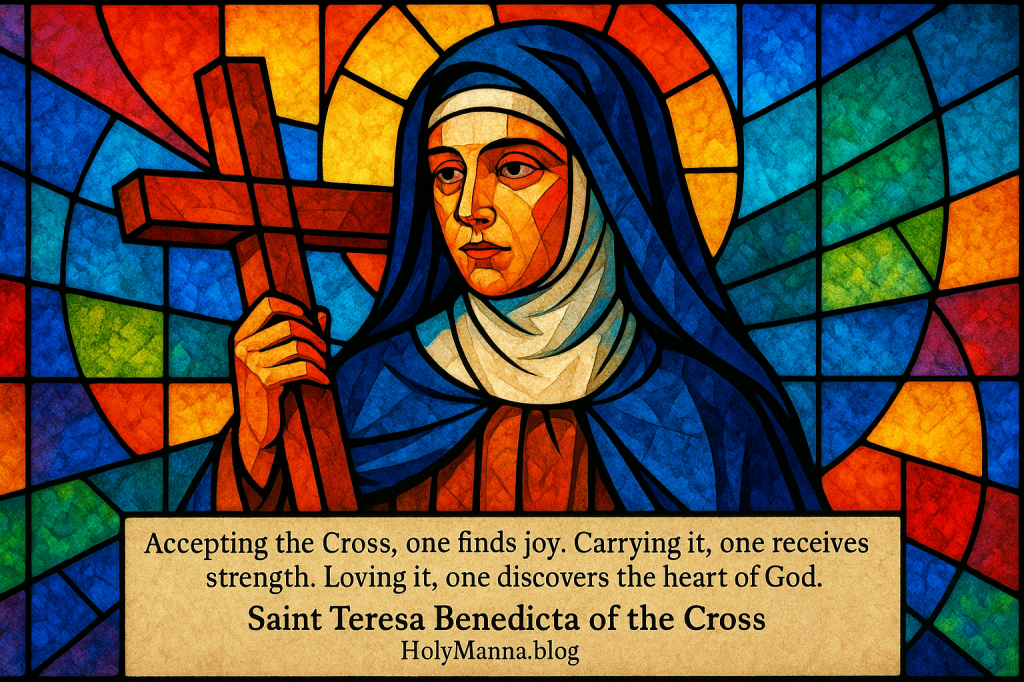
A Flame in the Darkness
Saint Teresa Benedicta of the Cross, also known as Saint Edith Stein, stands as one of the most compelling saints of the 20th century. Her journey from atheism to sainthood, from academic brilliance to martyrdom, embodies the deep unity of truth and love found in Christ. She is revered not only for her intellectual contributions to philosophy and theology, but also for her courageous witness in the face of suffering and death. Canonized by Pope Saint John Paul II in 1998, and declared co-patroness of Europe in 1999, Teresa Benedicta offers the modern world a powerful example of how reason can lead to faith, how faith must be lived with courage, and how the Cross is the path to life. She is a saint for seekers, for thinkers, for the broken-hearted, and for those longing to give everything for the glory of God.
A Jewish Mind and a Searching Heart
Edith Stein was born on October 12, 1891, in Breslau, Germany, to a devout Jewish family. Her father passed away when she was only two years old, leaving her mother Augusta to raise eleven children and run the family timber business. Edith was exceptionally bright and introspective from an early age. By her teenage years, she had lost her faith in God and declared herself an atheist, believing that reason alone could satisfy her longing for truth.
She pursued philosophy at the University of Göttingen and later at Freiburg, studying under the renowned Edmund Husserl, founder of phenomenology. She earned a doctorate with highest honors and was regarded as one of the most brilliant minds of her generation. However, intellectual achievement did not satisfy her heart. Her thirst for truth remained.
Her conversion to Catholicism began through the friendships she formed with Christians and especially through the witness of Anna Reinach, a widow whose peace in grief stunned Edith after the loss of her husband. But the turning point came in 1921, when she stayed at a friend’s home and picked up the Autobiography of Saint Teresa of Ávila. She read it in one night and, upon finishing it, declared: “This is the truth.” Less than a year later, on January 1, 1922, she was baptized into the Catholic Church. Her mother, deeply grieved by this decision, remained heartbroken. But Edith had found the truth for which she had been searching all her life—Jesus Christ.
Though she continued to teach and lecture after her baptism, Edith increasingly desired to dedicate herself wholly to Christ. Her writings reflected a growing understanding of the redemptive meaning of suffering and the mystical path of union with God. She would eventually enter the Carmelite monastery, becoming Teresa Benedicta of the Cross. Her name, chosen by herself, means “Blessed by the Cross”—a name that would become prophecy.
A Scholar Cloaked in Silence
Following years of discernment and growing persecution of Jews under the Nazi regime, Edith entered the Carmelite convent in Cologne in 1933. Her entrance into religious life marked a decisive embrace of the Cross she had already carried spiritually for years. Taking the name Teresa Benedicta of the Cross, she lived a hidden life of prayer, sacrifice, and contemplation. In Carmel, she was no longer a public intellectual but a bride of Christ, offering herself silently for the salvation of souls.
Her intellectual output continued in the cloister. She wrote deeply mystical works such as The Science of the Cross, a study on the spirituality of Saint John of the Cross, which she saw as a key to understanding suffering in light of divine love. Her insights wove together her philosophical background with profound theological reflection. Her writings explored themes of empathy, womanhood, the soul’s ascent to God, and the mystery of the Cross.
Though she is not known for physical miracles during her life, the true miracle was her total inner transformation. She lived out the teaching she once wrote: “The deeper one is drawn into God, the more one must ‘go out of oneself’; that is, one must go to the world in order to carry the divine life into it.” Her sanctity was not showy but real—proven in silence, service, and surrender. She lived with great charity in community, humility in labor, and peace in prayer. Every moment of her cloistered life was a light offered to God amid the rising shadows of Nazi terror.
The Road to Auschwitz
In 1938, as Nazi oppression intensified, Sister Teresa Benedicta was transferred to the Carmel in Echt, Netherlands, in hopes of protecting her due to her Jewish ancestry. But after the Dutch bishops issued a public statement condemning Nazi racism and anti-Semitism, the Nazis retaliated by arresting all Jewish converts to Catholicism.
On August 2, 1942, the Gestapo arrived at the Carmel in Echt. Teresa Benedicta, along with her sister Rosa who had also converted and served in the convent, was taken. Witnesses report that during their imprisonment at the Westerbork transit camp, she displayed extraordinary peace and selflessness—praying with others, comforting crying children, and helping mothers tend to their little ones. Her serenity was not naivety; it was supernatural grace.
Just days later, on August 9, 1942, Teresa Benedicta of the Cross and her sister were sent to the gas chambers at Auschwitz. She died not only as a victim of racial hatred but also as a Christian martyr. The Church recognizes her death as an act of martyrdom in odium fidei—in hatred of the faith.
In dying with her people, the Jewish people, and for her faith in Christ, she became a bridge between the Old and New Covenants. Her death is a testimony that Christ’s Cross stands at the heart of human suffering and that love is stronger than death. As she once wrote: “Accepting the Cross, one finds joy. Carrying it, one receives strength. Loving it, one discovers the heart of God.”
A Silent Thunder
Though no canonized miracles were required for her martyrdom to be recognized, numerous favors and graces have been attributed to Saint Teresa Benedicta’s intercession since her death. Pilgrims visit her Carmelite cell in Cologne, the convent in Echt, and her commemorative plaque at Auschwitz to seek her prayers and contemplate her holy life.
Her writings continue to influence countless souls—converts, philosophers, Carmelite nuns, Jewish seekers, and ordinary Catholics struggling to understand suffering in a world that often rejects the Cross. Many have reported intellectual conversions, healing of despair, and a renewed understanding of the union between the Jewish and Christian faiths through her legacy.
Her canonization was celebrated not only by Catholics but by Jewish leaders as well, who recognized in her life a unique and reverent bond between the two religions. Saint John Paul II called her “a daughter of Israel who, as a Catholic during the Nazi persecution, remained faithful to the crucified Lord Jesus Christ and, as a Jew, to her people.”
Her memory stands as a prophetic voice in our time: reminding the world that truth must be loved, that faith must be lived even unto death, and that every human life—no matter how small or forgotten—is sacred.
A Saint for the Modern Soul
Saint Teresa Benedicta of the Cross invites us to a radical surrender of mind and heart. Her story is not one of comfort but of courage—a call to seek truth no matter the cost, to embrace suffering not as a curse but as a pathway to love, and to trust that even in the darkest places, God is present.
She teaches us that faith and reason are not enemies but allies in the search for truth. In a culture that often promotes feelings over truth and comfort over sacrifice, her life is a gentle but firm rebuke. She lived her convictions with clarity and charity, never compromising her intellect nor her heart.
How can we bring that same courage into our lives today? We can start by praying for clarity in our vocations, offering our daily sufferings for others, reading the works of saints to deepen our understanding, and remaining faithful even when it costs us something. She challenges us to become saints not in spite of our wounds and weaknesses, but through them.
Saint Teresa Benedicta of the Cross, like Christ whom she followed, was a sign of contradiction—a Jewish philosopher who became a Catholic nun and gave her life in Auschwitz as an offering of love. She reminds us that sanctity is not a matter of circumstance, but of surrender.
May we, like her, be willing to search for truth with open minds and love Christ with undivided hearts.
Engage with Us!
We’d love to hear how Saint Teresa Benedicta of the Cross inspires you! Share your reflections, favorite quotes, or prayer intentions in the comments below.
- What truth are you being called to seek more deeply in your life right now?
- How can you unite your sufferings to the Cross like Saint Teresa Benedicta did?
- Where in your daily life are you being invited to blend reason and faith in love?
Let’s support one another in this journey of faith. May we always encourage each other to walk boldly, suffer joyfully, and love without fear—just as Jesus did.
Saint Teresa Benedicta of the Cross, pray for us! ✝️
Follow us on Instagram and Facebook for more insights and reflections on living a faith-filled life.

 Holy Manna!
Leave a comment