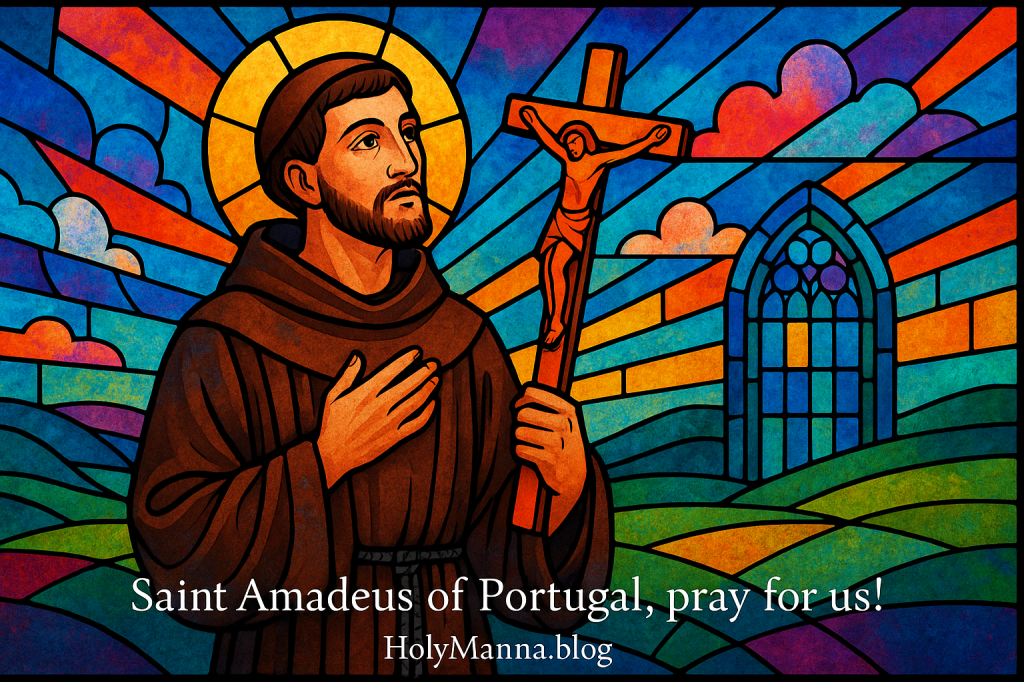
A Royal Soul in a Humble Habit
In a world ruled by power and prestige, few choose to lay it all down for Christ. But Saint Amadeus of Portugal, born into nobility, chose the narrow road. Known for his prophetic gifts, mystical visions, and reforming zeal, Saint Amadeus (also known as Amedeus) is revered not only for his personal holiness but for his efforts to renew religious life in the Church. A devout Franciscan and a trusted advisor to popes and kings, he reminds us that sanctity flourishes in both cloisters and courts—if the heart remains rooted in divine love.
From the Portuguese Court to the Cloister
Amadeus was born João de Menezes da Silva in 1420, into a noble Portuguese family of deep faith and high influence. His father was a counselor to the king, and his upbringing was steeped in courtly refinement, education, and expectations of secular greatness. Early on, he was drawn to prayer and piety, but he fulfilled his family’s wishes by marrying and serving at court.
When his wife passed away, Amadeus experienced a profound spiritual awakening. Freed from marital obligations, he discerned a call to religious life. Inspired by the poverty and simplicity of Saint Francis of Assisi, he entered the Franciscan Order as a lay brother in 1452, choosing the name “Amadeus,” meaning “lover of God.”
He would become one of the greatest reformers of the Franciscan movement in the 15th century, promoting strict poverty, fervent prayer, and loving service.
The Mystic Reformer and Servant of Christ
As a Franciscan, Amadeus’s life was marked by humility, obedience, and extraordinary devotion. He eventually became a priest and served in various roles, including spiritual director, confessor, and reformer of religious communities. He founded or revitalized several monasteries, especially in Milan and Italy, and eventually gathered a group of followers who became known as the Amadeites, a branch of the Franciscans devoted to greater asceticism and fidelity to the original Rule of Saint Francis.
Amadeus was known to receive visions of the Blessed Virgin Mary and of Christ Himself, including apocalyptic revelations later compiled in a book titled Apocalypsis Nova (“The New Revelation”). In these visions, he was shown God’s mercy, the suffering of the Church, and the coming renewal of the world through divine justice and love. These writings influenced theologians and mystics for centuries to come.
During his lifetime, people came from afar to seek his counsel and healing prayers. He was said to have the gift of prophecy, reading souls and foretelling future events. Though not formally canonized, his reputation for holiness spread rapidly after his death, and he has been honored as a saint by the Franciscan Order and various local devotions.
Suffering in Silence, Enduring in Grace
Despite his noble lineage and popular reputation, Saint Amadeus never sought power. In fact, he endured great opposition and suspicion—both within the Church and outside it. His growing influence attracted political scrutiny, and some within the Order questioned the need for reform. Yet he never retaliated or deviated from charity.
He bore all trials with Franciscan joy, seeing in them a participation in Christ’s own suffering. In his later years, his health declined under the strain of his work and penance. Still, he remained fervent in prayer and service until his death in 1482 at the monastery of Milan, where he had founded one of his most flourishing communities.
Though not a martyr in the traditional sense, Saint Amadeus exemplifies the white martyrdom of self-denial and complete offering to God.
A Heavenly Intercessor After Death
After his death, many miracles were reported at his tomb. Pilgrims came seeking healing, spiritual guidance, and consolation. The Franciscan communities he reformed continued to flourish, and his mystical writings were preserved and circulated widely among the faithful.
Though not formally raised to the altars through canonization, his cultus was confirmed, and he is honored as a saint within the Church—especially among Franciscans and in Portugal and northern Italy.
His relics were venerated, and his memory cherished as that of a man who saw beyond the politics and pageantry of the world, choosing instead the humility and hope of Christ’s kingdom.
Living the Legacy of Saint Amadeus
Saint Amadeus teaches us that holiness is not limited by our past, our status, or even the expectations others place on us. His life invites us to look deeply at what truly satisfies the soul. Is it prestige, comfort, and acclaim—or the peace that comes from following Christ wherever He leads?
His visions and mystical writings remind us of the reality of heaven and the urgency of conversion. His commitment to Franciscan poverty challenges us to detach from materialism and embrace simplicity. And his reforming spirit shows us that love of the Church often requires both courage and sacrifice.
How are you being called to deeper intimacy with Christ? Where is He asking you to surrender more completely?
Let us imitate Saint Amadeus by seeking God above all, reforming what is broken with truth and charity, and always walking the path of humility—even if we come from palaces.
Engage with Us!
We’d love to hear your reflections and thoughts in the comments. How does Saint Amadeus’ journey speak to your own walk of faith?
Reflection Questions:
- What comforts or privileges might God be calling you to surrender for the sake of a deeper relationship with Him?
- How can you be a reformer—loving and renewing your parish, family, or community—in a spirit of humility like Saint Amadeus?
- Do you seek visions and signs, or are you open to encountering God in silent, daily faithfulness?
Let us encourage each other to live with hearts fully given to God. May we strive to do everything with love, as our Lord Jesus did.
Saint Amadeus of Portugal, pray for us! 🕊️
Follow us on Instagram and Facebook for more insights and reflections on living a faith-filled life.

 Holy Manna!
Leave a comment