Saturday of the Eighteenth Week in Ordinary Time – Lectionary: 412
Faith That Remembers, Loves, and Moves Mountains
Have you ever noticed how easy it is to trust God in desperation but forget Him in abundance? Today’s readings invite us into a holy tension: to love God with everything we have, to never forget His saving works, and to trust that even the smallest act of faith can unleash divine power. In a world that prizes self-reliance and quick fixes, Scripture today reminds us that faith is not merely belief—it is radical love, obedient memory, and confident trust that moves mountains.
In Deuteronomy 6, Moses urges the Israelites to remain faithful as they prepare to enter the Promised Land—a land flowing with abundance they did not earn. His warning is striking: “Be careful not to forget the Lord, who brought you out of the land of Egypt” (Deut 6:12). These words are not merely historical—they are covenantal. God desires a people who remember Him in their routines, teach His commands to their children, and write His name on the very gates of their homes. This is not dry religion—it’s a lived relationship. Meanwhile, Psalm 18 bursts forth as a declaration of this remembered love: “I love you, Lord, my strength” (Ps 18:2). The psalmist rejoices not only in God’s past deliverance but in His ongoing strength, shielding, and mercy toward His anointed.
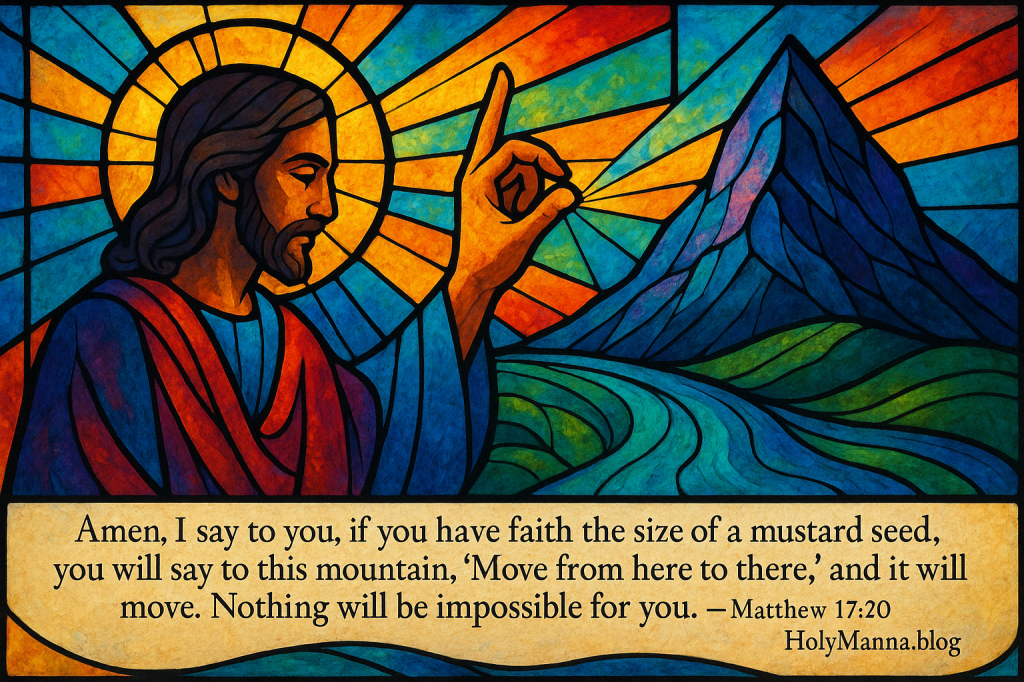
Then in The Gospel of Matthew, we see Jesus lament a faithless generation and reveal a stunning truth to His disciples: “If you have faith the size of a mustard seed… nothing will be impossible for you” (Mt 17:20). The contrast between God’s call in Deuteronomy to faithful remembrance and Jesus’ challenge to trust boldly unveils a central theme: authentic faith is a love that remembers and a trust that acts. The same God who delivered Israel and rescued David is the One who casts out demons and heals the broken today. Are we cultivating that kind of faith—one that remembers God’s past victories, loves Him in our daily lives, and believes that even our smallest prayers can move mountains?
First Reading – Deuteronomy 6:4–13
Wholehearted Love in a Land of Temptation
This passage from Deuteronomy is a cornerstone of Jewish faith and identity. Known as the Shema, which means “hear” in Hebrew, it is the central declaration of the oneness of God and the call to love Him fully. Moses speaks these words to Israel on the threshold of the Promised Land, after their long journey through the desert. The people are preparing to enter a new life—one filled with abundance, comfort, and cultural temptation. It is precisely in this moment of transition that Moses warns them: prosperity can lead to forgetfulness. This reading calls us not only to love God but to remember Him—especially when life is good. It fits beautifully into today’s theme: faith that remembers, loves, and moves mountains. If we do not intentionally cultivate faithful love in our hearts and homes, we risk slipping into a spiritual amnesia that weakens our faith and distances us from God’s presence.
Deuteronomy 6:4-13
New American Bible (Revised Edition)
4 Hear, O Israel! The Lord is our God, the Lord alone! 5 Therefore, you shall love the Lord, your God, with your whole heart, and with your whole being, and with your whole strength. 6 Take to heart these words which I command you today. 7 Keep repeating them to your children. Recite them when you are at home and when you are away, when you lie down and when you get up. 8 Bind them on your arm as a sign and let them be as a pendant on your forehead. 9 Write them on the doorposts of your houses and on your gates.
Fidelity in Prosperity. 10 When the Lord, your God, brings you into the land which he swore to your ancestors, to Abraham, Isaac, and Jacob, that he would give you, a land with fine, large cities that you did not build, 11 with houses full of goods of all sorts that you did not garner, with cisterns that you did not dig, with vineyards and olive groves that you did not plant; and when, therefore, you eat and are satisfied, 12 be careful not to forget the Lord, who brought you out of the land of Egypt, that house of slavery. 13 The Lord, your God, shall you fear; him shall you serve, and by his name shall you swear.
Detailed Exegesis
Verse 4 – “Hear, O Israel! The Lord is our God, the Lord alone!”
This is the Shema Yisrael, one of the most sacred declarations in Judaism. It affirms monotheism in a world surrounded by polytheistic cultures. The phrase “The Lord is our God, the Lord alone” emphasizes both the uniqueness and intimacy of God. He is not just a god; He is our God. The Church affirms this in CCC 201: “To Israel, his chosen, God revealed himself as the only One: ‘Hear, O Israel: The LORD our God is one LORD…’”
Verse 5 – “Therefore, you shall love the Lord, your God, with your whole heart, and with your whole being, and with your whole strength.”
This is the heart of covenantal faith. Love here is not merely emotional but involves the totality of one’s person: intellect, will, body, and soul. Jesus will later affirm this as the greatest commandment (Mt 22:37). As CCC 2083 explains: “Jesus summed up man’s duties toward God in this saying: ‘You shall love the Lord your God with all your heart, and with all your soul, and with all your mind.’”
Verse 6 – “Take to heart these words which I command you today.”
Moses urges internalization, not just memorization. The commands are to be written on the heart, forming conscience and character. This aligns with CCC 1777, which teaches: “When he listens to his conscience, the prudent man can hear God speaking.”
Verse 7 – “Keep repeating them to your children. Recite them when you are at home and when you are away, when you lie down and when you get up.”
Faith must be passed down in daily life. It’s not enough to go to temple or, for us, Mass—faith must be the air we breathe. Teaching children and integrating prayer into every moment ensures we don’t compartmentalize our relationship with God.
Verse 8 – “Bind them on your arm as a sign and let them be as a pendant on your forehead.”
This verse inspired the use of tefillin—small leather boxes containing Scripture that devout Jews still wear during prayer. It’s a call to let God’s Word guide both thought (forehead) and action (arm). Christians are called to similar intentionality, letting Christ shape our mind and deeds (Rom 12:2).
Verse 9 – “Write them on the doorposts of your houses and on your gates.”
The mezuzah—a small scroll containing this passage—is placed on Jewish doorposts to this day. It signifies that the home belongs to God. For Catholics, this evokes the sacramentality of the domestic Church. Our homes should proclaim, visibly and invisibly, the presence and lordship of God.
Verse 10 – “When the Lord, your God, brings you into the land which he swore to your ancestors, to Abraham, Isaac, and Jacob, that he would give you, a land with fine, large cities that you did not build,”
This begins a shift to the danger of prosperity. God reminds Israel that their blessings are unearned. Everything is gift. The Catholic tradition emphasizes gratitude as essential to holiness. As CCC 221 states: “God is an eternal exchange of love… He has destined us to share in that exchange.”
Verse 11 – “With houses full of goods of all sorts that you did not garner, with cisterns that you did not dig, with vineyards and olive groves that you did not plant; and when, therefore, you eat and are satisfied,”
The abundance Israel will inherit is not the fruit of their labor but of God’s providence. This humbling truth invites us to be good stewards, not proud owners. We are called to remember the Source of all blessing.
Verse 12 – “Be careful not to forget the Lord, who brought you out of the land of Egypt, that house of slavery.”
This is the central warning: do not forget. Memory is sacred in the biblical tradition. Forgetting God leads to idolatry and self-destruction. The Eucharist itself is the Church’s supreme act of remembrance: “Do this in memory of me” (Lk 22:19).
Verse 13 – “The Lord, your God, shall you fear; him shall you serve, and by his name shall you swear.”
This is a call to reverent worship and exclusive allegiance. Fear here means awe and obedience, not terror. The Catechism echoes this in CCC 2096: “Adoration is the first act of the virtue of religion. To adore God is to acknowledge him as God, as the Creator and Savior, the Lord and Master of everything that exists.”
Teachings of the Church
This passage is foundational for understanding the Jewish roots of Christian faith. Jesus Himself quotes the Shema when asked about the greatest commandment (Mk 12:29–30), affirming that love for God must be total and all-encompassing. The Catechism reaffirms this in CCC 2093: “Faith in God leads us to turn to Him alone as our first origin and our ultimate goal, and neither to prefer anything to Him nor to substitute anything for Him.” Saint Augustine taught that “Our hearts are restless until they rest in You.” This restlessness is healed when we love God with our whole being. The early Church Fathers also emphasized the unity of love and memory. Saint Irenaeus wrote, “The glory of God is man fully alive; and the life of man is the vision of God.” To see God, we must first remember Him. This is why the Church has always taught the importance of family catechesis, sacramentals in the home, and rituals that continually re-center the soul on God’s presence.
Reflection
Moses knew the human heart well—how quickly we forget the God who delivers us once we’re comfortable. This passage urges us to anchor our lives in a memory that loves. In our age of constant stimulation, it’s easy to drift into spiritual forgetfulness. Yet the Church gives us rhythms to remember: the Liturgy of the Hours, sacramentals, family prayer, and especially the Eucharist. How might we reorient our daily routines to reflect God’s presence in our homes, thoughts, and conversations? Is our love for God something we display only at church—or is it woven into the fabric of our life? Have we allowed abundance or routine to lull us into forgetfulness of His mercy? Today, the Lord invites us to remember, to love Him with all that we are, and to plant these truths so deeply in our hearts that they spill into every corner of our lives.
Responsorial Psalm – Psalm 18:2–4, 47, 51
Remembering Who Saves
Today’s responsorial psalm is a triumphant song of deliverance composed by David, traditionally believed to have been written after God rescued him from the hand of his enemies, especially Saul. Psalm 18 is both poetic and personal—a prayer that springs from real battles, real dangers, and real trust in the Lord. David doesn’t just describe God in abstract terms; he names Him as his “rock,” “fortress,” and “deliverer.” These are not metaphors born from theology books but from the battlefield. David has lived this trust, cried out in fear, and been rescued by the hand of the living God. This psalm fits perfectly within today’s theme: faith that remembers, loves, and moves mountains. It models for us what it means to praise God not just for what He can do, but for what He has done—and to let that remembrance give birth to confidence in His future help.
Psalm 18:2-4, 47, 51
New American Bible (Revised Edition)
2 He said:
I love you, Lord, my strength,
3 Lord, my rock, my fortress, my deliverer,
My God, my rock of refuge,
my shield, my saving horn, my stronghold!
4 Praised be the Lord, I exclaim!
I have been delivered from my enemies.
47 The Lord lives! Blessed be my rock!
Exalted be God, my savior!
51 You have given great victories to your king,
and shown mercy to his anointed,
to David and his posterity forever.
Detailed Exegesis
Verse 2 – “I love you, Lord, my strength,”
This opening line is stunning in its intimacy. The Hebrew verb used for “love” here, racham, implies deep compassion and tender affection. David is not offering cold obedience but passionate devotion. His love is not rooted in feelings but in response to God’s saving action.
Verse 3 – “Lord, my rock, my fortress, my deliverer, my God, my rock of refuge, my shield, my saving horn, my stronghold!”
Eight titles for God are listed in this one verse, a cascade of images drawn from military experience and personal deliverance. Each title reveals an aspect of God’s protective power: “rock” implies stability, “fortress” implies safety, “shield” implies defense. The “saving horn” (a common symbol of power) signifies victorious strength. David is stacking image upon image to emphasize just how fully God has saved him.
Verse 4 – “Praised be the Lord, I exclaim! I have been delivered from my enemies.”
David turns memory into doxology. He doesn’t just remember; he worships. His testimony is rooted in gratitude. He doesn’t downplay his past affliction, but he focuses on the One who delivered him from it. This verse mirrors the first reading’s call to remember the Lord in times of prosperity.
Verse 47 – “The Lord lives! Blessed be my rock! Exalted be God, my savior!”
This line is a bold proclamation of God’s active presence. “The Lord lives!” is a direct contrast to the lifeless idols of Israel’s neighbors. God is not a concept—He is alive and acting. By calling Him “my rock” and “my savior,” David again anchors his praise in personal experience.
Verse 51 – “You have given great victories to your king, and shown mercy to his anointed, to David and his posterity forever.”
This closing verse connects personal deliverance to God’s covenant promises. The word “anointed” (Hebrew mashiach, or “messiah”) evokes both David’s kingship and the future messianic hope. God’s mercy is not just a moment—it is a legacy, promised to David’s line forever. Christians see this fulfilled perfectly in Christ, the Son of David.
Teachings of the Church
The Church teaches that the Psalms are not merely historical poetry—they are living prayers that express the full range of human experience and the steadfastness of God. As CCC 2586 explains: “The Psalms nourish and express the prayer of the People of God… their prayer recalls the saving events of the past, yet extends into the future, even to the end of history.” David’s cry of victory is also the Church’s cry every time we gather for the Liturgy of the Hours or sing the psalms in Mass. His deliverance becomes our template for confidence. Saint John Paul II once said, “The psalms teach us how to turn our whole being—body and soul, joy and pain—into prayer.” And the Fathers of the Church, like Saint Augustine, loved to remind us that the voice of David in the psalms is often the voice of Christ Himself: “It is He who prays for us, He who prays in us, and He who is prayed to by us.” (CCC 2616)
Reflection
David’s words echo what many of us forget: that remembering God’s past help fuels present faith. In a culture that quickly moves on from both suffering and blessing, this psalm is a spiritual anchor. Do we remember the “fortresses” God has been for us? The times He shielded us, delivered us, or gave us strength beyond our own? Are we willing to love Him as David did—not just with emotion, but with declaration and trust? Today’s psalm calls us to praise God in both hindsight and hope, to bless His name not only because He can save, but because He has. Let this remembrance stir in you a mustard-seed faith that moves mountains.
Holy Gospel – Matthew 17:14–20
The Faith That Moves Mountains
Today’s Gospel places us at the foot of a mountain, not long after Jesus’ Transfiguration. The disciples have just glimpsed His glory, but now they’re faced with failure. A desperate father brings his afflicted son, tormented by what appears to be a demon, and the disciples cannot heal him. What follows is both a rebuke and a revelation: a rebuke of unbelief and a revelation of what faith can do. Jesus’ words—“If you have faith the size of a mustard seed…”—echo through the centuries as both a challenge and a promise. The cultural background here is crucial: in the Jewish mind, the mustard seed was proverbial for the smallest imaginable thing, while a mountain symbolized the largest obstacle. This passage fits seamlessly into today’s theme: faith that remembers, loves, and moves mountains. It reminds us that even the smallest sincere faith, rooted in God and not in self, can become a vessel of divine power.
Matthew 17:14-20
New American Bible (Revised Edition)
14 When they came to the crowd a man approached, knelt down before him, 15 and said, “Lord, have pity on my son, for he is a lunatic and suffers severely; often he falls into fire, and often into water. 16 I brought him to your disciples, but they could not cure him.” 17 Jesus said in reply, “O faithless and perverse generation, how long will I be with you? How long will I endure you? Bring him here to me.” 18 Jesus rebuked him and the demon came out of him, and from that hour the boy was cured. 19 Then the disciples approached Jesus in private and said, “Why could we not drive it out?” 20 He said to them, “Because of your little faith. Amen, I say to you, if you have faith the size of a mustard seed, you will say to this mountain, ‘Move from here to there,’ and it will move. Nothing will be impossible for you.”
Detailed Exegesis
Verse 14 – “When they came to the crowd a man approached, knelt down before him,”
Jesus descends the mountain with Peter, James, and John to find the other disciples in distress. The man’s posture—kneeling—reveals reverence and desperation. In the Gospels, kneeling often precedes healing; it is the bodily expression of faith.
Verse 15 – “And said, ‘Lord, have pity on my son, for he is a lunatic and suffers severely; often he falls into fire, and often into water.’”
The Greek word for “lunatic” (selēniazetai) reflects ancient beliefs that seizures were linked to the moon. Today, we might diagnose this as epilepsy, but Scripture also attributes the affliction to demonic oppression. The boy’s condition is life-threatening and relentless—he is literally being thrown into destruction.
Verse 16 – “I brought him to your disciples, but they could not cure him.”
This verse highlights the contrast between human limitation and divine authority. The disciples had previously been given power to heal and cast out demons (Mt 10:1), but here they fail. Their inability exposes a lack of spiritual readiness or depth of faith.
Verse 17 – “Jesus said in reply, ‘O faithless and perverse generation, how long will I be with you? How long will I endure you? Bring him here to me.’”
Jesus’ words are sharp. The term “faithless” indicates a lack of trust in God’s power, while “perverse” suggests a distortion of heart. He expresses frustration not only with the disciples but with the broader generation that remains spiritually blind. Yet His response is also merciful: “Bring him here to me.”
Verse 18 – “Jesus rebuked him and the demon came out of him, and from that hour the boy was cured.”
Jesus speaks with absolute authority. The word “rebuked” (epetimēsen) is often used in the Gospels when Jesus silences evil. The healing is immediate and complete, showing the difference between delegated power (the disciples) and divine origin (Christ Himself).
Verse 19 – “Then the disciples approached Jesus in private and said, ‘Why could we not drive it out?’”
Their question is humble and honest. It shows a desire to grow, to understand their failure. It also indicates that they recognize something essential was missing from their exercise of ministry.
Verse 20 – “He said to them, ‘Because of your little faith. Amen, I say to you, if you have faith the size of a mustard seed, you will say to this mountain, ‘Move from here to there,’ and it will move. Nothing will be impossible for you.’”
Jesus does not condemn them for having no faith, but for having little faith—faith that is unsure, unstable, and self-reliant. The mustard seed metaphor is stunning: even the tiniest authentic trust in God contains explosive potential. Mountains were symbols of immovable obstacles—Jesus is saying that nothing is beyond the reach of a trusting heart united with God. As CCC 2610 affirms: “Jesus is as saddened by the ‘lack of faith’ of his own neighbors and the ‘little faith’ of his own disciples as he is struck with admiration at the great faith of the centurion and the Canaanite woman.”
Teachings of the Church
The Church consistently teaches that faith is not merely intellectual agreement—it is relational trust, the confident surrender of one’s will to God’s. As CCC 1814 defines: “Faith is the theological virtue by which we believe in God and believe all that he has said and revealed to us… by faith ‘man freely commits his entire self to God.’” The disciples failed not because they lacked ritual, but because they lacked full surrender. Saint John Chrysostom writes: “The reason the apostles failed was not because they had no faith, but because they had not faith enough.” Their example shows us that faith is not static—it must grow. Jesus’ statement, “Nothing will be impossible for you,” is not a blank check for personal miracles but a promise that God’s power will work through those who trust Him completely. Saint Teresa of Ávila echoes this truth beautifully: “You pay God a compliment by asking great things of Him.”
Reflection
We all have mountains: personal battles, fears, sins, and spiritual dryness. Today’s Gospel reminds us that these are not moved by willpower or strategy—but by even the smallest seed of real faith. Do we trust God enough to place our impossible situations in His hands? Are we trying to operate in our spiritual lives with “little faith”—half-hearted prayers, routine obedience, and shallow surrender? Or are we kneeling, like the father in this Gospel, with desperation and belief? Jesus is not asking for perfect faith—He’s asking for living faith, planted in the soil of trust. When we remember what God has done, when we love Him with our whole heart, when we ask boldly—then mountains move.
Faith That Remembers, Praises, and Believes
Today’s readings form a powerful mosaic of what it means to live a vibrant, God-centered life. In Deuteronomy 6, we were called to love the Lord our God with our whole heart, soul, and strength—and to remember His faithfulness not only in moments of need but in times of abundance. In Psalm 18, David showed us how praise flows from a heart that remembers God’s past deliverance and rests securely in His strength. Then in The Gospel of Matthew, Jesus reminded us that even the smallest seed of true faith—faith that trusts, kneels, and depends entirely on God—can move mountains.
Each passage speaks to a different dimension of faith. Moses exhorts us to remember and teach; David inspires us to praise and proclaim; Jesus challenges us to trust and believe. Together, they show us that faith is not passive—it is active, personal, and powerful. It is a way of life built on remembrance, praise, and total reliance on the living God.
Where do you need to remember God’s faithfulness today? What mountain in your life seems immovable? Have you handed it to Jesus, even with just a mustard seed of faith? Let today’s Word stir your heart to deeper trust. Return to love, return to praise, return to bold belief. Write His promises on your heart, teach them to your children, and lift your eyes to the hills—“from whence shall come my help? My help comes from the Lord, the maker of heaven and earth” (Ps 121:1–2). Surrender your life anew to the One who delivers, strengthens, and saves. He is faithful—and with Him, nothing will be impossible for you (Mt 17:20).
Engage with Us!
We’d love to hear how today’s readings spoke to your heart. What moved you? What challenged you? Share your thoughts in the comments below and join this growing community of believers seeking to live each day rooted in God’s Word. Your insights may be the encouragement someone else needs today!
Reflection Questions:
First Reading – Deuteronomy 6:4–13:
How are you writing God’s Word into your daily routine—your home, your schedule, your relationships? Have moments of prosperity ever made you forget God’s faithfulness? How can you remember Him more intentionally this week?
Responsorial Psalm – Psalm 18:2–4, 47, 51:
Which image of God in this psalm—rock, fortress, deliverer—resonates most with you today? Why? When was the last time you praised God specifically for something He’s already brought you through?
Holy Gospel – Matthew 17:14–20:
What is the “mountain” in your life right now that needs to be moved? Have you brought it to Jesus in prayer with mustard-seed faith? Do you believe that your small, sincere faith can unleash God’s power in your life? Why or why not?
Keep showing up with love, courage, and faith. Remember the Lord in all things, praise Him in every season, and trust that with even the smallest offering of faith, He can do what seems impossible. Let’s live with the love and mercy Jesus taught us, moving mountains—one prayer, one act of love, one step of trust at a time.
Follow us on Instagram and Facebook for more insights and reflections on living a faith-filled life.

 Holy Manna!
Leave a comment