Memorial of Saint Dominic, Priest – Lectionary: 411
Take Up the Torch of Truth
Have you ever stopped to wonder why we follow the God we cannot see? What makes us trust His voice, obey His commands, and even carry a cross after Him? Today’s readings, crowned by the Memorial of Saint Dominic, draw us into the heart of a love story between God and His people—one marked by revelation, sacrifice, and unshakable truth. They remind us that our faith is not a vague spirituality but a radical response to a God who has spoken, acted, and called us to follow Him—even when it costs us everything.
In Deuteronomy 4:32–40, Moses stirs Israel’s memory with awe and conviction: “Did a people ever hear the voice of God speaking from the midst of fire, as you did, and live?” He recounts the extraordinary history of divine election and deliverance—a God who speaks from fire and redeems by power. This theme of divine self-revelation flows into Psalm 77, where the psalmist proclaims: “I will recall your wonders of old… you led your people like a flock by the hand of Moses and Aaron” (Psalm 77:12, 21). God is not distant; He leads, redeems, and speaks. Then in The Gospel of Matthew (Matthew 16:24–28), Jesus elevates the covenantal call to its highest expression: the cross. To know this God is to follow Him—to lose one’s life for His sake, trusting in the promise of glory.
We remember Saint Dominic today, a man who bore the torch of divine truth in a world riddled with spiritual confusion. In the 13th century, amid widespread heresies and a Church in crisis, Dominic heard the voice of God calling him to preach the Gospel with clarity, charity, and fire. He gave his life to forming preachers who would carry the Word with both intellectual rigor and apostolic zeal. Dominic understood that truth is not just an idea; it is a person—Christ Himself—and to follow Him means to proclaim Him, suffer with Him, and lead others to the God who still speaks from the fire. Are you ready to take up that torch?
First Reading – Deuteronomy 4:32–40
A God Who Draws Near
The Book of Deuteronomy is a farewell discourse—a sacred summoning from Moses to Israel as they prepare to enter the Promised Land. These words, delivered on the plains of Moab, come at a pivotal moment. Israel has been forged in the desert, purified through wandering, and now stands on the edge of inheritance. But Moses reminds them that the gift of the land is not earned by might—it is a fruit of divine election and love. In today’s passage, Moses calls the people to remember their unique history: no other nation has heard the voice of God and lived, no other has been redeemed with such signs and wonders. This reading highlights the extraordinary intimacy of the covenant. God is not distant; He is the God who speaks, saves, disciplines, and loves. This fits perfectly with today’s theme: to know, love, and follow the one true God, even unto the cross. As Saint Dominic would later live and preach, truth is not abstract—it is revealed, and it demands a response of fidelity.
Deuteronomy 4:32-40
New American Bible (Revised Edition)
32 Ask now of the days of old, before your time, ever since God created humankind upon the earth; ask from one end of the sky to the other: Did anything so great ever happen before? Was it ever heard of? 33 Did a people ever hear the voice of God speaking from the midst of fire, as you did, and live? 34 Or did any god venture to go and take a nation for himself from the midst of another nation, by testings, by signs and wonders, by war, with strong hand and outstretched arm, and by great terrors, all of which the Lord, your God, did for you in Egypt before your very eyes? 35 All this you were allowed to see that you might know that the Lord is God; there is no other. 36 Out of the heavens he let you hear his voice to discipline you; on earth he let you see his great fire, and you heard him speaking out of the fire. 37 For love of your ancestors he chose their descendants after them and by his presence and great power led you out of Egypt, 38 dispossessing before you nations greater and mightier than you, so as to bring you in and to give their land to you as a heritage, as it is today. 39 This is why you must now acknowledge, and fix in your heart, that the Lord is God in the heavens above and on earth below, and that there is no other. 40 And you must keep his statutes and commandments which I command you today, that you and your children after you may prosper, and that you may have long life on the land which the Lord, your God, is giving you forever.
Detailed Exegesis
Verse 32 – “Ask now of the days of old, before your time, ever since God created humankind upon the earth; ask from one end of the sky to the other: Did anything so great ever happen before? Was it ever heard of?”
Moses invites the people into sacred memory. The phrase “ask now of the days of old” echoes throughout Scripture (see Psalm 77 and Isaiah 46:9), calling God’s people to reflect on His faithfulness across history. The rhetorical question sets the tone for wonder: no event in human history compares to Israel’s experience of divine intervention.
Verse 33 – “Did a people ever hear the voice of God speaking from the midst of fire, as you did, and live?”
Here, Moses recalls the theophany at Mount Sinai (Exodus 19–20). Hearing God’s voice from the fire was terrifying yet transformative. Unlike pagan gods carved from stone, the Lord is a living, speaking God. This intimacy is unprecedented. It is the foundation for Israel’s identity—and for ours.
Verse 34 – “Or did any god venture to go and take a nation for himself from the midst of another nation, by testings, by signs and wonders, by war, with strong hand and outstretched arm, and by great terrors, all of which the Lord, your God, did for you in Egypt before your very eyes?”
God’s actions are not hidden or mythical. He acted visibly, dramatically, and personally to redeem His people. The phrase “strong hand and outstretched arm” is repeated throughout the Old Testament to emphasize God’s might in salvation. It also foreshadows the ultimate outstretched arms of Christ on the Cross.
Verse 35 – “All this you were allowed to see that you might know that the Lord is God; there is no other.”
This is the central claim of Jewish and Christian faith: “the Lord is God; there is no other.” The exclusive nature of Israel’s God is not arrogant—it is revealed truth. The miracles were not for spectacle but for knowledge: to know the Lord.
Verse 36 – “Out of the heavens he let you hear his voice to discipline you; on earth he let you see his great fire, and you heard him speaking out of the fire.”
God’s voice disciplines, purifies, and calls to conversion. Fire, both majestic and fearsome, symbolizes His presence and holiness. This verse reflects the dual reality of divine closeness and reverent fear, central themes in Israel’s relationship with God.
Verse 37 – “For love of your ancestors he chose their descendants after them and by his presence and great power led you out of Egypt,”
This verse emphasizes God’s chesed—His covenantal love. Israel’s deliverance was not a reward but a continuation of promises made to Abraham, Isaac, and Jacob. God is faithful across generations.
Verse 38 – “Dispossessing before you nations greater and mightier than you, so as to bring you in and to give their land to you as a heritage, as it is today.”
Israel’s inheritance was not based on military superiority but divine grace. The land is a gift—a heritage—not a conquest. This reinforces the humility required to live as God’s chosen.
Verse 39 – “This is why you must now acknowledge, and fix in your heart, that the Lord is God in the heavens above and on earth below, and that there is no other.”
Knowing God is not merely intellectual—it is covenantal. Moses calls them to fix in their heart the reality of God’s lordship. This internalization is what makes the law life-giving rather than burdensome.
Verse 40 – “And you must keep his statutes and commandments which I command you today, that you and your children after you may prosper, and that you may have long life on the land which the Lord, your God, is giving you forever.”
Obedience is not legalism—it is love. God’s commandments are a path to life, not constraint. The blessings extend to future generations, making the covenant a multigenerational inheritance of grace.
Teachings from the Church
The Catechism of the Catholic Church affirms this passage’s message: “God chose Abraham and made a covenant with him and his descendants. By the covenant God formed his people and revealed his law through Moses. Through the prophets, he prepared them to accept the salvation destined for all humanity” (CCC 72). Furthermore, “By revealing Himself God wishes to make them capable of responding to Him, and of knowing Him, and of loving Him far beyond their own natural capacity” (CCC 52). The miracles and signs were not ends in themselves but served the greater purpose of leading the people into intimate communion with God.
Saint Augustine echoes this in his Confessions: “You have made us for Yourself, O Lord, and our heart is restless until it rests in You.” Moses’s speech to Israel is a call to rest in God—not passively, but through remembrance, obedience, and love. Likewise, Saint Dominic understood that to know the true God is to preach Him, to live in fidelity to His word, and to form others in that truth.
Reflection
This reading challenges us to ask: Do I live as someone who has heard the voice of God? We may not have stood at Sinai, but we have been baptized into Christ and fed by His Word and Sacraments. The God who spoke from fire now speaks from the Cross, the Altar, and the silence of prayer. Like Israel, we are chosen—not because of merit but because of love. Do we remember His deeds? Do we pass on His commands to our children? Do we treasure the heritage of faith as something to live and share, not just preserve?
Take time today to recall the wonders God has worked in your own life. What has He delivered you from? Where has He spoken through fire, silence, or trial? Let this memory lead to awe, and let awe lead to obedience. Like Saint Dominic, may we treasure the truth and proclaim it—not only with words, but with lives set ablaze by the living God.
Responsorial Psalm – Psalm 77:12–16, 21
Memory that Fuels Faithfulness
Psalm 77 is a lament that transitions into praise. It belongs to the Asaphite tradition—a lineage of temple musicians entrusted with preserving Israel’s liturgical memory. The psalmist, possibly writing during a time of national crisis or exile, models what it means to recall God’s faithfulness in the face of distress. In verses 12–16 and 21, we witness a dramatic shift: the psalmist, instead of remaining in anguish, chooses to meditate on the mighty deeds of the Lord. Today, as we reflect on God’s saving power in Deuteronomy 4 and Christ’s radical call to discipleship in Matthew 16, this psalm becomes our prayerful response. It invites us to look backward in gratitude so we can walk forward in trust. Saint Dominic, too, was a man who built his mission on divine memory—studying Scripture, praying through salvation history, and forming others to do the same. This psalm speaks to all who seek to carry the truth through trial: we remember, because remembering keeps our hearts steadfast.
Psalm 77:12-16, 21
New American Bible (Revised Edition)
12 I will recall the deeds of the Lord;
yes, recall your wonders of old.
13 I will ponder all your works;
on your exploits I will meditate.
14 Your way, God, is holy;
what god is as great as our God?
15 You are the God who does wonders;
among the peoples you have revealed your might.
16 With your mighty arm you redeemed your people,
the children of Jacob and Joseph.
Selah
21 You led your people like a flock
by the hand of Moses and Aaron.
Detailed Exegesis
Verse 12 – “I will recall the deeds of the Lord; yes, recall your wonders of old.”
This verse sets the tone for contemplative remembrance. To “recall” the deeds of the Lord is not a passive memory but an act of worship. In Hebrew, the word zakar implies bringing the past into the present with reverence and gratitude. The psalmist chooses memory as a spiritual weapon against despair.
Verse 13 – “I will ponder all your works; on your exploits I will meditate.”
Here, remembering leads to pondering and meditation. This is not mere nostalgia—it’s an active engagement with God’s works. Lectio divina and other meditative forms of prayer follow this model: turning God’s actions into fuel for trust and conversion. In dark moments, we do not invent hope—we return to God’s proven faithfulness.
Verse 14 – “Your way, God, is holy; what god is as great as our God?”
After reflection, awe follows. The psalmist proclaims the holiness of God’s path. The question—“what god is as great as our God?”—is rhetorical but resounding. It echoes Deuteronomy 4:35: “that you might know that the Lord is God; there is no other.”
Verse 15 – “You are the God who does wonders; among the peoples you have revealed your might.”
The wonders of God are not hidden—they are made public. In Egypt, at Sinai, through the judges and prophets, and ultimately in Christ, God’s power is revealed not to dominate, but to save. This verse emphasizes the universality of God’s glory: it is meant to be known “among the peoples.”
Verse 16 – “With your mighty arm you redeemed your people, the children of Jacob and Joseph.”
God’s “mighty arm” again calls to mind Deuteronomy 4:34. Redemption is not just a theme—it is God’s very nature. The naming of Jacob and Joseph grounds this truth in the covenantal family of Israel. We are invited to remember that we, too, are spiritual descendants of that same covenant.
Verse 21 – “You led your people like a flock by the hand of Moses and Aaron.”
This final verse is profoundly pastoral. God is not only mighty—He is gentle. He does not drive His people with force but leads them with guidance, as a shepherd does a flock. Mentioning Moses and Aaron connects this verse directly to the first reading and to the broader leadership structure God establishes for His people. Through shepherds, He speaks and leads.
Teachings from the Church
The Catechism of the Catholic Church teaches: “The remembrance of God’s works is a fundamental element of the faith. The people of God confess their faith by remembering the marvelous works of God… recalling His promises to us and our ancestors” (CCC 2084). This psalm embodies that remembrance. It is not simply poetic—it is formative. As the Church teaches us to pray the Liturgy of the Hours and revisit the Paschal Mystery at every Mass, we are living out this very act of recalling and meditating on God’s wonders.
Saint John Paul II once wrote, “Memory is essential to the faith of the Church because salvation history is not mythology but real, lived encounter.” Saint Dominic’s entire preaching mission was rooted in that same reality: truth must be remembered, understood, and proclaimed. The Order of Preachers carries this psalmic mission—to ponder, meditate, and pass on the greatness of God’s saving deeds.
Reflection
What do you remember about God’s faithfulness in your life? In moments of fear, frustration, or spiritual dryness, do you call to mind His past deeds? This psalm invites you to make sacred memory a daily practice. Keep a journal. Recall your blessings. Write down the moments of mercy and the signs of His hand. What past graces need to be revisited so that your present faith may be strengthened?
Like the psalmist—and like Saint Dominic—you are called to be a guardian of memory and a witness to wonder. In a world tempted to forget God’s goodness, let your life be a testimony: “You are the God who does wonders” (Psalm 77:15).
Holy Gospel – Matthew 16:24–28
Following the Crucified King
Today’s Gospel passage comes immediately after Peter’s confession that Jesus is the Christ and his subsequent rebuke for rejecting the idea of a suffering Messiah (Matthew 16:16–23). Jesus now turns to all His disciples—not just Peter—to reveal the true nature of discipleship. In a world dominated by Roman power, where honor was sought through conquest and self-preservation, Jesus teaches that to follow Him means to lose one’s life in order to gain it. This was not just countercultural; it was scandalous. Crucifixion was the most humiliating death imaginable, reserved for criminals and traitors. And yet, Jesus makes it the path of salvation. In light of today’s readings, this call is the ultimate fulfillment of knowing and responding to the one true God. Deuteronomy 4 spoke of a God who acts in power and calls for obedience; Psalm 77 recalled His saving works. Now, Jesus—the Word made flesh—invites us to walk the path of divine love, not through spectacle, but through the cross. Saint Dominic, too, accepted this path, embracing poverty, suffering, and sacrifice for the sake of truth and souls. The Gospel reveals that the God who speaks and saves now leads—and we must follow.
Matthew 16:24-28
New American Bible (Revised Edition)
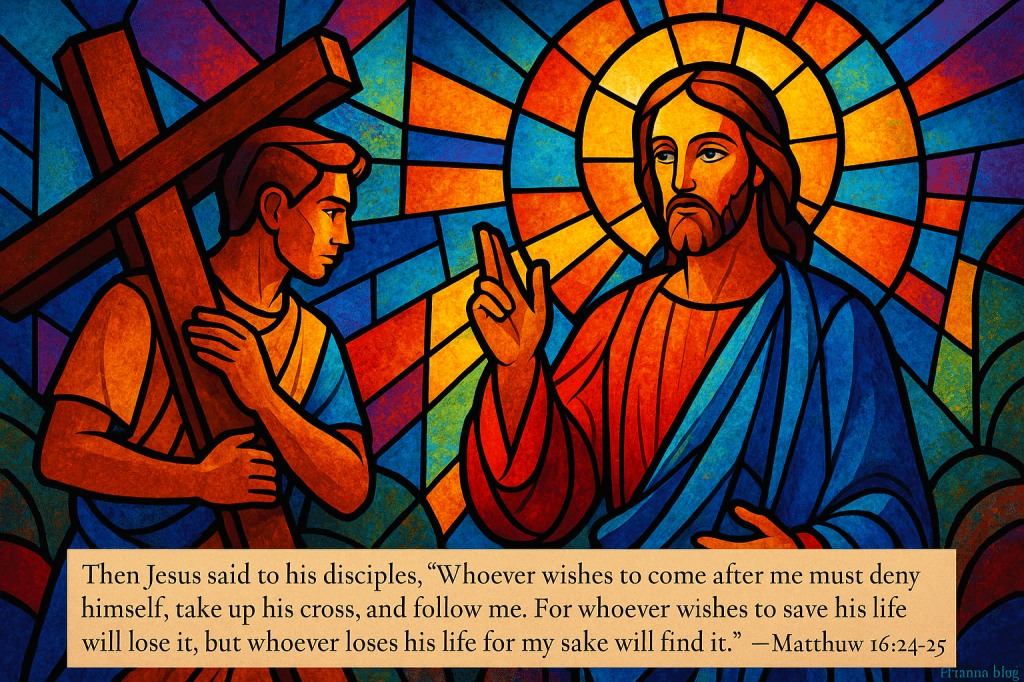
24 Then Jesus said to his disciples, “Whoever wishes to come after me must deny himself, take up his cross, and follow me. 25 For whoever wishes to save his life will lose it, but whoever loses his life for my sake will find it. 26 What profit would there be for one to gain the whole world and forfeit his life? Or what can one give in exchange for his life? 27 For the Son of Man will come with his angels in his Father’s glory, and then he will repay everyone according to his conduct. 28 Amen, I say to you, there are some standing here who will not taste death until they see the Son of Man coming in his kingdom.”
Detailed Exegesis
Verse 24 – “Then Jesus said to his disciples, ‘Whoever wishes to come after me must deny himself, take up his cross, and follow me.’”
This is one of the clearest summaries of Christian discipleship in the Gospels. Denial of self is not mere asceticism; it is the renunciation of autonomy in order to live for Christ. Taking up one’s cross is not metaphorical suffering—it is a willingness to embrace the sacrificial love that defines the Christian life. To follow Jesus means to go where He goes—ultimately, to Calvary.
Verse 25 – “For whoever wishes to save his life will lose it, but whoever loses his life for my sake will find it.”
This paradox is central to the Gospel. Clinging to control, comfort, or worldly identity leads to spiritual death. But surrendering all for Jesus brings eternal life. It’s important to note that this is not about self-destruction but self-offering. Christ invites us to imitate His love, which is total gift.
Verse 26 – “What profit would there be for one to gain the whole world and forfeit his life? Or what can one give in exchange for his life?”
Jesus confronts the false security of worldly success. Wealth, fame, and power are worthless if the soul is lost. This echoes the wisdom literature of the Old Testament and challenges every age. In an era of consumerism and individualism, these words strike at the heart: What am I trading my soul for?
Verse 27 – “For the Son of Man will come with his angels in his Father’s glory, and then he will repay everyone according to his conduct.”
Jesus shifts from present discipleship to future judgment. The Cross is not the end of the story—glory is coming. This verse affirms that our sacrifices are not in vain. Each act of love, each moment of surrender, will be weighed by Christ, the righteous Judge.
Verse 28 – “Amen, I say to you, there are some standing here who will not taste death until they see the Son of Man coming in his kingdom.”
This mysterious statement likely refers to the Transfiguration (which follows immediately in Matthew 17), the Resurrection, or even the birth of the Church at Pentecost. Either way, Jesus assures the disciples that the kingdom is already breaking in. Some of them would witness His glory in this life, even before the final fulfillment.
Teachings from the Church
The Catechism of the Catholic Church teaches: “The way of perfection passes by way of the Cross. There is no holiness without renunciation and spiritual battle” (CCC 2015). This Gospel passage is the blueprint for that spiritual path. It echoes Jesus’ own life and sets the standard for every disciple. The Catechism also states: “By his glorious Cross Christ has won salvation for all men. He redeemed them from the sin that held them in bondage” (CCC 617). Thus, the Cross is not only a call—it is our victory.
Saint Catherine of Siena, a spiritual daughter of Saint Dominic, once wrote: “We were created for Love, and redeemed in Love, and we are never so free as when we are nailed to the Cross with Christ.” Saint Dominic lived this truth by embracing voluntary poverty, tireless preaching, and constant prayer. He understood that the truth he carried was not just to be taught—it had to be embodied. Every Dominican friar carries the same cross-shaped mission: to follow Christ crucified in both word and deed.
Reflection
What does it mean for you to deny yourself and take up your cross? In a culture that worships comfort and personal freedom, these words of Jesus challenge us to reorient our desires. The Cross is not a punishment—it is a path. What attachments might you be clinging to that are keeping you from truly following Christ? Self-preservation often masquerades as wisdom, but Jesus invites us into a deeper trust.
Today, consider one area of your life where Jesus is asking for a “yes” that costs you something—time, ego, control, comfort. Bring it to Him in prayer. Are you trying to gain the world but losing your soul? Or are you ready to lose your life—for love—and finally find it? Like Saint Dominic, may we respond not with hesitation, but with fire. The kingdom has come, the path is marked, and the Cross stands before us. Let us rise and follow.
Kindled by Truth, Carried by the Cross
Today’s readings call us into a holy remembrance that does not remain in the past—it propels us forward into faithful discipleship. In Deuteronomy 4:32–40, we are invited to remember the God who spoke from the fire, who delivered Israel with a mighty hand, and who alone is worthy of our total allegiance. In Psalm 77, we see how memory becomes worship: the psalmist reflects on the wonders of old and rediscovers trust in God’s faithful love. And in Matthew 16:24–28, Jesus sets the conditions of discipleship with piercing clarity: “Whoever wishes to come after me must deny himself, take up his cross, and follow me.” These readings do not offer comfort without cost. They present a God who speaks, saves, and then calls us to respond with our lives.
Saint Dominic embraced this response fully. Burning with zeal for the salvation of souls, he preached the truth with gentleness and fire. He formed an Order rooted in Scripture, grounded in prayer, and poured out in sacrificial love. Dominic knew that to love God meant to love the truth—and to follow Christ meant to bear His Cross. His memory today invites us to ask: What fire are we carrying? What truth are we proclaiming? Are we willing to lose our lives for the One who gave His for us?
Let the witness of Saint Dominic inspire you to become a torchbearer in this age of shadows. Fix in your heart that the Lord is God—there is no other. Recall His mighty deeds. Meditate on His Word. And then rise each day to take up your cross, with courage and joy. Will you let your life become a living proclamation of the God who still speaks from the fire? Will you follow Him, all the way to glory?
Engage with Us!
We’d love to hear how today’s readings and the witness of Saint Dominic have spoken to your heart. Share your reflections in the comments below and join us in growing as a community rooted in truth, love, and the Cross. Let the Word of God transform your life—and inspire others by your witness!
Reflection Questions:
First Reading – Deuteronomy 4:32–40:
How have you seen God’s hand in your life like the people of Israel did? What wonders of the Lord do you need to recall and fix in your heart today?
Responsorial Psalm – Psalm 77:12–16, 21:
When you feel discouraged or distant from God, do you turn to His past faithfulness to renew your trust? What concrete practices can help you build a habit of sacred memory in your spiritual life?
Holy Gospel – Matthew 16:24–28:
What cross is Jesus asking you to take up right now? What part of your life are you clinging to that He may be asking you to surrender so that you may truly live?
Walk in faith today, remembering that the God who saved Israel, who raised Jesus from the dead, and who lit the heart of Saint Dominic on fire is with you now. Live boldly, love generously, speak truthfully—and do all things with the mercy and strength that Jesus Christ has taught us.
Follow us on Instagram and Facebook for more insights and reflections on living a faith-filled life.

 Holy Manna!
Leave a comment