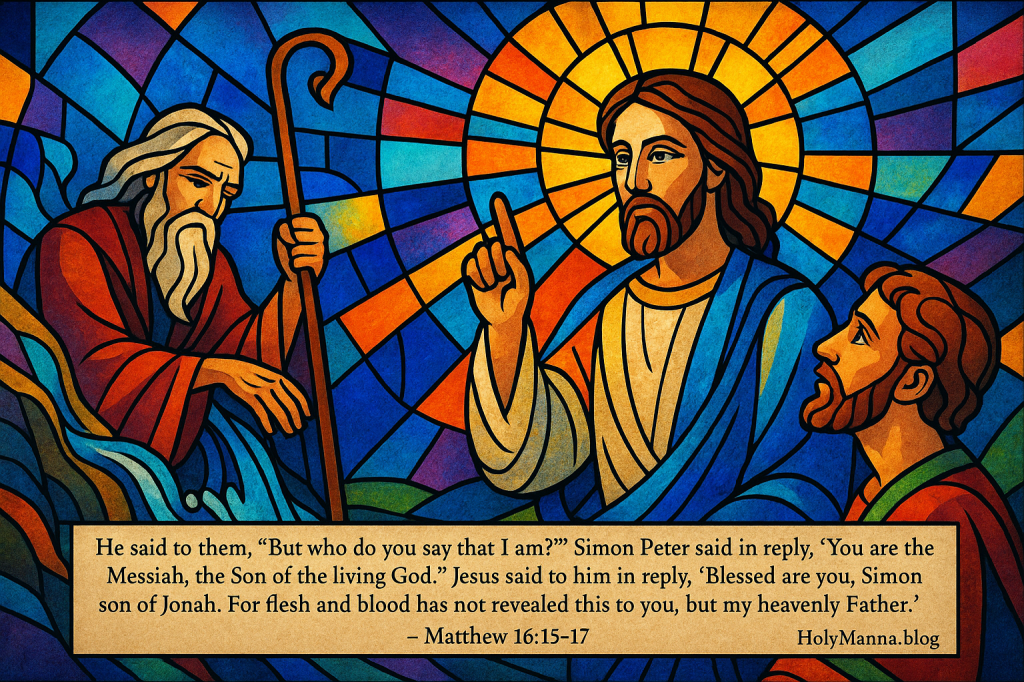
Thursday of the Eighteenth Week in Ordinary Time – Lectionary: 410
When the Rock Is Hard to Trust
Have you ever felt like God’s plan just didn’t make sense? Like you were doing everything right, but still left thirsty in a desert—confused, frustrated, maybe even angry? Today’s readings invite us to wrestle with those very moments, when obedience and trust feel the hardest, and when even our best intentions fall short of God’s holiness. From the wilderness of Zin to the gates of Caesarea Philippi, we encounter a recurring human struggle: the temptation to rely on our own reasoning instead of surrendering to God’s mysterious and perfect will.
In Numbers 20, we find Moses—a faithful leader worn down by the people’s complaints—striking the rock in frustration rather than speaking to it as God commanded. Though water flows, the act costs Moses and Aaron dearly. Their failure to uphold God’s holiness before the people points to a deeper spiritual truth: leadership and closeness to God demand not just obedience in action, but deep trust in heart. The Psalm 95 refrain—“Do not harden your hearts as at Meribah”—recalls this same episode, warning future generations not to test the Lord with grumbling disbelief. This psalm was likely used in liturgical worship to call Israel back to faithfulness through memory and praise. The cultural weight of Meribah is not merely geographical; it’s symbolic of the human heart when it resists God’s way.
That same tension appears in The Gospel of Matthew, when Peter—who moments earlier proclaims Jesus as “the Messiah, the Son of the living God”—is rebuked for rejecting the idea of a suffering Savior. In just a few verses, Peter moves from a vessel of divine revelation to a stumbling block. His reaction reveals a common spiritual trap: wanting God on our terms. But Jesus makes clear that to follow Him is to embrace the path of sacrificial love, not human success or safety. Taken together, today’s readings call us to reflect: Where am I resisting God’s way because it doesn’t align with my own understanding? Am I trusting the Rock, or striking it in frustration?
First Reading – Numbers 20:1–13
The Waters of Strife
As the Israelites continue their arduous journey through the wilderness, Numbers 20 captures a pivotal moment of spiritual tension, grief, and disobedience. The people have arrived at Kadesh, in the wilderness of Zin—a place already associated with testing and rebellion. The death of Miriam, a prophetess and sister to Moses and Aaron, sets a somber tone. Her passing marks the end of an era, and soon after, the community’s mounting anxiety about survival boils over into harsh complaints against their leaders. This passage reveals a crisis not only of physical thirst but of trust—both among the people and their leaders. While God’s mercy remains steady, this reading underscores the high cost of failing to honor His holiness, especially for those entrusted with spiritual authority. Within today’s theme, this passage lays the foundation for how hardened hearts and human frustration can lead even the most faithful astray when trust is lost.
Numbers 20:1-13
New American Bible (Revised Edition)
Death of Miriam. 1 The Israelites, the whole community, arrived in the wilderness of Zin in the first month, and the people stayed at Kadesh. It was here that Miriam died, and here that she was buried.
Need for Water at Kadesh. 2 Since the community had no water, they held an assembly against Moses and Aaron. 3 The people quarreled with Moses, exclaiming, “Would that we had perished when our kindred perished before the Lord! 4 Why have you brought the Lord’s assembly into this wilderness for us and our livestock to die here? 5 Why have you brought us up out of Egypt, only to bring us to this wretched place? It is not a place for grain nor figs nor vines nor pomegranates! And there is no water to drink!” 6 But Moses and Aaron went away from the assembly to the entrance of the tent of meeting, where they fell prostrate.
Sin of Moses and Aaron. Then the glory of the Lord appeared to them, 7 and the Lord said to Moses: 8 Take the staff and assemble the community, you and Aaron your brother, and in their presence command the rock to yield its waters. Thereby you will bring forth water from the rock for them, and supply the community and their livestock with water. 9 So Moses took the staff from its place before the Lord, as he was ordered. 10 Then Moses and Aaron gathered the assembly in front of the rock, where he said to them, “Just listen, you rebels! Are we to produce water for you out of this rock?” 11 Then, raising his hand, Moses struck the rock twice with his staff, and water came out in abundance, and the community and their livestock drank. 12 But the Lord said to Moses and Aaron: Because you did not have confidence in me, to acknowledge my holiness before the Israelites, therefore you shall not lead this assembly into the land I have given them.
13 These are the waters of Meribah, where the Israelites quarreled with the Lord, and through which he displayed his holiness.
Detailed Exegesis
Verse 1 – “The Israelites, the whole community, arrived in the wilderness of Zin in the first month, and the people stayed at Kadesh. It was here that Miriam died, and here that she was buried.”
Miriam’s death is deeply symbolic. As a co-leader with Moses and Aaron, she represents Israel’s spiritual past. Her burial in the wilderness—outside the Promised Land—echoes the consequences of Israel’s earlier disobedience. The mourning of a generation’s matriarch sets the emotional backdrop for what follows.
Verse 2 – “Since the community had no water, they held an assembly against Moses and Aaron.”
Scarcity of water was a serious threat to survival, but their reaction—forming an assembly against Moses and Aaron—reflects deep spiritual immaturity. Instead of trusting the God who had provided manna and quail, they return to complaint and rebellion.
Verse 3 – “The people quarreled with Moses, exclaiming, ‘Would that we had perished when our kindred perished before the Lord!’”
Their complaint is both irrational and blasphemous. They would rather have died in divine judgment than suffer in faith. This shows a hardened heart, as warned against in Psalm 95—“Do not harden your hearts as at Meribah”.
Verse 4 – “Why have you brought the Lord’s assembly into this wilderness for us and our livestock to die here?”
This is not a question of curiosity but accusation. They charge Moses and Aaron—and, indirectly, God—with malicious intent. It is a total loss of perspective on God’s covenant love.
Verse 5 – “Why have you brought us up out of Egypt, only to bring us to this wretched place? It is not a place for grain nor figs nor vines nor pomegranates! And there is no water to drink!”
The people idealize their past slavery and despise the slow path of freedom. Their mention of food and fruit contrasts with the Promised Land, showing they still long for physical comfort more than spiritual inheritance.
Verse 6 – “But Moses and Aaron went away from the assembly to the entrance of the tent of meeting, where they fell prostrate.”
Here, Moses and Aaron show the proper response—taking the people’s burdens to God. Falling prostrate signals humility and dependence, a moment of intercession that momentarily reorients the scene.
Verse 7 – “Then the glory of the Lord appeared to them,”
God responds to their humility with His glory, reaffirming His presence despite the people’s faithlessness. This echoes the Lord’s fidelity even when we stumble.
Verse 8 – “Take the staff and assemble the community, you and Aaron your brother, and in their presence command the rock to yield its waters. Thereby you will bring forth water from the rock for them, and supply the community and their livestock with water.”
God’s instructions are clear: speak to the rock. This is a test of faith and obedience. The staff symbolizes authority, but the miracle was to come from God’s word, not Moses’ force.
Verse 9 – “So Moses took the staff from its place before the Lord, as he was ordered.”
So far, Moses follows God’s command. The detail about taking the staff shows his intention to obey—but the true test is still coming.
Verse 10 – “Then Moses and Aaron gathered the assembly in front of the rock, where he said to them, ‘Just listen, you rebels! Are we to produce water for you out of this rock?’”
Moses’s tone shifts. His frustration erupts into insult and pride. The rhetorical question “Are we to produce…?” dangerously blurs the line between divine action and personal authority.
Verse 11 – “Then, raising his hand, Moses struck the rock twice with his staff, and water came out in abundance, and the community and their livestock drank.”
Water flows, but at a cost. Moses directly disobeys God by striking the rock instead of speaking to it. That he strikes it twice signals intensity—perhaps even desperation. God still provides, but this act dishonors His holiness.
Verse 12 – “But the Lord said to Moses and Aaron: Because you did not have confidence in me, to acknowledge my holiness before the Israelites, therefore you shall not lead this assembly into the land I have given them.”
This verse is both tragic and just. The leaders failed in public trust and did not reveal God’s holiness. The punishment is proportionate to their role: exclusion from the Promised Land. It is a sobering reminder that leadership carries accountability.
Verse 13 – “These are the waters of Meribah, where the Israelites quarreled with the Lord, and through which he displayed his holiness.”
The location is named after contention (“Meribah” means quarreling). Ironically, even through disobedience, God’s holiness is revealed—not through Moses’ actions, but in the contrast between human failure and divine faithfulness.
Teachings from the Church
The Catechism of the Catholic Church speaks clearly to this dynamic of trust and obedience in CCC 2119: “Tempting God consists in putting his goodness and almighty power to the test by word or deed… It always harbors doubt about his love, his providence, and his power.” This applies directly to the Israelites, and indirectly to Moses. Furthermore, CCC 2570 says, “Abraham’s faith was ‘credited to him as righteousness’ because he was ‘strong in his faith, giving glory to God,’ and ‘fully convinced that God was able to do what he had promised.’” In contrast, Moses and the people at Meribah failed to glorify God in this way.
Saint Augustine, reflecting on 1 Corinthians 10:4—“They drank from the spiritual rock that followed them, and the rock was Christ”—saw the rock as a type of Christ, and the striking of the rock as a profound mystery. Some early Church Fathers interpreted Moses’ action as symbolizing the people’s rejection of the Messiah, despite God’s abundant grace.
Reflection
In our lives, how often do we “strike the rock” when God asks us to speak in faith? Like Moses, we may feel overwhelmed, even justifiably frustrated, but spiritual maturity is measured not by emotions but by fidelity. God is not only the giver of water, but the one who teaches us to trust in the waiting. When we rely on our strength, we may get results—but at the cost of spiritual fruitfulness. Am I obeying God with reverence, or with resentment? Do I perform holy tasks while harboring unbelief? Today, let us ask for the grace to speak to the Rock, not strike it—and to honor God’s holiness by trusting in His ways, even when they don’t match our own.
Responsorial Psalm – Psalm 95:1–2, 6–9
Praise, Kneel, and Listen
Psalm 95 is both an invitation and a warning—one of the most well-known liturgical psalms in the Church’s history, especially used in morning prayer (the Invitatory Psalm in the Liturgy of the Hours). It opens with jubilant praise and worship, calling the faithful to rejoice before the Creator. But it quickly pivots, as if the psalmist knows that the heart prone to praise may also be prone to forget. The second half is a sober reminder of Meribah and Massah, where the Israelites tested the Lord despite His many works. This psalm, then, ties directly into the events of Numbers 20 and serves as a divine commentary on the First Reading. Today’s theme of trusting God even in confusion and hardship finds sharp focus here: when hearts harden, worship becomes hollow, and God’s voice is drowned out by fear and pride.
Psalm 95:1-2, 6-9
New American Bible (Revised Edition)
A Call to Praise and Obedience
1 Come, let us sing joyfully to the Lord;
cry out to the rock of our salvation.
2 Let us come before him with a song of praise,
joyfully sing out our psalms.
6 Enter, let us bow down in worship;
let us kneel before the Lord who made us.
7 For he is our God,
we are the people he shepherds,
the sheep in his hands.
Oh, that today you would hear his voice:
8 Do not harden your hearts as at Meribah,
as on the day of Massah in the desert.
9 There your ancestors tested me;
they tried me though they had seen my works.
Detailed Exegesis
Verse 1 – “Come, let us sing joyfully to the Lord; cry out to the rock of our salvation.”
This is a liturgical summons—a call to communal worship. The image of God as “the rock of our salvation” resonates powerfully with Numbers 20, where water came from the rock. But this line makes it clear: the rock is not just physical provision—it is God Himself. Joyful singing is not optional but the natural response to His saving power.
Verse 2 – “Let us come before him with a song of praise, joyfully sing out our psalms.”
Worship requires intention and heart. The repetition of joy—“joyfully sing out”—emphasizes that we do not come to God in fear or duty alone, but in gratitude and celebration. This verse reflects the posture we’re called to take: not demanding signs, but giving thanks for the ones we’ve already received.
Verse 6 – “Enter, let us bow down in worship; let us kneel before the Lord who made us.”
Here the mood deepens. Joy leads to reverence. The invitation to “bow down… kneel” reflects physical expressions of humility and awe. This is not emotionalism but proper orientation toward the Creator. In Hebrew worship, body and soul are united in praise.
Verse 7 – “For he is our God, we are the people he shepherds, the sheep in his hands.”
This line evokes the covenantal identity of Israel—and of us, the Church. God is not only Maker but Shepherd, tenderly guiding and protecting. Being “in his hands” reminds us of divine intimacy and care. Yet the metaphor also reminds us: sheep must listen and follow, or they wander into danger.
Verse 8 – “Oh, that today you would hear his voice: Do not harden your hearts as at Meribah, as on the day of Massah in the desert.”
This is the psalm’s turning point. The psalmist pleads—“Oh, that today…”—a desperate appeal not to repeat history. Meribah and Massah (see Exodus 17 and Numbers 20) are where the people doubted God’s presence. A hardened heart refuses to trust. This is the great danger: to appear devout in worship while deaf to His voice.
Verse 9 – “There your ancestors tested me; they tried me though they had seen my works.”
The gravity of the sin is clear: the people “tested” and “tried” God despite clear evidence of His faithfulness. The repetition underscores willful defiance, not ignorance. This verse calls us to examine our own hearts. Have we, too, demanded signs even after receiving grace?
Teachings from the Church
The Catechism of the Catholic Church repeatedly exhorts the faithful to cultivate a heart open to God’s Word. CCC 2090 teaches: “When God reveals Himself and calls him, man must respond with obedience of faith… This obedience is the personal adherence of man to God and the free assent to the whole truth that God has revealed.” The hardened heart refuses this obedience. Furthermore, CCC 2589 highlights the psalms as “the masterwork of prayer in the Old Testament… They remain essential to the prayer of the Church.” This means that Psalm 95 is not a relic of Israel’s past, but a living word meant to form our spiritual posture today.
Saint Benedict, in the Rule of Saint Benedict, chose Psalm 95 to begin each day’s prayers. The first words a monk would chant upon waking were: “If today you hear his voice, harden not your hearts.” This daily repetition formed hearts that remained soft, humble, and responsive to God. It reminds us that the dangers of Meribah are not locked in history—they echo in every generation.
Reflection
Psalm 95 holds up a mirror to our worship. Do we come to the Lord with joy, reverence, and trust? Or are we mouthing songs while nursing bitter doubts in our hearts? God does not ask for perfect emotions—but for soft hearts. Hearts that listen, trust, and surrender. When I’m suffering or confused, do I turn to praise—or complaint? Do I worship only when I understand, or even when I don’t? Today, let us begin our prayer by saying this psalm with attention. Let us kneel—literally or figuratively—and confess that God is the Rock, not just of salvation, but of every dry place in our life. May we not repeat the quarrels of Meribah, but be the sheep who recognize the voice of the Shepherd, and follow where He leads.
Holy Gospel – Matthew 16:13–23
The Rock and the Reprimand: When Faith Meets the Cross
The Gospel of Matthew presents a profound moment of identity and revelation in today’s passage. Jesus brings His disciples to Caesarea Philippi, a city known for its pagan temples and devotion to Caesar. In this spiritually contested space, Jesus asks the most important question of the Gospel: “Who do you say that I am?” Peter’s confession that Jesus is the Christ, the Son of the living God, becomes the rock upon which the Church is built. And yet, in the very same scene, Peter resists the idea of a suffering Messiah and is sharply rebuked: “Get behind me, Satan!” This dramatic pivot exposes a critical truth—faith in Jesus must go beyond words; it must conform to the mystery of the Cross. Today’s Gospel fits our central theme perfectly: trusting God’s ways even when they defy our understanding. Like Peter, we are often tempted to celebrate the glory of Christ while rejecting the suffering that precedes it.
Matthew 16:13-23
New American Bible (Revised Edition)
13 When Jesus went into the region of Caesarea Philippi he asked his disciples, “Who do people say that the Son of Man is?” 14 They replied, “Some say John the Baptist, others Elijah, still others Jeremiah or one of the prophets.” 15 He said to them, “But who do you say that I am?” 16 Simon Peter said in reply, “You are the Messiah, the Son of the living God.” 17 Jesus said to him in reply, “Blessed are you, Simon son of Jonah. For flesh and blood has not revealed this to you, but my heavenly Father. 18 And so I say to you, you are Peter, and upon this rock I will build my church, and the gates of the netherworld shall not prevail against it. 19 I will give you the keys to the kingdom of heaven. Whatever you bind on earth shall be bound in heaven; and whatever you loose on earth shall be loosed in heaven.” 20 Then he strictly ordered his disciples to tell no one that he was the Messiah.
The First Prediction of the Passion. 21 From that time on, Jesus began to show his disciples that he must go to Jerusalem and suffer greatly from the elders, the chief priests, and the scribes, and be killed and on the third day be raised. 22 Then Peter took him aside and began to rebuke him, “God forbid, Lord! No such thing shall ever happen to you.” 23 He turned and said to Peter, “Get behind me, Satan! You are an obstacle to me. You are thinking not as God does, but as human beings do.”
Detailed Exegesis
Verse 13 – “When Jesus went into the region of Caesarea Philippi he asked his disciples, ‘Who do people say that the Son of Man is?’”
Caesarea Philippi was a Gentile stronghold, filled with idols and imperial propaganda. Jesus chooses this backdrop to ask about His identity—subtly challenging the authority of Caesar and pagan deities. His use of “Son of Man” evokes Daniel 7:13 and emphasizes both humility and divine authority.
Verse 14 – “They replied, ‘Some say John the Baptist, others Elijah, still others Jeremiah or one of the prophets.’”
The disciples report public opinion, which recognizes Jesus as a prophetic figure. These guesses are flattering, but fall short. The crowd sees power and holiness, but misses divinity.
Verse 15 – “He said to them, ‘But who do you say that I am?’”
This is the heart of the passage. The question is personal, immediate, and unavoidable. Every disciple must eventually answer it—not with theology alone, but with the heart. How do I respond when Jesus asks me this today?
Verse 16 – “Simon Peter said in reply, ‘You are the Messiah, the Son of the living God.’”
Peter’s response is bold, correct, and divinely inspired. “Messiah” means the Anointed One—the fulfillment of Israel’s hopes. “Son of the living God” affirms Christ’s divinity in contrast to the dead idols of Caesarea Philippi. This is a pivotal moment in salvation history.
Verse 17 – “Jesus said to him in reply, ‘Blessed are you, Simon son of Jonah. For flesh and blood has not revealed this to you, but my heavenly Father.’”
Peter is praised not for clever insight, but for openness to divine revelation. Faith is a gift. Jesus affirms that Peter’s confession comes from the Father, not from mere human reasoning.
Verse 18 – “And so I say to you, you are Peter, and upon this rock I will build my church, and the gates of the netherworld shall not prevail against it.”
This is the foundation of the papacy. Jesus renames Simon as “Peter” (Petros = rock) and establishes him as the visible head of the Church. This authority is spiritual and structural. The Church is built not on Peter’s perfection, but on his confession of faith and his mission. The “gates of the netherworld” (Sheol) will not overcome the Church—a promise of divine protection and eschatological hope.
Verse 19 – “I will give you the keys to the kingdom of heaven. Whatever you bind on earth shall be bound in heaven; and whatever you loose on earth shall be loosed in heaven.”
This language mirrors Isaiah 22:22, where Eliakim is given the keys to the House of David. Jesus gives Peter real, spiritual authority—the power to teach, govern, and absolve sins. The keys symbolize stewardship and responsibility over the household of God.
Verse 20 – “Then he strictly ordered his disciples to tell no one that he was the Messiah.”
Jesus wants to avoid political misunderstanding. Many expected a military or revolutionary Messiah. Until the Cross and Resurrection, His mission would be misinterpreted.
Verse 21 – “From that time on, Jesus began to show his disciples that he must go to Jerusalem and suffer greatly from the elders, the chief priests, and the scribes, and be killed and on the third day be raised.”
This is the first prediction of the Passion. Jesus now reveals the cost of His messianic identity. The journey to glory must pass through suffering. He tells them plainly, showing that divine love embraces sacrifice.
Verse 22 – “Then Peter took him aside and began to rebuke him, ‘God forbid, Lord! No such thing shall ever happen to you.’”
Peter’s human reasoning kicks in. His love is real, but misguided. He wants glory without the Cross—something we all desire at times. His reaction is natural, but spiritually immature.
Verse 23 – “He turned and said to Peter, ‘Get behind me, Satan! You are an obstacle to me. You are thinking not as God does, but as human beings do.’”
The rebuke is fierce and necessary. Jesus addresses Peter as “Satan” because he echoes the devil’s temptation to avoid the Cross. Yet Jesus does not reject Peter—He calls him back to discipleship: “Get behind me” literally means, Return to your place as follower. Peter must learn that love requires trust in God’s plan, not control over it.
Teachings from the Church
The Church builds much of her ecclesiology on this passage. CCC 552 teaches: “Simon Peter holds the first place in the college of the Twelve; Jesus entrusted a unique mission to him. Through a revelation from the Father, Peter had confessed: ‘You are the Christ, the Son of the living God.’ Our Lord then declared to him: ‘You are Peter, and on this rock I will build my Church.’” The Catechism affirms that the Church’s endurance and unity are rooted in this confession and this office.
At the same time, the Church recognizes the tension in Peter’s journey. As CCC 440 explains, “Jesus accepted Peter’s profession of faith, which acknowledged him to be the Messiah, by announcing the imminent Passion of the Son of Man. He unveiled the authentic content of his messianic kingship both in the transcendent identity of the Son of Man ‘who came down from heaven,’ and in his redemptive mission as the suffering Servant.”
Saint John Chrysostom notes that Peter’s fall here is not permanent but formative. He writes, “Do you see how many times Peter sins? He is reproved, he confesses, he is praised, he is blamed. This is so you may not be discouraged if you too fall, for Peter fell often and rose often.”
Reflection
This Gospel strikes close to home. We may declare Jesus as Lord with boldness—and then, in the next moment, resist His will. Do I accept Christ’s identity but reject His path? Do I expect glory without the Cross in my own life or in others’? Peter reminds us that faith is not a one-time statement, but a lifelong surrender to God’s way. Today, Jesus asks each of us: “Who do you say that I am?” Let us answer not just with words, but with trust. Let us follow the Rock, even when the road leads through suffering. For only then will we discover that the Cross is not the end—but the doorway to resurrection.
Hearts Soft Enough to Follow the Rock
Today’s readings trace a powerful journey from wilderness to worship, from revelation to rebuke, from thirst to trust. In Numbers 20, we saw the Israelites cry out in fear and frustration, and Moses—overwhelmed—struck the rock instead of obeying God’s command. It was a moment of human weakness, born not from hatred, but from a tired heart that had lost sight of God’s holiness. In Psalm 95, the Church invites us to sing with joy, bow in reverence, and heed the warning: “Do not harden your hearts as at Meribah”. That same spiritual drama plays out in The Gospel of Matthew, where Peter is praised for confessing Jesus as “the Son of the living God”, yet quickly rebuked for resisting the suffering that would bring salvation.
All of these readings point us to a central truth: trust in God must include trust in His way—even when that way includes suffering, waiting, or mystery. To strike the rock instead of speaking to it is to rely on ourselves. To rebuke the Messiah when He speaks of the Cross is to cling to comfort rather than covenant. And yet, God does not abandon us. He still provides the water. He still builds the Church. He still calls us forward.
Is my heart soft enough to hear His voice today? Am I following Jesus as He is, or as I want Him to be? Let today be a turning point. Let us praise God with joy, kneel before Him in reverence, and follow Him with trust—even when the path doesn’t make sense. For the Rock is not just where water flows. The Rock is Christ. And He will never fail those who trust in Him.
Engage with Us!
We’d love to hear how today’s Word has touched your heart. Which verse challenged you? Which comforted you? Share your thoughts, prayers, or insights in the comments below. Let’s grow together as a community rooted in trust and holiness.
Reflection Questions
First Reading – Numbers 20:1–13
Have I ever “struck the rock” when God asked me to trust and obey? In what ways am I being invited to honor God’s holiness in the midst of frustration or leadership?
Responsorial Psalm – Psalm 95:1–2, 6–9
Is my worship rooted in joy and reverence, or is it clouded by a hardened heart? What would it look like to truly “hear His voice” today and respond with trust?
Holy Gospel – Matthew 16:13–23
Do I proclaim Jesus as Lord while resisting His call to embrace the Cross? What part of God’s plan for my life am I tempted to reject because it feels too difficult or painful?
May today’s readings inspire us to walk humbly with our God, to keep our hearts soft in worship and obedience, and to trust in the Rock who is Christ. Let us live every moment with the faith, courage, and mercy that Jesus taught us, knowing that He walks beside us—even when the path winds through the wilderness.
Follow us on Instagram and Facebook for more insights and reflections on living a faith-filled life.

 Holy Manna!
Leave a comment