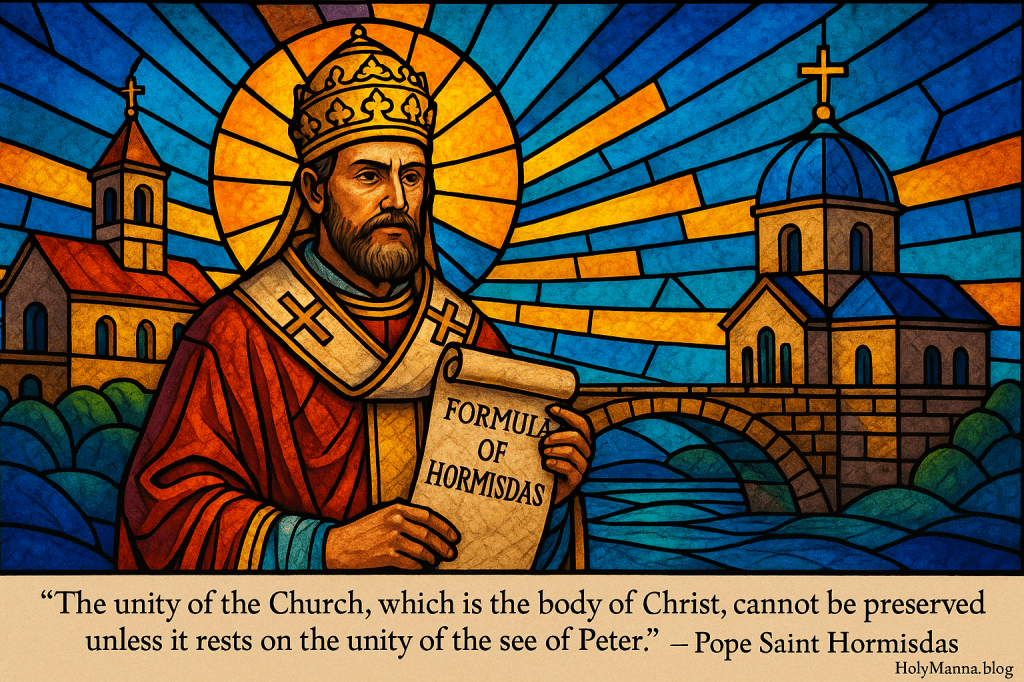
A Bridge Between East and West
Pope Saint Hormisdas is remembered as a shepherd of peace during one of the most turbulent times in Church history. Living in the early sixth century, he served as pope from 514 to 523 AD and is most revered for healing a massive rift between the Eastern and Western Churches known as the Acacian Schism. A man of deep diplomacy and uncompromising orthodoxy, Hormisdas is a shining example of leadership rooted in humility and truth. Through his steadfastness and faith, the Church was reconciled after a decades-long theological divide—making his legacy not only historical, but profoundly spiritual. His feast day is celebrated on August 6.
From a Layman to the Chair of Peter
Hormisdas was born in Frosinone, Italy, around the year 450, into a Christian family. He was a married man and father before entering the clergy—his son would later become Pope Silverius, making Hormisdas one of the few popes who was also the father of a future pope. Widowed at some point, Hormisdas eventually entered ecclesiastical service and became a deacon under Pope Symmachus.
He lived through intense Church conflict during the Laurentian Schism and the lingering effects of the Acacian Schism, which had caused a painful division between Constantinople and Rome. Hormisdas remained faithful to the See of Peter and showed great prudence and virtue during these challenges. When Pope Symmachus died, Hormisdas was elected pope with strong support, largely due to his reputation for holiness, wisdom, and integrity.
Hormisdas is most remembered for his role in ending the Acacian Schism, a division that had lasted 35 years and threatened the unity of Christendom. By working patiently and persistently with Eastern leaders—while never compromising on truth—he became a model of reconciliation without relativism.
The Healer of Schism
Pope Hormisdas’s pontificate is marked by his deep concern for unity, particularly the healing of the Church’s wounds caused by the Acacian Schism. This schism arose when Patriarch Acacius of Constantinople attempted to compromise on Christological doctrine in a way that pleased the Monophysites but contradicted the Council of Chalcedon’s definition of Christ as true God and true man.
Hormisdas refused any unity based on theological ambiguity. Instead, he sent a clear profession of faith known as the “Formula of Hormisdas” to Eastern bishops and the emperor. This document affirmed “the Apostolic See has always remained unsullied by error” and called for a return to communion with the See of Peter. After many years of diplomatic negotiation, the Eastern Church finally accepted the formula in 519, under Emperor Justin I and Patriarch John of Constantinople. The schism was healed.
Though not known for spectacular miracles, Pope Hormisdas performed a spiritual miracle of epic proportions—restoring the visible unity of the Church. His leadership preserved the doctrine of the Incarnation and upheld the authority of Rome in a time of dangerous confusion. He also worked to protect the Church from political manipulation, asserting the independence of the papacy from imperial control.
Endurance Without Martyrdom
Pope Hormisdas did not suffer martyrdom, but his papacy was filled with intense political and theological strife. The challenges he faced—rival claimants to the papacy, heretical pressures, and the need for Eastern-Western reconciliation—required heroic patience and courage. He dealt not only with ecclesiastical issues but also with civil interference from Theodoric the Ostrogoth, who ruled Italy at the time.
Yet, through it all, Hormisdas remained faithful to the truth. He endured criticism, political pressures, and setbacks without wavering. He is a witness to how suffering can purify and elevate leadership, especially when one’s eyes are fixed on Christ and His Church.
A Legacy that Echoes Beyond the Grave
Although Pope Hormisdas was not associated with posthumous miracles in the traditional sense—such as healings or supernatural phenomena—his enduring legacy is itself miraculous. The unity he forged continues to inspire ecumenical efforts and doctrinal clarity to this day. His relics were venerated in the Basilica of Saint Peter in Rome, and his feast continues to be celebrated as a reminder of the power of peace rooted in truth.
The formula he crafted—the “Formula of Hormisdas”—remains a powerful testimony to papal primacy and the importance of fidelity to the apostolic tradition. In this way, Pope Saint Hormisdas’ voice still echoes in the Church, inviting us to unity, not through compromise, but through fidelity to Christ.
Building Bridges with Truth and Grace
In today’s world, we too often confuse peace with appeasement and unity with uniformity. Pope Saint Hormisdas teaches us that authentic unity must be founded on truth, even if that truth is hard. His life reminds us that fidelity to Christ may require patience, negotiation, and even confrontation—but always with a heart rooted in charity.
Are there areas in your life where God is calling you to be a bridge-builder? Are you tempted to compromise truth for the sake of comfort or human approval? Can you stand firm in love, like Hormisdas, even when the world pressures you to remain silent?
Let us learn from Pope Saint Hormisdas that reconciliation must be rooted in conviction. Through prayer, humility, and courage, we too can help heal the wounds around us—in our families, communities, and even within the Church.
Engage with Us!
We’d love to hear how this post inspired you! Share your thoughts and reflections in the comments below. Let’s grow together as a community of faith, rooted in the courage and wisdom of the saints.
Reflection Questions:
- How do you respond to conflict—do you seek truth or simply peace at any cost?
- Where in your life might God be calling you to be an agent of unity?
- What practical steps can you take this week to be more rooted in truth and love?
Let’s support each other on this journey of faith and remember to do everything with love—just as our Lord Jesus did.
Pope Saint Hormisdas, pray for us! 📜
Follow us on Instagram and Facebook for more insights and reflections on living a faith-filled life.

 Holy Manna!
Leave a comment