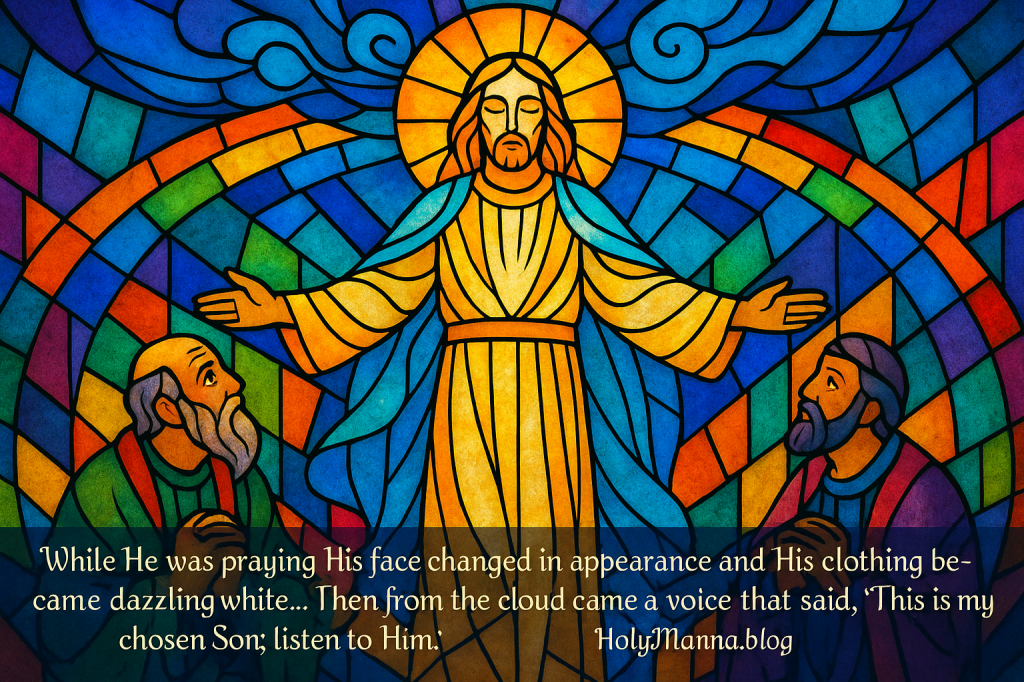
Feast of the Transfiguration of the Lord – Lectionary: 614
Beholding the Glory
Have you ever stood in awe before something so radiant, so beautiful, that it left you speechless—changed? That’s what today’s Feast invites us into: a stunning glimpse of glory that transforms not just how we see Jesus, but how we live with hope. The Transfiguration of the Lord is one of the most breathtaking moments in the Gospels, where Jesus pulls back the veil and reveals who He truly is—not merely a teacher or prophet, but the Eternal Son, clothed in divine majesty. In this luminous moment, heaven touches earth, the Law and the Prophets bear witness, and the Father’s voice commands: “This is my chosen Son; listen to him” (Luke 9:35).
Each of today’s readings leads us up the mountain to this mystery. In Daniel 7, we hear of a majestic throne room where “One like a son of man” is given dominion by the “Ancient of Days”. This prophetic vision, written centuries before Christ, sets the stage for the coming Messiah whose reign will never end. Psalm 97 responds with reverent praise for the Lord who is already enthroned above all the earth—whose justice and glory melt mountains and make the heavens sing. Then, in 2 Peter 1:16–19, Peter breaks the silence to tell us what he saw with his own eyes: Jesus transfigured in radiant light, heard the Father’s voice, and now urges us to cling to this “lamp shining in a dark place” until Christ rises in our hearts.
Historically, this feast has been celebrated in both East and West as a window into Christ’s divinity and a foretaste of His Resurrection glory. It marks a turning point in the Gospel narrative, occurring shortly before Jesus begins His journey toward the Cross. Culturally, it echoes the awe-inspiring theophanies of the Old Testament—like Moses on Sinai and Elijah on Horeb—yet now fulfilled in Jesus. Spiritually, it invites us to be transfigured with Him, to leave behind spiritual sleep and behold Him anew. Are we ready to follow Him down the mountain and carry that vision into our daily lives?
First Reading – Daniel 7:9–10, 13–14
The Crowned Son of Man
The Book of Daniel transports us into the realm of prophetic visions, where human history and heavenly reality intersect. In today’s reading, we are given a rare glimpse into the divine courtroom where God, the Ancient of Days, sits enthroned in majesty, surrounded by flames and myriads of angelic attendants. Amid this awe-inspiring scene emerges “One like a son of man”, who is presented before God and given everlasting dominion and glory. For the Jewish people living under oppressive foreign rule, this vision was a powerful proclamation of hope—a promise that one day God’s true King would rule forever in justice and splendor.
This reading is foundational for understanding the identity and mission of Jesus Christ, especially as revealed in the Transfiguration. When Jesus refers to Himself as the Son of Man throughout the Gospels, He is drawing directly from this passage in Daniel. The dazzling glory seen by the apostles on Mount Tabor is a visible manifestation of the eternal kingship described here. Today’s feast allows us to see that the one who will suffer and die is also the one who reigns eternally—His kingdom is not of this world, but it is breaking into our world through Him. Are our hearts ready to receive the King whose glory outshines every earthly power?
Daniel 7:9-10, 13-14
New American Bible (Revised Edition)
9 As I watched,
Thrones were set up
and the Ancient of Days took his throne.
His clothing was white as snow,
the hair on his head like pure wool;
His throne was flames of fire,
with wheels of burning fire.
10 A river of fire surged forth,
flowing from where he sat;
Thousands upon thousands were ministering to him,
and myriads upon myriads stood before him.
The court was convened, and the books were opened.
13 As the visions during the night continued, I saw coming with the clouds of heaven
One like a son of man.
When he reached the Ancient of Days
and was presented before him,
14 He received dominion, splendor, and kingship;
all nations, peoples and tongues will serve him.
His dominion is an everlasting dominion
that shall not pass away,
his kingship, one that shall not be destroyed.
Detailed Exegesis
Verse 9 – “As I watched, Thrones were set up and the Ancient of Days took his throne. His clothing was white as snow, the hair on his head like pure wool; His throne was flames of fire, with wheels of burning fire.”
This verse sets the stage for a heavenly courtroom. The “Ancient of Days” is a unique and mysterious title for God, emphasizing His eternal nature and supreme authority. The white clothing and hair symbolize purity and wisdom (see Revelation 1:14), while the fiery throne reflects judgment and divine power. The image of “wheels of burning fire” evokes the mobile glory throne seen in Ezekiel 1, signifying God’s omnipresence and might.
Verse 10 – “A river of fire surged forth, flowing from where he sat; Thousands upon thousands were ministering to him, and myriads upon myriads stood before him. The court was convened, and the books were opened.”
This river of fire reinforces the overwhelming holiness and power of God’s presence—nothing impure can withstand it. The countless angels reflect the heavenly host in constant worship and service, echoing Revelation 5:11. The opening of the books indicates divine judgment, where all deeds are laid bare before the eternal Judge. This moment anticipates the Final Judgment (cf. CCC 1021–1022), where Christ will return in glory.
Verse 13 – “As the visions during the night continued, I saw coming with the clouds of heaven One like a son of man. When he reached the Ancient of Days and was presented before him,”
This is one of the most pivotal messianic verses in the Old Testament. The “one like a son of man” is both human and divine—he comes “with the clouds”, a sign of divinity throughout Scripture. Jesus adopts this title more than any other for Himself in the Gospels. The image of Him being presented before the Father foreshadows His heavenly enthronement after the Resurrection and Ascension (see Acts 1:9–11, CCC 659).
Verse 14 – “He received dominion, splendor, and kingship; all nations, peoples and tongues will serve him. His dominion is an everlasting dominion that shall not pass away, his kingship, one that shall not be destroyed.”
Here, we see the heavenly enthronement of the Messiah. Unlike earthly kingdoms, His is eternal, universal, and indestructible. This verse resonates with the declaration at the Transfiguration: “This is my chosen Son”—Jesus is not only the fulfillment of prophecy but the eternal King whose reign brings salvation. This dominion finds its echo in the Church’s teaching that Christ is Lord over all creation (CCC 668–670).
Teachings of the Church
The Church Fathers, especially Saints Jerome and Augustine, understood the “Son of Man” in Daniel as a clear reference to the coming Messiah. Saint Thomas Aquinas comments that “the Son of Man is the one who will come with power and majesty on the clouds, to judge the living and the dead” (Summa Theologica, III, q.59, a.1). The Catechism of the Catholic Church confirms this interpretation: “The Church… awaits the return of Christ in glory, when his Messianic kingdom will be fulfilled. Christ the Lord already reigns through the Church, but all things of this world are not yet subjected to him” (CCC 671).
Liturgically, the Church links Daniel’s vision to both the Ascension and the Transfiguration. During the Transfiguration, Christ reveals in visible light what Daniel foresaw in visionary symbols: His divine authority, eternal kingship, and radiant glory. This reading teaches us that Jesus is not just the fulfillment of prophecy, but the one who brings about a kingdom that cannot be shaken (Hebrews 12:28).
Reflection
Have you allowed Jesus to reign in every area of your life? The vision of Daniel isn’t just about a distant future—it’s a reality now breaking into the present. Jesus, the “Son of Man”, reigns today in the Church, in the Eucharist, and in every heart that submits to His Lordship. Yet how often do we treat His kingship as optional? Do we truly believe His dominion will never be destroyed, even when the world seems to crumble around us?
Like the apostles on the mountain, we are called to behold Christ’s glory and listen to His voice. But we are also called to follow Him down the mountain into the struggles of daily life, carrying that vision of divine truth with us. What areas of your life still resist His rule? What would it look like to live each day as a citizen of an everlasting kingdom? Let this vision ignite your hope, purify your heart, and renew your desire to serve the King who will never be dethroned.
Responsorial Psalm – Psalm 97:1–2, 5–6, 9
The Glory of the King Who Reigns from the Mountain
Today’s Responsorial Psalm sings in perfect harmony with the majestic vision of Daniel 7 and the radiant glory of the Transfigured Christ in Luke 9. Psalm 97 is part of a group of enthronement psalms that exalt the Lord as King over all creation. Likely composed during or after the Babylonian exile, these psalms were liturgical affirmations that despite appearances, it is the Lord—not pagan kings or earthly powers—who reigns supreme. These verses echo the Old Testament’s mountain theophanies, especially Sinai, and they prefigure the New Testament revelation of God’s glory on another mount: the Mount of Transfiguration.
In the context of the Transfiguration, Psalm 97 takes on a deeper resonance. As Peter, James, and John stood trembling on the mountain, witnessing Jesus in dazzling light, they were beholding the very majesty that this psalm describes. The clouds, the glory, the justice—all the elements of divine kingship proclaimed in Psalm 97 were made flesh in Christ. The psalm reminds us that what the apostles experienced was not just a private moment of awe, but a public revelation of the cosmic truth: Jesus is Lord of all the earth. His throne is founded on justice, and His glory is seen by all who have eyes to see.
Psalm 97:1-2, 5-6, 9
New American Bible (Revised Edition)
The Divine Ruler of All
1 The Lord is king; let the earth rejoice;
let the many islands be glad.
2 Cloud and darkness surround him;
justice and right are the foundation of his throne.
5 The mountains melt like wax before the Lord,
before the Lord of all the earth.
6 The heavens proclaim his justice;
all peoples see his glory.
9 For you, Lord, are the Most High over all the earth,
exalted far above all gods.
Detailed Exegesis
Verse 1 – “The Lord is king; let the earth rejoice; let the many islands be glad.”
This verse declares the universal kingship of God with joy and confidence. The use of the present tense—“The Lord is king”—is a liturgical proclamation, not just a theological claim. The “many islands” symbolize the farthest reaches of the earth, indicating that God’s reign is not limited to Israel but extends to the nations. This affirms the theme of universality found in Daniel 7:14, where “all nations, peoples and tongues will serve him.”
Verse 2 – “Cloud and darkness surround him; justice and right are the foundation of his throne.”
This verse evokes the mystery and awe of God’s presence, reminiscent of the cloud on Mount Sinai (Exodus 19:9) and the cloud at the Transfiguration (Luke 9:34). The phrase “justice and right” as the foundation of His throne reveals the moral character of God’s reign—it is not arbitrary or cruel, but rooted in holiness and truth. The Church teaches that God’s justice is inseparable from His mercy (CCC 2009), and that His authority is exercised in righteousness.
Verse 5 – “The mountains melt like wax before the Lord, before the Lord of all the earth.”
Mountains, often symbols of strength and permanence, dissolve before the presence of God. This verse poetically illustrates the overwhelming power of divine glory. In the Transfiguration, the apostles witnessed this very reality as the mountain itself became a stage for divine manifestation. The phrase “Lord of all the earth” reiterates the universal dominion of Christ as revealed in today’s feast.
Verse 6 – “The heavens proclaim his justice; all peoples see his glory.”
This verse links cosmic order with divine justice. The heavens themselves—sun, moon, stars—testify to God’s righteousness, and all peoples are invited to perceive His glory. In the Transfiguration, it was not just the heavens but the Son Himself who radiated divine justice and glory. This verse aligns closely with Peter’s testimony in 2 Peter 1:17, where he recalls Jesus receiving “honor and glory from God the Father.”
Verse 9 – “For you, Lord, are the Most High over all the earth, exalted far above all gods.”
This closing declaration dismisses all idolatry and false power. The Lord is supreme—not just a local deity, but the “Most High” over all. In light of the Transfiguration, we see that Jesus is not just another prophet but the Incarnate Word, exalted far above Moses, Elijah, and any earthly power. His kingship is incomparable, and His name is above all names (Philippians 2:9).
Teachings of the Church
The Church proclaims with unwavering faith that Christ is the King not only of the Church but of the universe. The Catechism of the Catholic Church states: “Christ is Lord of eternal history. He is the Lord of the cosmos and of history, in him human history and indeed all creation are ‘set forth’ and transcendently fulfilled” (CCC 668). This echoes the theology of Psalm 97, which declares the Lord’s sovereignty over nature, nations, and even false gods.
Saint John Chrysostom, reflecting on God’s kingship, wrote: “He who governs heaven and earth and all creatures is not to be questioned but worshipped. His justice is the cause of all joy” (Homily on the Psalms). In this way, the Psalm not only comforts us with the assurance of God’s rule but also challenges us to trust in His justice, even when His ways are hidden in the cloud and darkness.
Reflection
How often do we forget that the Lord is already King? In the midst of worldly instability, personal suffering, or moral confusion, it is easy to think God is distant. But Psalm 97 invites us to rejoice—not because life is easy, but because God reigns. His justice will prevail, His glory will be revealed, and His throne is unshakable. Do we live as if Jesus is Lord of our daily decisions, our relationships, and our struggles?
Like the apostles on the mountain, we are called to see His glory—and then to carry that light into the valleys below. Let the image of His throne and the sound of the Father’s voice echo in your heart today. What needs to melt away like wax before the Lord’s presence in your life? And how can you proclaim His kingship through joy, prayer, and surrender? The mountains tremble before Him—so should our pride. Let us listen, let us rejoice, and let us live as citizens of the King.
Second Reading – 2 Peter 1:16–19
Eyewitnesses to Glory
As the early Church faced growing persecution and confusion, Saint Peter wrote his second letter to strengthen the faith of believers and defend the truth of the Gospel. False teachers had begun to twist the message of Christ, denying His second coming and casting doubt on the apostolic witness. In response, Peter delivers a powerful testimony rooted in personal experience. He reminds his readers that what the apostles proclaimed was not myth or fabrication—it was grounded in real events, especially the Transfiguration, where Peter, James, and John beheld the majesty of Christ and heard the voice of the Father.
This reading is uniquely suited to today’s feast because it provides a firsthand reflection on what happened on that holy mountain. Peter doesn’t merely describe a vision—he describes an encounter. He saw Jesus clothed in divine radiance, heard the voice from heaven, and now urges the faithful to pay close attention to the prophetic message, comparing it to a lamp that shines in the dark. On the Feast of the Transfiguration, Peter’s words invite us not only to admire Christ’s glory but to anchor our lives in it. His testimony becomes our reassurance: the light we follow is not an illusion—it is the radiance of the Risen Lord.
2 Peter 1:16-19
New American Bible (Revised Edition)
16 We did not follow cleverly devised myths when we made known to you the power and coming of our Lord Jesus Christ, but we had been eyewitnesses of his majesty. 17 For he received honor and glory from God the Father when that unique declaration came to him from the majestic glory, “This is my Son, my beloved, with whom I am well pleased.” 18 We ourselves heard this voice come from heaven while we were with him on the holy mountain. 19 Moreover, we possess the prophetic message that is altogether reliable. You will do well to be attentive to it, as to a lamp shining in a dark place, until day dawns and the morning star rises in your hearts.
Detailed Exegesis
Verse 16 – “We did not follow cleverly devised myths when we made known to you the power and coming of our Lord Jesus Christ, but we had been eyewitnesses of his majesty.”
Peter draws a clear line between the Gospel and the pagan myths common in the Greco-Roman world. Unlike the fables of the gods, the message of Christ is rooted in historical fact and personal witness. The phrase “power and coming” points both to Jesus’ Transfiguration and His future return in glory. By calling himself an “eyewitness of his majesty,” Peter affirms that he saw with his own eyes the divine nature of Christ unveiled.
Verse 17 – “For he received honor and glory from God the Father when that unique declaration came to him from the majestic glory, ‘This is my Son, my beloved, with whom I am well pleased.’”
Peter recounts the moment of the Father’s declaration during the Transfiguration. The “majestic glory” refers to the presence of God the Father, recalling the cloud of glory that overshadowed them (Luke 9:34). The quote—“This is my Son, my beloved, with whom I am well pleased”—is the same voice heard at Jesus’ baptism, reinforcing His divine sonship. This moment confirmed for Peter that Jesus was not merely a rabbi, but the very Son of God.
Verse 18 – “We ourselves heard this voice come from heaven while we were with him on the holy mountain.”
Peter emphasizes the reliability of his account: he not only saw the Transfiguration but heard the voice of God. The “holy mountain” becomes sacred not only because of what occurred there, but because it was the meeting place of heaven and earth. Just as Sinai was made holy by God’s presence, so too this mountain becomes a site of revelation. This verse highlights the apostolic witness as the foundation of the Church’s faith (CCC 860).
Verse 19 – “Moreover, we possess the prophetic message that is altogether reliable. You will do well to be attentive to it, as to a lamp shining in a dark place, until day dawns and the morning star rises in your hearts.”
Peter now moves from personal testimony to Scripture. The “prophetic message” refers to the Old Testament prophecies fulfilled in Christ. It is “altogether reliable”—unlike the myths he warned against. He urges believers to attend to Scripture as one would to a lamp in the darkness. The “morning star” is a title for Christ (see Revelation 22:16), and the “day” that dawns is both the second coming and the moment when Christ is fully formed within us (Galatians 4:19). This verse beautifully captures the tension of Christian life: we walk by faith, illuminated by the Word, awaiting the full light of glory.
Teachings of the Church
The Church treasures this passage as a clear link between Scripture, apostolic witness, and the lived reality of divine revelation. The Catechism of the Catholic Church affirms: “The Christian faith is not a ‘religion of the book.’ Christianity is the religion of the ‘Word’ of God, ‘not a written and mute word, but the Word which is incarnate and living’” (CCC 108). Saint Peter’s testimony is more than an eyewitness report—it is a living word of encounter, carried forward by the Church.
The Transfiguration is also a foretaste of the glory that awaits the faithful. According to CCC 556: “Christ’s Transfiguration aims at strengthening the apostles’ faith in anticipation of his Passion: the ascent onto the ‘high mountain’ prepares for the ascent to Calvary. Christ, Head of the Church, manifests what his Body contains and radiates in the sacraments: ‘the hope of glory’”. The radiant Christ of the mountain is the same Christ who comes to us in the Eucharist—hidden yet glorious, veiled yet real.
Reflection
What would happen if we really believed that Christ is the Morning Star shining into our darkness? Peter’s witness invites us to trust the Church’s teaching, to study Scripture with reverence, and to look toward the coming dawn with hope. Are we attentive to the lamp of God’s Word, or do we drift in the shadows of distraction, skepticism, or apathy?
Like Peter, we too have holy mountain moments—times of clarity, of awe, of closeness to God. But Peter’s message today is not just about past experience. It is a call to attentiveness in the present. How can we make space for the light of Christ to rise in our hearts—through silence, through Scripture, through prayer? Let us cling to the prophetic word, follow the lamp through the night, and prepare for the day when the glory we glimpsed becomes the glory we share.
Holy Gospel – Luke 9:28–36
A Glimpse of the Glory to Come
The account of the Transfiguration in The Gospel of Luke brings us to the very heart of today’s feast. Occurring shortly after Jesus foretells His suffering and death, this moment of divine revelation is not merely a display of glory—it is preparation for the Passion. Culturally and religiously, mountains in Scripture are the place of encounter with God: Moses met the Lord on Sinai, and Elijah heard His voice on Horeb. Now, in the presence of Moses and Elijah, Jesus is transfigured before His closest disciples, confirming that He is the fulfillment of both the Law and the Prophets.
For Luke’s audience—many of whom were Gentile Christians facing trials—the Transfiguration offered assurance: this Jesus they followed, though crucified, is the radiant Son of God. Today, the Church lifts our eyes to that same mountaintop. We are reminded that in the midst of suffering and sacrifice, there is glory ahead. The Father’s voice declares Jesus as His Chosen One and commands us: “Listen to him”. In this divine unveiling, the disciples are being prepared not only to endure the scandal of the Cross but to proclaim the victory of the Resurrection.
Luke 9:28-36
New American Bible (Revised Edition)
28 About eight days after he said this, he took Peter, John, and James and went up the mountain to pray. 29 While he was praying his face changed in appearance and his clothing became dazzling white. 30 And behold, two men were conversing with him, Moses and Elijah, 31 who appeared in glory and spoke of his exodus that he was going to accomplish in Jerusalem. 32 Peter and his companions had been overcome by sleep, but becoming fully awake, they saw his glory and the two men standing with him. 33 As they were about to part from him, Peter said to Jesus, “Master, it is good that we are here; let us make three tents, one for you, one for Moses, and one for Elijah.” But he did not know what he was saying. 34 While he was still speaking, a cloud came and cast a shadow over them, and they became frightened when they entered the cloud. 35 Then from the cloud came a voice that said, “This is my chosen Son; listen to him.” 36 After the voice had spoken, Jesus was found alone. They fell silent and did not at that time tell anyone what they had seen.
Detailed Exegesis
Verse 28 – “About eight days after he said this, he took Peter, John, and James and went up the mountain to pray.”
The phrase “after he said this” refers to Jesus’ foretelling of His Passion (Luke 9:22–27). The number eight evokes new creation, resurrection, and covenant renewal. Peter, James, and John—Jesus’ inner circle—are chosen to witness this revelation, just as they will later be invited to stay close during His agony in Gethsemane. The mountain, as in many theophanies, becomes a place of prayer, intimacy, and divine manifestation.
Verse 29 – “While he was praying his face changed in appearance and his clothing became dazzling white.”
Unlike the other Synoptic Gospels, Luke emphasizes that the transformation happens “while he was praying”, underscoring the importance of communion with the Father. The radiant light signifies divine glory. The dazzling white garments recall the description of the “Ancient of Days” in Daniel 7:9 and anticipate the glory of the Resurrection. Jesus is revealing who He is: not merely a prophet or teacher, but the Eternal Son.
Verse 30 – “And behold, two men were conversing with him, Moses and Elijah,”
Moses represents the Law; Elijah, the Prophets. Both had profound encounters with God on mountains and were associated with eschatological expectation. Their presence confirms that all Scripture finds fulfillment in Christ. They are not merely symbolic figures—they appear in “glory”, participating in the divine mystery that is unfolding.
Verse 31 – “who appeared in glory and spoke of his exodus that he was going to accomplish in Jerusalem.”
This is a remarkable line found only in Luke: Jesus’ Passion is called an “exodus”. Just as Moses led the Israelites from slavery to freedom, Jesus will lead humanity from sin and death into the Kingdom of God. The Greek word exodos evokes both deliverance and fulfillment. This glory is not disconnected from suffering—it passes through the Cross.
Verse 32 – “Peter and his companions had been overcome by sleep, but becoming fully awake, they saw his glory and the two men standing with him.”
The disciples’ struggle with sleep prefigures their failure to watch in Gethsemane. Yet upon waking, they behold “his glory”—the very glory that Peter will later recall in 2 Peter 1:16–18. Their awakening symbolizes the spiritual vigilance all disciples are called to: to stay awake and attentive to the revelation of God.
Verse 33 – “As they were about to part from him, Peter said to Jesus, ‘Master, it is good that we are here; let us make three tents, one for you, one for Moses, and one for Elijah.’ But he did not know what he was saying.”
Peter’s desire to build “tents” may reflect the Feast of Tabernacles, which commemorated God’s presence with Israel in the wilderness. But Peter’s instinct to prolong the moment misunderstands the mission: glory is not to be preserved on a mountaintop but carried into the world. His confusion is gently noted—“he did not know what he was saying”—reminding us that divine mysteries often exceed our understanding.
Verse 34 – “While he was still speaking, a cloud came and cast a shadow over them, and they became frightened when they entered the cloud.”
The cloud recalls the Shekinah glory of God’s presence in the Old Testament—the cloud that led Israel through the desert and descended on Sinai. It brings both awe and fear, for God’s holiness is overwhelming. Entering the cloud signifies entering into mystery, into the space where human understanding ends and divine revelation begins.
Verse 35 – “Then from the cloud came a voice that said, ‘This is my chosen Son; listen to him.’”
This is the climax of the scene. The Father confirms Jesus’ identity as His “chosen Son”, echoing Isaiah’s Servant and Psalm 2. The command—“listen to him”—recalls Deuteronomy 18:15, where Moses foretells a prophet like himself to whom the people must listen. This is not merely a suggestion; it is a divine imperative.
Verse 36 – “After the voice had spoken, Jesus was found alone. They fell silent and did not at that time tell anyone what they had seen.”
The vision fades, but the message remains. Jesus stands alone, the fulfillment of the Law and the Prophets. The disciples’ silence is not forgetfulness but reverence. They will later testify, but for now, the mystery must rest in their hearts.
Teachings of the Church
The Catechism of the Catholic Church teaches: “The Transfiguration gives us a foretaste of Christ’s glorious coming, when he ‘will change our lowly body to be like his glorious body’” (CCC 556). The glory revealed on the mountain points forward to the Resurrection, and ultimately, to the eternal glory promised to the faithful.
Saint Leo the Great writes: “The great reason for this Transfiguration was to remove the scandal of the Cross from the hearts of His disciples” (Sermon 51). This event fortified their faith for what lay ahead. It also reminds us that Jesus’ identity is not diminished by suffering—His path to glory includes the Cross. As CCC 554 says: “From the day Peter confessed that Jesus is the Christ, the Son of the living God, the Master ‘began to show his disciples that he must go to Jerusalem and suffer’… The Transfiguration is meant to strengthen their faith in anticipation of the Passion.”
Reflection
Do we listen to Him? In a noisy world filled with opinions, fears, and distractions, the Father’s voice cuts through with clarity and urgency: “Listen to him.” The Transfiguration is not only a glimpse of Jesus’ glory—it is an invitation to discipleship. Are we awake, like Peter and the others became, or do we remain spiritually drowsy, missing the glory all around us?
Jesus’ face shines in prayer. His glory is revealed on the way to the Cross. The light we seek is not a diversion from suffering—it is found through surrender. How might God be inviting you to behold His glory more deeply—in the silence of prayer, in the Scriptures, in the Eucharist? Let today’s Gospel rouse your heart, lift your gaze, and give you courage to follow Him, from the mountain to the valley, until you see Him face to face.
Living in the Light of the Transfigured Christ
Today’s readings come together like facets of a single, radiant jewel—each revealing a different dimension of the glory of Christ. In Daniel 7, we saw the “Son of Man” exalted before the “Ancient of Days,” receiving eternal dominion and kingship. Psalm 97 echoed this cosmic reign with awe and joy: “The Lord is king; let the earth rejoice”. Then, in 2 Peter 1, we heard the voice of an eyewitness who beheld the majesty of Jesus on the mountain and urges us to trust the prophetic Word as a lamp in the darkness. Finally, in Luke 9, we stood beside Peter, James, and John as Jesus was transfigured before their eyes and the Father declared: “This is my chosen Son; listen to him.”
The Feast of the Transfiguration is not simply about looking at Christ’s glory—it is about being transformed by it. The Catechism reminds us that the Transfiguration is a foretaste of our own glorification: “He will change our lowly body to be like his glorious body” (CCC 556). But we are not called to remain on the mountain. Just as Jesus descended toward Jerusalem and the Cross, so too must we take this revelation into the heart of our daily lives—our struggles, our sacrifices, our service.
Will you listen to Him? Will you trust the light, even in the dark? The glory revealed today is not just a future promise—it is a present call to holiness, prayer, and courageous witness. Let your heart be awakened. Let His Word be your guiding lamp. And let the vision of the Transfigured Christ shine through you, until the Morning Star rises in your heart and you reflect His glory in the world.
Engage with Us!
We would love to hear how the Word of God has moved your heart today. What part of today’s readings spoke to you the most? Share your thoughts, prayers, and reflections in the comments below so we can grow together as a community of faith rooted in Christ’s glory. Here are some reflection questions to guide your meditation and spark meaningful conversation:
First Reading – Daniel 7:9–10, 13–14
What does the vision of the “Son of Man” receiving everlasting dominion teach you about who Jesus truly is? Are there areas of your life where you struggle to trust in Christ’s kingship? What would it look like to surrender those areas to His authority?
Responsorial Psalm – Psalm 97:1–2, 5–6, 9
How do you respond to the proclamation that “The Lord is king”? Does your daily life reflect this truth? Where have you seen the light of God’s justice and glory at work, even in the midst of darkness?
Second Reading – 2 Peter 1:16–19
What “lamp” has helped guide you in moments of darkness or doubt? How can you be more attentive to the Word of God in your daily life? Do you see the Transfiguration as a moment of preparation for suffering or only as a vision of glory?
Holy Gospel – Luke 9:28–36
What does the Father’s command—“Listen to him”—mean for you personally right now? How can you make more space in your life to hear the voice of Jesus, especially through prayer and Scripture?
Let us walk boldly in the light of Christ, keeping our eyes fixed on the glory that has been revealed and the mission that lies ahead. May everything we do be rooted in the love and mercy Jesus taught us—so that, transformed by His grace, we may one day share fully in His glory.
Follow us on Instagram and Facebook for more insights and reflections on living a faith-filled life.

 Holy Manna!
Leave a comment