The Shepherd of Souls
In an age where simplicity is often overshadowed by charisma and status, Saint John Baptist Vianney stands as a beacon of holiness rooted in humility, perseverance, and a burning love for souls. Known across the world as the Curé of Ars, this 19th-century French priest became the embodiment of what it means to be a spiritual father. His life was not marked by academic brilliance or worldly success, but by a tireless dedication to the confessional, the Eucharist, and the transformation of a small, forgotten village into a place of pilgrimage and grace. Canonized in 1925 by Pope Pius XI and later declared the Patron Saint of Parish Priests, Saint John Vianney is revered not because he was extraordinary by the world’s standards—but because he made himself radically available to God.
A Flame Ignited in the Fields
Saint John Vianney was born on May 8, 1786, in the rural village of Dardilly, near Lyon, France, during a time of immense national and ecclesial upheaval. His parents, Matthieu and Marie Vianney, were devout Catholics who lived simply and faithfully on their farm. John grew up witnessing the courage of underground priests during the French Revolution—men who risked their lives to celebrate Mass in barns and administer the sacraments in secret. This witness planted the seeds of his vocation and gave him a profound reverence for the priesthood.
Despite having a deep love for God from a young age, John struggled immensely with his education. He found Latin especially difficult and nearly failed out of seminary multiple times. However, what he lacked in intellect he made up for in virtue: he was prayerful, obedient, charitable, and unwavering in his desire to serve the Church. With the help of his mentor Abbé Balley and after much perseverance, he was ordained to the priesthood in 1815. Just three years later, he was sent to Ars-en-Dombes—a remote village that seemed spiritually dead. There, the young priest would become a living icon of Christ’s mercy, radically transforming the lives of countless souls through prayer, penance, and pastoral care.
The Light of Ars
Father Vianney arrived in Ars with a simple mission: to bring his people back to God. He fasted often, eating little more than a few boiled potatoes, and he spent hours in front of the Blessed Sacrament, pleading for the conversion of his parishioners. In his early years, he would visit every home in the village, gently inviting people to return to Mass and the sacraments. His perseverance bore fruit, and soon, the confessional at Ars became a fountain of grace, drawing thousands from across France and beyond.
One of the most astonishing features of his ministry was his ability to read souls. Penitents reported that he would gently mention sins they had forgotten or were too afraid to confess. Many were brought to tears simply by his gaze or words. “God has been good to you; be good to Him,” he would often say. His confessional lines became so long that people would wait days to see him, and he would spend 12–16 hours daily hearing confessions.
Miracles also marked his time in Ars. He multiplied food to feed the orphans under his care at La Providence. He healed the sick through the intercession of Saint Philomena, to whom he had a deep devotion. Pilgrims reported receiving physical healings, deliverance from sin, and emotional peace simply by attending his Mass or receiving his blessing. Yet for Vianney, the greatest miracle was always the return of a soul to God. He said, “The soul is more precious than all the riches of the world.”
His Battle for Souls
Saint John Vianney’s life was not without intense trials. He became a fierce target of the devil, who tormented him nightly with physical noises, screams, and even visible assaults. Once, his bed was set on fire. Rather than fear these attacks, Vianney treated them with holy humor, calling the devil “Grappin” and saying that if he was being harassed, it must mean a great sinner was on the way to confession. These spiritual battles only deepened his reliance on God.
He also faced inner torment. Convinced of his own unworthiness, he tried multiple times to leave Ars and live a hidden life of penance. Yet each time, the people begged him to stay, and God made it clear through divine signs and the pleas of souls that his mission was not yet complete. The weight of spiritual responsibility often brought him to the brink of collapse, but he endured it all out of love for Jesus and for the salvation of souls.
He once said, “To serve the poor is to go to God; you must see God in the poor.” This spirit of sacrificial love fueled everything he did, whether it was sitting for hours in a freezing church to hear confessions or quietly giving away the little he had to those in need.
A Saint Who Still Heals
Saint John Vianney died on August 4, 1859, after a life poured out completely for God and His people. His body was found to be incorrupt and now rests in a glass reliquary in the basilica at Ars, where pilgrims continue to visit and pray. Numerous miracles have occurred at his tomb—especially spiritual conversions, vocations to the priesthood, and physical healings.
The Curé of Ars was beatified in 1905 and canonized in 1925. His legacy became even more widespread in 2009 when Pope Benedict XVI declared a Year for Priests in his honor. The Holy Father called him a “true example of a shepherd who seeks not his own gain, but the salvation of souls.”
Today, the village of Ars remains a place of pilgrimage, especially for priests who seek renewal in their vocation. His confessional, his presbytery, and the chapel where he prayed still stand as silent witnesses to a life consumed by Christ. His heart, preserved separately, was even displayed during a relic tour in the United States, drawing tens of thousands to venerate it and seek his intercession.
A Living Lesson in Love and Sacrifice
Saint John Vianney’s life is a vivid illustration that sanctity is not reserved for the brilliant or the powerful, but for those who love deeply, suffer patiently, and remain faithful in obscurity. In a time when many priests face burnout, loneliness, or cultural hostility, his example is a call back to the heart of the vocation: to shepherd souls with tenderness, humility, and zeal.
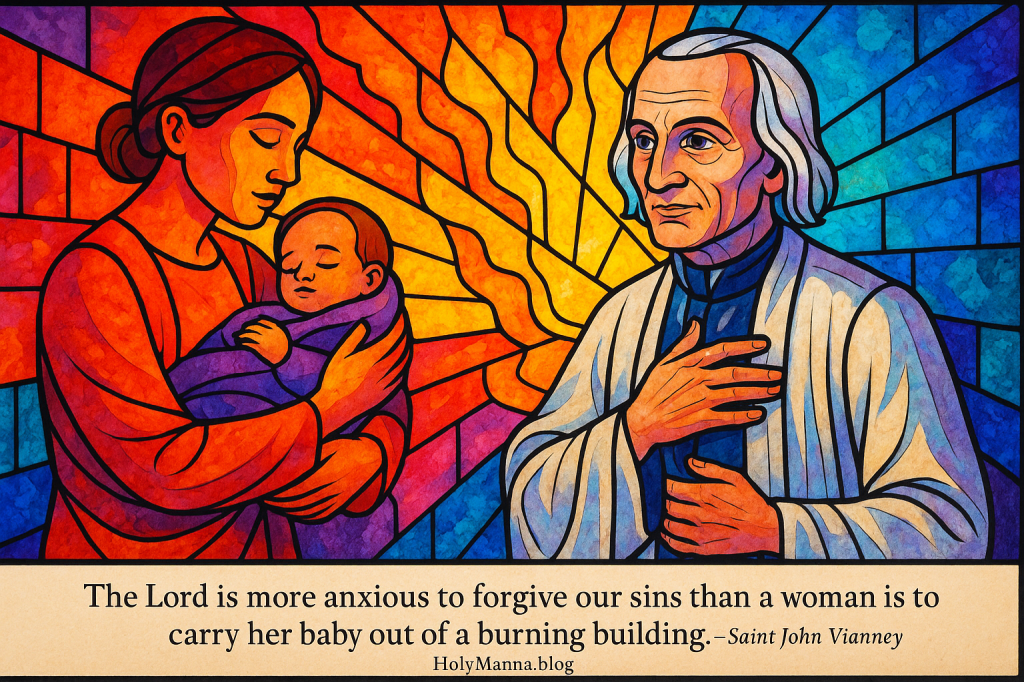
For the laity, his life reminds us that frequent confession is a path to holiness. That prayer, especially before the Eucharist, is the lifeblood of our spiritual health. That we must never judge others, for as he said, “The Lord is more anxious to forgive our sins than a woman is to carry her baby out of a burning building.”
You don’t have to be a priest to follow in his footsteps. Every Catholic is called to pray fervently, love sacrificially, and fast for the salvation of souls. Can you offer a weekly Holy Hour for your parish priest? Could you commit to monthly confession as a step toward deeper conversion? How might you love more like Jesus today, with the simplicity and courage of Saint John Vianney?
Let his life ignite in us a passion for souls, a hunger for the sacraments, and a love that doesn’t count the cost.
Engage with Us!
How does the life of Saint John Vianney inspire your own spiritual journey? We’d love to hear your thoughts and reflections in the comments below.
Reflection Questions:
- What role does the Sacrament of Confession play in your spiritual life? How can you approach it more like Saint John Vianney?
- In what ways can you offer greater sacrifices—time, comfort, or prayer—for the salvation of others?
- How can you grow in reverence for the Eucharist and deepen your relationship with Jesus in the Blessed Sacrament?
Let us support one another in our walk with Christ and strive, like Saint John Vianney, to do everything with love—just as our Lord Jesus did.
Saint John Vianney, pray for us! 🕊️
Follow us on Instagram and Facebook for more insights and reflections on living a faith-filled life.

 Holy Manna!
Leave a comment