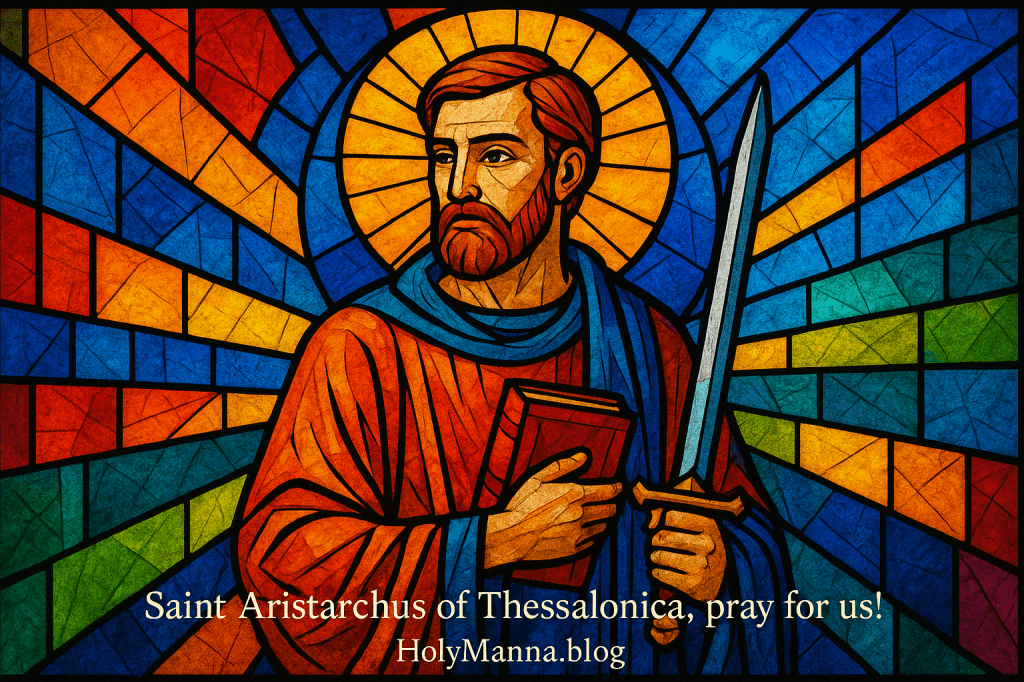
A Faithful Companion of the Apostles
Saint Aristarchus may not be a household name, but in the early Church, his fidelity, courage, and closeness to Saint Paul made him a powerful witness to the Gospel. Mentioned multiple times in the New Testament, Aristarchus is remembered as a steadfast companion of the Apostle Paul, enduring beatings, imprisonment, and persecution for the sake of Christ. A bishop and martyr, his life echoes the very heartbeat of early Christian courage—a model of faithful friendship, missionary zeal, and heroic endurance.
From Thessalonica to the Heart of the Mission
Saint Aristarchus was born in Thessalonica, a major city in ancient Macedonia, which today lies in modern Greece. Though details about his early life are sparse, his conversion likely came during Paul’s missionary efforts in Thessalonica, where Paul preached the Gospel and formed one of the earliest Christian communities (see Acts 17).
Aristarchus quickly emerged as one of Paul’s closest collaborators. Described in Acts 19:29 as one of _“Paul’s travel companions from Macedonia”, Aristarchus was seized during the riot in Ephesus—a violent protest instigated by pagan silversmiths angered by Paul’s preaching against idolatry. This moment, dangerous as it was, reveals Aristarchus’s unwavering commitment. Later, we find him again by Paul’s side, this time accompanying him on his voyage to Rome, as documented in Acts 27:2. In Philemon 1:24, Paul lists Aristarchus among his “fellow workers,” and in Colossians 4:10, he even refers to him as a _“fellow prisoner”.
These references show not only that Aristarchus was loyal to the end, but also that he shared in Paul’s very sufferings for the Gospel. He is believed to have been consecrated as the bishop of Apamea in Syria, continuing his ministry and leadership in the early Church until his martyrdom.
A Life Lived in the Shadow of the Cross
Though the New Testament does not describe miracles performed by Aristarchus, his life itself was a miracle of grace, perseverance, and charity. Few men were so closely tied to the Apostle Paul during his most trying moments. It is no small thing to be considered a fellow prisoner with Paul, who suffered deeply for the Gospel. Aristarchus’s “yes” to the missionary life meant hardship, risk, and ultimately a hidden, holy life of service.
The early Church Fathers honored his name, and tradition holds that his ministry bore great fruit, especially in the city of Apamea. Through his preaching and example, he brought countless souls to the knowledge of Christ, offering them not just words, but the testimony of a life poured out.
Trials, Chains, and the Crown of Martyrdom
Saint Aristarchus’s hardships were intimately bound to Paul’s own. Being dragged by a mob in Ephesus, enduring the rigors of missionary journeys, and being imprisoned for the faith all formed part of his path. But Aristarchus did not run away. He walked forward, eyes fixed on Christ.
According to Church tradition, Aristarchus was ultimately martyred under Emperor Nero in Rome. Some early Christian sources—including Eastern martyrologies—report that he was beheaded alongside Saint Paul, as well as Saints Trophimus and Pudens, sharing in the same brutal persecution that struck the heart of the early Church.
He gave his life in the Eternal City, sealing his testimony with his blood. In a time when being a Christian meant risking everything, Aristarchus chose Christ—and won the unfading crown of glory.
Signs from Heaven: Miracles and Memory
While specific posthumous miracles of Saint Aristarchus have not been documented with the same richness as other saints, his memory has endured powerfully in the Church’s tradition. The Eastern Orthodox Church venerates him as one of the Seventy Apostles—a group of early disciples sent out by Christ (cf. Luke 10:1), and his name appears in the Roman Martyrology on April 4.
His relics, though not widely attested in the West, are believed to have been honored in various places, particularly in the East. Wherever his name is spoken, it is with reverence, for Aristarchus stands as a symbol of loyal discipleship and suffering love.
A Model of Courageous Friendship and Endurance
Saint Aristarchus teaches us something profound and beautiful—faithfulness in the shadows. He was not the one writing the epistles, performing dramatic miracles, or preaching to thousands. He was the companion, the silent rock, the one who endured chains out of love for Christ and his mission.
How can we be faithful companions in our own lives—especially when the world turns against truth?
Saint Aristarchus challenges us to stand firm, even when our role seems small or invisible. He reminds us that loyalty, courage, and presence are powerful forms of evangelization. In our own age, when truth is often ridiculed and discipleship costs comfort and reputation, Aristarchus calls us to remain—with Christ, and with His Body, the Church.
Let us be companions of Christ, fellow workers for the Gospel, and—if God wills it—fellow prisoners of love.
Engage with Us!
How does Saint Aristarchus inspire you in your walk of faith? Share your thoughts in the comments—we’d love to hear from you.
Here are some questions for reflection:
When was the last time you stood by someone in difficulty, even when it cost you?
Do you see your current role—however hidden—as part of God’s mission?
How can you become a more faithful companion of Jesus, through prayer, service, or suffering?
Let us continue to support each other in our journeys of faith, reminding one another that every act of courage, no matter how small, matters deeply to God. May we strive to do all things with love, just as our Lord Jesus did.
Saint Aristarchus of Thessalonica, pray for us! 🗡️
Follow us on Instagram and Facebook for more insights and reflections on living a faith-filled life.

 Holy Manna!
Leave a comment