Memorial of Saint John Vianney, Priest – Lectionary: 407
Bread for the Hungry, Strength for the Weary
Have you ever found yourself longing for something more, even after receiving what you once begged God for? Today’s readings invite us into the wilderness of human weakness and divine mercy, where our deep hunger—physical, emotional, and spiritual—is met not with judgment, but with compassionate provision. Whether it’s the grumbling Israelites craving meat in the desert, the hungry crowds following Jesus into a desolate place, or the exhausted soul of Saint John Vianney burdened by the sins of his people, each story echoes a cry: Lord, we need more than what we have. And God answers—not always with what we expect, but always with what we need.
In Numbers 11, we encounter the Israelites, miraculously sustained by manna, yet nostalgic for the flavors of Egypt. Their craving reveals more than a desire for food; it exposes a restless heart, ungrateful and untrusting. Moses, their shepherd, becomes overwhelmed by the burden of their complaints. Similarly, in Psalm 81, the Lord grieves Israel’s refusal to listen: “But my people did not listen to my words… I would feed them with the finest wheat” (Psalm 81:12, 17). This divine sorrow echoes through time until The Gospel of Matthew, where Jesus, moved with pity, heals the sick and feeds thousands—not with manna from heaven, but with bread broken in His hands, prefiguring the Eucharist.
The Memorial of Saint John Vianney illuminates this theme with stunning clarity. As the patron saint of parish priests, he bore the weight of thousands of penitents on his shoulders, often spending 12–16 hours a day in the confessional. Like Moses, he cried out to God under the burden of spiritual fatherhood. Like Jesus, he fed the multitudes with divine nourishment—not fish and loaves, but mercy and truth. Through his tireless ministry in the tiny village of Ars, he revealed what today’s readings proclaim: God does not abandon His people in their hunger. He raises up humble servants who become vessels of grace—even when they are weary, even when they feel insufficient. God is enough.
First Reading – Numbers 11:4–15
When Gratitude Fades in the Wilderness
The Book of Numbers picks up during Israel’s journey through the wilderness after their dramatic exodus from Egypt. This passage comes shortly after the people have received manna from heaven—a miraculous sign of God’s provision (cf. Exodus 16). Yet even in the midst of divine care, the people grow weary and complain, romanticizing their past enslavement in Egypt. Their cravings are not just for meat and melons but for a life without trust, a life they controlled—even if it meant bondage. Today’s reading confronts us with the painful truth of spiritual forgetfulness and how easily we trade the promise of heaven for the memory of Egypt. As we reflect on this moment of rebellion and Moses’ raw prayer, we find a mirror to our own temptations, weariness, and resistance to divine dependence. This passage fits deeply within today’s theme of God’s Compassionate Provision in the Midst of Human Weakness—God sees not only our hunger but also our burdens, and He responds not with wrath, but with mercy and sustenance.
Numbers 11:4-15
New American Bible (Revised Edition)
4 The riffraff among them were so greedy for meat that even the Israelites lamented again, “If only we had meat for food! 5 We remember the fish we used to eat without cost in Egypt, and the cucumbers, the melons, the leeks, the onions, and the garlic. 6 But now we are famished; we have nothing to look forward to but this manna.”
7 Manna was like coriander seed and had the appearance of bdellium. 8 When they had gone about and gathered it up, the people would grind it between millstones or pound it in a mortar, then cook it in a pot and make it into loaves, with a rich creamy taste. 9 At night, when the dew fell upon the camp, the manna also fell.
10 When Moses heard the people, family after family, crying at the entrance of their tents, so that the Lord became very angry, he was grieved. 11 “Why do you treat your servant so badly?” Moses asked the Lord. “Why are you so displeased with me that you burden me with all this people? 12 Was it I who conceived all this people? or was it I who gave them birth, that you tell me to carry them at my breast, like a nurse carrying an infant, to the land you have promised under oath to their fathers? 13 Where can I get meat to give to all this people? For they are crying to me, ‘Give us meat for our food.’ 14 I cannot carry all this people by myself, for they are too heavy for me. 15 If this is the way you will deal with me, then please do me the favor of killing me at once, so that I need no longer face my distress.”
Detailed Exegesis
Verse 4 – “The riffraff among them were so greedy for meat that even the Israelites lamented again, ‘If only we had meat for food!’”
The “riffraff” refers to the non-Israelite people who joined the Exodus, but their discontent stirs up the Israelites as well. This verse reveals the contagious nature of spiritual dissatisfaction. What began as a craving becomes a communal complaint, exposing how easily the heart forgets the slavery of sin when it yearns for former comforts.
Verse 5 – “We remember the fish we used to eat without cost in Egypt, and the cucumbers, the melons, the leeks, the onions, and the garlic.”
Nostalgia clouds their judgment. They speak of “free food” in Egypt, forgetting it came with chains and beatings. Like us, they reinterpret their past without the pain, glorifying it in a way that distorts the present reality of God’s providence.
Verse 6 – “But now we are famished; we have nothing to look forward to but this manna.”
Ingratitude poisons their vision. Though they are sustained daily by divine bread from heaven, they see it as a disappointment. Their desire is not for sustenance but satisfaction on their own terms.
Verse 7 – “Manna was like coriander seed and had the appearance of bdellium.”
The description emphasizes manna’s heavenly origin and beauty. Bdellium was a precious resin. This is no ordinary food, yet it is treated with contempt.
Verse 8 – “When they had gone about and gathered it up, the people would grind it between millstones or pound it in a mortar, then cook it in a pot and make it into loaves, with a rich creamy taste.”
God provided not just food but a variety of ways to prepare it. It was adaptable and enjoyable. Still, their hearts could not delight in what was given.
Verse 9 – “At night, when the dew fell upon the camp, the manna also fell.”
This verse speaks quietly of God’s tender provision. As the dew gently blankets the earth, so does God’s gift descend—unearned, unexpected, and daily.
Verse 10 – “When Moses heard the people, family after family, crying at the entrance of their tents, so that the Lord became very angry, he was grieved.”
The mourning is public and widespread. The Lord’s anger reflects divine heartbreak, not petty vengeance. Moses, too, is “grieved”—a word often used to describe deep, personal sorrow.
Verse 11 – “Why do you treat your servant so badly?” Moses asked the Lord. “Why are you so displeased with me that you burden me with all this people?”
This prayer is raw and honest. Moses feels crushed beneath the weight of leadership. It is the plea of a spiritual father at the edge of despair.
Verse 12 – “Was it I who conceived all this people? or was it I who gave them birth, that you tell me to carry them at my breast, like a nurse carrying an infant, to the land you have promised under oath to their fathers?”
Moses invokes maternal imagery to describe his burden. He is not rejecting his vocation but acknowledging that it is beyond human capacity. He needs divine strength.
Verse 13 – “Where can I get meat to give to all this people? For they are crying to me, ‘Give us meat for our food.’”
Moses’ desperation is practical. He doesn’t have the resources. It is a foreshadowing of Matthew 14, where the disciples will ask the same: Where can we feed so many?
Verse 14 – “I cannot carry all this people by myself, for they are too heavy for me.”
This is the cry of every weary servant of God. Ministry, family life, responsibility—all can become too heavy when carried alone. Moses models what to do when overwhelmed: bring it to God.
Verse 15 – “If this is the way you will deal with me, then please do me the favor of killing me at once, so that I need no longer face my distress.”
A startling verse. Moses isn’t suicidal—he’s honest. This is a prayer of exhaustion, not despair. He would rather die than fail God or mislead His people.
Teachings
The Catechism of the Catholic Church teaches that “God tirelessly calls each person to this mysterious encounter with Himself” (CCC 2567), even when we complain, even when we are tired. This divine persistence is at the heart of today’s passage. Moses, though a towering leader, acknowledges his limits—a reflection of the Church’s teaching on the necessity of grace: “Since the initiative belongs to God in the order of grace, no one can merit the initial grace of forgiveness and justification” (CCC 2010). Saint John Vianney, too, understood this deeply. He once said, “The eyes of the world see no farther than this life, but the eyes of the Christian see deep into eternity.” Like Moses, he bore the weight of his people’s burdens and confessed often his sense of inadequacy. Yet God did not remove the burden; He sustained him under it. The Israelites’ craving for meat reveals a deeper spiritual truth: without gratitude, even miracles feel insufficient. This moment anticipates Christ’s own gift in the Eucharist, where the Bread from Heaven will return—not just to fill bellies, but to satisfy souls.
Reflection
What are you hungry for today? Is your heart remembering the comforts of a former life, even if it meant bondage to sin? This passage challenges us to recognize the presence of manna in our midst—the daily graces, the silent mercies, the undeserved gifts. It invites us to bring our exhaustion and weakness before the Lord in prayer, just as Moses did. Do you trust that God will provide what you need, even when you don’t see how? Let us not be quick to grumble when God’s ways stretch our faith. Let us instead look at the Bread of Life with gratitude, knowing that He feeds us not just for survival, but for transformation. When we are weary like Moses, may we remember that God’s strength is made perfect in weakness, and that even in the desert, honey flows from the rock (Psalm 81:17).
Responsorial Psalm – Psalm 81:12–17
The Voice We Refuse, the Feast We Forfeit
This psalm, attributed to Asaph, is both a lament and a divine plea. Set within the liturgical and covenantal context of ancient Israel, Psalm 81 recalls God’s mighty acts of deliverance and His continued desire to bless His people. Yet it also recounts a recurring tragedy: Israel’s hardened heart and unwillingness to listen. These verses reflect a divine heartbreak—a God who longs to bless but is resisted by His own beloved. In the rhythm of today’s liturgy, this psalm echoes the themes of Numbers 11, where Israel rejected God’s provision of manna, and prefigures Matthew 14, where Jesus offers Himself as the new manna, satisfying those who follow Him in faith. The psalm becomes a divine commentary on the human condition: when we turn away from God’s voice, we also close ourselves to His blessings. Yet the invitation remains. Even in our hardness of heart, He still desires to feed us with “the finest wheat” and “honey from the rock”.
Psalm 81:12-17
New American Bible (Revised Edition)
12 But my people did not listen to my words;
Israel would not submit to me.
13 So I thrust them away to the hardness of their heart;
‘Let them walk in their own machinations.’
14 O that my people would listen to me,
that Israel would walk in my ways,
15 In a moment I would humble their foes,
and turn back my hand against their oppressors.
16 Those who hate the Lord will try flattering him,
but their fate is fixed forever.
17 But Israel I will feed with the finest wheat,
I will satisfy them with honey from the rock.”
Detailed Exegesis
Verse 12 – “But my people did not listen to my words; Israel would not submit to me.”
This verse reveals the core sin: deafness to God’s voice. The Hebrew word for “listen” implies not only hearing but obeying. Israel’s refusal to submit is not passive; it is an active rejection of God’s authority. The same rebellious spirit seen in Numbers 11 is repeated here.
Verse 13 – “So I thrust them away to the hardness of their heart; ‘Let them walk in their own machinations.’”
God respects human freedom. When His people repeatedly resist, He allows them to follow their own designs—machinations—knowing they will lead to ruin. This mirrors Romans 1:24: “Therefore, God handed them over to impurity through the lusts of their hearts.” It is not abandonment, but a sorrowful permission.
Verse 14 – “O that my people would listen to me, that Israel would walk in my ways,”
This cry from God’s heart is deeply intimate. The divine longing is palpable. God is not distant; He desires relationship. His laws are not burdens but ways—paths to life, flourishing, and communion.
Verse 15 – “In a moment I would humble their foes, and turn back my hand against their oppressors.”
God’s protection is never far from His people. If only they would return to Him, their enemies would be defeated. This is not militarism, but a divine promise: fidelity brings deliverance.
Verse 16 – “Those who hate the Lord will try flattering him, but their fate is fixed forever.”
This verse reveals the futility of false piety. God cannot be manipulated. Empty gestures or hollow worship—offered without true conversion—do not change the justice of God. His truth is eternal.
Verse 17 – “But Israel I will feed with the finest wheat, I will satisfy them with honey from the rock.”
Here is the climax of divine generosity. The “finest wheat” and “honey from the rock” are rich images of both material and spiritual abundance. God offers not just survival, but sweetness in desolate places. This verse prefigures the Eucharist, where Christ—the Bread of Life—feeds us with Himself.
Teachings
The Catechism of the Catholic Church reminds us that the voice of God is not distant or ambiguous. “In the Sacred Scriptures, the Church constantly finds her nourishment and her strength, for she welcomes it not as a human word, ‘but as what it really is, the word of God’” (CCC 104). This psalm laments that God’s people closed their ears to that living Word. It also affirms God’s desire to provide: “God gives us the ‘daily bread’—the earthly nourishment all creatures need and the Bread of Life: the Word of God accepted in faith, the Body of Christ received in the Eucharist” (CCC 2835). Saint Augustine once wrote: “God is more willing to give than we are to receive”, capturing the tone of this psalm perfectly. The Lord longs to bless, protect, and nourish His people—but He waits for our return. Like Saint John Vianney, who called people back to the sacraments with tireless love, we are invited to tune our hearts to the Shepherd’s voice.
Reflection
What voices are you listening to today? Have you grown deaf to the Lord’s gentle promptings—distracted by noise, worry, or stubbornness? This psalm is a sobering reminder that divine blessing is not automatic—it flows through trust and obedience. If we feel spiritually dry, perhaps it is not God who has stopped speaking, but we who have stopped listening. Let us return to His voice in Scripture, in prayer, in the sacraments. Are you feeding on the “finest wheat,” or still craving the leeks and onions of Egypt? God offers not only bread but sweetness in hard places—honey from the rock. All He asks is that we come to Him, open and hungry. Let our prayer be that of today’s psalm: Lord, soften my heart. Teach me to listen again.
Holy Gospel – Matthew 14:13–21
The God Who Feeds in the Desert Place
Today’s Gospel recounts the miraculous feeding of the five thousand—one of the few events recorded in all four Gospels. This takes place after the death of John the Baptist, a pivotal moment that prompts Jesus to withdraw in sorrow. Yet even in His grief, Christ is moved with compassion for the crowd that follows Him. This is no mere story of divine power—it is a revelation of God’s heart: a heart that sees, feels, and provides. In the cultural context of first-century Palestine, food was not just nourishment; it was tied to hospitality, survival, and covenant blessing. For a rabbi to feed the masses in the wilderness was to echo the story of Exodus, of manna, of Moses—and to declare a new kind of provision. Here, Jesus reveals Himself not just as a prophet, but as the divine Shepherd-King who feeds His people with more than bread. This moment anticipates the Eucharist and is deeply bound to today’s theme of God’s Compassionate Provision in the Midst of Human Weakness.
Matthew 14:13-21
New American Bible (Revised Edition)
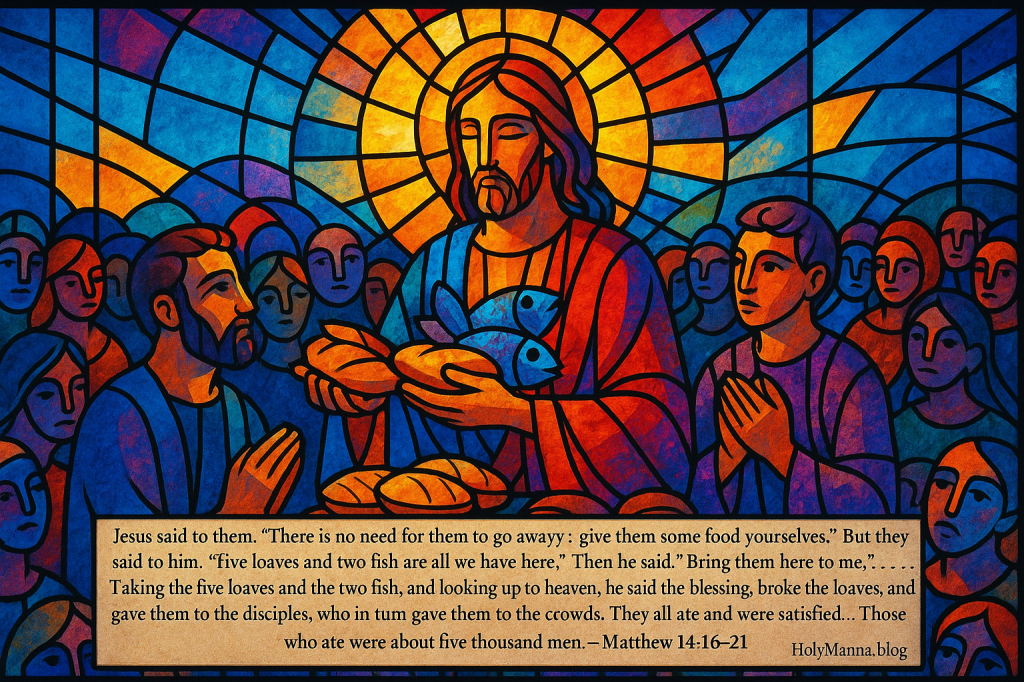
13 When Jesus heard of it, he withdrew in a boat to a deserted place by himself. The crowds heard of this and followed him on foot from their towns. 14 When he disembarked and saw the vast crowd, his heart was moved with pity for them, and he cured their sick. 15 When it was evening, the disciples approached him and said, “This is a deserted place and it is already late; dismiss the crowds so that they can go to the villages and buy food for themselves.” 16 [Jesus] said to them, “There is no need for them to go away; give them some food yourselves.” 17 But they said to him, “Five loaves and two fish are all we have here.” 18 Then he said, “Bring them here to me,” 19 and he ordered the crowds to sit down on the grass. Taking the five loaves and the two fish, and looking up to heaven, he said the blessing, broke the loaves, and gave them to the disciples, who in turn gave them to the crowds. 20 They all ate and were satisfied, and they picked up the fragments left over—twelve wicker baskets full. 21 Those who ate were about five thousand men, not counting women and children.
Detailed Exegesis
Verse 13 – “When Jesus heard of it, he withdrew in a boat to a deserted place by himself. The crowds heard of this and followed him on foot from their towns.”
Jesus has just received news of John the Baptist’s martyrdom. His withdrawal shows His humanity—grieving, needing solitude. Yet the people follow Him. Their hunger overrides distance and desert. The “deserted place” is rich with biblical meaning: it is where God formed Israel, where manna fell, where trust is tested.
Verse 14 – “When he disembarked and saw the vast crowd, his heart was moved with pity for them, and he cured their sick.”
This verse contains one of the most beautiful descriptions of Jesus’ heart: “moved with pity” (Greek: splagchnizomai)—a gut-wrenching compassion. He sees their sickness, both physical and spiritual, and responds with healing. His grief does not make Him retreat; it draws Him into love.
Verse 15 – “When it was evening, the disciples approached him and said, ‘This is a deserted place and it is already late; dismiss the crowds so that they can go to the villages and buy food for themselves.’”
The disciples offer a practical solution: let the people fend for themselves. But this exposes a lack of vision. They see the limitation—desert, hunger, night. Jesus sees opportunity for grace.
Verse 16 – “[Jesus] said to them, ‘There is no need for them to go away; give them some food yourselves.’”
Jesus places the responsibility back on the disciples. He invites them to participate in the miracle. This moment is pedagogical—He is forming them to be shepherds. Like Moses, they are being taught to rely not on their own ability but on divine abundance.
Verse 17 – “But they said to him, ‘Five loaves and two fish are all we have here.’”
The disciples are honest about their lack. What they hold is laughably insufficient for the need. But their offering—small and sincere—is what Jesus asks for. God does not demand more than we have; He asks us to surrender what little we carry.
Verse 18 – “Then he said, ‘Bring them here to me,’”
This command is everything. Jesus takes what they have and transforms it. He invites them to trust that what they offer in faith will be multiplied in grace.
Verse 19 – “and he ordered the crowds to sit down on the grass. Taking the five loaves and the two fish, and looking up to heaven, he said the blessing, broke the loaves, and gave them to the disciples, who in turn gave them to the crowds.”
This verse mirrors the language of the Last Supper: “took… blessed… broke… gave”. It is Eucharistic. Jesus is not just feeding bodies—He is preparing hearts for the Bread of Life. The distribution through the disciples shows how Christ continues to feed His Church through human hands.
Verse 20 – “They all ate and were satisfied, and they picked up the fragments left over—twelve wicker baskets full.”
The abundance is staggering. Not only is everyone fed—they are satisfied. The twelve baskets recall the twelve tribes of Israel, signifying the fullness of God’s provision. Nothing is wasted. In Christ, even the leftovers are sacred.
Verse 21 – “Those who ate were about five thousand men, not counting women and children.”
The number highlights the scale of the miracle. Scholars estimate the actual number fed could be fifteen to twenty thousand. But Jesus is not overwhelmed. Where human capacity fails, divine mercy overflows.
Teachings
This Gospel passage is a powerful prefiguration of the Eucharist. The Catechism of the Catholic Church affirms this: “The miracles of the multiplication of the loaves… announce the superabundance of this unique bread of his Eucharist” (CCC 1335). In the feeding of the five thousand, we glimpse not only a miracle of food but a sign of the eternal banquet. The Church Fathers saw this moment as a bridge between the manna of the Old Covenant and the living Bread of the New. Saint John Chrysostom taught: “You give your loaves and fishes, and God multiplies them into spiritual nourishment for thousands.” The Gospel also reminds us that Christ’s heart is moved by need. He is not a distant savior. As CCC 2715 teaches, “Contemplation is a gaze of faith, fixed on Jesus. ‘I look at him and he looks at me.’” Today, we gaze upon a God who sees our hunger—and feeds it with Himself.
Reflection
What desert are you walking through today? Where do you feel you don’t have enough—enough time, enough love, enough strength? This Gospel reminds us that Jesus sees, feels, and provides. He is not asking you to solve everything—only to bring your “five loaves and two fish” with trust. What small thing is He asking you to surrender so He can multiply it? Like Saint John Vianney, who brought only a simple heart and deep love for Christ to a tiny parish, we too can be vessels of grace. Let us ask the Lord today: Jesus, take what little I have. Break it. Bless it. Use it. The world is hungry, and He still feeds through the hands of those who follow Him.
A Table in the Wilderness
Today’s liturgy draws us into the mystery of a God who provides—not just in times of plenty, but precisely in our moments of weakness, weariness, and want. In Numbers 11, we saw the people of Israel grumble in the desert, despising the very manna that fell from heaven. In Psalm 81, we heard the aching voice of God who longs to satisfy His people with “the finest wheat” and “honey from the rock”, if only they would listen. And in The Gospel of Matthew, we witnessed Jesus, moved with compassion, feeding thousands with five loaves and two fish—giving not just food, but Himself. Through it all, we are reminded that God’s response to our insufficiency is never abandonment but abundance.
The Memorial of Saint John Vianney ties these readings together with holy clarity. Like Moses, he carried the burdens of a people. Like the disciples, he gave what little he had so Christ could multiply it. And like Christ, he poured himself out with compassion, feeding hungry souls through hours in the confessional, daily Eucharistic adoration, and humble preaching. His life teaches us that holiness does not come from having much, but from surrendering all. He reminds us that God can feed a multitude through even the smallest hands—if they are open.
Where do you need God’s provision today? What part of your life feels like a desert? The Lord is not asking for perfection—only for your trust. Bring Him your exhaustion, your doubts, your five loaves and two fish. Let Him bless it, break it, and make it fruitful. The world is still starving for truth, mercy, and love. But the good news is this: Christ is still feeding His people. He is still calling humble hearts—like yours—to be His hands. Come to the table. There is always enough.
Engage with Us!
We’d love to hear how today’s readings spoke to your heart. Share your thoughts, prayers, or favorite verses in the comments below. Your reflections might inspire someone else on their journey of faith!
Reflection Questions:
First Reading – Numbers 11:4–15:
When have you found yourself complaining about what you lack instead of thanking God for what you have? What “Egypt” do you sometimes long for, even if it means turning from God’s promises?
Responsorial Psalm – Psalm 81:12–17:
What voices compete with God’s voice in your life right now? How can you make more room for silence, Scripture, and prayer to better hear Him?
Holy Gospel – Matthew 14:13–21:
What are your “five loaves and two fish”? What small gift or weakness might God be inviting you to offer Him? When have you seen God multiply your efforts beyond what seemed possible?
Stay rooted in God’s Word, and never underestimate the power of bringing your humble gifts to Jesus. Live today with trust in His provision, openness to His grace, and hearts full of love and mercy—just as Saint John Vianney did. Let everything you do be done with the love and mercy Jesus taught us.
Follow us on Instagram and Facebook for more insights and reflections on living a faith-filled life.

 Holy Manna!
Leave a comment