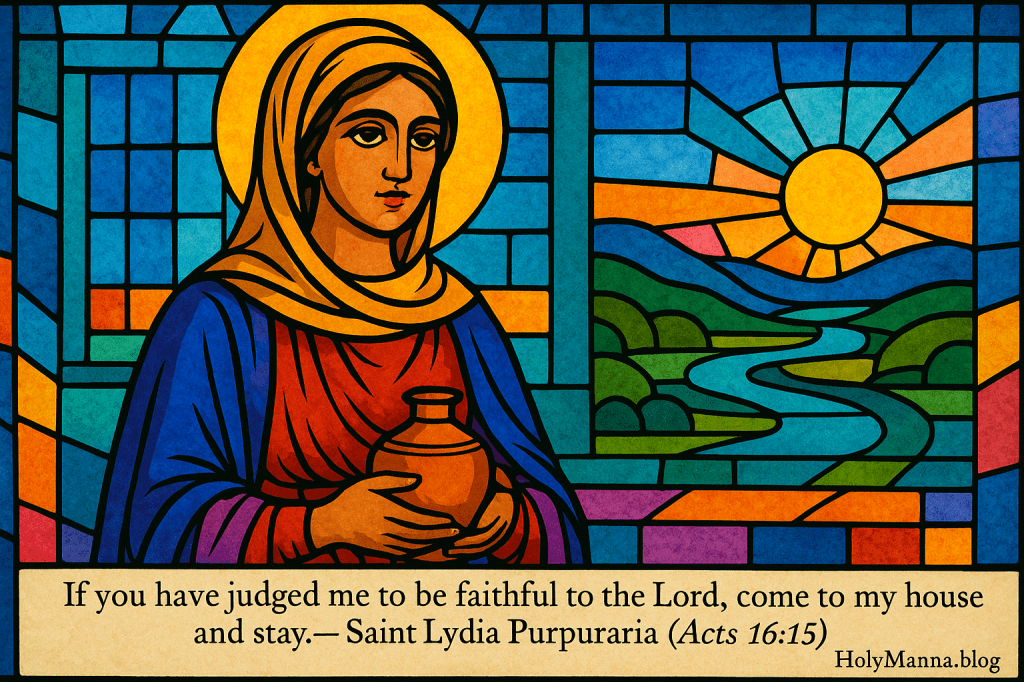
The First Christian in Europe
Among the earliest and most quietly powerful figures in the New Testament stands Saint Lydia Purpuraria—also known simply as Lydia of Thyatira. Though she appears briefly in The Acts of the Apostles, her role in salvation history is profound: she was the first recorded convert to Christianity in Europe. As a successful merchant of purple cloth, Lydia’s heart was as open to God as her home was to the Apostles. Her faith, hospitality, and courage in embracing the Gospel transformed not only her own life but laid the foundation for the spread of Christianity throughout the Western world. Today, she is honored as a saint in both the Catholic and Orthodox traditions, and her legacy reminds us that holiness often begins with hospitality and obedience to the Spirit.
A Merchant Woman with a Listening Heart
Saint Lydia was a native of Thyatira, a city in the Roman province of Asia (modern-day Akhisar, Turkey), known for its dyeing industry, particularly in purple cloth—a luxury fabric associated with royalty and wealth. Though originally from Asia Minor, Lydia had settled in Philippi, a Roman colony in Macedonia. She is described in Acts 16:14 as a “worshiper of God,” a term that often referred to Gentiles who revered the God of Israel without fully converting to Judaism.
Her conversion story unfolds through divine orchestration. While Saint Paul and his companions were in Philippi on their missionary journey, they went outside the city gate to a place of prayer by the river on the Sabbath. There, they encountered a group of women, including Lydia. “The Lord opened her heart to pay attention to what Paul was saying” (Acts 16:14), and she responded with immediate faith. She and her household were baptized, and she invited Paul and his companions to stay in her home, saying: “If you have judged me to be faithful to the Lord, come to my house and stay.” (Acts 16:15).
This seemingly simple act of hospitality marked the beginning of the Christian Church in Europe. Lydia’s house became the first domus ecclesiae—a house church—in Philippi, and potentially the entire continent.
A Life of Quiet Power and Radical Faith
Though Lydia is not recorded to have performed miraculous healings or dramatic acts, her life was one of profound spiritual authority. She is remembered for three qualities that made her saintly: her openness to the Holy Spirit, her hospitality to the apostles, and her courage in aligning her life with the Gospel despite her high social and economic status.
Her conversion marks a miracle of the heart—a divine encounter between the Word of God and a soul ready to receive it. Lydia didn’t merely accept Christ inwardly; she translated her faith into action. Her home became the first base of operations for Paul in Macedonia. After Paul and Silas were released from prison, they went to Lydia’s house to meet and encourage the brothers and sisters (Acts 16:40), suggesting that a small Christian community had already formed there.
Saint Lydia shows us that being a “doer of the word” often begins with listening and welcoming. In a world where hospitality is sometimes undervalued, she demonstrates how opening one’s door can open hearts to grace.
Trials, Risks, and Steadfast Love
Though Scripture does not detail any explicit persecution Lydia endured, we can infer the risks she took. Philippi was a Roman colony steeped in imperial cult worship and pagan practices. By aligning herself publicly with Paul and the message of Jesus Christ—a crucified Jew declared Lord and Savior—Lydia was placing her social status, business, and possibly her life at risk.
It takes holy boldness to live counterculturally. Hosting Christian missionaries, baptizing her household, and founding a house church could have exposed Lydia to scrutiny, loss of clientele, or worse. Yet she embraced this new identity with serenity and strength. In the early Church, such silent courage was as precious as martyrdom itself.
While Lydia was not martyred in the traditional sense, her spiritual martyrdom—dying to worldly status for the sake of Christ—remains an inspiring witness.
A Saint Remembered with Love and Pilgrimage
Though Lydia’s story ends quietly in the Bible, her memory did not fade. The Orthodox Church honors her as Equal to the Apostles, and she is venerated in the Catholic Church as a holy woman of the early Church. In modern-day Greece, near the site believed to be where Lydia was baptized, there is a beautiful outdoor baptistery near Philippi, dedicated to her memory. Pilgrims visit the area, especially around her feast day on August 3rd, and celebrate the enduring impact of her “yes” to God.
Her relics are not widely known or authenticated, but her presence in the New Testament and continued veneration in both East and West underscore her spiritual legacy. Churches named in her honor can be found in Europe and North America, especially among communities who value women’s leadership and hospitality in the Church’s early days.
Learning from Lydia
Saint Lydia’s life invites us to reflect on the simplicity and depth of Christian discipleship. She reminds us that faith often begins by listening—and flourishes through hospitality, courage, and service. Lydia didn’t wait for a dramatic sign to follow Christ; she opened her ears, her heart, and her home to the Word of God and His messengers.
In our own daily lives, how can we imitate Lydia’s courage and generosity? When we feel uncertain about evangelizing, can we instead begin by simply opening our hearts and homes to others with Christ-like love?
Like Lydia, we are called to make space—literal and spiritual—for the Gospel to dwell and grow. This might look like welcoming someone into your home for dinner, inviting a friend to Mass, or simply listening with compassion to someone in need. God works powerfully through those who, like Lydia, say: “Come and stay in my house.”
Engage with Us!
What part of Lydia’s story speaks most to your heart today? Have you ever experienced a moment where you knew God was opening your heart to something new? Share your reflections in the comments—we’d love to hear from you!
- How can I cultivate a heart that is truly open to God’s Word, like Lydia?
- What does Christian hospitality look like in my life right now?
- Who are the “Paul and Silas” in my life that I can welcome and support?
Let’s continue supporting one another on this journey of faith. May we be bold in our love, generous in our hospitality, and steadfast in following Jesus—just like Saint Lydia.
Saint Lydia Purpuraria, pray for us! 💜
Follow us on Instagram and Facebook for more insights and reflections on living a faith-filled life.

 Holy Manna!
Leave a comment