Eighteenth Sunday in Ordinary Time – Lectionary: 114
Eternity Is the Only Safe Investment
What if everything you worked for vanished tomorrow? What if the accolades, the house, the savings account, even the health you count on—what if all of it passed away like morning dew? Today’s readings ask us to confront the uncomfortable truth that everything in this world is passing. And yet, in a world that measures success by accumulation, today’s liturgy breaks through the illusion with a loving but firm warning: “Life does not consist of possessions” (Luke 12:15). God is not condemning wealth or work, but rather reminding us that these are not our end. Our hearts were made for something more.
This theme of detachment from worldly pursuits echoes across time. In Ecclesiastes, the voice of Qoheleth (a Hebrew term meaning “Teacher”) arises from Israel’s post-exilic period, wrestling with the enigma of life’s fleeting nature. His lament—“Vanity of vanities! All things are vanity!” (Ecclesiastes 1:2)—echoes the frustration of a people who, despite rebuilding their lives after exile, still find emptiness in toil disconnected from God. In Psalm 90, one of the few psalms attributed to Moses, we hear a cry for divine perspective in the face of life’s brevity: “Teach us to count our days aright, that we may gain wisdom of heart” (Psalm 90:12). These are not just ancient words—they are mirror reflections of our modern anxieties, ambitions, and distractions.
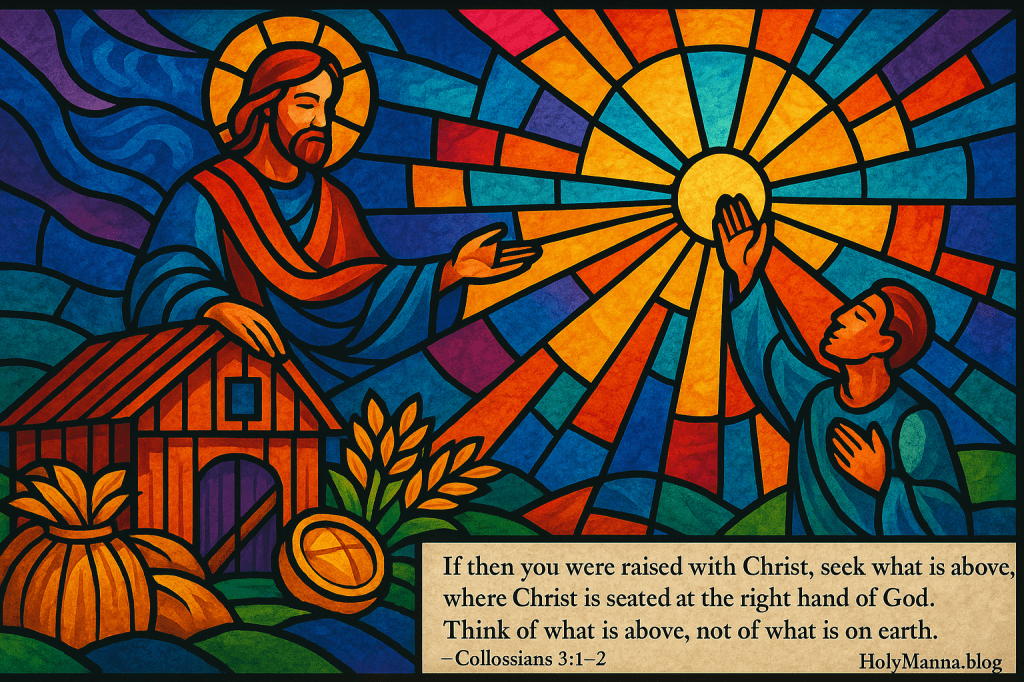
Saint Paul, writing to the Colossians from prison, urges the early Christians—and us today—to stop clinging to the earth and instead “seek what is above” (Colossians 3:1), where true life is hidden with Christ. The Gospel reading from Luke 12 then drives the point home with the parable of the rich fool, whose full barns could not save him from the ultimate truth: death comes, and only treasures stored in heaven endure. In a culture obsessed with wealth, comfort, and control, Jesus offers us a new metric for success: being “rich in what matters to God” (Luke 12:21). Today’s readings call us to examine where our heart truly rests—and to realign it with the only One who can satisfy it eternally.
First Reading – Ecclesiastes 1:2; 2:21–23
The Emptiness of a Life Without God
The Book of Ecclesiastes is one of the most mysterious and contemplative works in the Old Testament. Written by an author who calls himself Qoheleth—a name often translated as “Teacher” or “Preacher”—this book belongs to the genre of wisdom literature and likely dates to the post-exilic period, around the 3rd century BCE. Israel, having returned from Babylonian captivity, was wrestling with profound questions about human suffering, the limits of wisdom, and the meaning of life. Unlike other Old Testament books that are more didactic or historical, Ecclesiastes dares to explore life’s paradoxes with brutal honesty. Today’s passage fits perfectly into the overarching theme of the futility of earthly striving. It reminds us that labor, even when guided by wisdom, ultimately ends in loss if it’s not rooted in eternal purpose. The author’s haunting refrain—“Vanity of vanities! All things are vanity!”—echoes across millennia, shaking modern readers out of our materialistic slumber.
Ecclesiastes 1:2; 2:21-23
New American Bible (Revised Edition)
1:2 Vanity of vanities, says Qoheleth,
vanity of vanities! All things are vanity!
2:21 For here is one who has toiled with wisdom and knowledge and skill, and that one’s legacy must be left to another who has not toiled for it. This also is vanity and a great evil. 22 For what profit comes to mortals from all the toil and anxiety of heart with which they toil under the sun? 23 Every day sorrow and grief are their occupation; even at night their hearts are not at rest. This also is vanity.
Detailed Exegesis
Verse 1:2 – “Vanity of vanities, says Qoheleth, vanity of vanities! All things are vanity!”
This poetic phrase forms the thesis of the entire book. The word “vanity” comes from the Hebrew hevel, meaning vapor or breath—something that disappears as quickly as it appears. Qoheleth is not denying the goodness of creation but is pointing out the transience of all created things when pursued as ends in themselves. Everything under the sun is fleeting. Even the most impressive human accomplishments are, in the end, like smoke—visible for a moment, then gone.
Verse 21 – “For here is one who has toiled with wisdom and knowledge and skill, and that one’s legacy must be left to another who has not toiled for it. This also is vanity and a great evil.”
Qoheleth laments the injustice of laboring wisely only to have your life’s work handed off to someone who may not appreciate it. The verse critiques the worldly obsession with legacy and control, challenging us to accept the reality that we are not the masters of our work’s future. The great evil lies in the heartache of investing one’s soul into a world that cannot guarantee permanence.
Verse 22 – “For what profit comes to mortals from all the toil and anxiety of heart with which they toil under the sun?”
Here the Teacher questions the very notion of profit. Unlike material profit, spiritual gain cannot be measured by earthly effort alone. The phrase “under the sun” is a key concept in Ecclesiastes, referring to the fallen, temporal world. This verse critiques the anxiety and restlessness that plague those who work without anchoring their lives in God.
Verse 23 – “Every day sorrow and grief are their occupation; even at night their hearts are not at rest. This also is vanity.”
Qoheleth points out that even rest is elusive for those consumed by worldly pursuits. Their minds are weighed down by ambition, regret, or fear. Saint Augustine once wrote, “You have made us for yourself, O Lord, and our heart is restless until it rests in you” (Confessions, I.1). This verse captures that restlessness perfectly. Without God, even rest becomes labor.
Teachings: The Restlessness of Earthly Pursuits
The Catechism of the Catholic Church teaches that the desire for God is written in the human heart because man is created by God and for God. As CCC 27 states: “The dignity of man rests above all on the fact that he is called to communion with God… Only in God will he find the truth and happiness he never stops searching for.” Qoheleth’s cries of vanity reflect that innate desire being thwarted by disordered attachments. Pope Saint John Paul II also reflected on this tension in his Theology of the Body, teaching that human work must be integrated with divine purpose to bear eternal fruit. Saint Teresa of Ávila similarly warned, “All things pass. God never changes. Whoever has God lacks nothing. God alone suffices.”
Historically, this passage has resonated deeply during times of societal upheaval. During the Black Death, the Renaissance, and even after the two World Wars, Christians have returned to Ecclesiastes as a reminder that material success is fleeting, and only what is done in love for God endures. The Church, in her wisdom, often pairs this reading with New Testament exhortations like Colossians 3, which tell us where our true life lies: not “under the sun” but above it, in Christ.
Reflection: Let Go of What You Cannot Keep
This reading invites us to take an honest look at what we’re clinging to. What drives your daily efforts—fear of failure, desire for legacy, the need to be seen as successful? Qoheleth reminds us that these things cannot ultimately satisfy or save us. We are called instead to offer our labor to the Lord, trusting that His will gives eternal meaning to even the smallest task. If we’re losing sleep over our anxieties, today is a call to surrender them. Can you ask the Holy Spirit to reorder your desires and free you from chasing vapor? Let us ask God to help us labor not for our own gain, but for His glory, so that even our daily work becomes worship.
Responsorial Psalm – Psalm 90:3–6, 12–14, 17
Teach Us to Number Our Days
Psalm 90 is the only psalm attributed to Moses, making it one of the oldest in the entire Psalter. This prayer offers a deeply sobering reflection on the fragility and brevity of human life in contrast to God’s eternal nature. Likely composed during Israel’s wilderness journey or in reflection upon it, the psalm speaks with ancient authority to a universal human anxiety: our time is limited. In a culture that constantly pushes the illusion of control and permanence, this psalm cuts to the heart of today’s theme—the futility of trusting in what is temporary and the necessity of anchoring our hearts in God. In harmony with Ecclesiastes and Luke 12, Psalm 90 confronts the illusion of self-sufficiency and reminds us that our only lasting security lies in the mercy and favor of the Lord.
Psalm 90:3-6, 12-14, 17
New American Bible (Revised Edition)
3 You turn humanity back into dust,
saying, “Return, you children of Adam!”
4 A thousand years in your eyes
are merely a day gone by,
Before a watch passes in the night,
5 you wash them away;
They sleep,
and in the morning they sprout again like an herb.
6 In the morning it blooms only to pass away;
in the evening it is wilted and withered.
12 Teach us to count our days aright,
that we may gain wisdom of heart.
13 Relent, O Lord! How long?
Have pity on your servants!
14 Fill us at daybreak with your mercy,
that all our days we may sing for joy.
17 May the favor of the Lord our God be ours.
Prosper the work of our hands!
Prosper the work of our hands!
Detailed Exegesis
Verse 3 – “You turn humanity back into dust, saying, ‘Return, you children of Adam!’”
This verse recalls the curse of Genesis 3:19—“For you are dust, and to dust you shall return”—reminding us of our mortality. The psalmist is not being morbid, but realistic. Our lives are not self-generated; they come from God, and to Him we return. In the Hebrew mindset, this acknowledgment of dust is not a source of despair, but a path to humility and wisdom.
Verse 4 – “A thousand years in your eyes are merely a day gone by, before a watch passes in the night.”
This verse speaks to God’s transcendence over time. While we are creatures of the clock, bound by years and deadlines, God sees all of time in a single instant. This echoes 2 Peter 3:8: “With the Lord one day is like a thousand years and a thousand years like one day.” It places our concerns in a cosmic perspective, exposing the smallness of our worries when set against eternity.
Verse 5 – “You wash them away; they sleep, and in the morning they sprout again like an herb.”
Human lives are like grass washed away in a storm—brief, delicate, easily uprooted. The image of sleep and sprouting reflects the rhythm of life and death. Just as vegetation withers and returns, so too do our bodies. This is not nihilism but a reminder that our earthly existence is fragile and not meant to be our final dwelling.
Verse 6 – “In the morning it blooms only to pass away; in the evening it is wilted and withered.”
This completes the image: life is beautiful but transient. The Hebrew day begins in the evening and ends at sundown, so this verse describes a full life span compressed into one day. It’s poetic and piercing: we bloom, we fade. This sets the stage for a deeper cry—not for more time, but for eternal meaning within time.
Verse 12 – “Teach us to count our days aright, that we may gain wisdom of heart.”
This is the heart of the psalm and the pivot point in the entire reading. The psalmist doesn’t ask for longer life, but for a rightly ordered one. “Counting our days” is a spiritual practice—a daily awareness that our time is limited and must be lived wisely. In this humility, we find wisdom, which the Church Fathers called the root of holiness.
Verse 13 – “Relent, O Lord! How long? Have pity on your servants!”
This is a plea for mercy. Moses had seen God’s justice in the wilderness—how Israel’s sins led to discipline. Yet he also knew God’s mercy. This verse holds the tension between justice and compassion, a reminder that our proper response to life’s brevity is not despair, but repentance and hope.
Verse 14 – “Fill us at daybreak with your mercy, that all our days we may sing for joy.”
The image of daybreak speaks of resurrection, newness, and light. When God fills us with His mercy at the start of the day, our whole life becomes a song, even in sorrow. This is the Christian posture: to begin each day with God’s love and allow that love to order our time and intention.
Verse 17 – “May the favor of the Lord our God be ours. Prosper the work of our hands! Prosper the work of our hands!”
This final verse is a prayer that our work would not be in vain, but blessed. It reorients labor toward God, not self. The repetition emphasizes the deep desire that our efforts would bear fruit—not just earthly fruit, but eternal. This ties directly into the theme from Ecclesiastes and the Gospel: our toil only finds meaning in God.
Teachings: Time as Sacred Gift
The Church teaches that time is not a random sequence of events, but a gift given for the sake of salvation. The Catechism of the Catholic Church tells us in CCC 1007: “Death is the end of man’s earthly pilgrimage, of the time of grace and mercy which God offers him so as to work out his earthly life in keeping with the divine plan.” Saint Benedict instructed his monks to live as though each day might be their last, teaching them to “keep death daily before your eyes” (The Rule of St. Benedict, 4:47)—not to depress them, but to focus their hearts on eternity. Saint Thérèse of Lisieux captured this spirit beautifully when she said, “We have only this life to live by faith.”
In liturgical time, especially during Lent and Advent, the Church reawakens this psalm’s themes. The season of Lent begins with ashes and the reminder—“Remember you are dust, and to dust you shall return”—taken directly from this very psalm. Time, toil, and mortality all become sacred when seen through the lens of God’s mercy and our hope in resurrection.
Reflection: Make Each Day a Seed of Eternity
This psalm is a holy invitation to mindfulness in the most spiritual sense. Are you spending your days as though they are infinite, or as though they are a gift? Our mortality should not lead us to fear but to trust. What would it look like to begin each day by asking God to “fill you at daybreak with His mercy”? We can begin by offering Him our first thoughts, our first words, and our first actions. Ask the Holy Spirit to help you “count your days aright” and bring intention to your work, patience to your rest, and joy to your journey. When we entrust our time to God, even our most ordinary moments become sacred.
Second Reading – Colossians 3:1–5, 9–11
Dying to the World, Living for Eternity
Saint Paul’s Letter to the Colossians was written to a young Christian community facing pressures from both pagan philosophies and Jewish legalism. Paul wrote from prison to correct their theology and re-anchor them in the supremacy of Christ. In this portion of the letter, Paul turns from doctrine to application, urging believers to live out their baptismal identity. If they have died and risen with Christ, then their lives must reflect that truth. In today’s context, this reading continues the theme found in Ecclesiastes, Psalm 90, and Luke 12: earthly things are fleeting, and only the eternal matters. Paul sharpens the focus: not only must we recognize the vanity of worldly pursuits, we must actively “put them to death” and live in the image of our Creator. The reading is a powerful exhortation to let go of what is passing and cling to what is above—where Christ is, and where our true life is hidden.
Colossians 3:1-5, 9-11
New American Bible (Revised Edition)
Mystical Death and Resurrection. 1 If then you were raised with Christ, seek what is above, where Christ is seated at the right hand of God. 2 Think of what is above, not of what is on earth. 3 For you have died, and your life is hidden with Christ in God. 4 When Christ your life appears, then you too will appear with him in glory.
Renunciation of Vice. 5 Put to death, then, the parts of you that are earthly: immorality, impurity, passion, evil desire, and the greed that is idolatry.
9 Stop lying to one another, since you have taken off the old self with its practices 10 and have put on the new self, which is being renewed, for knowledge, in the image of its creator. 11 Here there is not Greek and Jew, circumcision and uncircumcision, barbarian, Scythian, slave, free; but Christ is all and in all.
Detailed Exegesis
Verse 1 – “If then you were raised with Christ, seek what is above, where Christ is seated at the right hand of God.”
This verse assumes a profound truth: through baptism, we have died and risen with Christ. The Christian life is not about improvement, but transformation. Paul directs our gaze heavenward—not to escape the world, but to live in it with a new orientation. Christ’s position at the right hand of God signals both His authority and His victory. We are called to live in union with that victory.
Verse 2 – “Think of what is above, not of what is on earth.”
Here, Paul is not condemning creation but redirecting our priorities. “What is above” refers to heavenly virtues, eternal truth, and divine intimacy. Earthly concerns, when pursued as ends, cloud our vision. This echoes Psalm 90’s plea for wisdom of heart and aligns with Ecclesiastes’ warning about the vanity of worldly focus.
Verse 3 – “For you have died, and your life is hidden with Christ in God.”
This is one of the most mystical lines in Paul’s writings. Our old self has died through baptism, and our new self is veiled in mystery—hidden with Christ. This “hiddenness” speaks to both security and secrecy: our identity is protected in God and not yet fully revealed to the world. The Church Fathers often pointed to this verse as a call to humility and quiet holiness.
Verse 4 – “When Christ your life appears, then you too will appear with him in glory.”
This is a promise of resurrection. Just as Christ was revealed in glory, so too will we be, if we remain in Him. This verse reassures us that our detachment from the world is not loss but preparation for glory. It reminds us of the beatitude: “Blessed are the pure of heart, for they shall see God” (Matthew 5:8).
Verse 5 – “Put to death, then, the parts of you that are earthly: immorality, impurity, passion, evil desire, and the greed that is idolatry.”
Paul is not suggesting a metaphorical attitude but a spiritual battle. To “put to death” is to actively renounce sin and live in grace. Greed is singled out as idolatry because it displaces God with created things. This connects directly with the Gospel’s warning against storing up treasures for oneself.
Verse 9 – “Stop lying to one another, since you have taken off the old self with its practices.”
Falsehood undermines the unity of the Body of Christ. Paul reminds the Colossians that their baptismal identity requires truthfulness and integrity. Lying is part of the “old self,” the person enslaved to sin and illusion.
Verse 10 – “And have put on the new self, which is being renewed, for knowledge, in the image of its creator.”
This verse introduces the idea of continual renewal. We are not static in Christ—we are growing. “Knowledge” here refers not merely to intellectual understanding, but to relational, experiential knowing. The “image of the Creator” echoes Genesis 1:27 and points to our restoration in Christ, who is the perfect image of the Father.
Verse 11 – “Here there is not Greek and Jew, circumcision and uncircumcision, barbarian, Scythian, slave, free; but Christ is all and in all.”
Paul demolishes every earthly distinction. Ethnic, cultural, religious, and social divisions vanish in the new humanity Christ creates. This is the antithesis of worldly striving: instead of climbing over others, we become one in Christ. He becomes our entire identity.
Teachings: The New Self in Christ
The Catechism of the Catholic Church teaches that through baptism we are truly incorporated into the death and resurrection of Christ. CCC 1227 states: “Baptism… makes us members of Christ’s Body. Baptism seals the Christian with the indelible spiritual mark… of belonging to Christ.” This sacramental reality is the foundation for Paul’s instruction in Colossians 3. We no longer live according to the old order. CCC 1691 calls us to live out our dignity: “Christian, recognize your dignity and, now that you share in God’s own nature… do not return to your former base condition by sinning.”
Saint John Chrysostom taught that putting on Christ means putting on every virtue: humility, patience, chastity, charity. Saint Catherine of Siena said, “Be who God meant you to be, and you will set the world on fire.” To be our true selves is to be conformed to Christ, whose life transforms us from within. This reading also speaks prophetically to our current culture, which idolizes personal identity, self-expression, and material success. Paul reminds us that our true identity is not something we create—it is someone we receive.
Reflection: Trade the Old for the Eternal
This passage invites you to consider: Have you truly died with Christ, or are you still clinging to the old self? Paul’s words are a call to daily conversion, not a one-time event. The “new self” doesn’t emerge by accident—it is “put on” by grace, prayer, and intentional detachment from sin. What earthly parts of yourself need to be put to death today—greed, impurity, pride, comparison? Don’t be afraid of letting go. The self you are shedding is not the one you were created to be. Ask Christ to help you live as one who is “hidden in God,” rooted not in this world, but in eternity. Only then will you appear with Him in glory.
Holy Gospel – Luke 12:13–21
Rich in What Matters to God
This Gospel scene unfolds in the midst of Jesus’ public ministry, as He travels toward Jerusalem teaching the crowds. In Luke 12, Jesus is addressing large groups of followers, warning them about hypocrisy, persecution, and the need for spiritual vigilance. Suddenly, someone in the crowd interrupts, asking Jesus to settle a family dispute about inheritance. In ancient Jewish culture, family inheritance was governed by Mosaic Law, but disputes were common and often brought before respected rabbis. Instead of taking sides, Jesus sees deeper: the issue is not fairness, but greed. This sets the stage for one of the most poignant parables in all of Luke’s Gospel—a direct challenge to the illusion that life’s security lies in possessions. Echoing Ecclesiastes and Paul’s call to “seek what is above,” Jesus reveals that true wealth is not in what we store in barns, but in how we store up eternal treasures in the heart of God.
Luke 12:13-21
New American Bible (Revised Edition)
Saying Against Greed. 13 Someone in the crowd said to him, “Teacher, tell my brother to share the inheritance with me.” 14 He replied to him, “Friend, who appointed me as your judge and arbitrator?” 15 Then he said to the crowd, “Take care to guard against all greed, for though one may be rich, one’s life does not consist of possessions.”
Parable of the Rich Fool. 16 Then he told them a parable. “There was a rich man whose land produced a bountiful harvest. 17 He asked himself, ‘What shall I do, for I do not have space to store my harvest?’ 18 And he said, ‘This is what I shall do: I shall tear down my barns and build larger ones. There I shall store all my grain and other goods 19 and I shall say to myself, “Now as for you, you have so many good things stored up for many years, rest, eat, drink, be merry!”’ 20 But God said to him, ‘You fool, this night your life will be demanded of you; and the things you have prepared, to whom will they belong?’ 21 Thus will it be for the one who stores up treasure for himself but is not rich in what matters to God.”
Detailed Exegesis
Verse 13 – “Someone in the crowd said to him, ‘Teacher, tell my brother to share the inheritance with me.’”
This is a relatable, very human concern. Inheritance disputes were common in Jesus’ day and often filled with deep resentment. The request shows that even as Jesus is teaching profound spiritual truths, some hearts remain fixed on worldly gain. This man does not ask for truth or wisdom, but financial intervention.
Verse 14 – “He replied to him, ‘Friend, who appointed me as your judge and arbitrator?’”
Jesus’ response may seem dismissive, but it’s actually revealing. He refuses to play the role of civil judge because He has come not to divide property but to divide truth from falsehood, life from death, self from sin. By calling him “Friend,” Jesus shows personal concern while redirecting the man’s priorities.
Verse 15 – “Then he said to the crowd, ‘Take care to guard against all greed, for though one may be rich, one’s life does not consist of possessions.’”
Jesus widens the conversation from one man’s concern to a universal warning. Greed (pleonexia in Greek) means an insatiable desire for more. Jesus teaches that our life—our zoe, our soul—is not defined by what we own. This echoes Colossians 3:5, where Paul calls greed “idolatry.” To guard against greed is to guard one’s soul.
Verse 16 – “Then he told them a parable. ‘There was a rich man whose land produced a bountiful harvest.’”
Jesus often uses parables to bypass defenses and reach the heart. This rich man isn’t necessarily evil—his land simply prospers. The danger lies not in his wealth, but in what he does with it.
Verse 17 – “He asked himself, ‘What shall I do, for I do not have space to store my harvest?’”
The man speaks only to himself—there is no mention of God, neighbor, or gratitude. His concern is not generosity, but storage. He sees abundance not as gift, but as a logistical problem.
Verse 18 – “And he said, ‘This is what I shall do: I shall tear down my barns and build larger ones. There I shall store all my grain and other goods.’”
Notice the repetition of “I” and “my.” The man is entirely self-referential. In the biblical worldview, barns symbolize more than storage—they reflect what we value and where we place our trust. He chooses to hoard rather than share, to isolate rather than integrate.
Verse 19 – “And I shall say to myself, ‘Now as for you, you have so many good things stored up for many years, rest, eat, drink, be merry!’”
This phrase echoes the Epicurean philosophy of the day—live for pleasure. But it forgets the one thing that matters: we are not in control of time. The man treats life as his possession rather than a gift from God. This verse mirrors the folly condemned in Ecclesiastes: to toil for years and think we can finally relax, only to realize we built on sand.
Verse 20 – “But God said to him, ‘You fool, this night your life will be demanded of you; and the things you have prepared, to whom will they belong?’”
This is the only time in Luke’s Gospel where God directly speaks in a parable. The title “Fool” is not an insult but a moral judgment. The man has made plans without considering eternity. His soul is demanded—this word echoes the language of debt. Everything he prepared now benefits others, just as Ecclesiastes 2:21 lamented.
Verse 21 – “Thus will it be for the one who stores up treasure for himself but is not rich in what matters to God.”
Jesus closes with the moral: the real tragedy is not that the man died, but that he never truly lived. He was rich in barns but poor in love. The phrase “rich in what matters to God” redefines wealth in terms of charity, humility, and eternal wisdom.
Teachings: True Wealth Is Eternal
The Church consistently teaches that detachment from earthly goods is essential for spiritual freedom. The Catechism of the Catholic Church says in CCC 2547: “The Lord grieves over the rich, because they find their consolation in the abundance of goods. ‘Let the proud seek and love earthly kingdoms, but blessed are the poor in spirit for theirs is the kingdom of heaven.’” This parable speaks prophetically to modern consumerism, where accumulation is often seen as security. Pope Francis has repeatedly warned against the “throwaway culture” and the idolatry of wealth, reminding us that “things have a price and are for sale, but people have dignity and are worth more than things.” (Evangelii Gaudium, 55).
Saint Basil the Great offers a striking commentary: “The bread you store belongs to the hungry; the coat you guard in your closet belongs to the naked.” Wealth is not condemned, but its misuse is. Jesus’ parable reminds us that all we possess is on loan, and its purpose is to glorify God and serve others.
Reflection: What Are You Storing Up?
Where is your barn? What do you consider your greatest treasure—your savings, your plans, your comfort? Jesus challenges us to take inventory of our hearts. Are we rich in what matters to God? That means being rich in mercy, rich in compassion, rich in surrender. One small act of generosity, one hidden prayer, one moment of honest repentance stores treasure in heaven far beyond what barns can hold. Can you let go of something temporal today and offer it for something eternal? Ask Jesus to free you from the illusion of control and to fill you with the desire for His kingdom. For where your treasure is, there your heart will be also.
Store Your Life in Heaven’s Barn
Today’s readings stir the soul with an urgent, loving reminder: everything on earth is passing, but your soul is eternal. Ecclesiastes begins with the sobering refrain—“Vanity of vanities! All things are vanity!”—reminding us that toil and anxiety disconnected from God lead only to restlessness. Psalm 90 gives voice to this longing with the prayer: “Teach us to count our days aright, that we may gain wisdom of heart”, placing our fleeting days in the hands of the Eternal One. Saint Paul in Colossians then offers a radical invitation—to die to the world and live hidden in Christ, renewed in His image. Finally, in Luke’s Gospel, Jesus calls out the false security of wealth and comforts, urging us to be “rich in what matters to God”.
All of these voices converge on one truth: our lives are not our own, and the only true security is found in surrender to the Lord. The world tells us to build bigger barns, to accumulate and insulate, to hustle and secure. But Christ teaches us to let go, to trust, and to love generously—to store up treasures in heaven, where no moth or thief can reach. This doesn’t mean we abandon our responsibilities, but rather that we root them in eternity. What would it look like to offer your work, your time, and even your fears as daily gifts to God?
So today, let’s count our days—not with fear, but with purpose. Let’s trade anxiety for adoration, hoarding for holiness, vanity for virtue. And let’s ask for the grace to wake up each day and pray: “Lord, prosper the work of our hands—only if that work glorifies You.” May we live not as fools clinging to dust, but as saints in training—joyful, watchful, and storing our lives in heaven’s barn.
Engage with Us!
We’d love to hear how today’s Word has touched your heart. What verse stood out to you most? Where is God calling you to let go, trust more deeply, or reorder your life toward eternity? Share your reflections, insights, or prayer intentions in the comments below—we grow stronger when we walk this journey together in faith.
Reflection Questions:
First Reading – Ecclesiastes 1:2; 2:21–23
What areas of your life feel like “vanity”? How can you begin offering your daily work to God instead of clinging to its results?
Responsorial Psalm – Psalm 90:3–6, 12–14, 17
Are you counting your days with gratitude and purpose? How can you make space each morning to be “filled with God’s mercy”?
Second Reading – Colossians 3:1–5, 9–11
What parts of your “old self” still need to be put to death? What does being “renewed in the image of the Creator” look like for you today?
Holy Gospel – Luke 12:13–21
What are you storing in your barn—fear, comfort, wealth, pride? How can you begin storing up treasures in heaven instead?
Go forth today with confidence in Christ. Let go of what fades, cling to what lasts, and do all things with the love and mercy Jesus has taught us. Heaven is not a far-off dream—it is a life we begin living now, one surrendered moment at a time.
Follow us on Instagram and Facebook for more insights and reflections on living a faith-filled life.

 Holy Manna!
Leave a comment