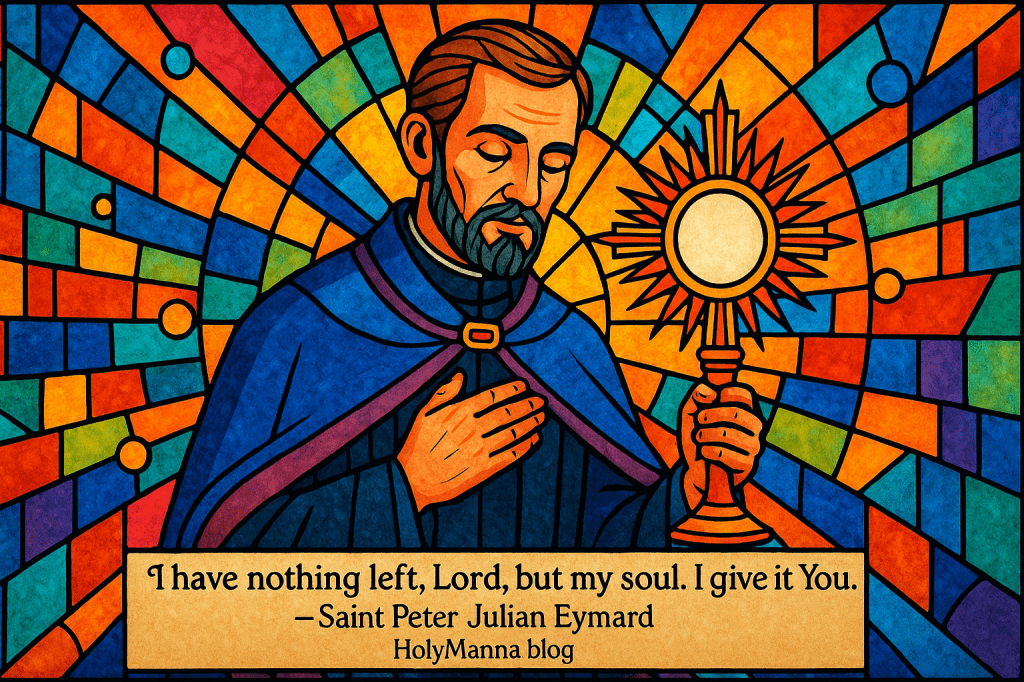
A Flame of Love for the Eucharist
Few saints have loved Jesus in the Eucharist as passionately and completely as Saint Peter Julian Eymard. Known as “the Apostle of the Eucharist,” his life was a continual offering to the Lord truly present in the Blessed Sacrament. In a 19th-century France increasingly marked by secularism and spiritual indifference, Eymard was a prophetic voice calling the faithful back to the heart of Catholic worship: the Real Presence of Christ in the Eucharist. His mission was not driven by a desire for fame or recognition, but by a consuming love for Jesus hidden under the appearance of bread. Through his preaching, writings, and the founding of the Congregation of the Blessed Sacrament, he inspired generations of Catholics to rediscover the source and summit of the Christian life. His feast day, celebrated on August 2, invites us to pause and ask: Do I live my life in the light of the Eucharist, as he did?
Forged in the Furnace of Faith
Peter Julian Eymard was born on February 4, 1811, in the small town of La Mure d’Isère, nestled in the French Alps. He grew up in a deeply Catholic household, though marked by the spiritual wounds left behind by the French Revolution. His father, a hardworking blacksmith, was a stern but faithful man who hoped his son would carry on the family trade. From his earliest days, Peter was drawn to the sacred. He would often spend hours before the tabernacle, even as a child, captivated by the mystery of Jesus in the Eucharist. His sister once recalled how he would sneak away from home to visit the church and simply sit in silence before the Blessed Sacrament.
Yet, Peter’s path to the priesthood was anything but smooth. His father’s resistance was only the beginning. He was plagued by poor health, particularly severe migraines and lung problems, which forced him to leave seminary twice. Still, he persevered, clinging to the call he felt so deeply in his soul. Finally, at the age of 23, he was ordained a diocesan priest in the Diocese of Grenoble in 1834.
As a parish priest, his fervent preaching and love for the poor drew many hearts closer to Christ. But within him, there remained a longing—a call to deeper spiritual perfection. In 1839, he joined the Society of Mary (Marists), a congregation dedicated to evangelization and Marian devotion. While serving as a Marist, his devotion to the Blessed Virgin deepened, but it was during a Corpus Christi procession in 1845 that everything changed. As the Eucharist passed by, he felt interiorly compelled: he must dedicate his life entirely to the glory of the Blessed Sacrament. That moment became a second conversion, a radical turning toward a singular mission—adoration and reparation before the Eucharistic Lord.
Living Bread for a Hungry World
From the moment Peter Julian Eymard founded the Congregation of the Blessed Sacrament in 1856, his life became one of constant labor for Christ in the Eucharist. He sought to revive faith in a France increasingly disconnected from its Catholic roots, believing that the only way to restore society was to return to the altar. His motto was simple yet profound: “You take communion to become a saint.” He believed that frequent reception of the Eucharist and prolonged adoration could transform even the hardest hearts.
He worked tirelessly to establish houses of Eucharistic worship, promote perpetual adoration, and offer catechesis on the Real Presence. Through his gentle, persuasive manner, he influenced both the simple and the educated, the lukewarm and the devout. His Eucharistic meditations—many of which he wrote late at night after hours of prayer—are rich in mystical insight and theological depth. He wrote, “The Eucharist is the supreme proof of the love of Jesus. After this, there is nothing more but Heaven itself.”
Although he did not perform dramatic physical miracles during his life, the spiritual miracles wrought through his work were countless. Hardened sinners returned to confession, religious vocations were rekindled, and many found solace, purpose, and joy through adoration. He led souls to profound conversion simply by teaching them to sit still before Jesus and let His love do the rest. He once told a struggling penitent: “Go to your adoration as one would go to Heaven, to the divine banquet. You will see the God of love giving Himself to you.”
Carrying the Cross of Obedience and Obscurity
Peter Julian Eymard’s sanctity was forged not in glory but in struggle. Though aflame with love for Jesus, he was frequently misunderstood and resisted by others. When he left the Marists to pursue his Eucharistic mission, he did so with great sorrow, feeling as though he were tearing his heart in two. The road to founding a new congregation was steep. Financial resources were scarce, and some Church leaders were skeptical of his mission. Others questioned the need for yet another religious order, particularly one centered on perpetual adoration, which was not yet widely practiced.
He also battled constant illness—bronchial infections, migraines, exhaustion—and the weight of spiritual desolation. Like many saints before him, he endured the “dark night of the soul,” moments when God felt painfully absent. Yet, he never wavered. In his trials, he learned to identify even more with the hiddenness and vulnerability of Jesus in the Eucharist. He wrote: “The Eucharist is the sacrament of the God who is alone, forgotten, despised, left behind, and insulted.”
His humility was profound. Though he was the founder, he often lived as the servant of his own congregation, cleaning chapels, writing letters by hand, and spending long nights in prayer when he could barely breathe. Every suffering, every setback, he offered in union with the Sacrificial Lamb on the altar.
He died quietly on August 1, 1868, in La Mure, having poured out every ounce of his life for the glory of the Eucharist. His final words, whispered through pain, were a prayer of surrender: “I have nothing left, Lord, but my soul. I give it to You.”
Heavenly Signs of a Eucharistic Saint
The years following Saint Peter Julian Eymard’s death saw a steady growth in devotion to his memory and mission. His tomb in La Mure quickly became a site of pilgrimage, especially for those seeking healing—both physical and spiritual—through the intercession of the Eucharistic saint. Many came away reporting peace, healing, and a renewed desire to spend time before the Blessed Sacrament.
Numerous healings were attributed to him during the investigations for his canonization. One such case involved a young boy in France who suffered from a severe bone disease. After his parents prayed through the intercession of Father Eymard and placed a relic on their son, the boy’s condition inexplicably reversed. He grew into adulthood with no further complications.
But perhaps even more powerful than physical miracles were the spiritual awakenings that followed. His writings began to circulate more widely, sparking Eucharistic renewal movements across Europe and eventually in North America. The Congregation of the Blessed Sacrament expanded to multiple continents, continuing his mission of adoration and evangelization.
When Pope John XXIII canonized him in 1962, he remarked that Saint Peter Julian had opened the door for the laity to rediscover the Eucharist as a source of daily strength and transformation. Today, countless parishes around the world practice perpetual adoration thanks to his tireless efforts.
A Heart Consumed by the Eucharist
Saint Peter Julian Eymard challenges every modern Catholic to ask: Is the Eucharist truly the center of my life? In a world that often rushes past the sacred and substitutes entertainment for intimacy with God, his example draws us back to silence, reverence, and real presence. He shows us that adoration is not only for mystics or clergy—it is for everyone. It is a path to holiness that begins with simply sitting before Jesus and letting Him love us.
If you’ve never spent time in Eucharistic adoration, consider making a short visit this week. Let it be quiet. Let it be awkward, if necessary. Let Jesus look at you. As Saint Peter Julian said, “Look at the Host. It is the answer to every problem, the medicine for every wound, the light in every darkness.”
We can also honor his legacy by preparing more attentively for Holy Communion, approaching the altar with hearts full of gratitude and humility. We might deepen our understanding of the Mass, or share the beauty of Eucharistic adoration with a friend who is struggling. In all these small ways, we imitate a man who gave everything to make Jesus known and loved in the Blessed Sacrament.
Saint Peter Julian Eymard reminds us that holiness is possible—not in grand gestures, but in simple, quiet acts of devotion rooted in the love of Christ present in the Host.
Engage with Us!
What part of Saint Peter Julian Eymard’s story touched you most? Have you experienced a deep encounter with Jesus in the Eucharist like he did? Share your thoughts and experiences in the comments—we’d love to hear from you!
Here are a few questions to reflect on today:
How does Saint Peter Julian’s devotion to the Eucharist challenge or inspire your own prayer life?
What concrete step can you take this week to deepen your relationship with Jesus in the Blessed Sacrament?
Have you ever considered spending time in Eucharistic adoration? What’s holding you back—or drawing you in?
Let’s support each other in this journey of faith and strive to do everything with love, as our Lord Jesus did.

 Holy Manna!
Leave a comment