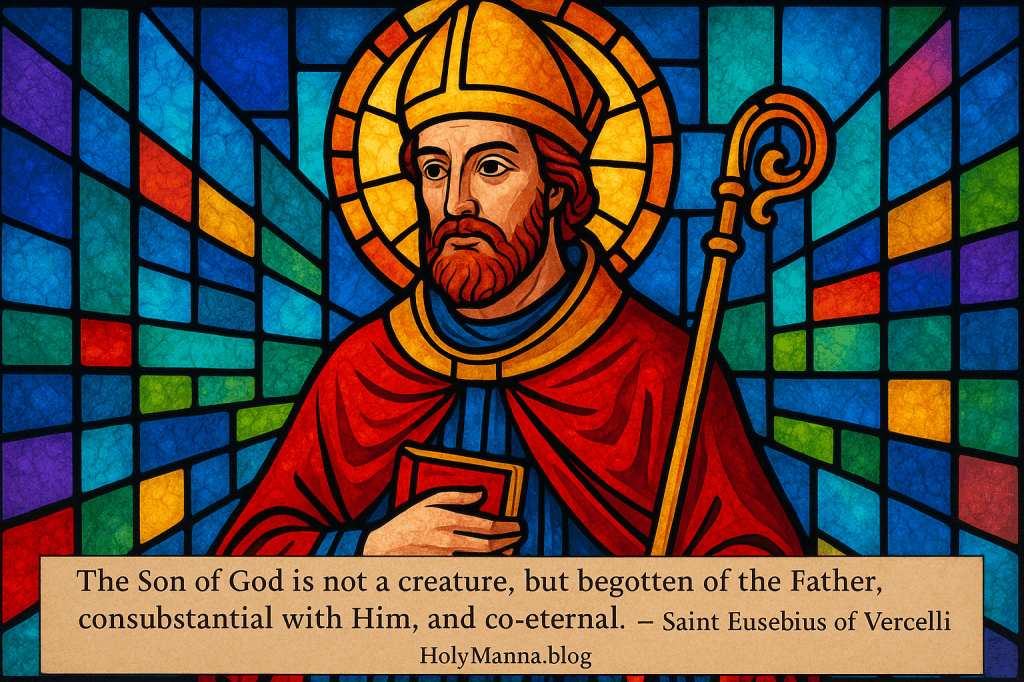
The Torchbearer of Truth in an Age of Heresy
In the great cloud of witnesses that surrounds us (cf. Hebrews 12:1), Saint Eusebius of Vercelli shines as one of the earliest and boldest defenders of Christ’s divinity and the unity of the Church. Living in the 4th century—a time when theological conflict shook the foundations of the Church—he stood fearlessly for the Nicene Creed and suffered dearly for it. A bishop, confessor, and spiritual father, he helped shape the model of clerical life in the West and left an enduring legacy rooted in fidelity, courage, and reconciliation. Though not as widely known as some of his contemporaries like Saint Athanasius or Saint Ambrose, Eusebius is a spiritual giant whose witness still echoes through the centuries. He is revered not for dramatic miracles or martyrdom by blood, but for the martyrdom of the will—a heart entirely surrendered to God amidst exile, persecution, and heretical pressure.
Champion of Christ
Eusebius was born around the year 283 AD on the island of Sardinia, part of the Roman Empire. After the early death of his father—who may have died a martyr for the faith—he moved with his mother to Rome, where he would spend his formative years. Immersed in the early Christian community of the Eternal City, Eusebius was educated in Scripture and theology and served as a lector in the Church. These early encounters with the Word of God and the persecution endured by his family laid the groundwork for a soul that would later face imperial wrath with unshakable peace.
His path to deeper holiness wasn’t marked by a single dramatic conversion, but rather by a steady growth in virtue, doctrine, and ecclesial commitment. In 345 AD, he was appointed as the first Bishop of Vercelli in northern Italy. There, he introduced a groundbreaking model: he gathered his clergy into a community that combined pastoral ministry with a monastic way of life. Inspired by the practices of Eastern monks, Eusebius created a brotherhood of priests devoted to prayer, Scripture, and ascetic living. This deeply influenced later Western practices of religious and clerical life, anticipating the reforms of Saint Augustine and Saint Benedict.
Eusebius was most known for his unswerving defense of the Nicene faith, which proclaimed that Jesus Christ is “consubstantial with the Father.” When many bishops caved to pressure from heretical factions or imperial politics, he stood firm—refusing to compromise, no matter the cost.
The Defender of the Incarnate Word
As a bishop, Eusebius was not content with comfort or popularity. The true test of his sanctity came in 355 AD at the Synod of Milan, convened by Emperor Constantius II, who sought to force the bishops of the West to condemn Saint Athanasius—a heroic defender of the Nicene Creed. While many bishops gave in, Eusebius, with a heart ablaze for Christ, refused. With unwavering boldness, he declared that fidelity to Christ was more important than imperial favor.
He was seized, beaten, and exiled to distant and harsh regions—first Scythopolis (modern-day Israel), then Cappadocia, and finally Thebaid in Egypt. During these years of exile, Eusebius suffered physical abuse and lived in isolation. He was kept under constant surveillance by Arian sympathizers and denied basic comforts. Yet even in exile, he wrote letters encouraging fellow bishops, urging them to stay faithful to the truth.
Though no physical miracles during his life have been recorded by historians, his life itself was a miraculous witness to divine perseverance. His leadership served as a stabilizing force during one of the Church’s greatest theological crises. Saint Ambrose would later credit Eusebius with helping to preserve the Nicene faith in the West during its most vulnerable moment. Through his teaching, example, and spiritual endurance, Eusebius helped lay the foundation for what the Church would later declare at the First Council of Constantinople in 381 AD: that Christ is truly God, equal to the Father in divinity.
Scars for the Savior
The white martyrdom of Saint Eusebius was as grueling as any red martyrdom. For six long years, he was tossed from one place of exile to another—always under guard, always treated with suspicion, and often physically mistreated. In Thebaid, he endured extreme conditions, facing the searing desert and the threat of wild animals and hostile soldiers.
But it was not merely the harshness of exile that made his suffering heroic—it was the interior fortitude with which he bore it. While other bishops sought political solutions or faded into silence, Eusebius kept preaching the truth, sometimes at great personal risk. He did not lash out in bitterness, nor did he sow division. He carried his cross with the same dignity that Christ bore His. “If we suffer with Him, we shall also reign with Him” (2 Timothy 2:12) seemed etched into his soul.
After the death of Emperor Constantius II, Eusebius was finally allowed to return to Italy in 361 AD. Rather than returning with vengeance, he came with a spirit of healing. He visited churches torn apart by heresy and worked to rebuild both faith and fraternity. In Vercelli, he resumed his pastoral work and helped organize synods that restored orthodoxy across the region. His endurance became a seedbed for renewal.
The Fruit of His Holy Witness
Eusebius died around the year 371 AD, not by the sword or fire, but in peace after a life of faithful suffering. While there are no spectacular miracles attributed to him after death, the fruits of his holy witness lived on. The Church in Vercelli became a center of orthodoxy, and future saints like Ambrose and Augustine were profoundly influenced by his life and structure of clerical community.
His relics were venerated in the Cathedral of Vercelli, where he was buried. The cathedral itself, built on the foundation of his episcopacy, became a place of pilgrimage and prayer. The faithful saw in Eusebius not a saint who dazzled with outward signs, but one who drew hearts through his interior conformity to Christ. He was canonized by the early acclaim of the Church, his feast day placed on August 2nd in recognition of his sanctity.
In a world fascinated with dramatic signs, Saint Eusebius reminds us that the greatest miracles are often quiet: the strength to endure, the humility to forgive, and the courage to stand firm in the truth when no one else will.
Faithful Until the End
Saint Eusebius’ life offers us a powerful example in a world often swayed by relativism, popularity, and fear of conflict. His fidelity to the divinity of Christ—even when it cost him his freedom and comfort—invites us to ask ourselves: Do I stand for the truth, even when it’s hard? Am I willing to be exiled from cultural approval to remain close to Christ?
In an age where even Christians are tempted to dilute the Gospel or compromise for convenience, Eusebius stands as a beacon of integrity. His life urges us to deepen our knowledge of Catholic teaching, to read and pray with Scripture, and to remain faithful to the Church, even when it’s not easy.
We can imitate him by living lives of prayer and community, by encouraging our pastors and praying for our bishops, and by resisting the temptation to speak half-truths for the sake of comfort. Let us remember that real unity in the Church is always grounded in the truth of Christ, not merely in external peace.
Saint Eusebius teaches us that holiness does not require applause—it requires courage. And courage, when offered to Christ, becomes a light for generations to come.
Engage with Us!
We’d love to hear your thoughts on Saint Eusebius of Vercelli. How has his story inspired you? What stood out most to you about his life?
Reflection Questions:
- What modern-day “exiles” are you willing to endure for your faith in Christ?
- In what ways can you help your local Church community grow in holiness and unity like Eusebius did in Vercelli?
- Are there areas where you have been tempted to compromise the truth for the sake of comfort or acceptance?
Let’s continue encouraging one another in faith, always seeking the truth in love, and doing everything for the glory of God, as our Lord Jesus did.
Saint Eusebius of Vercelli, pray for us! 🔥
Follow us on Instagram and Facebook for more insights and reflections on living a faith-filled life.

 Holy Manna!
Leave a comment