Saturday of the Seventeenth Week in Ordinary Time – Lectionary: 406
The Cost of Truth, the Blessing of Justice
What would it look like to live in a world where mercy restores the broken, justice sets people free, and truth is spoken boldly, no matter the consequence? Today’s readings invite us to imagine just such a world—while also challenging us to embrace the cost of living in it.
In Leviticus 25, the Lord commands the observance of a Jubilee Year—every fiftieth year, debts are forgiven, slaves are released, and land returns to its original owners. This was not merely an economic policy; it was a profound theological statement that all belongs to God. The Jubilee was a safeguard against oppression, a holy recalibration of society grounded in reverence for the Lord: “Do not deal unfairly with one another, then; but stand in fear of your God” (Leviticus 25:17). In ancient Israelite culture, where land, labor, and lineage defined your place in society, the Jubilee was radical. It proclaimed that no injustice was permanent and that God Himself was the true owner of all things.
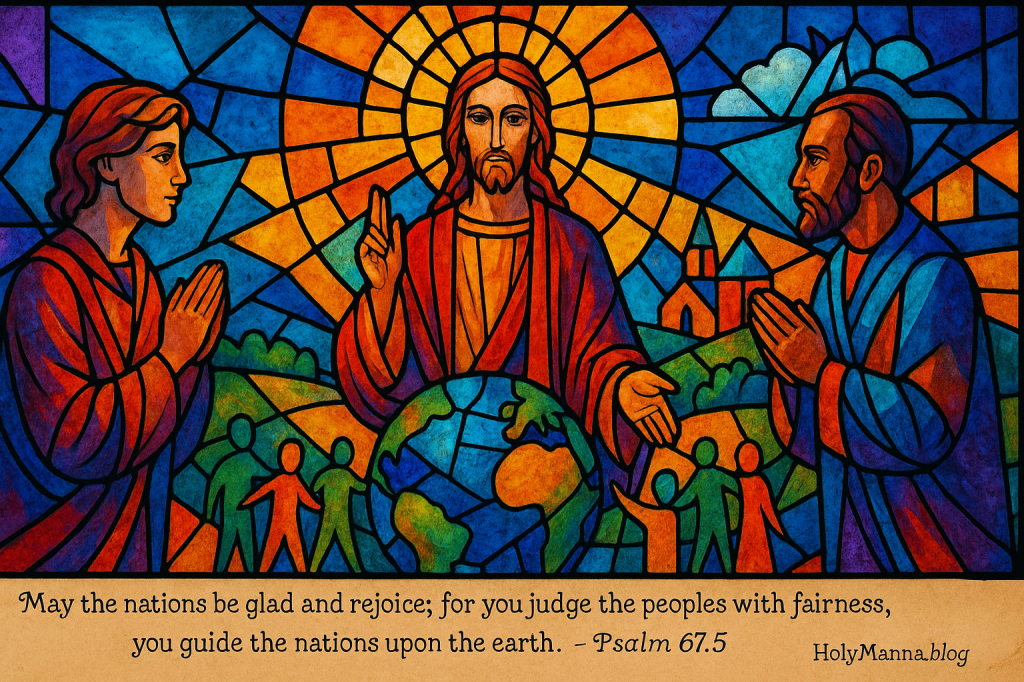
This vision of justice is echoed in Psalm 67, where the psalmist prays: “May the nations be glad and rejoice; for you judge the peoples with fairness” (Psalm 67:5). But this sacred order is shattered in The Gospel of Matthew, where John the Baptist—God’s courageous voice of truth—is silenced by a ruler more afraid of losing face than of offending God. Herod’s tragic decision to execute John reveals what happens when power is divorced from truth, and when fear of man overrides fear of the Lord. The contrast is striking: God’s law liberates and blesses, while human pride enslaves and destroys. Today’s readings stir our hearts to ask: Do I live in awe of God’s justice and truth—or in fear of what others think?
First Reading – Leviticus 25:1, 8–17
A Sacred Reset
The passage from Leviticus 25 transports us into the heart of ancient Israel’s covenantal society—a society uniquely shaped by divine commands that touched every aspect of life, from farming practices to economic transactions. Today’s reading focuses on the institution of the Jubilee Year, a radical call to communal justice, mercy, and trust in divine providence. For the Israelites, land was not merely property—it was inheritance from the Lord, a sacred trust passed down through generations. By instituting a Jubilee every fiftieth year, God reminded His people that they were stewards, not owners. The land, the people, and even time itself belonged to Him. This holy year proclaimed liberty throughout the land and demanded social restoration: property returned, debts forgiven, slaves set free. It was a divine safeguard against generational poverty, inequality, and greed. In the context of today’s theme, this reading reveals that justice is not merely a societal good—it is a sacred act of obedience and reverence toward God.
Leviticus 25:1, 8-17
New American Bible (Revised Edition)
The Sabbatical Year. 1 The Lord said to Moses on Mount Sinai:
The Jubilee Year. 8 You shall count seven weeks of years—seven times seven years—such that the seven weeks of years amount to forty-nine years. 9 Then, on the tenth day of the seventh month let the ram’s horn resound; on this, the Day of Atonement, the ram’s horn blast shall resound throughout your land. 10 You shall treat this fiftieth year as sacred. You shall proclaim liberty in the land for all its inhabitants. It shall be a jubilee for you, when each of you shall return to your own property, each of you to your own family. 11 This fiftieth year is your year of jubilee; you shall not sow, nor shall you reap the aftergrowth or pick the untrimmed vines, 12 since this is the jubilee. It shall be sacred for you. You may only eat what the field yields of itself.
13 In this year of jubilee, then, each of you shall return to your own property. 14 Therefore, when you sell any land to your neighbor or buy any from your neighbor, do not deal unfairly with one another. 15 On the basis of the number of years since the last jubilee you shall purchase the land from your neighbor; and so also, on the basis of the number of years of harvest, that person shall sell it to you. 16 When the years are many, the price shall be so much the more; when the years are few, the price shall be so much the less. For it is really the number of harvests that the person sells you. 17 Do not deal unfairly with one another, then; but stand in fear of your God. I, the Lord, am your God.
Detailed Exegesis
Verse 1 – “The Lord said to Moses on Mount Sinai:”
This opening verse anchors the entire chapter in divine authority. Mount Sinai was not just the site of the Ten Commandments; it was the spiritual epicenter of the covenant between God and Israel. Everything that follows, including economic laws and social mandates, comes directly from the Lord. This verse reminds us that God is not indifferent to how we structure our societies.
Verse 8 – “You shall count seven weeks of years—seven times seven years—such that the seven weeks of years amount to forty-nine years.”
The use of “seven times seven” mirrors the sacredness of the number seven in Jewish tradition—symbolizing completeness and divine perfection. Just as the seventh day was for rest (Sabbath), and the seventh year for the land to rest (sabbatical year), the seven sabbatical cycles culminate in a Jubilee—a super-Sabbath of societal restoration.
Verse 9 – “Then, on the tenth day of the seventh month let the ram’s horn resound; on this, the Day of Atonement, the ram’s horn blast shall resound throughout your land.”
The Jubilee is inaugurated on Yom Kippur—the Day of Atonement—linking personal and national repentance with collective renewal. The sounding of the ram’s horn (shofar) served as a public call to freedom, justice, and mercy. True atonement was not only inward but social: healing relationships, correcting injustice, and setting captives free.
Verse 10 – “You shall treat this fiftieth year as sacred. You shall proclaim liberty in the land for all its inhabitants. It shall be a jubilee for you, when each of you shall return to your own property, each of you to your own family.”
This verse is the beating heart of the Jubilee command. “Proclaim liberty in the land” is not a suggestion—it is a divine imperative. Returning to one’s family and property restored the dignity of each person as a child of God. The Jubilee reflects God’s nature as Liberator and Provider.
Verse 11 – “This fiftieth year is your year of jubilee; you shall not sow, nor shall you reap the aftergrowth or pick the untrimmed vines,”
This command requires radical trust. No planting or harvesting meant depending entirely on God’s providence. The land rests, the people rest, and all wait upon the Lord. It echoes Exodus 16, when manna fell from heaven: God is the ultimate Sustainer.
Verse 12 – “Since this is the jubilee. It shall be sacred for you. You may only eat what the field yields of itself.”
The year is not just practical—it is sacred. This highlights the spiritual nature of economic and agricultural life. Eating only what grows naturally keeps the people from exploiting the land and reinforces God’s ownership of creation.
Verse 13 – “In this year of jubilee, then, each of you shall return to your own property.”
This is the second mention of returning to property, emphasizing God’s desire to restore balance and protect families from generational loss. It prevents the permanent accumulation of wealth and power in a few hands.
Verse 14 – “Therefore, when you sell any land to your neighbor or buy any from your neighbor, do not deal unfairly with one another.”
Economic transactions are not separate from holiness. They must be governed by fairness and love of neighbor. The Catechism teaches: “In economic matters, respect for human dignity requires the practice of the virtue of temperance, so as to moderate attachment to this world’s goods” (CCC 2407).
Verse 15 – “On the basis of the number of years since the last jubilee you shall purchase the land from your neighbor; and so also, on the basis of the number of years of harvest, that person shall sell it to you.”
Land sales are essentially leases, not permanent transfers. Value is based on expected yields, which keeps pricing fair and grounded in reality. This prevents exploitation of desperate sellers.
Verse 16 – “When the years are many, the price shall be so much the more; when the years are few, the price shall be so much the less. For it is really the number of harvests that the person sells you.”
The economy is not to be manipulated for greed. God’s law insists on just scales and honest valuation. This principle anticipates later prophetic warnings against unjust trade (see Amos 8:5–6).
Verse 17 – “Do not deal unfairly with one another, then; but stand in fear of your God. I, the Lord, am your God.”
This final verse roots justice in worship. Business ethics are not optional or secular—they are a direct reflection of our relationship with God. “I, the Lord, am your God” makes it unmistakably clear: justice is sacred.
Teachings: God’s Justice and Our Conversion
The Jubilee year was a prophetic symbol pointing forward to the Kingdom of God—a time when captives would be released and the poor would hear good news (see Luke 4:18–19). Jesus Himself proclaimed this passage from Isaiah 61 at the start of His public ministry, revealing that He is the fulfillment of the Jubilee. The Catechism of the Catholic Church affirms: “The Law of the Gospel ‘fulfills,’ refines, surpasses, and leads the Old Law to its perfection… Its principal precept is to love one another as Christ has loved us” (CCC 1968). The Jubilee prefigures this call to mercy, justice, and love. Saint John Paul II, in his apostolic letter Tertio Millennio Adveniente, called the Jubilee year a time for “a great prayer of praise and thanksgiving, above all for the gift of the Incarnation and the Redemption.” He encouraged Christians to “rediscover the demands of conversion, justice, and forgiveness.”
Living the Jubilee
This reading is not just a lesson in ancient law—it’s a mirror for our modern hearts. Where in our lives do we need a Jubilee? Are there people we need to forgive? Debts—emotional or spiritual—that we are called to release? Have we clung too tightly to what we think is ours, forgetting that all we have is God’s gift? The command to “proclaim liberty” challenges us to become agents of God’s justice, both personally and socially. Do we honor fairness in how we work, shop, lend, and give? The Jubilee invites us into a rhythm of trust—trust that God will provide when we loosen our grip. It also calls us to reverence: “Stand in fear of your God” (Leviticus 25:17). When we live in holy fear, we see every relationship, every transaction, and every possession through the eyes of eternity. May we ask the Holy Spirit today: Where am I called to proclaim liberty in my life, and how can I live in reverent justice before my God?
Responsorial Psalm – Psalm 67:2–3, 5, 7–8
A Harvest of Justice and Praise
Psalm 67 is a radiant hymn of thanksgiving and hope, composed for liturgical use during the harvest season in ancient Israel. This psalm expresses the joy of a people who have not only received material abundance but have come to recognize God’s providential hand in their blessings. It opens with a priestly blessing reminiscent of the Aaronic benediction in Numbers 6:24–26—“May God be gracious to us and bless us; may His face shine upon us.” In the agricultural culture of Israel, the fertility of the land was seen as a direct sign of God’s favor, and the Psalmist links this fruitfulness with God’s desire to make His ways known to all nations. Today, this psalm connects beautifully with the theme from Leviticus 25—the just and sacred order of God reflected in the land’s produce, and in how that fruit is shared among peoples. As the First Reading calls for economic justice and divine reverence, the psalm responds with joyful praise for the God who judges fairly and blesses abundantly.
Psalm 67:2-3, 5, 7-8
New American Bible (Revised Edition)
2 May God be gracious to us and bless us;
may his face shine upon us.
Selah
3 So shall your way be known upon the earth,
your victory among all the nations.
5 May the nations be glad and rejoice;
for you judge the peoples with fairness,
you guide the nations upon the earth.
Selah
7 The earth has yielded its harvest;
God, our God, blesses us.
8 May God bless us still;
that the ends of the earth may revere him.
Detailed Exegesis
Verse 2 – “May God be gracious to us and bless us; may his face shine upon us.”
This opening petition invokes divine favor, grace, and light—three images deeply tied to covenantal blessing. To ask that God’s face shine upon us is to seek His presence, His delight, and His guidance. In Hebrew thought, the face of God symbolized relationship and blessing. This echoes Numbers 6:25, part of the priestly blessing God commanded: “The Lord let his face shine upon you, and be gracious to you.” It is also fulfilled in Christ, “the image of the invisible God” (Colossians 1:15).
Verse 3 – “So shall your way be known upon the earth, your victory among all the nations.”
God’s blessing upon Israel is not meant to be hoarded but shared. The fruit of God’s goodness in one land becomes a witness to His justice and power for all peoples. The word “victory” here can also be translated as saving help or salvation. The psalmist prays that the abundance of God’s mercy and provision would become a sign that draws the nations to know Him. This verse connects directly to the Jubilee in Leviticus—a sacred social witness to God’s liberating power.
Verse 5 – “May the nations be glad and rejoice; for you judge the peoples with fairness, you guide the nations upon the earth.”
Here, the psalm becomes a missionary song. It envisions not only Israel, but all nations rejoicing in the fairness and justice of God’s rule. Unlike earthly rulers like Herod in today’s Gospel of Matthew, God does not exploit or manipulate—He judges with righteousness. His “guidance” is not coercive but life-giving. The fairness of God’s judgment is cause for global rejoicing, not fear.
Verse 7 – “The earth has yielded its harvest; God, our God, blesses us.”
This verse shifts from petition to praise. God’s blessing is no longer hoped for—it has arrived in the form of a fruitful harvest. The response to divine blessing is not pride but praise. This verse echoes the Jubilee principle that the land’s fruit is ultimately God’s gift, not man’s achievement.
Verse 8 – “May God bless us still; that the ends of the earth may revere him.”
The psalm ends with a forward-looking prayer: not just gratitude for what God has done, but hope that His blessings continue and spread. The ultimate purpose of blessing is worship—that the whole earth may revere God. This reverence ties back to Leviticus 25:17: “Stand in fear of your God. I, the Lord, am your God.”
Teachings: God’s Justice for All
This psalm anticipates the universal call of the Gospel—that all nations are invited to know, love, and worship the one true God. It proclaims that God’s justice is not tribal or localized but global, and it praises a divine economy that blesses the earth not for greed, but for glory. The Catechism of the Catholic Church teaches: “The beauty of creation reflects the infinite beauty of the Creator and ought to inspire the respect and submission of man’s intellect and will” (CCC 341). Psalm 67 calls us to see in the harvest a sacrament of God’s goodness—and in justice, a path to conversion. Saint Augustine saw in the earth’s harvest a metaphor for the Church, saying: “The earth has yielded its fruit: Christ has risen in the flesh, and now the world brings forth a harvest of souls” (Exposition on the Psalms, Ps. 67).
Living the Psalm
Do we see the blessings in our lives—our homes, jobs, food, and relationships—as gifts to be shared or hoarded? Psalm 67 challenges us to gratitude that overflows into mission. How are we making God’s “way known upon the earth”? Like Israel, we are blessed so that others may see and come to know the Lord. This means living justly, giving generously, and praising openly. In a culture that prizes self-sufficiency and personal gain, the psalm reminds us that the true harvest is reverence for God. What fruits are we cultivating in our lives, and do they lead others to rejoice in His justice? Let today be a day of thanksgiving—for what we have, and for the God who blesses with purpose.
Holy Gospel – Matthew 14:1–12
The Price of Truth and the Power of Conscience
Today’s Gospel recounts one of the most sorrowful and shocking moments in the New Testament: the martyrdom of John the Baptist. As a prophet, John boldly called Israel to repentance and directly confronted the sin of Herod Antipas, the tetrarch of Galilee and Perea, who had unlawfully taken his brother’s wife, Herodias. In the cultural and political context of first-century Judea, speaking truth to power could cost one everything—including one’s life. Herod ruled as a client king under Roman authority, and his court reflected the corruption, vanity, and political manipulation typical of the Herodian dynasty. By exposing Herod’s sin, John touched a nerve not just politically, but spiritually, challenging the very foundation of Herod’s self-serving rule. This reading stands in stark contrast to the Jubilee law in Leviticus, where God commands justice, equity, and reverence for His name. Here, we witness a ruler who fears man more than God, and a prophet who fears God more than death. John’s beheading is not just an ancient tragedy—it is a prophetic call to each of us to consider: Are we willing to live—and die—for the truth?
Matthew 14:1-12
New American Bible (Revised Edition)
Herod’s Opinion of Jesus. 1 At that time Herod the tetrarch heard of the reputation of Jesus 2 and said to his servants, “This man is John the Baptist. He has been raised from the dead; that is why mighty powers are at work in him.”
The Death of John the Baptist. 3 Now Herod had arrested John, bound [him], and put him in prison on account of Herodias, the wife of his brother Philip, 4 for John had said to him, “It is not lawful for you to have her.” 5 Although he wanted to kill him, he feared the people, for they regarded him as a prophet. 6 But at a birthday celebration for Herod, the daughter of Herodias performed a dance before the guests and delighted Herod 7 so much that he swore to give her whatever she might ask for. 8 Prompted by her mother, she said, “Give me here on a platter the head of John the Baptist.” 9 The king was distressed, but because of his oaths and the guests who were present, he ordered that it be given, 10 and he had John beheaded in the prison. 11 His head was brought in on a platter and given to the girl, who took it to her mother. 12 His disciples came and took away the corpse and buried him; and they went and told Jesus.
Detailed Exegesis
Verse 1 – “At that time Herod the tetrarch heard of the reputation of Jesus”
Herod Antipas ruled a quarter of his father Herod the Great’s former kingdom. “Tetrarch” means ruler of a fourth. He is introduced here not as a man of power and stability, but as one who is disturbed by the growing influence of Jesus. The phrase “heard of the reputation” indicates that Jesus had become a widely known figure, performing miracles and teaching with authority—perhaps even reminding Herod of the last prophet he encountered.
Verse 2 – “This man is John the Baptist. He has been raised from the dead; that is why mighty powers are at work in him.”
Herod’s conscience is clearly tormented. Though John is dead, Herod is haunted by guilt and fear. He mistakes Jesus for a resurrected John, revealing a superstitious and guilty mind. This belief, though not doctrinally accurate, shows that even those in power cannot escape the consequences of sin. As CCC 1861 teaches, “Mortal sin destroys charity in the heart of man by a grave violation of God’s law… it causes exclusion from Christ’s kingdom and the eternal death of hell.”
Verse 3 – “Now Herod had arrested John, bound him, and put him in prison on account of Herodias, the wife of his brother Philip,”
Herod’s arrest of John is politically motivated but morally driven by Herodias’s grudge. John had spoken the truth of God’s law. Under Mosaic Law (Leviticus 18:16), it was forbidden to marry a brother’s wife while he lived. Herod’s violation of this law was not private—it had public scandal, and John’s role as a prophet demanded he speak out.
Verse 4 – “For John had said to him, ‘It is not lawful for you to have her.’”
This is the prophetic cry that sealed John’s fate. He does not mince words or temper truth. Like the prophets before him, John calls out injustice and sin, regardless of the cost. His words echo the boldness of Elijah before Ahab and Nathan before David. Prophets are never politically convenient.
Verse 5 – “Although he wanted to kill him, he feared the people, for they regarded him as a prophet.”
Herod is torn between his desire to eliminate a moral nuisance and his fear of public opinion. His internal conflict reveals cowardice and vanity—he is more concerned with appearances than righteousness. The fear of man, not the fear of God, dominates his choices.
Verse 6 – “But at a birthday celebration for Herod, the daughter of Herodias performed a dance before the guests and delighted Herod”
Herod’s court is shown here in decadence and manipulation. The daughter of Herodias—traditionally known as Salome—dances, likely in a seductive manner, pleasing the drunken king and his guests. Lust, pride, and vanity set the stage for injustice.
Verse 7 – “So much that he swore to give her whatever she might ask for.”
In a rash moment of pride and pleasure, Herod makes an oath without wisdom. Jesus warns in Matthew 5:37, “Let your ‘Yes’ mean ‘Yes,’ and your ‘No’ mean ‘No.’ Anything more is from the evil one.” Oaths made to impress others can easily become snares of sin.
Verse 8 – “Prompted by her mother, she said, ‘Give me here on a platter the head of John the Baptist.’”
Herodias’s vengeance is calculated and chilling. She uses her daughter as a weapon to destroy John. The request for John’s head on a platter mocks the very idea of a feast, turning celebration into execution.
Verse 9 – “The king was distressed, but because of his oaths and the guests who were present, he ordered that it be given,”
Herod’s sorrow is not repentance—it is regret without courage. Rather than lose face before his guests, he sacrifices a righteous man. His distress mirrors Pontius Pilate, who also sentenced an innocent man to death under social pressure.
Verse 10 – “And he had John beheaded in the prison.”
The prophet’s life ends in silence, far from the crowds. There is no trial, no defense—only execution in the darkness. Yet, like Christ, John’s death becomes a light that will not go out. His blood, like the martyrs after him, becomes a seed of the Kingdom.
Verse 11 – “His head was brought in on a platter and given to the girl, who took it to her mother.”
This grotesque image stands as one of the darkest scenes in the Gospels. The prophet’s head, once proclaiming truth, now lies silenced by hatred and vanity. The feast becomes a funeral for the conscience of Herod’s court.
Verse 12 – “His disciples came and took away the corpse and buried him; and they went and told Jesus.”
The disciples’ act of reverence honors John’s body, while their message to Jesus signals the passing of the prophetic mantle. The voice in the wilderness is gone, but the Word made flesh continues His mission. The stage is set for Jesus to take center stage, for the Lamb of God to walk toward His own sacrifice.
Teachings: Prophetic Witness and Holy Courage
John the Baptist is the last and greatest of the Old Testament prophets. As Jesus declares in Matthew 11:11, “Among those born of women there has been none greater than John the Baptist”. He is the forerunner of the Messiah, the one who pointed beyond himself and prepared the way of the Lord. His martyrdom fulfills the pattern of all true prophets—rejected by the powerful, silenced by the proud, honored by God. The Catechism of the Catholic Church reminds us: “The Church has always venerated the martyrs as the supreme witnesses to the truth of the faith: they have borne witness to Christ even to the point of death” (CCC 2473). John’s fearless witness is not simply historical—it is exemplary. Saint Bede the Venerable wrote, “He died for justice and truth, and therefore he is held in high honor by the Church”. His life calls each of us to examine whether we, too, will stand for God’s truth even when it costs us reputation, relationships, or comfort.
Living the Gospel
How do we respond when truth is inconvenient or uncomfortable? John the Baptist shows us that living in truth sometimes means standing alone, confronting injustice, and risking everything. In a world where moral relativism is celebrated and truth is often silenced for political convenience, are we willing to speak up with charity and conviction? Herod feared the crowd more than he feared God. Do we seek approval from others more than holiness before the Lord? The Gospel invites us today to examine our own hearts: Where have we been silent when we should have spoken? Where have we compromised truth for comfort or acceptance? Let us ask for the intercession of John the Baptist, that we may have his courage, clarity, and humility. May we live not by fear of man, but in awe of God—proclaiming with our lives: “It is not lawful”, “It is not just”, “It is not holy.” May the truth cost us everything—and lead us home to Christ.
Living Jubilee, Speaking Truth, Sowing Praise
Today’s readings form a striking and sobering tapestry—a vision of divine justice, holy fear, and bold witness. In Leviticus 25, we are given the blueprint for a society rooted not in personal gain but in sacred order: a Jubilee year of release, restoration, and reverence for the Lord. Psalm 67 responds with the joyful refrain of a people who see God’s justice as cause for praise and evangelization—“May the nations be glad and rejoice”, because God’s blessings are meant to be shared and His fairness known throughout the earth. Then, in The Gospel of Matthew, we encounter the chilling reality of what happens when justice is trampled, truth is silenced, and fear of man replaces fear of God. John the Baptist, the last and greatest of the prophets, gives his life to uphold the sanctity of God’s law, standing as a beacon for all of us who seek to live with integrity and courage.
Together, these passages ask us: Do we live in a way that reflects God’s justice and mercy? Do we bless others with what we’ve received, or hoard what was meant to be shared? Are we courageous enough to speak the truth when it costs us something—or everything? The Jubilee calls us to reorder our lives, the Psalm calls us to rejoice and give thanks, and the Gospel calls us to live and die for the truth.
May we allow God to plant these words deep in our hearts today. Let us be people who proclaim liberty—not just with our lips but through our actions. Let us return, like in the Jubilee, to our true inheritance: a life rooted in Christ. And let us not fear the cost of truth, but embrace it, knowing that our reward is not the approval of men, but the blessing of God—“May His face shine upon us”, and may we live in such a way that even the ends of the earth revere Him.
Engage with Us!
We’d love to hear how today’s Scriptures moved your heart. Share your thoughts, prayers, or personal experiences in the comments below. Whether a word challenged you, a verse comforted you, or a theme inspired you—your voice adds richness to this reflection community.
Reflection Questions:
First Reading – Leviticus 25:1, 8–17
What parts of my life need a spiritual “Jubilee”—a return, a reset, or a release? Am I treating others fairly in my relationships, work, or business dealings? How can I grow in holy reverence for God in how I manage the resources He has entrusted to me?
Responsorial Psalm – Psalm 67:2–3, 5, 7–8
Do I recognize and give thanks for the blessings in my life as gifts from God? In what ways can I make God’s ways “known upon the earth” through my daily actions? What harvest is God asking me to offer back in praise and mission?
Holy Gospel – Matthew 14:1–12
When have I stayed silent in the face of injustice or moral compromise? What fears keep me from living or speaking the truth with boldness and love? Am I more concerned with the approval of others or with standing in the truth before God?
Let us continue to walk together in faith, trusting in the God who restores, blesses, and leads us into truth. May everything we do today—whether in word, work, or silence—be done with the love and mercy Jesus taught us, that the world may see Him living in us.
Follow us on Instagram and Facebook for more insights and reflections on living a faith-filled life.

 Holy Manna!
Leave a comment