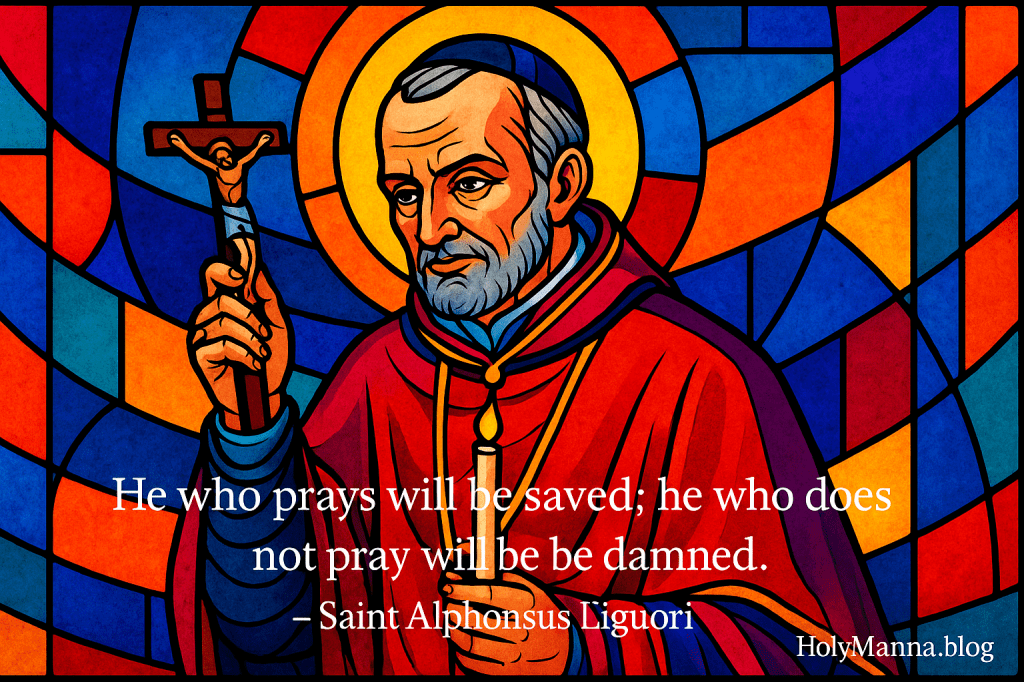
A Flame of Mercy and Truth
In an age of harsh rigorism and growing alienation from the Church, Saint Alphonsus Marie Liguori emerged as a beacon of mercy, intellect, and unwavering devotion to the poor and forgotten. Canonized in 1839 and declared a Doctor of the Church in 1871, Alphonsus’s legacy remains foundational in Catholic moral theology, especially for his clear, compassionate treatment of conscience, confession, and the Eucharist. A brilliant scholar, gifted writer, and humble shepherd of souls, he founded the Congregation of the Most Holy Redeemer—the Redemptorists—to preach Christ’s love where it was most needed. With over 100 published works and a deep Marian spirituality, his teachings continue to illuminate the path of holiness for the Church today. But it was not just what he taught—it was how he lived: with profound humility, burning love for God, and complete surrender to the cross.
A Lawyer Turned Saint
Born into nobility on September 27, 1696, in Marianella near Naples, Alphonsus was the eldest of seven children in a cultured and devout household. His father, Don Giuseppe Liguori, was a naval officer determined to see his son rise in society, while his mother, Anna Cavalieri, instilled in him a deep love for prayer and the Blessed Virgin Mary. Alphonsus’s mind was prodigious—he earned doctorates in both civil and canon law by age sixteen, and by nineteen, he was already practicing law and winning cases in the bustling courts of Naples.
Despite this promising career, his soul grew restless. He became increasingly disillusioned with the corruption and vanity of the legal world. The breaking point came in 1723 when he lost a major case—not due to error, but due to a political betrayal that shattered his ideals. He walked out of the courtroom and, with piercing clarity, said: “World, I know you now. Courts, never shall you see me again.”
That moment marked his conversion—not from sin, but from worldliness to radical holiness. He dedicated himself to God completely, was ordained a priest in 1726, and immediately poured himself into evangelizing the poor, especially in rural and neglected regions. He would later found the Redemptorists in 1732, an order specifically aimed at reaching those forgotten by society and the Church alike.
A Shepherd with the Heart of the Redeemer
Saint Alphonsus’s priestly ministry was marked by extraordinary tenderness, theological brilliance, and pastoral zeal. He traveled on foot to preach missions in the poorest villages, catechizing the uneducated and offering the sacraments to people who had long been abandoned. His preaching was not lofty, but accessible. His confessional lines were long, filled with people who sensed that in him, they would find not condemnation, but mercy and truth.
He was also a mystic of sorts. Though he didn’t work dramatic miracles of healing or levitation, many testified to his uncanny ability to read hearts in confession and to guide souls with divine clarity. His advice was often so accurate that penitents were moved to tears. He once said, “The most powerful weapon to conquer the devil is humility. For, as he does not know how to employ it, neither does he know how to defend himself from it.”
He wrote some of the most influential spiritual texts in Catholic history. The Glories of Mary helped fuel the Marian devotion of countless faithful, and Moral Theology helped the Church navigate a path between excessive severity and irresponsible permissiveness. He emphasized that God’s mercy is greater than our sins and that a scrupulous conscience is not the voice of God, but often a tactic of the enemy. His Visits to the Blessed Sacrament and Preparation for Death continue to touch hearts centuries later. Even as arthritis bent his body and nearly blinded him, Alphonsus dictated books with help from others, often under tremendous pain, never ceasing his work for the Kingdom.
Crosses of the Soul
Despite his holiness, Alphonsus endured deep suffering—physical, emotional, and spiritual. His body was ravaged by rheumatic fever and chronic arthritis, leaving his neck permanently bent forward and his spine curved into a painful arch. He spent the last years of his life confined to a wheelchair, nearly blind and tormented by internal trials, including scruples and feelings of abandonment. But he bore it all with heroic patience.
Perhaps the most painful trial came when political manipulation from within his own Redemptorist congregation led to his being deceived into signing documents that resulted in his expulsion from the very order he had founded. Imagine the agony of seeing your spiritual children turn against you, your life’s work distorted. Yet Alphonsus never lashed out. Instead, he surrendered to God’s will and said: “God has permitted it, and so it is all for the best.” This profound trust in Divine Providence is what marked his sanctity.
Though he was appointed Bishop of Sant’Agata dei Goti in 1762 and served faithfully for over a decade, he eventually resigned due to health. But even in retirement, he continued to write, to counsel souls, and to suffer in union with Christ.
Signs from Heaven
Saint Alphonsus died on August 1, 1787, at the age of 90, in the Redemptorist monastery in Pagani. Shortly after his death, miracles began to be attributed to his intercession. Healings, conversions, and protections were reported throughout Italy. One miraculous story tells of a young girl cured of a terminal illness after her parents placed one of Alphonsus’s images near her bed and prayed through his intercession.
His tomb in Pagani became a site of pilgrimage, and his relics—treated with great reverence—have been known to bring peace and healing to those who venerate them. The Church recognized his sanctity swiftly: he was beatified in 1816, canonized in 1839, and declared a Doctor of the Church in 1871. In 1950, Pope Pius XII named him the patron of moral theologians and confessors.
Even in heaven, his mission continues: to remind the Church that mercy and truth are not enemies, but friends.
Saint of the Confessional
Saint Alphonsus Liguori has never been more relevant than he is today. In a world where people are often torn between fear of God’s wrath and despair of His mercy, Alphonsus calls us back to the heart of the Gospel. He shows us that God is not a tyrant waiting to punish us, but a loving Father eager to forgive.
His writings teach us how to confess with confidence, how to trust even in our failures, and how to pray with the heart of a child. His life encourages us to never give up—even when betrayed, misunderstood, or broken in body and spirit. His motto could easily be the words of 2 Corinthians 12:10: “When I am weak, then I am strong.”
Do you struggle with scruples, shame, or fear that you’ve gone too far? Read Saint Alphonsus. Do you long to love Jesus in the Eucharist more deeply? Sit with Visits to the Blessed Sacrament. Do you want to understand Our Lady’s love for you? Let The Glories of Mary be your guide.
More than anything, live what Alphonsus preached: trust God, pray always, serve the poor, and never let discouragement win. That is the path to holiness.
Engage with Us!
How has Saint Alphonsus’s message of mercy touched your heart? Have you read any of his spiritual writings, or do you know someone who could benefit from them? We’d love to hear your reflections in the comments!
Reflection Questions:
- How can I bring Christ’s mercy to someone struggling with guilt or shame?
- Am I more focused on God’s justice or His mercy in my spiritual life? Why?
- What is one way I can imitate Saint Alphonsus’s devotion to the Eucharist this week?
Let us support one another in our journey toward holiness, and strive to do everything with love, just as our Lord Jesus Christ and His faithful servant, Saint Alphonsus Liguori, did.
“He who prays will be saved; he who does not pray will be damned.” – Saint Alphonsus Liguori
Saint Alphonsus Liguori, pray for us! ✨
Follow us on Instagram and Facebook for more insights and reflections on living a faith-filled life.

 Holy Manna!
Leave a comment