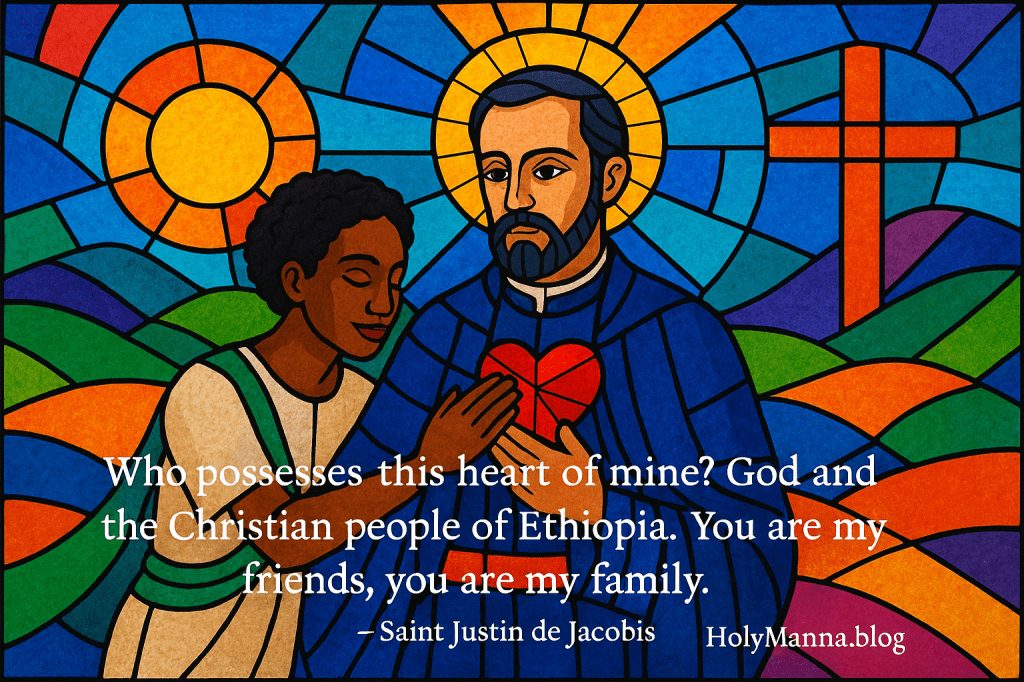
A Missionary of Mercy
Saint Justin de Jacobis is one of the most remarkable yet lesser-known missionary saints in the Catholic Church. A man of deep humility, cultural sensitivity, and pastoral charity, he is best remembered for bringing the Catholic faith to Ethiopia and Eritrea in the 19th century. Known for his ability to work within the local traditions rather than against them, Saint Justin is a model for evangelization done with love, patience, and respect. Pope Paul VI declared him a saint in 1975, recognizing the impact of his missionary zeal and unwavering commitment to Christ in difficult terrain and times.
A Heart on Fire for God
Saint Justin was born on October 9, 1800, in San Fele, a small town in southern Italy. He was the youngest of fourteen children in a devout, middle-class family. At a young age, he discerned a religious vocation and entered the Congregation of the Mission, also known as the Vincentians, founded by Saint Vincent de Paul. He was ordained a priest in 1824 and served in various ministries across Italy.
His conversion wasn’t from paganism or scandalous sin, but from a life of ordinary service to one of extraordinary sacrifice. In 1839, Father Justin was sent as a missionary to Abyssinia (modern-day Ethiopia and Eritrea), a region historically rich in Christian roots but separated from the Catholic Church since the schism following the Council of Chalcedon. It was here that his missionary identity would be tested and sanctified. He immersed himself in the local language, culture, and liturgical tradition, striving not to impose Latin customs but to bring unity in Christ while honoring the heritage of the Ethiopian Church.
Love Without Borders
Saint Justin’s daily life was marked by holiness and heroic charity. He traveled on foot for miles across dangerous terrain, often in extreme heat or rain, to minister to the sick, celebrate the sacraments, and comfort the poor. His knowledge of the local languages, Ge’ez and Amharic, helped him deeply connect with the people he served.
One notable miracle involved a young boy who had fallen gravely ill in a remote village. After Saint Justin prayed over him and anointed him, the boy recovered quickly—an event which the villagers attributed to divine intervention through the holy priest’s prayer.
But perhaps his greatest miracle was his approach: Justin didn’t seek to conquer the culture—he sought to understand it. He developed an Ethiopian Catholic liturgy, formed native clergy, and restored the sense of dignity among the local faithful, many of whom had felt abandoned. His compassion, gentleness, and integrity won over even those who initially resisted him.
Persecution, Imprisonment, and the Crown of Suffering
Despite his good works, Saint Justin faced intense opposition. Both the political authorities and leaders of the Ethiopian Orthodox Church viewed his mission as a threat. He was arrested multiple times, beaten, and imprisoned in dire conditions. In one instance, he was shackled and forced to walk hundreds of miles through the highlands, suffering from exposure and disease. Yet he never lost his peace or joy.
In these sufferings, Saint Justin saw Christ crucified. He once wrote: “If we are missionaries of Christ, we must also be missionaries of His Cross.”
Though he did not die a martyr in the strictest sense, his entire life was a white martyrdom—a gradual self-offering of body and soul. He died on July 31, 1860, in Halai, Eritrea, after a long illness worsened by years of physical and spiritual hardship.
Miracles That Echo in the Hills
After his death, many local Christians came to venerate Saint Justin as a holy man. Testimonies of healings and favors granted through his intercession spread quickly. Pilgrims would visit the site of his death and burial, and several miraculous healings were attributed to him—particularly cases of blindness and fevers suddenly cured after prayers made in his name.
In 1939, Pope Pius XII declared him Venerable. His beatification followed in 1939, and Pope Paul VI canonized him in 1975. His tomb in Eritrea has become a pilgrimage site for many seeking healing and guidance, especially during times of national hardship.
Walking with the People
Saint Justin de Jacobis teaches us that true evangelization is not domination—it is incarnation. Just as Christ took on human flesh and entered into our history, so Justin entered into the lives of the Ethiopian people with love, respect, and humility.
His life invites us to ask: Do I serve others with compassion, or with control? Do I seek to understand, or to be understood first?
In a world where evangelization can be reduced to marketing or debate, Saint Justin reminds us of the power of incarnational presence—of walking with the suffering, of listening, and of being faithful even when rejected.
We are called to be missionaries too: in our families, workplaces, parishes, and communities. Like Saint Justin, we can choose to be bridges of peace and unity. We can learn languages—not only of words, but of the heart. We can be living icons of Christ by our gentleness and courage.
Engage with Us!
What part of Saint Justin’s story spoke to you the most? Share your thoughts, testimonies, or prayer requests in the comments—we’d love to hear from you!
Reflection Questions:
- What does it mean for you to live as a missionary in your daily life?
- In what ways can you better serve those around you with humility and cultural sensitivity?
- How do you respond to suffering or rejection for your faith—do you embrace the Cross as Saint Justin did?
Let us continue to lift each other in prayer and strive to imitate the saints. May we do everything with love, just as our Lord Jesus did.
Saint Justin de Jacobis, pray for us!
Follow us on Instagram and Facebook for more insights and reflections on living a faith-filled life.

 Holy Manna!
Leave a comment