Memorial of Saint Ignatius of Loyola, Priest – Lectionary: 404
Cloud and Compass
There is a quiet ache in every human heart for something greater—something enduring, sacred, and sure. Today’s readings stir that ache and answer it, pointing us toward a God who does not remain distant but draws near to dwell with His people and guide their every step. Whether through the cloud in the wilderness, the temple of the heart, or the net of divine judgment, the Lord reveals Himself as both home and compass. As we celebrate the Memorial of Saint Ignatius of Loyola, we’re invited into the same dynamic tension he lived: a burning desire for the presence of God and the continual discernment of His will.
The Israelites in Exodus 40 have just completed the tabernacle, a sacred space where God chooses to dwell visibly among them in cloud and fire. This divine presence isn’t stationary—it moves with purpose, signaling when to stay and when to journey on. Psalm 84 echoes this longing to be close to God’s dwelling: “My soul yearns and pines for the courts of the Lord… Blessed are those who dwell in your house!” (Ps 84:3,5). Yet this presence also demands a response, a purification of heart. In The Gospel of Matthew (Mt 13:47-53), Jesus offers the parable of the net, warning of the final separation between good and evil. The image is both sobering and hopeful: those who live in God’s presence now must be vigilant, discerning what is of eternal value.
Few saints lived this call to presence and discernment like Saint Ignatius of Loyola. A soldier wounded in battle, his dramatic conversion led him from worldly glory to spiritual warfare. He understood that God’s will is not always loud or obvious, but gently revealed through the movements of the soul. His Spiritual Exercises became a pathway to see “God in all things,” to journey with the divine cloud, and to make choices in alignment with the Kingdom. Today’s readings and memorial together call us to ask: Are we building our lives around the presence of God? Are we discerning His movement and responding with trust?
First Reading – Exodus 40:16–21, 34–38
God in Our Midst
Today’s first reading brings us to the climactic moment of the Book of Exodus: the completion of the tabernacle—the portable sanctuary where the glory of the Lord would dwell among His people. The Israelites, newly delivered from slavery in Egypt, have been journeying through the wilderness, learning what it means to trust and obey the Lord. Now, under Moses’ obedience, the tabernacle is constructed exactly as God commanded. What follows is one of the most awe-inspiring scenes in the Old Testament: the descent of God’s glory in the form of a cloud. In ancient Jewish culture, this cloud—the Shekinah—represented the tangible presence of God. The significance of this moment cannot be overstated: the God of Abraham, Isaac, and Jacob, the Creator of the universe, chooses to take up residence in the midst of His people, guiding them with clarity and love. In light of today’s theme—dwelling with God and discerning His way—we are reminded that God not only invites us to build sacred space for Him but also to follow His lead with trust. This is the same call Saint Ignatius of Loyola embraced when he surrendered his own plans to God and discerned a path of radical discipleship.
Exodus 40:16-21, 34-38
New American Bible (Revised Edition)
16 Moses did just as the Lord had commanded him. 17 On the first day of the first month of the second year the tabernacle was set up. 18 It was Moses who set up the tabernacle. He placed its pedestals, set up its frames, put in its bars, and set up its columns. 19 He spread the tent over the tabernacle and put the covering on top of the tent, as the Lord had commanded him. 20 He took the covenant and put it in the ark; he placed poles alongside the ark and set the cover upon it. 21 He brought the ark into the tabernacle and hung the curtain veil, thus screening off the ark of the covenant, as the Lord had commanded him.
God’s Presence in the Tabernacle. 34 Then the cloud covered the tent of meeting, and the glory of the Lord filled the tabernacle. 35 Moses could not enter the tent of meeting, because the cloud settled down upon it and the glory of the Lord filled the tabernacle. 36 Whenever the cloud rose from the tabernacle, the Israelites would set out on their journey. 37 But if the cloud did not lift, they would not go forward; only when it lifted did they go forward. 38 The cloud of the Lord was over the tabernacle by day, and fire in the cloud at night, in the sight of the whole house of Israel in all the stages of their journey.
Detailed Exegesis
Verse 16 – “Moses did just as the Lord had commanded him.”
This brief but powerful verse emphasizes Moses’ obedience. He doesn’t alter God’s instructions or improvise. His faithfulness sets the stage for God to dwell among His people. In our spiritual lives, God often reveals His will in small, specific ways, and our response—like Moses’—must be prompt and precise. Obedience prepares the soul to become a tabernacle of God.
Verse 17 – “On the first day of the first month of the second year the tabernacle was set up.”
This marks a new beginning: the first month of the second year since their departure from Egypt. It is a liturgical and historical milestone. The timing underscores that freedom from slavery is not the end of the story—God frees us for relationship, for worship, and for mission.
Verse 18 – “It was Moses who set up the tabernacle. He placed its pedestals, set up its frames, put in its bars, and set up its columns.”
Moses personally assembles the tabernacle, showing that leadership in the Kingdom of God is not about command from a distance but about humble service. Every detail is deliberate; this is not a random tent, but a holy space made worthy of divine presence.
Verse 19 – “He spread the tent over the tabernacle and put the covering on top of the tent, as the Lord had commanded him.”
Again, obedience is emphasized. The coverings were multilayered—both for protection and symbolism. They represented God’s mysterious and majestic presence veiled from direct human sight, yet near.
Verse 20 – “He took the covenant and put it in the ark; he placed poles alongside the ark and set the cover upon it.”
The Ark of the Covenant is not just a relic; it contains the Ten Commandments—the Word of God written in stone. This represents the meeting of divine law and human dwelling. God’s law is not external but at the heart of His presence with His people.
Verse 21 – “He brought the ark into the tabernacle and hung the curtain veil, thus screening off the ark of the covenant, as the Lord had commanded him.”
The veil separates the Holy of Holies, accessible only to the high priest, prefiguring Christ’s high priesthood and the veil torn at His crucifixion. It reveals both the transcendence of God and our need for a mediator.
Verse 34 – “Then the cloud covered the tent of meeting, and the glory of the Lord filled the tabernacle.”
This is the divine affirmation. God is pleased to dwell in what has been prepared in obedience. The same glory that descended on Mount Sinai now fills the tent. For us, this points forward to Pentecost, when God would dwell not in a tent but in human hearts.
Verse 35 – “Moses could not enter the tent of meeting, because the cloud settled down upon it and the glory of the Lord filled the tabernacle.”
Even Moses is awestruck, overwhelmed by the intensity of God’s presence. This reminds us that while God desires intimacy, He is also holy and other. Reverence must accompany relationship.
Verse 36 – “Whenever the cloud rose from the tabernacle, the Israelites would set out on their journey.”
The cloud is more than a symbol; it’s a guide. The people don’t move unless God does. This is the model of discernment: to wait for the Lord, to follow His lead, not to rush ahead or lag behind.
Verse 37 – “But if the cloud did not lift, they would not go forward; only when it lifted did they go forward.”
This teaches radical trust and patience. Discernment often involves waiting, even when it’s uncomfortable. Israel’s obedience to the cloud is a sign of spiritual maturity.
Verse 38 – “The cloud of the Lord was over the tabernacle by day, and fire in the cloud at night, in the sight of the whole house of Israel in all the stages of their journey.”
Day or night, God is present. The fire at night ensures there is never darkness too deep for His guidance. His presence is public, not hidden; it is meant to be seen, trusted, and followed.
Teachings
In the Catechism of the Catholic Church, this dwelling of God in the tabernacle foreshadows both the Incarnation and the indwelling presence of Christ in the Eucharist. CCC 2578 teaches: “The prayer of the People of God flourishes in the shadow of God’s dwelling place, first the Ark of the Covenant and later the Temple.” Likewise, CCC 1183 emphasizes: “The tabernacle is to be situated in churches in a most worthy place with the greatest honor. The dignity, placing, and security of the Eucharistic tabernacle should foster adoration before the Lord really present in the Blessed Sacrament.” This divine presence—visible in the Old Testament cloud—is fully realized in Christ, who dwells with us and guides us through the Holy Spirit. Saint Ignatius of Loyola deeply understood this truth and formed an entire spirituality around it. His Spiritual Exercises help the soul discern the presence of God, not just in churches but in everyday choices. His principle of “finding God in all things” calls us to turn every moment into a tabernacle of divine encounter.
Reflection
Where is God dwelling in your life right now? Have you created space for Him to take up residence in your heart? Are you moving only when He moves—or are you rushing ahead on your own timeline? This passage invites us to practice holy waiting, joyful obedience, and attentive discernment. Like Moses, we are called to construct our interior tabernacles with care, intention, and faithfulness. Spend time today in Eucharistic Adoration or in silent prayer, asking the Lord to show you where His cloud rests in your life. Let your heart become His tabernacle. Let His glory be your guide.
Responsorial Psalm – Psalm 84:3–6, 8, 11
Pilgrims of the Presence
Today’s psalm places us not in the wilderness, like the Israelites in Exodus, but in the courts of the Temple in Jerusalem, the visible dwelling place of God. Psalm 84 is a profound expression of desire—not for material wealth or earthly achievement—but for the nearness of the Lord. In ancient Israelite religion, the Temple was more than a building; it was the meeting point between heaven and earth, where God’s glory dwelt. Pilgrims would travel great distances to be in His courts, offering sacrifice and praise. This psalm captures that heart-aching yearning for communion with God and aligns beautifully with today’s theme of discerning and dwelling in His presence. In the spirit of Saint Ignatius of Loyola, this passage speaks to the inner compass of the soul that longs to live in alignment with God, to find refuge in Him, and to walk every road as a journey toward His glory.
Psalm 84:3-6, 8, 11
New American Bible (Revised Edition)
3 My soul yearns and pines
for the courts of the Lord.
My heart and flesh cry out
for the living God.
4 As the sparrow finds a home
and the swallow a nest to settle her young,
My home is by your altars,
Lord of hosts, my king and my God!
5 Blessed are those who dwell in your house!
They never cease to praise you.
Selah
6 Blessed the man who finds refuge in you,
in their hearts are pilgrim roads.
8 They will go from strength to strength
and see the God of gods on Zion.
11 Better one day in your courts
than a thousand elsewhere.
Better the threshold of the house of my God
than a home in the tents of the wicked.
Detailed Exegesis
Verse 3 – “My soul yearns and pines for the courts of the Lord. My heart and flesh cry out for the living God.”
The psalmist begins with an all-consuming desire. This is not a passing feeling; it is a deep spiritual hunger that engages both body and soul. The mention of courts refers to the outer areas of the Temple, where worshippers would gather. In this context, yearning for the courts of the Lord means yearning for nearness to His presence. It is a holy homesickness, a longing to be where God is.
Verse 4 – “As the sparrow finds a home and the swallow a nest to settle her young, my home is by your altars, Lord of hosts, my king and my God!”
The imagery of birds nesting near the altar conveys safety, intimacy, and belonging. Even the most vulnerable creatures are welcome in the Lord’s sanctuary. The psalmist identifies the altar—where sacrifices are offered—as a place of refuge. In calling God “my king and my God,” the speaker unites worship with personal devotion. This verse invites us to ask: Where do I nest? Where do I build my spiritual home?
Verse 5 – “Blessed are those who dwell in your house! They never cease to praise you.”
To dwell in God’s house is the ultimate beatitude. The Hebrew idea of blessing (ashrei) implies joy, contentment, and divine favor. Those who remain close to God are filled with unending praise—not because life is easy, but because their hearts are rooted in His presence. True blessedness is found not in circumstance, but in communion.
Verse 6 – “Blessed the man who finds refuge in you, in their hearts are pilgrim roads.”
This verse beautifully blends the images of safety and journey. The one who finds refuge in God is not static; his heart contains “pilgrim roads”—paths of transformation, growth, and direction. This speaks to the Ignatian principle of discernment in motion—our journey is not aimless, but a pilgrimage guided by the inner presence of God.
Verse 8 – “They will go from strength to strength and see the God of gods on Zion.”
Pilgrimage is not merely a physical trek, but a spiritual ascent. Those who walk with God find their strength renewed along the way. The final destination is Zion—the holy city, the place of divine encounter. This foreshadows the beatific vision in Heaven, where the faithful will finally see God face to face.
Verse 11 – “Better one day in your courts than a thousand elsewhere. Better the threshold of the house of my God than a home in the tents of the wicked.”
This is the climax of the psalmist’s longing. Even to stand at the doorway of God’s house is more desirable than living in comfort apart from Him. This radical preference for the presence of God challenges us to reexamine our priorities. Are we willing to sacrifice comfort, status, or ambition in order to remain near to the Lord?
Teachings
The Catechism of the Catholic Church affirms this longing for God as something planted in every human heart. CCC 27 teaches: “The desire for God is written in the human heart, because man is created by God and for God; and God never ceases to draw man to himself.” Psalm 84 exemplifies this desire fully expressed and directed toward its proper end. Similarly, CCC 2096 states: “Adoration is the first act of the virtue of religion. To adore God is to acknowledge him as God, as the Creator and Savior, the Lord and Master of everything that exists, as infinite and merciful love.” The psalmist models this act of adoration in his very breath. Saint Augustine reflects the same truth in his famous line: “You have made us for yourself, O Lord, and our heart is restless until it rests in you.” This restlessness is not a flaw; it is a summons. Saint Ignatius, in his spiritual exercises, taught that everything in our lives—health, sickness, wealth, poverty—must be ordered toward this one goal: the praise and service of God.
Reflection
Do you long for God’s presence with the same passion as the psalmist? Have you cultivated “pilgrim roads” in your heart, or have you settled for tents of comfort far from His courts? This psalm invites us into a daily examination of desire. Where is our soul leaning? Where do we seek refuge? If we are honest, many of us dwell in the courts of anxiety, distraction, or self-reliance. But the Lord invites us to come home. One concrete step to take today is to sanctify the first moments of your morning—before screens, news, or noise—with a simple prayer of longing: “My heart and flesh cry out for the living God.” Let that cry lead you into silence, and from silence into communion. Let every step today become a pilgrim road.
Holy Gospel – Matthew 13:47–53
Discernment at the End and in the Everyday
Jesus continues His teachings in parables, this time comparing the Kingdom of Heaven to a fishing net—a common image in the daily lives of His Galilean listeners, many of whom were fishermen by trade. In The Gospel of Matthew, chapter 13 forms a treasury of parables that reveal the mystery of the Kingdom in layered images and allegories. Today’s reading highlights two central ideas: final judgment and the necessity of wise discernment. As part of a culture that valued ritual purity and moral uprightness, Jesus’ Jewish audience would have immediately understood the concept of separation between the clean and the unclean, the righteous and the wicked. Yet here, Christ elevates this to eschatological proportions, revealing the divine discernment that will occur at the end of the age. This parable fits seamlessly with today’s theme of dwelling in God’s presence and discerning His movements. Just as the Israelites followed the cloud, and the psalmist longed for the courts of the Lord, so too must we learn to live now in such a way that we are found among the righteous when the net is drawn in. Saint Ignatius of Loyola understood that discernment isn’t only for great decisions, but for everyday faithfulness, preparing us to meet the Lord whenever He comes.
Matthew 13:47-53
New American Bible (Revised Edition)
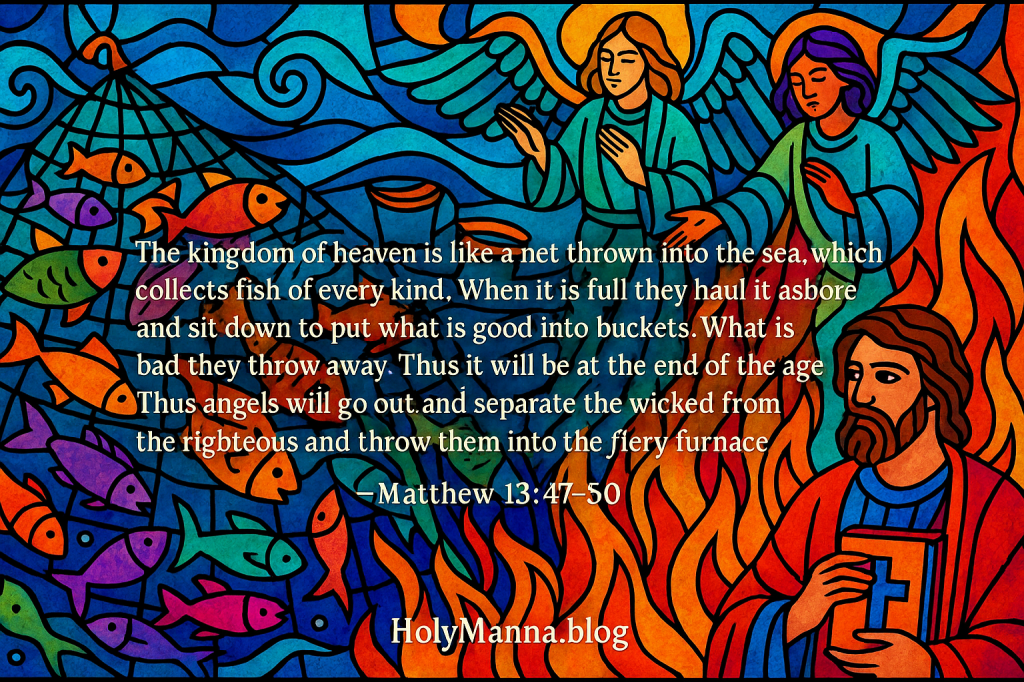
47 Again, the kingdom of heaven is like a net thrown into the sea, which collects fish of every kind. 48 When it is full they haul it ashore and sit down to put what is good into buckets. What is bad they throw away. 49 Thus it will be at the end of the age. The angels will go out and separate the wicked from the righteous 50 and throw them into the fiery furnace, where there will be wailing and grinding of teeth.
Treasures New and Old. 51 “Do you understand all these things?” They answered, “Yes.” 52 And he replied, “Then every scribe who has been instructed in the kingdom of heaven is like the head of a household who brings from his storeroom both the new and the old.” 53 When Jesus finished these parables, he went away from there.
Detailed Exegesis
Verse 47 – “Again, the kingdom of heaven is like a net thrown into the sea, which collects fish of every kind.”
The image of the net—sagēnē in Greek—refers to a dragnet, which gathers fish indiscriminately. This signifies the inclusive nature of the Church and the Gospel message, which is cast widely across humanity. The “fish of every kind” represent people of all nations, backgrounds, and responses to grace. There is no partiality in the invitation of the Kingdom.
Verse 48 – “When it is full they haul it ashore and sit down to put what is good into buckets. What is bad they throw away.”
Here we move from inclusivity to accountability. Though the net collects all, there will come a time of separation. The fishermen do not sort until the net is full, implying a divine timetable. The good and the bad are not determined by human standards but by the righteousness of the heart. This reflects the principle of final judgment, when each soul will be measured not merely by external actions but by the quality of faith and love.
Verse 49 – “Thus it will be at the end of the age. The angels will go out and separate the wicked from the righteous.”
Jesus clarifies that this is not a lesson about fishing, but about eternity. The sorting will be done by angels, under divine authority. The wicked and righteous will be revealed in full truth. In Ignatian terms, this is the ultimate discernment—the final sorting of spirits, not in personal conscience but in eternal destiny.
Verse 50 – “And throw them into the fiery furnace, where there will be wailing and grinding of teeth.”
This verse is both sobering and urgent. The “fiery furnace” evokes the image of Gehenna, a trash heap outside Jerusalem that had become a symbol for Hell. Jesus does not soften the consequences of rejection. The “wailing and grinding of teeth” express deep regret and eternal separation from God. This verse invites deep self-examination and a renewed desire for holiness.
Verse 51 – “Do you understand all these things?” They answered, ‘Yes.’”
Jesus pauses to check comprehension, suggesting that these truths are meant to be understood, not hidden. The disciples’ “Yes” reveals a willingness to receive the teaching, even if full understanding will come later through the Spirit. This moment also teaches us that knowledge is not passive—it demands response and conversion.
Verse 52 – “And he replied, ‘Then every scribe who has been instructed in the kingdom of heaven is like the head of a household who brings from his storeroom both the new and the old.’”
This concluding verse is rich with meaning. The scribe refers to someone well-versed in Scripture, now trained in the teachings of Christ. The storeroom is the treasury of God’s revelation—the Law, the Prophets, and the Gospel. To bring out “the new and the old” is to teach with discernment, honoring tradition while embracing the newness of Christ. This is exactly what Saint Ignatius exemplified—rooted in Scripture and Church tradition, yet led by the living Spirit to apply the Gospel anew in each person’s life.
Verse 53 – “When Jesus finished these parables, he went away from there.”
With this line, a section of Jesus’ public teaching concludes. His departure marks the end of a chapter, a turning point. For the listener, it leaves a holy silence—a moment to absorb what has been said and choose a response. Just like the Israelites watching the cloud lift, we too must decide: Will we follow where He leads?
Teachings
The Church teaches that discernment and judgment are integral to the Christian life. CCC 678 states: “Following in the steps of the prophets and John the Baptist, Jesus announced the judgment of the Last Day in his preaching. Then will the conduct of each one and the secrets of hearts be brought to light. Then will the culpable unbelief that counted the offer of God’s grace as nothing be condemned.” This parable of the net highlights that judgment is not arbitrary, but based on a person’s response to God’s grace. Saint Ignatius devoted his life to helping others discern that response through the Spiritual Exercises, particularly the “Rules for the Discernment of Spirits.” These rules help the soul distinguish between movements from God and those from the enemy. His aim was simple: to prepare hearts to choose the “good fish”—to live each day in a way that would be worthy of the Kingdom. In this way, discernment becomes not just a spiritual luxury, but a daily necessity.
Reflection
Are you living in such a way that you would be found among the good fish in the net? Are you drawing from the storeroom of your soul both the new and the old—Scripture, tradition, and personal experience—to discern God’s will? Jesus calls us not only to believe but to examine our lives with honesty and humility. Take time today to reflect on what you are allowing into your net. Are you gathering truth, virtue, and mercy—or distraction, pride, and fear? Consider journaling through a simple Ignatian examen: where did you experience God today? Where did you resist Him? Bring it all to the Lord’s storeroom, and let Him teach you how to sort what is of eternal worth. In a world filled with noise and mixed messages, let Christ’s voice be the net that draws you into the safety of His Kingdom.
When the Cloud Moves, Follow
Today’s readings lead us through a sacred journey—a pilgrimage of presence, discernment, and holy desire. In Exodus 40, we behold the awe-filled moment when God chooses to dwell visibly among His people. His glory fills the tabernacle, and the cloud becomes their compass, guiding every step through the wilderness. In Psalm 84, that same longing for divine presence wells up in the psalmist’s heart: “My soul yearns and pines for the courts of the Lord” (Ps 84:3). The pilgrimage becomes inward—a movement from distraction to desire, from wandering to worship. Then, in The Gospel of Matthew, Jesus reminds us that there will be a day of final discernment, when the net is drawn full and the good is separated from the wicked. Yet He ends with hope, commissioning every disciple to be a wise steward who draws from both old and new treasures.
All of this converges in the life and legacy of Saint Ignatius of Loyola, a man who knew what it meant to long for God, to discern His will, and to follow the Spirit’s movement even when it disrupted everything he thought his life would be. Ignatius teaches us that holiness is not about rigid perfection but about listening—watching for the cloud to lift, examining the stirrings of the heart, and responding with love. He discovered that true joy is found in dwelling where God dwells, and in choosing, each day, what leads us closer to Him.
What is God asking you to build today? Where is His presence resting in your life? When the cloud moves, will you follow? Whether in the tabernacle, the psalms, the parables, or the silence of your heart, God is speaking. He desires to dwell with you, guide you, and shape you into a vessel of His glory. Today, inspired by the example of Saint Ignatius, choose to live with your heart on pilgrimage. Ask the Lord for the grace to desire Him above all else, to discern His movement in your soul, and to follow wherever He leads. The cloud has lifted. The road awaits.
Engage with Us!
We’d love to hear how today’s Word is speaking to your heart. Share your reflections, prayers, or questions in the comments below—your insight may be exactly what someone else needs today. Let’s grow together as a community seeking to dwell in God’s presence and discern His will more faithfully.
Reflection Questions:
First Reading – Exodus 40:16–21, 34–38:
How do you recognize the presence of God in your daily life? Are there areas of your life where He’s asking you to wait until “the cloud lifts” before moving forward?
Responsorial Psalm – Psalm 84:3–6, 8, 11:
What does your soul truly long for? How can you cultivate “pilgrim roads” in your heart and draw closer to the Lord each day?
Holy Gospel – Matthew 13:47–53:
What spiritual “fish” are you allowing into your net? Are you learning to discern between what leads you toward God and what leads you away from Him?
May you go forth today renewed in your desire for God, strengthened in your discernment, and anchored in His abiding presence. Live a life of faith that shines with clarity and love, and do everything—yes, everything—with the mercy, joy, and truth that Jesus taught us.
Follow us on Instagram and Facebook for more insights and reflections on living a faith-filled life.

 Holy Manna!
Leave a comment