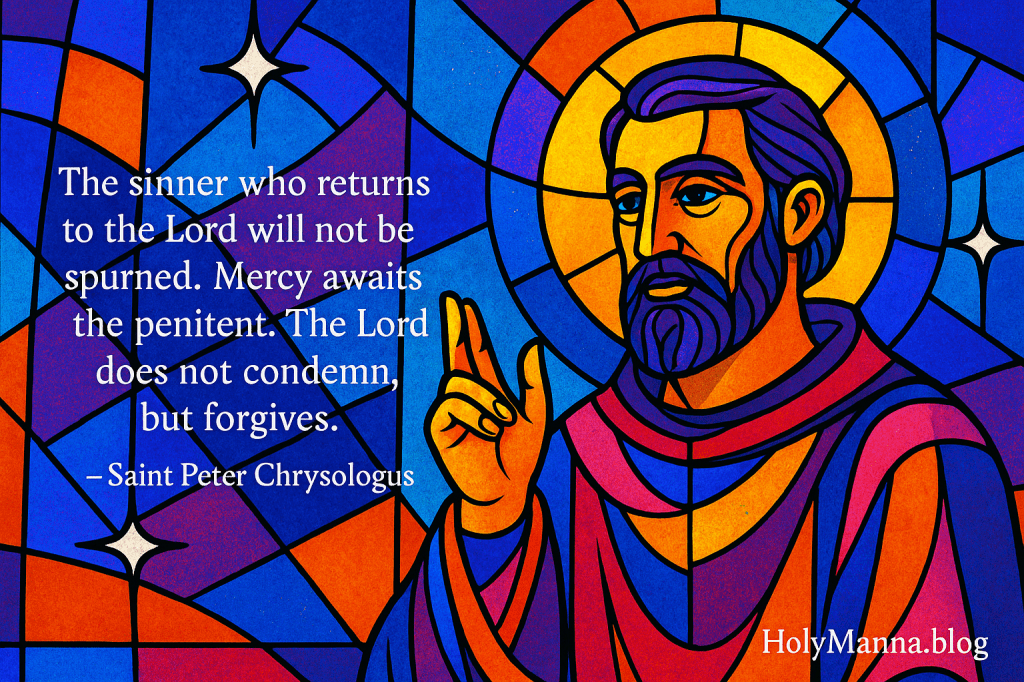
A Voice of Fire in the Early Church
Saint Peter Chrysologus, whose name means golden-worded, stands among the greatest preachers in the history of the Catholic Church. Born in the early 5th century and later named Bishop of Ravenna, Peter is one of the few saints honored with the title Doctor of the Church for his outstanding theological insight and pastoral care. He earned his title through his concise yet powerful homilies, which were rich in doctrinal purity and love for Christ. He is revered not only for his eloquence but also for his deep devotion to the mystery of the Incarnation, the Virgin Mary, and the Eucharist. Declared a Doctor of the Church by Pope Benedict XIII in 1729, Saint Peter Chrysologus continues to inspire clergy and laity alike with his burning zeal for the Gospel and his golden words that reveal the heart of divine truth.
From Humble Roots to Heavenly Wisdom
Peter was born around 380 AD in Imola, Italy, in the region of Emilia-Romagna. His early years were shaped by the Christian values of his devout family, particularly under the spiritual mentorship of Cornelius, the Bishop of Imola, who baptized him and later ordained him a deacon and then a priest. Peter was educated in the classical tradition and trained in rhetoric, which would later serve as a foundation for his powerful homiletic style. There is no dramatic conversion in his life—rather, it was a steady and faithful ascent to holiness, guided by obedience and humility.
His rise to the episcopacy was unexpected. Legend has it that Pope Sixtus III had a vision instructing him to appoint Peter, an unknown deacon, as Bishop of Ravenna—a position of political and spiritual importance at the time, given Ravenna’s status as the western capital of the Roman Empire. Despite his youth and obscurity, Peter accepted the call with humility. As bishop, he dedicated himself tirelessly to pastoral care, promoting orthodoxy, defending the Church against heresies like Arianism and Monophysitism, and encouraging devotion to the Incarnate Word of God.
Words That Healed, Truths That Burned
Saint Peter Chrysologus is most known for his extraordinary homilies—over 180 of which have survived. Though brief in length, often under five minutes when read aloud, they are dense with theological richness and scriptural depth. Through these golden sermons, Peter emphasized the mystery of Christ’s incarnation, the dignity of the human person, and the mercy of God. One of his most famous quotes is: “He is The Bread sown in the Virgin, leavened in the Flesh, molded in His Passion, baked in the oven of the Sepulcher, placed in the Churches, and set upon the Altars, which daily supplies Heavenly Food to the faithful.”
While there are no specific miracles during his life recorded in detail, the miraculous nature of his preaching—converting hearts and fortifying souls—can be seen as a spiritual miracle in itself. His ability to synthesize deep truths with warmth and clarity brought countless people to a deeper love of Jesus Christ and a firmer grasp of the Catholic faith.
Trials of a Shepherd in a Tumultuous Time
Peter’s episcopacy was not without hardship. He lived during a time of great theological confusion and social upheaval. The Roman Empire was crumbling in the West, and heresies threatened the unity of the Church. In his writings and correspondence, he constantly had to guide his flock through these storms with pastoral wisdom and doctrinal precision. One of his more famous letters was addressed to the heretic Eutyches, in which he encouraged obedience to the Apostolic See of Rome, writing: “We exhort you, honorable brother, to listen obediently to what has been written by the blessed Pope of the Roman See, since Blessed Peter, who lives and presides in his own See, offers the truth of the faith to those who seek it.”
Though not martyred in the physical sense, Peter bore the white martyrdom of suffering for the truth and shepherding his people through persecution, confusion, and political instability. He died around the year 450 AD in Imola, where he had been born and raised.
Echoes of Grace
After his death, devotion to Saint Peter Chrysologus grew steadily, particularly in Ravenna and Imola. His relics were venerated, and many faithful reported graces and favors received through his intercession. The simple fact that so many of his homilies were preserved in an age when few writings survived is itself seen by many as providential. The Church’s recognition of him as a Doctor nearly 1,300 years after his death speaks to the timeless relevance and spiritual potency of his words.
Pilgrimages to Imola continue today, and his feast day on July 30 invites the faithful to remember the transformative power of preaching when it is inspired by the Holy Spirit and rooted in love.
What Saint Peter Chrysologus Teaches Us Today
In a culture saturated with noise and shallow speech, Saint Peter Chrysologus reminds us that words matter. His life shows us that preaching is not about eloquence for its own sake but about communicating the living Word of God. He challenges us to let Christ shape our thoughts, inform our words, and guide our actions.
How often do we speak “golden words” that build up others in truth and love? Are we grounded in Scripture and the teachings of the Church, ready to give an account of our hope? Do we pray for our pastors and bishops, that they may preach with clarity and conviction like Peter Chrysologus?
To walk in his footsteps is to live with both conviction and compassion, to let the fire of God’s Word burn brightly in our hearts and on our lips. We can follow his example by reading Scripture daily, studying the Catechism of the Catholic Church, listening attentively to homilies, and sharing our faith with clarity, humility, and love.
Engage with Us!
We’d love to hear your reflections and thoughts in the comments! Has Saint Peter Chrysologus inspired you? How can we become better messengers of Christ’s truth in our daily lives?
Reflection Questions:
- How can I cultivate a heart and mind like Saint Peter Chrysologus—deeply rooted in Scripture and love for Christ?
- Do I use my words to build up others in truth and charity, or do I sometimes speak out of pride, fear, or frustration?
- How can I better support my parish priests and bishops as they preach the Gospel and guide the Church?
Let’s encourage one another in the comments and strive, like Saint Peter Chrysologus, to do everything with love—just as our Lord Jesus did.
Saint Peter Chrysologus, pray for us! ✨
Follow us on Instagram and Facebook for more insights and reflections on living a faith-filled life.

 Holy Manna!
Leave a comment