Wednesday of the Seventeenth Week in Ordinary Time – Lectionary: 403
Radiant Encounters and Hidden Treasures
Have you ever experienced a moment so profound, so drenched in light, that it left you changed—marked, even—by joy or truth? Today’s readings invite us into that very mystery: what happens when a soul truly encounters God. Whether on the heights of Mount Sinai or in the humble soil of an ordinary field, when the divine breaks into our world, it leaves behind something unmistakably radiant.
In Exodus 34, we see Moses descending from Mount Sinai, his face literally shining after speaking with the Lord. This wasn’t just a glow of joy—it was a visible, fearsome radiance that signaled to Israel the gravity and holiness of God’s presence. It marked Moses as someone who had seen God and could not return unchanged. The Psalmist remembers these holy moments of communion, recounting how Moses, Aaron, and Samuel called upon the Lord and He answered them from a pillar of cloud. This isn’t abstract spirituality—it’s the real, historical interaction between the living God and His people, rooted in covenant, obedience, and awe.
Then, Jesus in The Gospel of Matthew unveils two tiny parables that explode with eternal weight: the Kingdom of Heaven is a treasure so valuable, a pearl so precious, that one should sell everything to possess it. The connection is clear—those who come close to God, who see even a glimpse of His glory or the promise of His Kingdom, recognize that nothing else compares. Whether through glowing skin or radical surrender, the readings call us to consider: What would I give to truly live in God’s presence? Have I let myself be transformed by encountering Him?
First Reading – Exodus 34:29-35
The Radiance of God’s Presence
Have you ever encountered someone whose very presence seems changed after deep prayer? Today’s first reading captures such a moment—one of the most awe-filled encounters in all of Scripture. Following Israel’s idolatry with the golden calf, God renews His covenant with the people. Moses ascends Mount Sinai once more to receive the Law, and as he descends, something extraordinary happens: his face shines with divine light. This wasn’t a symbolic glow; it was so real and so startling that it filled the people with fear. The ancient world recognized light as a sign of divine favor or power. Here, it marks Moses as someone who has stood before the living God. His radiance reveals a deeper truth: true communion with God transforms us. This reading introduces today’s central theme—the power of divine encounter to change a person from the inside out.
Exodus 34:29-35
New American Bible (Revised Edition)
29 As Moses came down from Mount Sinai with the two tablets of the covenant in his hands, he did not know that the skin of his face had become radiant while he spoke with the Lord. 30 When Aaron, then, and the other Israelites saw Moses and noticed how radiant the skin of his face had become, they were afraid to come near him. 31 Only after Moses called to them did Aaron and all the leaders of the community come back to him. Moses then spoke to them. 32 Later, all the Israelites came up to him, and he enjoined on them all that the Lord had told him on Mount Sinai. 33 When Moses finished speaking with them, he put a veil over his face. 34 Whenever Moses entered the presence of the Lord to speak with him, he removed the veil until he came out again. On coming out, he would tell the Israelites all that he had been commanded. 35 Then the Israelites would see that the skin of Moses’ face was radiant; so he would again put the veil over his face until he went in to speak with the Lord.
Detailed Exegesis
Verse 29 – “As Moses came down from Mount Sinai with the two tablets of the covenant in his hands, he did not know that the skin of his face had become radiant while he spoke with the Lord.”
Moses, the mediator of the covenant, descends from the mountain bearing God’s Law once again. But this time, the covenant is inscribed not only on stone but on his very flesh. The Hebrew word qaran suggests rays of light bursting forth. That he was unaware of his radiance speaks to the humility of true holiness—it is not performative, but rooted in God.
Verse 30 – “When Aaron, then, and the other Israelites saw Moses and noticed how radiant the skin of his face had become, they were afraid to come near him.”
Fear is a natural response to divine presence. Just as Israel trembled at Sinai earlier (Exodus 19), now they shrink back from Moses, whose face bears the imprint of God’s glory. This awe is not just fear—it’s reverence for the holiness they can barely comprehend.
Verse 31 – “Only after Moses called to them did Aaron and all the leaders of the community come back to him. Moses then spoke to them.”
Moses invites them into God’s message. He is not only the bearer of the tablets, but also the one who mediates God’s voice. His leadership, formed by prayer, draws others closer to God—not through domination, but through divine authority.
Verse 32 – “Later, all the Israelites came up to him, and he enjoined on them all that the Lord had told him on Mount Sinai.”
This verse highlights Moses’ prophetic role. He is not just transformed for his own sake—his radiance leads to mission. He communicates what God has revealed, embodying the call of every believer: to encounter God and then go forth to proclaim.
Verse 33 – “When Moses finished speaking with them, he put a veil over his face.”
The veil reflects both mercy and mystery. It shields the people from overwhelming holiness and reminds us that the fullness of God’s glory is not yet fully revealed. St. Paul later reflects on this veil being removed in Christ, through whom we now have unveiled access to the Father (2 Corinthians 3:13-16).
Verse 34 – “Whenever Moses entered the presence of the Lord to speak with him, he removed the veil until he came out again. On coming out, he would tell the Israelites all that he had been commanded.”
Moses lives in a rhythm of intimacy and mission. When he’s with God, the veil drops—there’s nothing hidden. But when he’s among the people, the veil returns, symbolizing the distance between God’s holiness and fallen humanity.
Verse 35 – “Then the Israelites would see that the skin of Moses’ face was radiant; so he would again put the veil over his face until he went in to speak with the Lord.”
The passage ends with this rhythm reinforced: Moses is both a man of contemplation and action. He veils his glory to protect the people, but he keeps returning to the Lord, who is the source of that light. Transformation is not a one-time event—it is sustained by ongoing relationship.
Teachings
The Catechism of the Catholic Church emphasizes that intimacy with God brings about real transformation: “Contemplation is a gaze of faith, fixed on Jesus… His gaze purifies our heart; the light of the countenance of Jesus illumines the eyes of our heart” (CCC 2715). Like Moses, we are changed not simply by knowing about God, but by being with Him.
St. Gregory of Nyssa beautifully wrote, “The man who sees God receives in himself the characteristics of the divine.” The face of Moses was not just illuminated—it became a reflection of the One he beheld. This same transformation is available to us in the sacraments, especially the Eucharist, where we come face-to-face with Christ.
Historically, this radiant encounter influenced Christian art and theology for centuries. The depiction of halos around saints stems from this moment—a visible sign of interior holiness. And in the liturgy, when the priest blesses us with the words, “The Lord make His face shine upon you” (Numbers 6:25), it’s an echo of Sinai, inviting us into that same glory.
Reflection
Moses glowed because he spent time in the presence of God. Do we allow ourselves the time and silence to do the same? Whether through daily Mass, adoration, or silent prayer, God still desires to radiate His glory through us—not for our recognition, but for the world’s renewal.
What would it look like to live in such a way that others could sense you’ve been with God? This might mean being more patient with your children, more attentive to your spouse, more courageous in your witness at work. It might also mean removing the veils of fear, pride, or distraction that keep us from honest prayer.
Let today be an invitation to live unveiled before God. Seek His face in prayer, receive His light in the sacraments, and carry that radiance into your daily life. Holiness is not flashy—it’s luminous. And like Moses, we are called to shine.
Responsorial Psalm – Psalm 99:5-7, 9
Worship Before His Radiant Throne
Today’s responsorial psalm echoes the awe and reverence we saw in Exodus 34, inviting us to contemplate the holiness of God and the power of His presence among His people. Psalm 99 is one of the royal psalms that exalts the Lord as King—not only over Israel but over all creation. It draws upon the memory of sacred history, particularly the priestly leadership of Moses, Aaron, and Samuel, and reminds the worshiper of how God answered them and revealed Himself through the cloud of glory. The psalm is deeply liturgical in tone, calling the people to exalt the Lord, to bow down in adoration before His throne. It situates us in the very drama of covenantal worship, grounding us in the transformative power of God’s voice, His law, and His dwelling among us. This ties seamlessly into today’s theme: the encounter with God’s presence always demands reverence, obedience, and results in deep transformation.
Psalm 99:5-7, 9
New American Bible (Revised Edition)
5 Exalt the Lord, our God;
bow down before his footstool;
holy is he!
6 Moses and Aaron were among his priests,
Samuel among those who called on his name;
they called on the Lord, and he answered them.
7 From the pillar of cloud he spoke to them;
they kept his decrees, the law he had given them.
9 Exalt the Lord, our God;
bow down before his holy mountain;
holy is the Lord, our God.
Detailed Exegesis
Verse 5 – “Exalt the Lord, our God; bow down before his footstool; holy is he!”
The command to exalt is a call to lift high the name and authority of God, recognizing His absolute kingship. The footstool refers to the Ark of the Covenant, which in ancient Israel represented the physical meeting point between God and His people. Bowing before it signifies total submission and reverence. The repeated phrase “holy is he!” drives home the transcendence and majesty of the Lord, setting the tone for a worship that is not casual, but awe-filled.
Verse 6 – “Moses and Aaron were among his priests, Samuel among those who called on his name; they called on the Lord, and he answered them.”
This verse roots the psalm in the communal memory of Israel’s holy leaders. Moses and Aaron stand for the priestly and prophetic tradition, while Samuel represents the judges and intercessors. These men weren’t perfect, but they sought the Lord—and He responded. The emphasis here is relational: God is not distant. He is a God who hears and answers. Their closeness to God reminds us of Moses’ radiant face—proof that those who call upon the Lord will be transformed by the encounter.
Verse 7 – “From the pillar of cloud he spoke to them; they kept his decrees, the law he had given them.”
The “pillar of cloud” refers to God’s guidance during the Exodus, a visible sign of His presence (see Exodus 13:21). This verse highlights not just God’s revelation but Israel’s response: obedience to the Law. Divine encounter is not merely emotional or symbolic—it demands moral fidelity. Just as Moses brought the commandments from Sinai, this verse emphasizes the link between divine revelation and the covenantal call to obedience.
Verse 9 – “Exalt the Lord, our God; bow down before his holy mountain; holy is the Lord, our God.”
The psalm concludes as it began—with exaltation and worship. “His holy mountain” likely refers to Mount Zion, the site of the temple, where God’s glory dwelled. This verse renews the invitation to enter into reverent adoration. The final line—“holy is the Lord, our God”—punctuates the whole psalm with a divine refrain. His holiness is not just an attribute—it’s a call to conversion.
Teachings
The Church teaches that adoration is the first and most fundamental act of justice toward God. The Catechism states: “Adoration is the first attitude of man acknowledging that he is a creature before his Creator… It exalts the greatness of the Lord who made us and the almighty power of the Savior who sets us free from evil” (CCC 2628). Psalm 99 exemplifies this attitude: we are to bow low in the presence of a God who not only rules from heaven but also draws near to guide, speak, and sanctify.
St. Augustine, reflecting on the psalms, taught: “In praising God, the faithful lift themselves up to God’s own level, not to elevate God, who is already exalted, but to elevate their own souls to what is holy.” Worship, in this sense, is transformative—it changes us more than it changes God. This is what Moses experienced, and it is what we are called to in every liturgy.
Historically, Psalm 99 was likely sung during major feasts in the Temple, especially on the Day of Atonement, when the people remembered God’s covenant and renewed their reverence. Today, the Church invites us to join in that same spirit of holy awe, particularly when approaching the Eucharist—the new and everlasting covenant.
Reflection
Do you approach God in your daily prayer with the same reverence the Israelites had before the Ark or the holy mountain? Or has worship become routine? This psalm reminds us that God is not just close—He is holy. And true encounter with Him must lead to humility and transformation.
Ask yourself today: Am I exalting God with my life? Do my words and choices reflect someone who bows before His majesty? Take time to pause in silence, to listen for His voice, and to obey what He commands. Like Moses and Samuel, let your prayer be rooted in relationship and fidelity.
Before your next Mass, make an act of spiritual reverence: bow your head, whisper an act of contrition, and call on His name. Let your worship become radiant—not just in song or posture, but in a heart that listens, obeys, and adores.
Holy Gospel – Matthew 13:44-46
The Treasure That Transforms
Today’s Gospel contains two of the shortest but most powerful parables in all of The Gospel of Matthew. These twin images—the hidden treasure and the pearl of great price—are spoken by Jesus as part of a larger teaching on the Kingdom of Heaven. To His first-century Jewish audience, the concept of the kingdom was charged with hope, longing, and expectation. Many anticipated a political or military restoration of Israel. But Jesus redefines the Kingdom as something hidden, surprising, and radically personal. Rather than a regime to be enforced, the Kingdom is a treasure to be discovered and joyfully sacrificed for. These parables not only continue today’s theme of the transformative power of divine encounter, but also show us the radical response such an encounter demands. Just as Moses was visibly changed by his time with God, so too the person who finds the Kingdom becomes a different person—one willing to surrender everything.
Matthew 13:44-46
New American Bible (Revised Edition)
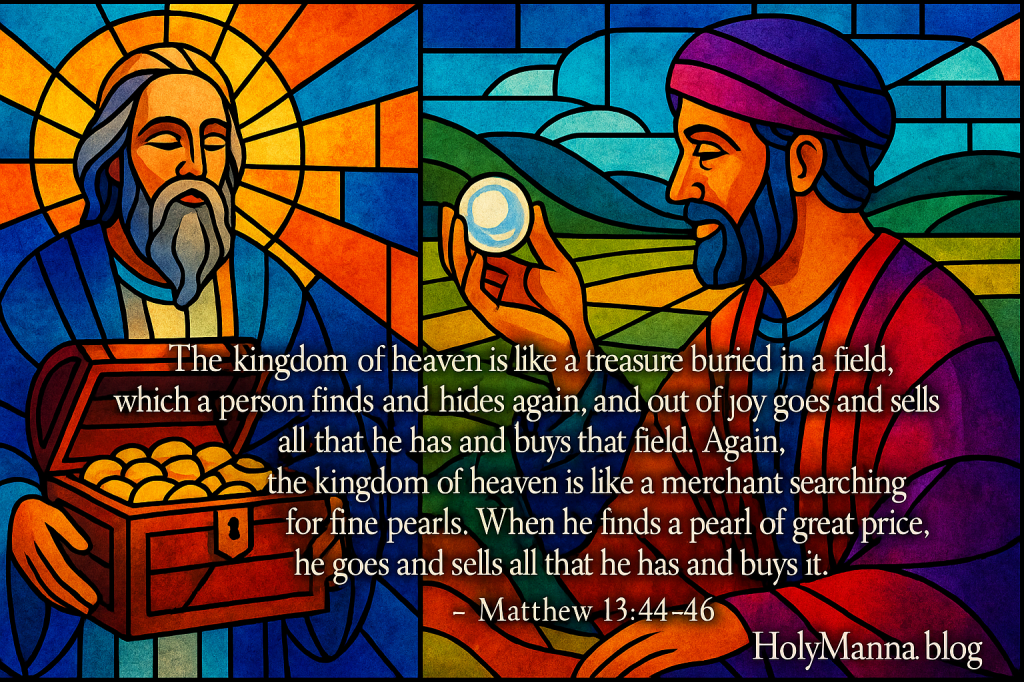
44 “The kingdom of heaven is like a treasure buried in a field, which a person finds and hides again, and out of joy goes and sells all that he has and buys that field. 45 Again, the kingdom of heaven is like a merchant searching for fine pearls. 46 When he finds a pearl of great price, he goes and sells all that he has and buys it.
Detailed Exegesis
Verse 44 – “The kingdom of heaven is like a treasure buried in a field, which a person finds and hides again, and out of joy goes and sells all that he has and buys that field.”
In Jesus’ time, it was common for people to bury valuables in the ground, especially in times of war or uncertainty. The man in this parable isn’t seeking treasure, but stumbles upon it—an image of the surprising nature of grace. His response is immediate and total: he sells everything, not out of obligation, but “out of joy.” This reflects the deep fulfillment that comes from encountering God. It’s not a reluctant trade—it’s a joyful surrender. The field represents the world, and the treasure, the hidden reality of God’s reign. The man buys the field because the treasure is worth more than anything he possesses.
Verse 45 – “Again, the kingdom of heaven is like a merchant searching for fine pearls.”
This parable offers a contrast: unlike the first man, the merchant is actively seeking. He is discerning, experienced, and knows the value of what he’s looking for. This reveals another aspect of the Kingdom—it is for both the seeker and the surprised. God meets us whether we are on a spiritual quest or caught off guard by His beauty. The merchant represents the soul who has long searched for truth and, at last, finds it in Christ.
Verse 46 – “When he finds a pearl of great price, he goes and sells all that he has and buys it.”
Just like the man in the field, the merchant makes a total sacrifice. Nothing else compares to the value of this single pearl. The act of selling “all that he has” emphasizes total commitment. The Church Fathers often saw the pearl as representing Christ Himself—beautiful, perfect, and worth all. To possess Him is to possess everything. This parable calls each of us to ask: What am I willing to surrender for the sake of the Kingdom?
Teachings
The Catechism of the Catholic Church teaches that the Kingdom of God is both a present reality and a future fulfillment: “The Kingdom of God has come in the person of Christ and grows mysteriously in the hearts of those incorporated into Him” (CCC 865). Both parables reveal the inward transformation that takes place when someone receives the Gospel—it becomes the center of their life. This aligns with CCC 546, which teaches: “Jesus’ invitation to enter his Kingdom comes in the form of parables, a characteristic feature of his teaching. Through them he invites people to the feast of the Kingdom, but he also asks for a radical choice.”
St. John Chrysostom, reflecting on this passage, wrote: “So great is the value of the treasure that nothing is to be preferred before it. Neither father, nor mother, nor children, nor wife, nor even life itself.” This is not meant to diminish these blessings but to show that only God gives them their true meaning. St. Thomas Aquinas taught that the pearl of great price represents “the wisdom of God, which exceeds all the treasures of the earth.”
In the early Church, many martyrs lived out this parable literally—selling all, even their lives, for the sake of Christ. Their witness reminds us that the Kingdom is not just about personal fulfillment, but about total fidelity to the truth, no matter the cost.
Reflection
Have you found the treasure? And if so, what have you done about it? Today’s Gospel challenges us to examine our attachments. Are we still clinging to possessions, plans, or pleasures that prevent us from giving our all to God? The man in the field and the merchant both responded with urgency and joy. Do we delay when God calls us to something deeper? Do we hesitate to surrender because we’re afraid of what we’ll lose?
The Kingdom of Heaven is not an abstract ideal—it is a lived reality. It is Jesus Christ, present in His Word, His Church, and especially in the Eucharist. He is the Treasure. He is the Pearl. And once we truly see Him for who He is, nothing else will satisfy.
Consider this: What is one thing you could “sell”—one sacrifice you could make—to move closer to the Kingdom today? Maybe it’s your time. Maybe it’s your pride. Maybe it’s your comfort zone. Whatever it is, trust that what God offers in return is worth far more. Like Moses coming down radiant from the mountain, or the merchant walking away lighter but richer, you too can be transformed—if only you’re willing to let go.
Unveiled Hearts, Joyful Surrender
Today’s readings draw us into the mystery of transformation that occurs when we truly encounter the living God. From Moses’ radiant face in Exodus 34, to the solemn worship of Psalm 99, to the joyful sacrifice of those who find the treasure in Matthew 13, each passage reveals a different facet of the same truth: when God reveals Himself, He changes us. And that change is never superficial—it pierces the heart, reorders our desires, and invites us into a life of deeper communion and purpose.
Moses, whose skin glowed with God’s glory, reminds us that prayer is not a box to check—it is a place of transfiguration. The psalmist teaches us that awe, obedience, and adoration are the proper response to a holy God who still speaks to His people. And in the Gospel, Jesus invites us to ask: What are you willing to give up for the Kingdom? Because once you’ve seen its beauty—once you’ve tasted its joy—nothing else compares.
So what now? Take time today to remove the veil—whether it’s distraction, fear, or pride—and sit with the Lord face-to-face. Let His light shine on your heart in prayer, in the Eucharist, or in quiet reflection with Scripture. And when you find the Treasure—when you glimpse the Pearl of great price—run after it with all you have. Sell your comfort, your excuses, your small plans. For what He offers is infinitely greater: a life radiant with His glory, a heart transformed by His presence, and a joy the world cannot steal. Will you let yourself be changed?
Engage with Us!
We’d love to hear how God spoke to your heart through today’s readings. Share your reflections, insights, or prayer intentions in the comments below—your witness could be the spark that encourages someone else to draw nearer to the Lord!
Reflection Questions:
First Reading – Exodus 34:29-35:
Have you ever come away from prayer or Adoration changed in a visible or interior way? What does “veiling” your spiritual life look like for you—and what would it mean to live unveiled?
Responsorial Psalm – Psalm 99:5-7, 9:
Do you approach God in prayer with awe and reverence? What practices help you enter more deeply into worship, and how can you guard against routine in your spiritual life?
Holy Gospel – Matthew 13:44-46:
What treasure has God revealed to you in your life? What might you be clinging to that prevents you from fully receiving the Kingdom? Are you willing to sell all—spiritually, emotionally, or practically—for the sake of Christ?
Let’s live unveiled and radiant lives, joyfully surrendering all for the treasure of knowing Jesus. May everything we do be rooted in the love, mercy, and holiness He taught us. Keep seeking Him with your whole heart, and let His light shine through you today and always.
Follow us on Instagram and Facebook for more insights and reflections on living a faith-filled life.

 Holy Manna!
Leave a comment