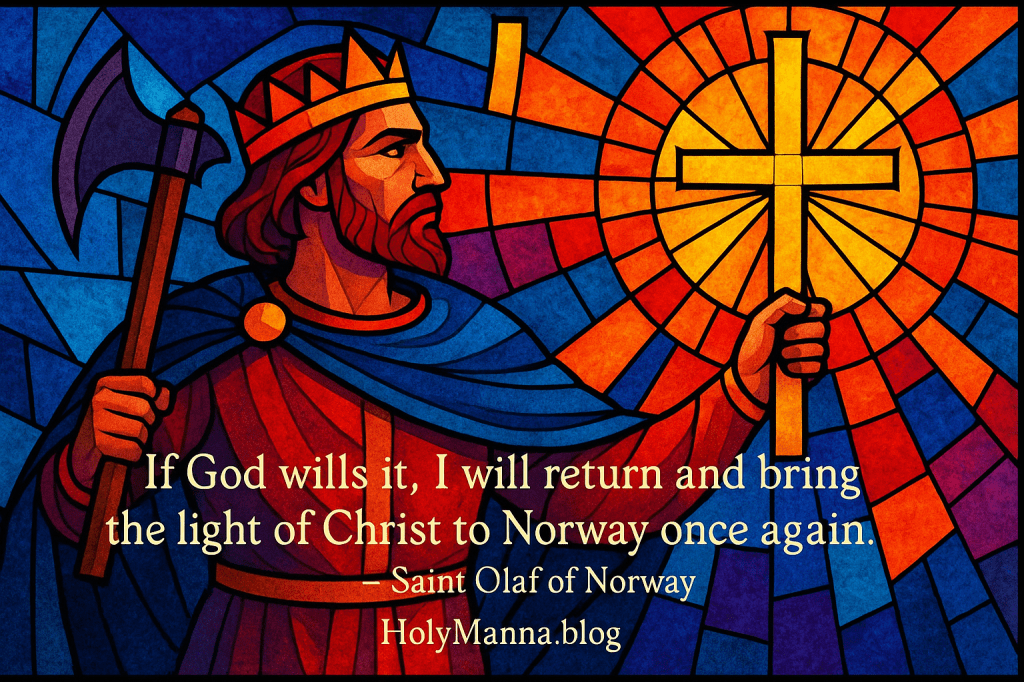
The Axe and the Cross
Saint Olaf of Norway is a saint whose legacy is steeped in fire, sword, and redemption. Once a fierce Viking warrior, he became a passionate Christian king who is remembered not for his conquests, but for his zeal in bringing the light of Christ to a pagan land. Patron of Norway and one of the most revered figures in Scandinavian Christianity, Saint Olaf’s life is a striking testimony of how God can transform even the most hardened hearts. Known as “Rex Perpetuus Norvegiae” (the Eternal King of Norway), his story blends political courage, evangelical fervor, and ultimately, martyrdom.
From Viking Raider to Christ’s Servant
Olaf Haraldsson was born around the year 995 in Ringerike, a region in southeastern Norway. He belonged to a noble lineage, claiming descent from Harald Fairhair, the first king to unite Norway. Like many young Norsemen of his time, Olaf was raised in the old pagan ways and began his career as a Viking raider. From a very early age, he embarked on sea expeditions across the Baltic, England, and even as far as Spain, gaining wealth and fame through battle.
Everything changed around the year 1010 when Olaf traveled to Normandy. There, through the witness of Christian nobility and likely through the influence of Duke Richard II’s Christian court, he received catechesis and was baptized at Rouen. This marked a dramatic turn in Olaf’s life. No longer did he fight merely for plunder and glory—his new mission was to return to Norway and unite his homeland under one crown and one faith: Christianity.
When he returned to Norway in 1015, he was determined to evangelize his people. As king, he enforced Christian laws, built churches, and invited missionaries. Though his methods were often harsh by modern standards, his underlying goal was to end idolatry and establish the reign of Christ in Norway.
A Saintly King in Action
Saint Olaf’s reign from 1015 to 1028 was marked by both political and spiritual reform. He brought bishops and clergy from England to support the fledgling Norwegian Church and worked tirelessly to eliminate the old pagan rites. His laws supported Sunday rest, banned pagan sacrifices, and promoted Christian marriage customs.
Despite opposition, he pressed on with what he saw as a divine mandate. His transformation from Viking to Christian king inspired many Norwegians to convert. While no elaborate miracles during his life are recorded in the style of healing the sick or raising the dead, his very life was miraculous: a violent man transformed into a shepherd of souls, a warrior now fighting for eternal peace.
His commitment to spreading Christianity in a land that fiercely resisted it makes him one of the most important missionary kings in Church history, alongside figures like Saint Stephen of Hungary.
Betrayal, Exile, and the Crown of Martyrdom
Olaf’s reign was not without turmoil. Norwegian nobles who resisted his religious reforms began to conspire against him, allying with King Cnut of Denmark. In 1028, Olaf was forced into exile in Kievan Rus’ (present-day Ukraine), where he spent time in reflection and prayer. His faith deepened even more during this exile.
In 1030, Olaf attempted to reclaim his throne. He returned to Norway with a small army, believing it was God’s will. However, at the Battle of Stiklestad on July 29, 1030, Olaf was killed in combat. He was struck down with swords and spears, refusing to abandon his mission or his God.
Though he died in apparent defeat, his martyrdom ignited something far greater than a political victory. His blood became the seed of faith for the nation.
The King Who Reigned from the Grave:
After Olaf’s death, a wave of miracles began to sweep across Norway. His body, buried in secret, was found uncorrupted a year later—a classic sign of sainthood in the Church. Witnesses claimed that a heavenly fragrance emanated from his grave, and healings began to be reported at his tomb.
The people began to venerate him as a saint almost immediately, and the bishop of Nidaros (modern Trondheim) confirmed the cultus. Within a year of his death, his remains were enshrined, and miracles continued—especially healings of the sick and blind. Pilgrimages to his shrine at Nidaros became among the most popular in Europe during the Middle Ages, rivaling even those to Santiago de Compostela.
Olaf’s relics became a source of immense grace, and his tomb became a symbol of national unity and faith for Norway. His sainthood was formally recognized by Pope Alexander III, and the shrine at Nidaros Cathedral remains a sacred site to this day.
From Warrior to Witness
Saint Olaf’s life challenges us in a profound way. In a world that often idolizes comfort and compromise, Olaf reminds us that the Gospel demands courage, conviction, and often great personal cost. He was not perfect, and his methods were at times flawed, but his heart burned with zeal for Christ and the salvation of his people.
His life calls us to ask: Do I allow Christ to transform even the most difficult parts of my life? Am I willing to stand for the truth, even when it means losing comfort, approval, or power? Like Olaf, we may face exile, rejection, or spiritual battle—but we are called to trust that victory lies not in worldly success but in faithfulness to Christ.
We can also draw hope from Olaf’s conversion. No one is beyond the reach of grace. If a Viking warrior could become a martyr for Jesus, then we too can be transformed, no matter our past.
In our daily lives, let us seek to be faithful in small acts of evangelization—whether that means standing up for truth, praying for our enemies, or inviting others into deeper faith. May we, like Saint Olaf, strive to bring Christ’s kingdom to the hearts around us.
Engage with Us!
Share your reflections on Saint Olaf on the comments below!
- What part of Saint Olaf’s story spoke to your heart today?
- Have you ever experienced a conversion moment like Saint Olaf?
- In what ways can you be a missionary for Christ in your home, workplace, or community?
Let us lift each other up in prayer and remember that no act of faith is too small when done with love. May Saint Olaf, Eternal King of Norway, intercede for us all on our journey to holiness.
Saint Olaf of Norway, pray for us! ✝️
Follow us on Instagram and Facebook for more insights and reflections on living a faith-filled life.

 Holy Manna!
Leave a comment