Memorial of Saints Martha, Mary, and Lazarus – Lectionary: 402/607
Dwelling with the Divine
Have you ever longed for the kind of relationship with God that feels personal, even face-to-face? Today’s readings invite us into precisely that kind of intimacy—a sacred friendship that transforms our hearts, our homes, and our hope in the Resurrection. As we celebrate the Memorial of Saints Martha, Mary, and Lazarus, we are drawn into a mystery that links the tent of meeting in the wilderness, the whispered promises of mercy in Psalm 103, and the quiet home in Bethany where Jesus wept and revealed Himself as “the resurrection and the life” (John 11:25). At the center of it all is this truth: God desires to dwell with us—not only as Lord, but as Friend.
The Book of Exodus offers a powerful glimpse into Moses’ friendship with God. The Lord descends in a cloud to speak with him “as a person speaks to a friend” (Ex 33:11), revealing His name and His nature: “The Lord, the Lord, a God gracious and merciful, slow to anger and abounding in love and fidelity” (Ex 34:6). This is no distant deity but a God who pitches His tent among His people, a foreshadowing of Christ who would later dwell in the house of Martha, Mary, and Lazarus. Psalm 103 echoes this covenantal mercy, reminding us that “as far as the east is from the west, so far has he removed our sins from us” (Ps 103:12). Together, these texts offer a sweeping image of divine compassion—from Sinai’s glory to Bethany’s grief.
In The Gospel of John, Martha’s profound profession of faith emerges not from theological argument but from her relationship with Jesus. In her sorrow, she still dares to believe: “Yes, Lord. I have come to believe that you are the Messiah, the Son of God” (Jn 11:27). Today’s memorial honors this household of faith—a brother raised from the dead, and two sisters who loved and served Jesus in complementary ways. In a world that often treats God as abstract or remote, the witness of Moses and the family at Bethany reminds us that friendship with God is possible—and transformative. What does it mean to welcome God into the tent of your heart, the home of your life? This is the question that opens today’s readings, and one we carry into each reflection.
First Reading – Exodus 33:7–11; 34:5–9, 28
The Tent of Friendship
The Book of Exodus captures one of the most intimate moments in salvation history—the encounter between Moses and God in the Tent of Meeting. These chapters are situated after Israel’s great sin with the golden calf (Exodus 32), a moment of deep betrayal, yet also of even deeper divine mercy. In today’s reading, Moses acts as the intercessor and friend of God, begging not only for forgiveness but for the continued presence of the Lord among His people. The Tent of Meeting, set apart from the camp, becomes a sacred threshold: it is both a physical space and a symbol of the soul that seeks communion with God. The reading reveals the character of the Lord in a stunning theophany, proclaiming His divine name and attributes. This sets the stage for the renewed covenant—and mirrors the way Martha, Mary, and Lazarus would host the Lord in their home, living out that same intimacy that Moses experienced in the wilderness.
Exodus 33:7-11; 34:5-9, 28
New American Bible (Revised Edition)
Moses’ Intimacy with God. 33:7 Moses used to pitch a tent outside the camp at some distance. It was called the tent of meeting. Anyone who wished to consult the Lord would go to the tent of meeting outside the camp. 8 Whenever Moses went out to the tent, the people would all rise and stand at the entrance of their own tents, watching Moses until he entered the tent. 9 As Moses entered the tent, the column of cloud would come down and stand at its entrance while the Lord spoke with Moses. 10 On seeing the column of cloud stand at the entrance of the tent, all the people would rise and bow down at the entrance of their own tents. 11 The Lord used to speak to Moses face to face, as a person speaks to a friend. Moses would then return to the camp, but his young assistant, Joshua, son of Nun, never left the tent.
34:5 The Lord came down in a cloud and stood with him there and proclaimed the name, “Lord.” 6 So the Lord passed before him and proclaimed: The Lord, the Lord, a God gracious and merciful, slow to anger and abounding in love and fidelity, 7 continuing his love for a thousand generations, and forgiving wickedness, rebellion, and sin; yet not declaring the guilty guiltless, but bringing punishment for their parents’ wickedness on children and children’s children to the third and fourth generation! 8 Moses at once knelt and bowed down to the ground. 9 Then he said, “If I find favor with you, Lord, please, Lord, come along in our company. This is indeed a stiff-necked people; yet pardon our wickedness and sins, and claim us as your own.”
28 So Moses was there with the Lord for forty days and forty nights, without eating any food or drinking any water, and he wrote on the tablets the words of the covenant, the ten words.
Detailed Exegesis
Verse 33:7 – “Moses used to pitch a tent outside the camp at some distance. It was called the tent of meeting. Anyone who wished to consult the Lord would go to the tent of meeting outside the camp.”
This verse introduces us to the sacred geography of Israel’s spiritual life. The tent placed outside the camp emphasizes the holy separateness of God—yet it is open to all who seek Him. The fact that anyone could approach shows God’s desire for relationship, though Moses alone speaks face to face. This foreshadows Christ, who will tear down the veil and make such access universal.
Verse 8 – “Whenever Moses went out to the tent, the people would all rise and stand at the entrance of their own tents, watching Moses until he entered the tent.”
The people’s reverence for Moses shows their awareness of the gravity of his task. He represents them before God. Their rising in silence echoes the sacred awe the Church still shows toward the Eucharist—standing when Christ is present.
Verse 9 – “As Moses entered the tent, the column of cloud would come down and stand at its entrance while the Lord spoke with Moses.”
The cloud is a classic symbol of divine presence (the Shekinah). God guards the threshold, speaking with Moses within the mystery. Just as God came down in a cloud, so Christ would one day descend into the world as the fullness of the Father’s presence.
Verse 10 – “On seeing the column of cloud stand at the entrance of the tent, all the people would rise and bow down at the entrance of their own tents.”
The people respond with reverent worship. Though they are distant from the cloud, they still bow down. This illustrates a hierarchy of presence—God is near, but mediated. In the Incarnation, that distance would be erased.
Verse 11 – “The Lord used to speak to Moses face to face, as a person speaks to a friend. Moses would then return to the camp, but his young assistant, Joshua, son of Nun, never left the tent.”
This verse is the heart of the reading. Moses experiences unparalleled intimacy with God—“face to face”. Friendship with God is possible! And notice Joshua: he remains behind, lingering in the sacred presence, being formed to lead Israel after Moses. We too are invited to dwell in the tent of divine friendship.
Verse 34:5 – “The Lord came down in a cloud and stood with him there and proclaimed the name, ‘Lord.’”
This is the beginning of one of the most sacred moments in the Old Testament. God does not simply speak to Moses—He reveals His name. This self-disclosure is pure gift. In revealing His name, God offers His heart.
Verse 6 – “So the Lord passed before him and proclaimed: The Lord, the Lord, a God gracious and merciful, slow to anger and abounding in love and fidelity.”
Here we have one of the most repeated descriptions of God in all of Scripture. These words shape Israel’s understanding of the Lord and are echoed directly in Psalm 103. Mercy, love, and fidelity define God’s identity.
Verse 7 – “Continuing his love for a thousand generations, and forgiving wickedness, rebellion, and sin; yet not declaring the guilty guiltless, but bringing punishment for their parents’ wickedness on children and children’s children to the third and fourth generation!”
God is just. He forgives sin, but also respects the moral consequences that ripple through generations. The contrast between “a thousand generations” and “to the third and fourth” underscores that His mercy vastly outweighs His justice.
Verse 8 – “Moses at once knelt and bowed down to the ground.”
The only fitting response to this revelation is adoration. Moses, though already God’s friend, prostrates himself in awe. Intimacy with God never leads to familiarity—it deepens reverence.
Verse 9 – “Then he said, ‘If I find favor with you, Lord, please, Lord, come along in our company. This is indeed a stiff-necked people; yet pardon our wickedness and sins, and claim us as your own.’”
Moses intercedes with humility and honesty. He does not downplay the people’s sin, but begs for mercy. He desires not only pardon but union: that God would dwell with them. This is a prophetic cry for the Incarnation.
Verse 28 – “So Moses was there with the Lord for forty days and forty nights, without eating any food or drinking any water, and he wrote on the tablets the words of the covenant, the ten words.”
Moses fasts in the presence of God, completely sustained by grace. He receives the renewed covenant—written not just in stone but into his very being. This foreshadows Christ’s own forty-day fast, and the Church’s tradition of Lenten preparation for covenant renewal.
Teachings of the Church
The Catechism of the Catholic Church draws directly on this passage to describe God’s mercy: “After Israel’s sin, when the people had turned away from God to worship the golden calf, God hears Moses’ prayer of intercession and agrees to walk in the midst of an unfaithful people, thus demonstrating his love” (CCC 210). This shows us that divine mercy is not sentimental—it is covenantal. God continues to walk with us even when we fall, inviting us to rise again through repentance and communion.
Saint Gregory of Nyssa saw Moses’ ascent to intimacy with God as a model for the soul’s own mystical journey. He wrote: “To Moses, God speaks face to face; but the more he ascends, the more he discovers that God dwells in the darkness of mystery.” True friendship with God never flattens mystery—it draws us into deeper wonder. Like Joshua, we must be willing to linger, not rush, in the tent of God’s presence.
Historically, this passage was beloved by the Desert Fathers, who saw in the tent a symbol of the inner cell of prayer. Just as Moses withdrew to speak with God, so too must every disciple have a place where they meet the Lord daily. As Saint Teresa of Ávila taught: “Prayer is nothing else than an intimate sharing between friends; it means taking time frequently to be alone with Him who we know loves us.” This is the legacy of Moses—and the legacy of Bethany.
Reflection
Where is your Tent of Meeting? Do you have a place where you go, even metaphorically, to seek the Lord with undivided attention? In a world of distractions, this passage calls us to build a space in our lives where God can speak to us “as a person speaks to a friend”. Maybe it’s a chapel, maybe it’s your car before work, maybe it’s a quiet moment in the morning. The point is not the location—but the intention.
Moses’ hunger for God led him to fast forty days, to fall to his knees in worship, and to intercede for a people who didn’t yet understand the gravity of grace. We are called to the same. How often do we kneel in awe before the God who proclaims Himself merciful and gracious? And like Martha in The Gospel of John, are we willing to speak to God honestly, even in grief, trusting that His presence will be enough?
Today’s reading invites us to deepen our intimacy with the Lord—not as strangers, but as friends of God. Let’s take a step toward the tent. Let’s pause, listen, and allow His presence to dwell within us. Are you ready to meet God face to face?
Responsorial Psalm – Psalm 103:6–13
Mercy That Stretches from Heaven to Earth
Psalm 103 is one of the most beloved and tender psalms in the entire Psalter, a hymn that lifts the soul into an awareness of God’s overwhelming compassion. Ascribed to David, it likely arose during a time of reflection on the Lord’s covenant fidelity to His people despite their many failures. Culturally, Israel’s view of justice was often communal and generational—yet here we see an emphasis on God’s mercy as personal, paternal, and transformative. This psalm directly echoes God’s revelation of Himself in Exodus 34:6, proclaimed to Moses during the theophany on Mount Sinai: “The Lord, the Lord, a God gracious and merciful, slow to anger and abounding in love”. In today’s liturgy, Psalm 103 becomes our prayerful response to that divine self-revelation. It anchors the theme of intimate friendship with God, reminding us that mercy is not just an attribute of God—it is the very way He draws near to us.
Psalm 103:6-13
New American Bible (Revised Edition)
6 The Lord does righteous deeds,
brings justice to all the oppressed.
7 He made known his ways to Moses,
to the Israelites his deeds.
8 Merciful and gracious is the Lord,
slow to anger, abounding in mercy.
9 He will not always accuse,
and nurses no lasting anger;
10 He has not dealt with us as our sins merit,
nor requited us as our wrongs deserve.
11 For as the heavens tower over the earth,
so his mercy towers over those who fear him.
12 As far as the east is from the west,
so far has he removed our sins from us.
13 As a father has compassion on his children,
so the Lord has compassion on those who fear him.
Detailed Exegesis
Verse 6 – “The Lord does righteous deeds, brings justice to all the oppressed.”
God’s mercy does not ignore injustice—it includes setting things right. This verse reminds us that righteousness and justice are not opposites to mercy, but its fruit. When God acts, it is to defend the downtrodden and lift up the afflicted, reflecting His covenant love.
Verse 7 – “He made known his ways to Moses, to the Israelites his deeds.”
This verse ties directly to Exodus 33–34, showing that what Moses experienced personally—God’s face-to-face revelation—became a public testimony for all of Israel. God’s ways refer to His intentions, His mercy, and His desire to be in relationship with His people. His deeds refer to the visible signs of His faithfulness: liberation, protection, and forgiveness.
Verse 8 – “Merciful and gracious is the Lord, slow to anger, abounding in mercy.”
These words are nearly identical to Exodus 34:6, showing how foundational this description of God is to Israel’s spiritual imagination. God is not volatile or capricious—He is patient. Mercy is not a temporary state but a permanent disposition. This verse is chanted as both a declaration of praise and a reminder of who God truly is.
Verse 9 – “He will not always accuse, and nurses no lasting anger.”
God’s justice is not vengeful. This verse reassures us that while the Lord may correct and discipline, His desire is reconciliation, not retribution. Unlike human wrath, which can burn for years, divine anger is always aimed at healing.
Verse 10 – “He has not dealt with us as our sins merit, nor requited us as our wrongs deserve.”
This verse is the core of divine mercy. God’s judgment is not transactional—it is redemptive. The psalmist marvels at the disproportion between human sin and divine forgiveness. What a striking contrast to our world, which so often demands punishment rather than pardon.
Verse 11 – “For as the heavens tower over the earth, so his mercy towers over those who fear him.”
Here we see a cosmic metaphor for mercy. God’s love isn’t just a warm feeling—it’s vast, immeasurable, and majestic. The phrase “those who fear him” refers not to dread but to reverent awe, the posture of the one who knows they are beloved yet unworthy.
Verse 12 – “As far as the east is from the west, so far has he removed our sins from us.”
East and west never meet—this is a poetic way of saying our sins are utterly gone. God’s forgiveness is not half-hearted or conditional. When He forgives, He does so completely. This verse offers a powerful invitation to let go of guilt once it has been confessed and absolved.
Verse 13 – “As a father has compassion on his children, so the Lord has compassion on those who fear him.”
The psalm ends with a deeply personal image. God is not only Lord and Judge—He is Abba. His compassion flows from His fatherly love. The same intimacy Moses experienced, and the same closeness that Jesus had with Martha, Mary, and Lazarus, is available to all who trust in Him.
Teachings of the Church
The Catechism of the Catholic Church draws from this psalm to articulate the richness of God’s mercy. It teaches: “The Gospel is the revelation in Jesus Christ of God’s mercy to sinners” (CCC 1846). Mercy is not just what God does—it is who He is. In the person of Jesus, the mercy of Psalm 103 takes on flesh and walks among us, healing, forgiving, and restoring.
Saint John Paul II, in his encyclical Dives in Misericordia (Rich in Mercy), wrote: “The Church must consider it one of her principal duties to proclaim and to introduce into life the mystery of mercy, supremely revealed in Jesus Christ” (DM 2). He cites Psalm 103 specifically as a hymn of confidence in God’s goodness, encouraging the faithful to never fear returning to the Father’s arms, no matter how far they have strayed.
Saint Thérèse of Lisieux also echoes the spirit of this psalm in her Little Way. She once wrote: “What pleases God is to see me love my littleness and poverty; it is the blind hope I have in His mercy… That is my only treasure.” The distance between east and west? That is the space where Thérèse learned to rest in divine love, trusting not in her merits, but in His compassion.
Reflection
How do you see God’s mercy in your life today? Too often, we live under the weight of old sins, defining ourselves by our faults rather than by God’s forgiveness. This psalm invites us to reframe our identity—not as condemned sinners, but as beloved children. Do you trust that God has removed your sins as far as the east is from the west?
Practically, this means approaching confession not as a shameful obligation but as a liberating return to the Father’s embrace. It means refusing to define others by their worst moments. And it means embracing God’s justice—not as punishment, but as the righteous restoration of all that has been broken.
Let Psalm 103 be your daily anthem. Repeat its verses aloud in prayer. Commit to memory “He has not dealt with us as our sins merit”. Let that truth echo in your heart when you feel unworthy or distant. Will you dare to believe that God’s mercy towers higher than your sin, your shame, or your past?
Holy Gospel – John 11:19–27
Faith in the Face of Death
This passage from The Gospel of John unfolds within the larger story of the raising of Lazarus—a miracle that serves as both a foretaste of Jesus’ own Resurrection and a deeply personal moment of love and grief. Culturally, mourning in first-century Jewish society was a public, communal act, often lasting for seven days, with friends and family arriving to console the bereaved. Into this setting of sorrow steps Jesus, revealing Himself not only as a comforter but as “the resurrection and the life”. This exchange between Jesus and Martha is one of the most profound theological moments in the entire Gospel. It bridges human suffering and divine promise, and shows us that faith is not just belief in doctrines but trust in the person of Christ—even when hope seems lost. Within the context of today’s memorial, Martha’s faith echoes Moses’ bold intimacy with God and complements the mercy sung in Psalm 103. She becomes a model of friendship and spiritual courage for all believers.
John 11:19-27
New American Bible (Revised Edition)
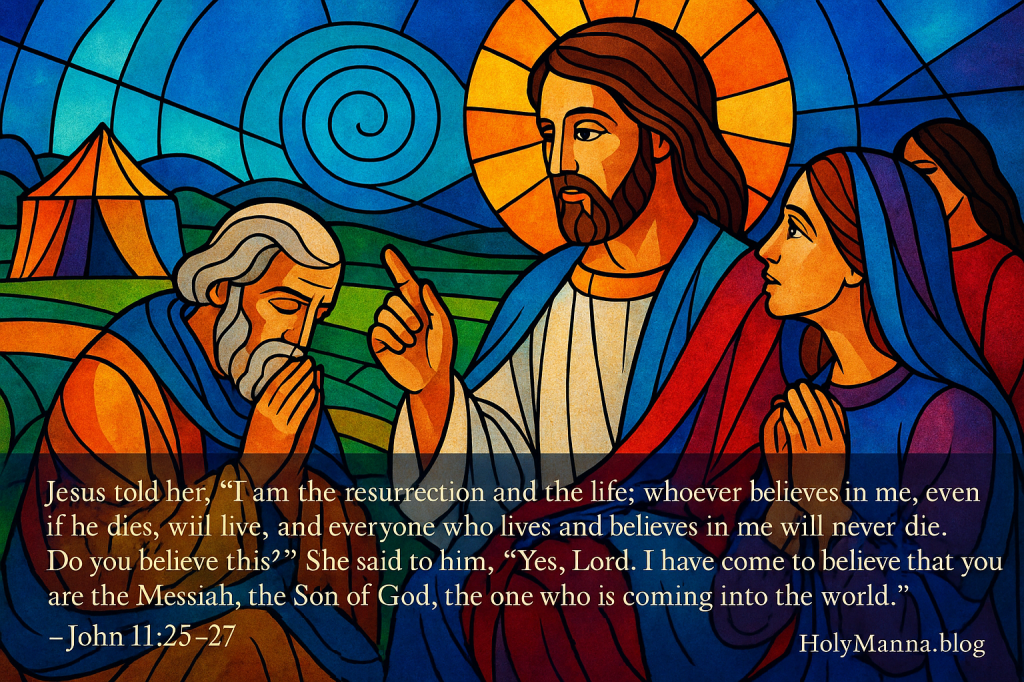
19 And many of the Jews had come to Martha and Mary to comfort them about their brother. 20 When Martha heard that Jesus was coming, she went to meet him; but Mary sat at home. 21 Martha said to Jesus, “Lord, if you had been here, my brother would not have died. 22 [But] even now I know that whatever you ask of God, God will give you.” 23 Jesus said to her, “Your brother will rise.” 24 Martha said to him, “I know he will rise, in the resurrection on the last day.” 25 Jesus told her, “I am the resurrection and the life; whoever believes in me, even if he dies, will live, 26 and everyone who lives and believes in me will never die. Do you believe this?” 27 She said to him, “Yes, Lord. I have come to believe that you are the Messiah, the Son of God, the one who is coming into the world.”
Detailed Exegesis
Verse 19 – “And many of the Jews had come to Martha and Mary to comfort them about their brother.”
This verse sets the scene of mourning and support. The community comes to grieve with the sisters, highlighting both their social standing and the gravity of Lazarus’ death. Grief, in Jewish tradition, was not borne alone—it was shared, echoed by Christ’s own tears later in the chapter.
Verse 20 – “When Martha heard that Jesus was coming, she went to meet him; but Mary sat at home.”
Martha, often seen as the active one, again takes initiative. She doesn’t wait for Jesus to come to her; she goes out to meet Him. This act is filled with hope and longing, showing that her love and faith in Christ persist even in sorrow. Mary’s stillness may reflect deeper grief or a different temperament, reminding us that faith expresses itself differently in different souls.
Verse 21 – “Martha said to Jesus, ‘Lord, if you had been here, my brother would not have died.’”
These words are full of sorrow, but not accusation. Martha believes in Jesus’ healing power and wishes He had come sooner. This human honesty mirrors our own prayers when we face suffering—Lord, where were You? Yet beneath her grief is trust.
Verse 22 – “[But] even now I know that whatever you ask of God, God will give you.”
Here, Martha expresses a stunning faith. Even now—even after death—she believes in Jesus’ authority and connection to the Father. She does not yet expect the resurrection of her brother, but she believes that Jesus has divine favor. Her words are a bridge between despair and hope.
Verse 23 – “Jesus said to her, ‘Your brother will rise.’”
Jesus begins with a promise rooted in Jewish belief in the final resurrection. But He is about to shift Martha’s understanding from a distant event to a present reality found in His person.
Verse 24 – “Martha said to him, ‘I know he will rise, in the resurrection on the last day.’”
Martha responds with orthodoxy—she believes in the resurrection of the dead at the end of time. Her knowledge is solid, but Jesus desires to draw her deeper—not just to believe in something, but in someone.
Verse 25 – “Jesus told her, ‘I am the resurrection and the life; whoever believes in me, even if he dies, will live.’”
This is one of the most powerful I AM statements in The Gospel of John. Jesus reveals that the resurrection is not merely an event—it is a person. Belief in Him leads to life that death cannot destroy. This verse invites us to see eternal life not only as future, but as a present relationship with Christ.
Verse 26 – “And everyone who lives and believes in me will never die. Do you believe this?”
Jesus draws Martha into a personal decision. It is not enough to affirm doctrine—she must profess trust in Him. His question echoes through the centuries to each one of us: Do you believe this?
Verse 27 – “She said to him, ‘Yes, Lord. I have come to believe that you are the Messiah, the Son of God, the one who is coming into the world.’”
Martha’s reply is a profound profession of faith—parallel to Peter’s confession in Matthew 16. She declares not only belief in resurrection but in Jesus’ divine identity. This makes her one of the first to publicly articulate Jesus as both Christ and Son of God. Her faith becomes a cornerstone moment in the Gospel.
Teachings of the Church
The Catechism of the Catholic Church affirms that Jesus’ words to Martha reveal the heart of Christian hope: “I am the Resurrection and the Life.” It teaches: “Christ is risen from the dead and by His death He has conquered death… so that those who die in Christ live with Him” (CCC 1005). This hope is not mere consolation—it is the foundation of our faith. In Martha’s profession, we see what the Church calls the anamnesis, or living memory, of the Paschal Mystery made personal.
Pope Benedict XVI reflected on this passage in Spe Salvi: “It is not science that redeems man: man is redeemed by love. This is the message of Jesus Christ. His presence gives life and meaning even in suffering and death” (Spe Salvi, 26). Jesus does not give Martha a theological treatise—He gives her Himself. And that changes everything.
Saint Augustine, commenting on this Gospel, beautifully wrote: “Martha was mourning, and yet believing; she was sad for her brother, and yet hoped in Christ. Her faith shone even in her sorrow”. Like Moses before her, Martha speaks with the Lord face to face. Like the psalmist, she places her trust in His mercy. Her house in Bethany, like the Tent of Meeting, becomes holy ground.
Reflection
What does it mean to believe in the Resurrection—not just as a future event, but as a person you know? Martha’s journey invites us to live our faith not only with our intellect but with our hearts. She brings her grief, her questions, and her love to Jesus—and He meets her there with truth and tenderness. Her profession is not perfect understanding, but perfect trust.
In times of loss or confusion, it’s easy to echo Martha’s words: “Lord, if you had been here…” Yet Jesus invites us to go further. Can you trust Him even now? Can you say, “But even now, I believe” in the middle of your suffering? Today’s Gospel teaches us that resurrection life begins the moment we say yes to Christ—not just once, but every day.
Ask yourself today: Where is my faith anchored? In ideas or in Jesus? Like Martha, let us go out to meet Him, even in our sorrow. Let us believe that He is the Resurrection and the Life, and let our lives reflect that hope. Do you believe this?
Welcoming God Home
Today’s readings form a beautiful mosaic of divine intimacy—from the tent of Moses, to the psalmist’s hymn of mercy, to the quiet grief and bold faith of Martha. Each passage invites us to reflect not only on who God is, but how He desires to dwell with us: as a friend, a Father, and the Resurrection and the Life. In Exodus, we saw the Lord speaking “face to face, as a person speaks to a friend” (Ex 33:11), revealing His name and His merciful nature. In Psalm 103, we echoed those words in song, proclaiming “as far as the east is from the west, so far has he removed our sins from us” (Ps 103:12). And in The Gospel of John, Martha stood in sorrow yet spoke in trust, declaring: “Yes, Lord. I have come to believe that you are the Messiah, the Son of God” (Jn 11:27).
The Memorial of Saints Martha, Mary, and Lazarus brings all of this into lived reality. Their home in Bethany was not a palace, but it was a place where Jesus was welcomed, served, listened to, and loved. Each sibling showed us a different expression of discipleship: Martha through active service and courageous faith, Mary through contemplative love, and Lazarus through his silent witness to the power of Christ over death. Their friendship with Jesus reminds us that holiness is not distant—it is found in the ordinary places where God is invited in.
How might your home become a Bethany? Where might you pitch your own tent of meeting? The call today is simple but profound: welcome Jesus into your grief, your questions, your service, your silence. Let His mercy become the air you breathe, and let your profession of faith rise from a heart that knows Him personally. Like Martha, say to Him today, “Yes, Lord, I believe.” And then, live as one who walks with the Resurrection Himself.
Engage with Us!
We’d love to hear how God is speaking to you through today’s readings and the witness of Saints Martha, Mary, and Lazarus. Share your thoughts, experiences, or prayers in the comments below—your story could be the encouragement someone else needs today.
Reflection Questions:
First Reading – Exodus 33:7–11; 34:5–9, 28
Do you have a “tent of meeting” in your daily life—a place or time where you encounter God as a friend? What prevents you from seeking deeper intimacy with the Lord, and how can you invite His presence more fully into your routine?
Responsorial Psalm – Psalm 103:6–13
Do you truly believe that God has removed your sins “as far as the east is from the west”? In what ways can you imitate God’s mercy toward others, especially when it’s hardest to forgive?
Holy Gospel – John 11:19–27
When have you felt like Martha—grieving, questioning, yet holding onto faith? How would you answer Jesus’ question today: “Do you believe this?” What helps you renew that belief when it wavers?
Let us strive to be people of presence, faith, and mercy—those who welcome Jesus into every corner of our lives and reflect His love to others. May our homes be like Bethany: places where Christ is honored, friendship with God is real, and every act is done with the love and compassion He taught us.
Follow us on Instagram and Facebook for more insights and reflections on living a faith-filled life.

 Holy Manna!
Leave a comment