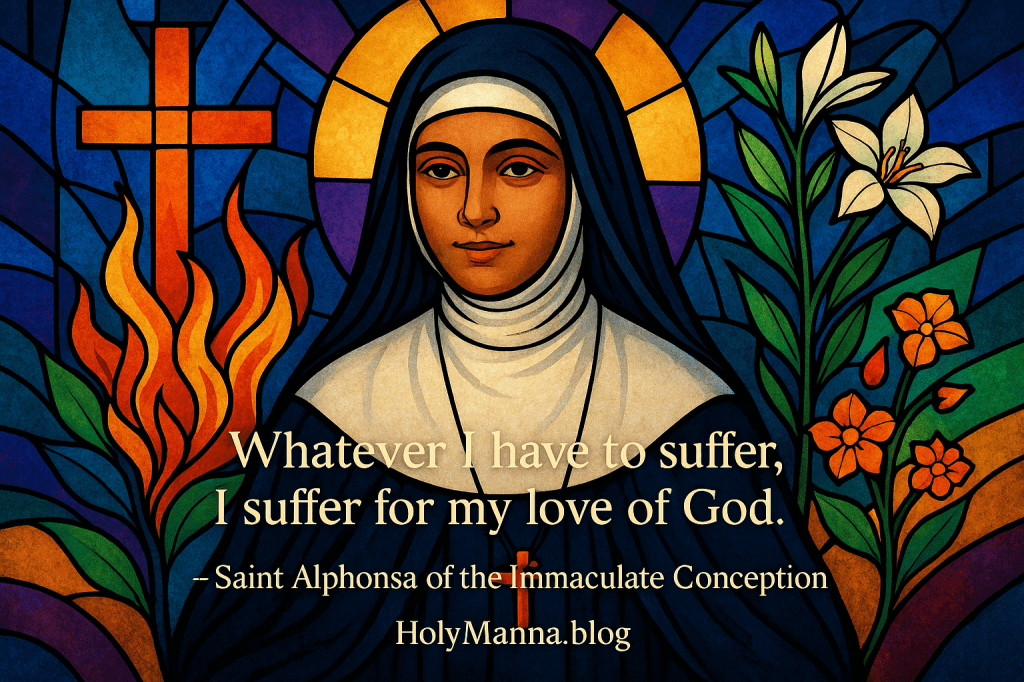
A Flower in the Fire
In the wide horizon of the Church’s saints, some shine with bold miracles and public missions, while others—like Saint Alphonsa of the Immaculate Conception—burn quietly, hidden from the world but deeply ablaze with divine love. Saint Alphonsa is the first woman of Indian origin to be canonized by the Roman Catholic Church, and her life is a radiant testimony to the beauty of suffering accepted with joy, humility, and trust in God. Her entire existence was cloaked in obscurity and illness, yet from this humble soil grew a sanctity so pure that her memory now draws thousands in pilgrimage and prayer. She is venerated especially in the Syro-Malabar Catholic Church, which traces its roots back to Saint Thomas the Apostle. Through her deep love for Jesus in the Eucharist and her joyful embrace of suffering, she taught the world a sacred truth: that hidden holiness can transform countless lives. She is the saint for the brokenhearted, the ill, the discouraged—and for all who carry a cross in secret.
From Orphan to Bride of Christ
Saint Alphonsa was born Anna Muttathupadathu on August 19, 1910, in the peaceful village of Kudamaloor, near Kottayam, Kerala, into a devout Syro-Malabar Catholic family. Her father, Joseph, was a prosperous farmer, but her mother, Maria, died just months after Anna’s birth, leaving her to be raised by a loving but strict maternal aunt. From the beginning, her life was a mix of faith and affliction. She was sensitive, devout, and showed an extraordinary inner maturity at a young age. Even as a small child, Anna was drawn to the stories of the saints and desired nothing more than to become a nun and serve Jesus alone.
At the age of 13, a defining moment came. Faced with pressure to enter into an arranged marriage—a common practice at the time—Anna made a radical decision to preserve her vocation. In a desperate plea to avoid being taken from her calling, she stepped into a pit of burning embers, intentionally causing third-degree burns on her feet. Her injuries left her physically deformed for life, but they also freed her from the marriage proposal. This act was not a rejection of her culture, but a passionate expression of her desire to belong to Christ completely, body and soul.
In 1930, she entered the Franciscan Clarist Congregation, a religious community marked by simplicity, silence, and deep Eucharistic devotion. Taking the religious name Sister Alphonsa of the Immaculate Conception, she consecrated her life to Jesus through Mary. From this moment onward, she lived the Gospel in radical humility and heroic love, quietly offering all her sufferings for the sanctification of others.
A Cloistered Light
Though Sister Alphonsa never stepped onto a public stage, her sanctity became a beacon to those around her. The sisters in her convent often noted the peace and joy that radiated from her sickroom. Her suffering was intense: she battled recurring illness, including dysentery, pneumonia, and even epilepsy. Still, she never complained. Instead, she welcomed every pain as a way to draw closer to her crucified Savior. “I am like a little wild flower at the foot of the Cross,” she once wrote. “I should be ready to be crushed by the feet of passersby if this would please my Divine Spouse.”
Though she never sought attention, people began to notice unexplained healings and graces after visiting her or asking for her prayers. A student cured of a debilitating disease. A child comforted from nightmares and seizures. A sister healed of chronic migraines. These were not headline miracles but quiet testimonies to her intimacy with the Lord and her powerful intercession. Her hidden life began to blossom into spiritual fruit for others. Her spiritual director and fellow sisters began to document her writings and spiritual reflections, sensing that her soul was something rare and deeply conformed to Christ.
Suffering as a Path to Glory
Saint Alphonsa’s cross was not made of swords and blood but of long, drawn-out suffering—a kind of martyrdom known in Catholic tradition as “white martyrdom.” From the moment she entered the convent, she was plagued by constant illness and physical torment. She could rarely walk without pain and spent most of her religious life bedridden. At times she endured spiritual dryness and isolation, compounded by the incomprehension of those around her. Yet never did she complain, despair, or draw attention to herself. Instead, she embraced her suffering with the words, “I consider a day without suffering as a day lost.”
She offered every agony—physical and spiritual—as a sacrifice of love for Christ and for the conversion of sinners. Her union with Jesus Crucified became the cornerstone of her life, a source of hidden joy that confounded even those closest to her. She wrote movingly of the value of suffering when united to Jesus, echoing Saint Paul’s words: “I rejoice in my sufferings for your sake” (Colossians 1:24).
On July 28, 1946, at just 35 years old, Sister Alphonsa entered eternal life. Her death was quiet and unnoticed by the world—but heaven had gained a soul of immense beauty. The fragrance of her sanctity was about to spread far beyond her convent walls.
The Heavenly Bloom
In the days and weeks following her death, stories of miraculous healings began to spread across Kerala. Sick children recovered. Terminal patients experienced sudden health. Parents who had prayed for years for a child were granted the gift of life. The faithful flocked to her grave at Bharananganam, where her body was buried. Over time, her tomb became one of the most visited pilgrimage sites in India, especially among the Syro-Malabar Catholics.
In 1985, Pope John Paul II declared her Blessed Alphonsa during his historic visit to India, following the approval of a miraculous healing of a young boy with clubfoot who was completely cured after prayers to the nun. The final miracle that led to her canonization occurred when a young Indian child was healed of a congenital deformity, with doctors unable to explain the recovery. These and many other reported miracles were meticulously examined by the Vatican and deemed authentic signs of her heavenly intercession.
On October 12, 2008, Pope Benedict XVI declared her a saint, proclaiming: “Her heroic virtues of patience, fortitude, and faith are a model for Christians throughout the world.” Today, her shrine continues to attract millions of pilgrims, many of whom testify to miracles of healing, peace, and reconciliation. Relics of Saint Alphonsa are now enshrined in churches and chapels across India and beyond, and her life is especially honored by women, the sick, and those who suffer in silence.
A Flower for Our Wounds
What can we learn from this hidden flower of India? In a world driven by power, noise, and success, Saint Alphonsa offers us a radically different model of holiness—one rooted in hidden suffering, quiet love, and unwavering trust in the Divine Will. She teaches us that our pain is not wasted when united with Jesus, and that even the most silent suffering can be transformed into grace for the world.
She reminds us that we do not need a grand stage to be saints. We need only a heart surrendered in love. She challenges us to look at our own wounds, fears, and trials—not as curses, but as opportunities to love more deeply and to rely entirely on the Lord. Her life reflects the truth of The Catechism of the Catholic Church, which states: “Illness becomes a way to conversion; God’s forgiveness initiates the healing.” (CCC 1502)
Saint Alphonsa’s story encourages each of us to embrace our crosses, no matter how small or heavy, and to offer them up as a fragrant offering to God. May her quiet holiness inspire us to carry our own sufferings with love, patience, and joy.
Engage with Us!
We invite you to reflect on the life of Saint Alphonsa and how her radical love might transform your own walk with Christ. Share your thoughts, prayers, or personal stories in the comments below. Let’s lift each other up in our shared pursuit of holiness.
Reflection Questions:
- What areas of suffering in your life can be united with Christ’s Passion like Saint Alphonsa did?
- How can you grow in silent charity and self-offering today?
- Who in your life needs healing—and can you ask Saint Alphonsa’s intercession on their behalf?
Let us continue to support one another, carrying our crosses with love, and striving always to reflect the compassionate Sacred Heart of Jesus.
Saint Alphonsa of the Immaculate Conception, pray for us!
Follow us on Instagram and Facebook for more insights and reflections on living a faith-filled life.

 Holy Manna!
Leave a comment