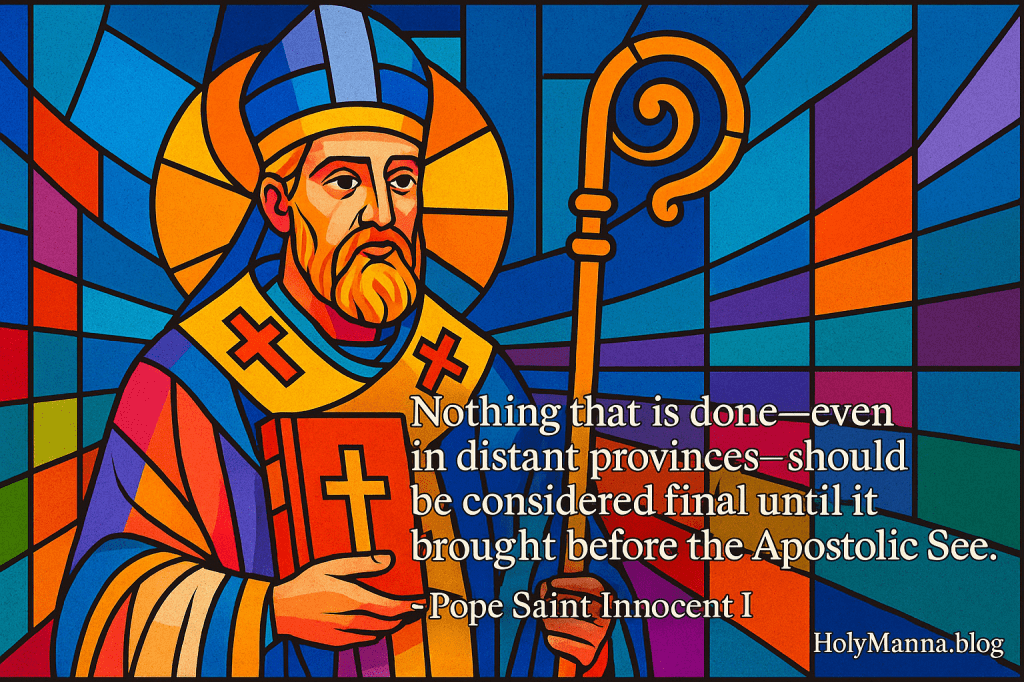
A Rock Amid the Ruins
In the turbulent years of the early fifth century, when the crumbling Roman Empire left both its citizens and its Church vulnerable to spiritual confusion and political collapse, one man stood firm as a beacon of divine truth and ecclesial order: Pope Saint Innocent I. As the 40th pope of the Roman Catholic Church, his leadership during the sack of Rome in 410 AD and his unyielding defense of orthodoxy earned him a place not only in history but in the communion of saints.
Innocent I’s pontificate was defined by theological clarity, pastoral compassion, and an unwavering insistence on the authority of the See of Rome as the final court of appeal in Church matters. His correspondence with bishops across the Christian world—offering decisions on matters ranging from clerical discipline to sacramental practice—solidified the role of the papacy as a central pillar in the universal Church. Though he died a natural death, the weight he bore was no less than the burden of martyrdom: the cross of leadership in a decaying world.
Formed in the Heart of the Church
Though historical records are sparse, most scholars place the birth of Innocent I around the mid-fourth century in Albano, a town close to Rome. His upbringing occurred in the spiritual shadow of the Eternal City, where Christian faith and Roman identity intertwined. Some sources, such as the Liber Pontificalis, suggest that his father may have been Pope Anastasius I—though this is more likely a reference to a spiritual rather than biological relationship. Regardless, Innocent’s early life was undoubtedly shaped by deep exposure to the Church’s inner workings and a formative sense of divine mission.
Innocent’s ascent to the papacy in 401 AD was not due to political power or worldly prestige, but to the esteem he had earned through his wisdom, virtue, and fidelity to tradition. His election marked a transition from quiet service to active guardianship of the faith. Unlike many other saints, Innocent did not undergo a dramatic conversion from sin or paganism. His journey was one of deepening commitment—an ongoing surrender of his heart, mind, and will to the mission of Christ through His Church.
Known primarily as a defender of orthodoxy, Innocent’s fame arose from his unflinching decisions on matters of doctrine, his support of persecuted bishops, and his tireless efforts to maintain ecclesial unity. His legacy would later influence future developments in papal primacy and Church governance.
Letters of Light
The life of Pope Saint Innocent I is not one filled with tales of physical healings or dramatic apparitions, but rather with miracles of unity, truth, and courage amid immense spiritual warfare. He wrote numerous letters that would have far-reaching consequences for the governance and doctrinal integrity of the Church. To the bishops of Gaul, Spain, and North Africa, he addressed questions on the Eucharist, penance, and clerical celibacy, always pointing back to the traditions inherited from the Apostles.
Among his most heroic acts was his defense of Saint John Chrysostom, the famed archbishop of Constantinople, who had been unjustly deposed and exiled by imperial and ecclesiastical intrigue. Innocent refused to accept the decisions of the Synod of the Oak, which condemned Chrysostom, and tirelessly advocated for justice, even when it put him at odds with powerful Eastern authorities. His loyalty to Chrysostom was not merely personal—it was a bold stance for ecclesial integrity and the rights of every bishop within the Body of Christ.
Another defining feature of his papacy was his insistence that final ecclesial judgments must rest with the See of Rome. In a famous letter to the bishops of Africa dealing with the Pelagian controversy, he wrote that “Nothing that is done—even in distant provinces—should be considered final until it is brought before the Apostolic See.” His clarity and conviction helped shape the understanding of the pope as the ultimate arbiter in matters of faith and morals—a teaching that would develop further in subsequent centuries.
Though Innocent I is not associated with miraculous signs in the traditional sense, the order and clarity he brought to a fractured Church can be seen as a divine intervention in its own right. His wisdom helped prevent disunity from turning into disaster.
The Cross of Leadership
The papacy of Innocent I was marked by intense pressure—not only from theological heresies like Pelagianism and Donatism—but also from the external threat of barbarian invasion. Perhaps the darkest moment of his pontificate came in 410 AD when the Visigoth king Alaric led a brutal sack of Rome, a city that had not fallen to an enemy in 800 years.
At the time of the invasion, Innocent was in Ravenna, appealing to Emperor Honorius for help. Though unsuccessful in halting the attack, he returned to a devastated Rome and began the long task of spiritual rebuilding. He offered comfort to the traumatized, preserved the sacred liturgies, and reminded the faithful that while earthly empires crumble, the Kingdom of God endures.
Unlike many saints of the early Church, Innocent was not martyred by blood. Yet he bore the suffering of a Church under siege and the isolation of a leader who often had to stand alone. His suffering was interior—marked by responsibility, prayer, and steadfast obedience to God’s will. His endurance in the face of such overwhelming responsibility was a martyrdom of the heart.
The Echo of His Voice
Pope Saint Innocent I died on March 12, 417, having served as pontiff for over fifteen years. Though he did not leave behind tales of bodily miracles or dramatic apparitions, his enduring influence on the Catholic Church stands as a miracle of another kind—the miracle of continuity, unity, and faithful governance.
His burial site along the Via Portuensis, near the catacombs of Saint Pontian, became a place of veneration for the faithful, though never a site of massive pilgrimage. Yet his legacy was cemented in the papal documents and conciliar decisions that followed. His letters were cited by later popes and Church Fathers, including Saint Augustine, as doctrinal anchors in times of dispute.
In both the Eastern and Western traditions, Innocent is venerated as a saint. The Roman Martyrology honors him on July 28, while other sources preserve his memory on the date of his death, March 12. His sanctity lies not in sensational miracles but in the quiet, powerful witness of fidelity, justice, and shepherding the Church through stormy waters.
Strength, Study, and Sacred Duty
Pope Saint Innocent I speaks powerfully to our age—an age also riddled with confusion, division, and spiritual weariness. His example reminds us that fidelity to truth, even when unpopular, is the deepest form of love. As a shepherd of souls, he teaches that leadership in the Church is not about personal power, but about service, sacrifice, and steadfastness.
In our lives, we too are often called to defend what is right amid the noise of compromise. Like Innocent, we may not perform spectacular miracles, but our daily acts of clarity, courage, and compassion can heal divisions and illuminate hearts. His trust in the teachings passed down from the Apostles urges us to root ourselves deeply in Sacred Scripture and the Catechism of the Catholic Church, so that we too may guide others with wisdom and love.
Whether we are parents, teachers, clergy, or simply Christians seeking to live faithfully, Innocent’s life calls us to spiritual maturity and responsibility. His courage in crisis, his unwavering teaching, and his love for the Church remain enduring gifts for all the faithful.
How can we live out the virtues of clarity, conviction, and courage in a world that often rejects absolute truth?
What sacrifices are we willing to make in order to remain faithful to the teachings of Christ and His Church?
Are we actively supporting our shepherds, or merely observing from the sidelines?
Engage with Us!
👇 Share your thoughts in the comments below!
- What do you think about the legacy of Pope Saint Innocent I?
- Have you ever been called to defend your faith in a difficult situation?
- How can we better support our Church leaders in their spiritual and doctrinal responsibilities?
Let’s continue to lift each other up as brothers and sisters in Christ, seeking to live boldly for the truth and to do everything with love—just as our Lord Jesus did.
Pope Saint Innocent I, pray for us! ⛪️
Follow us on Instagram and Facebook for more insights and reflections on living a faith-filled life.

 Holy Manna!
Leave a comment