Monday of the Seventeenth Week in Ordinary Time – Lectionary: 401
How God’s Mercy Transforms Our Failures
Have you ever looked back on something you did—something rooted in impatience, fear, or pride—and wondered how God could still love you after that? Today’s readings speak directly into that spiritual ache. They remind us that even in our worst moments—when we forget God, rebel, or lose hope—He does not abandon us. Instead, He meets us in our failure and plants within us the seed of His mercy, a mercy that can grow into something far greater than we could ever imagine.
The story from Exodus 32 is one of the most tragic and yet deeply human episodes in Israel’s journey: the golden calf. Moses descends from Mount Sinai holding the very tablets engraved by the hand of God, only to find his people dancing around an idol they crafted while he was away. It is a scene of betrayal—but also of intercession. Moses, a foreshadowing of Christ, offers to be blotted from God’s book for the sake of his people. This echoes in Psalm 106, where we hear of Moses standing “in the breach” to turn away God’s wrath. These moments take place within a historical context where the Israelites, freshly delivered from Egypt, are still learning what it means to trust in an invisible God who leads them not by visible strength, but by covenant and promise. Their fall into idolatry reveals how quickly human hearts can forget—even in the shadow of miracles.
But The Gospel of Matthew flips this on its head in a stunning way. Jesus speaks of the Kingdom of Heaven as a mustard seed and yeast—tiny, hidden things that work quietly and patiently. While the Israelites looked for tangible gods to worship, Jesus reveals that the true work of God often begins in hiddenness, in humility, and in small, faithful acts. The same people who once fashioned a lifeless idol now receive the promise of a living kingdom—one that can grow within them if they are open to grace. What golden calves are we still clinging to—and how might God be inviting us to trade them for a seed of His Kingdom?
First Reading – Exodus 32:15–24, 30–34
When We Forget the God Who Saved Us
The Book of Exodus is the story of deliverance—from slavery in Egypt to covenantal relationship with the living God. It is the second book of the Bible and a foundational text in both Jewish and Christian traditions, revealing God’s power, justice, mercy, and desire for intimacy with His people. Today’s passage captures a tragic turning point: the people of Israel, recently liberated from centuries of slavery, betray the very God who freed them. Set at the base of Mount Sinai, this scene unfolds just as God has been giving Moses the divine Law. In cultural terms, the Israelites were still being spiritually weaned off Egyptian influences, and their desire for a tangible god exposes both their fear and their lack of faith. Spiritually, this is a cautionary tale of what happens when we allow impatience, insecurity, or cultural compromise to take root. And yet, even here, God’s mercy pierces through the breach. This passage is deeply connected to today’s Gospel theme: while sin can be sudden and destructive, grace—like a mustard seed—can still grow and redeem.
Exodus 32:15-24, 30-34
New American Bible (Revised Edition)
15 Moses then turned and came down the mountain with the two tablets of the covenant in his hands, tablets that were written on both sides, front and back. 16 The tablets were made by God; the writing was the writing of God, engraved on the tablets. 17 Now, when Joshua heard the noise of the people shouting, he said to Moses, “That sounds like a battle in the camp.” 18 But Moses answered,
“It is not the noise of victory,
it is not the noise of defeat;
the sound I hear is singing.”
19 As he drew near the camp, he saw the calf and the dancing. Then Moses’ anger burned, and he threw the tablets down and broke them on the base of the mountain. 20 Taking the calf they had made, he burned it in the fire and then ground it down to powder, which he scattered on the water and made the Israelites drink.
21 Moses asked Aaron, “What did this people do to you that you should lead them into a grave sin?” 22 Aaron replied, “Do not let my lord be angry. You know how the people are prone to evil. 23 They said to me, ‘Make us a god to go before us; as for this man Moses who brought us out of the land of Egypt, we do not know what has happened to him.’ 24 So I told them, ‘Whoever is wearing gold, take it off.’ They gave it to me, and I threw it into the fire, and this calf came out.”
The Atonement. 30 On the next day Moses said to the people, “You have committed a grave sin. Now I will go up to the Lord; perhaps I may be able to make atonement for your sin.” 31 So Moses returned to the Lord and said, “Ah, this people has committed a grave sin in making a god of gold for themselves! 32 Now if you would only forgive their sin! But if you will not, then blot me out of the book that you have written.” 33 The Lord answered Moses: Only the one who has sinned against me will I blot out of my book. 34 Now, go and lead the people where I have told you. See, my angel will go before you. When it is time for me to punish, I will punish them for their sin.
Detailed Exegesis
Verse 15 – “Moses then turned and came down the mountain with the two tablets of the covenant in his hands, tablets that were written on both sides, front and back.”
This moment marks Moses descending from an intimate encounter with God, physically carrying the covenant that would bind Israel to Yahweh. The tablets, written by the finger of God, symbolize divine initiative—God’s desire to dwell among His people through law and relationship.
Verse 16 – “The tablets were made by God; the writing was the writing of God, engraved on the tablets.”
The Hebrew emphasizes the direct authorship of God. These are not mere human commandments—they are a sacred trust. The engraving indicates permanence, like the marriage covenant, showing God’s deep commitment.
Verse 17 – “Now, when Joshua heard the noise of the people shouting, he said to Moses, ‘That sounds like a battle in the camp.’”
Joshua, still loyal and waiting halfway down the mountain, hears the uproar and mistakes it for war. This misinterpretation highlights the chaos that sin brings—it distorts perception and unsettles peace.
Verse 18 – “But Moses answered, ‘It is not the noise of victory, it is not the noise of defeat; the sound I hear is singing.’”
Moses discerns the truth: what Joshua interprets as battle is actually revelry—worship of the golden calf. The singing is not joy rooted in God but noise fueled by idolatry.
Verse 19 – “As he drew near the camp, he saw the calf and the dancing. Then Moses’ anger burned, and he threw the tablets down and broke them on the base of the mountain.”
Seeing the idol with his own eyes, Moses breaks the tablets—a prophetic action representing the broken covenant. The tablets are not merely dropped—they are shattered at the mountain’s base, symbolizing the people’s descent from divine intimacy.
Verse 20 – “Taking the calf they had made, he burned it in the fire and then ground it down to powder, which he scattered on the water and made the Israelites drink.”
This dramatic act destroys the idol physically and forces the people to ingest their sin—a bitter taste of the consequences of unfaithfulness. It’s a ritual of humiliation, purging, and memory.
Verse 21 – “Moses asked Aaron, ‘What did this people do to you that you should lead them into a grave sin?’”
Moses confronts Aaron, his brother, who was left in charge. The question cuts to the heart: leadership is not neutral—Aaron’s failure to stand firm led to communal destruction.
Verse 22 – “Aaron replied, ‘Do not let my lord be angry. You know how the people are prone to evil.’”
Aaron deflects responsibility, blaming the people’s nature. This echoes the Garden of Eden, where Adam blamed Eve. Sin leads to cowardice, and leadership requires accountability.
Verse 23 – “They said to me, ‘Make us a god to go before us; as for this man Moses who brought us out of the land of Egypt, we do not know what has happened to him.’”
The people’s fear and forgetfulness are laid bare. Moses’ temporary absence leads to panic, and instead of waiting for God, they demand a replacement. The desire for a god “to go before us” reflects a deep human tendency to control and domesticate divinity.
Verse 24 – “So I told them, ‘Whoever is wearing gold, take it off.’ They gave it to me, and I threw it into the fire, and this calf came out.”
Aaron’s excuse is almost laughable in its deflection—“this calf came out.” It underscores how absurd sin can look when brought into the light. But it also reveals how easily leaders can be seduced into compromise.
Verse 30 – “On the next day Moses said to the people, ‘You have committed a grave sin. Now I will go up to the Lord; perhaps I may be able to make atonement for your sin.’”
Moses prepares to intercede. The phrase “perhaps I may be able” shows the gravity of the offense—atonement is not guaranteed. This foreshadows the need for a greater intercessor: Christ Himself.
Verse 31 – “So Moses returned to the Lord and said, ‘Ah, this people has committed a grave sin in making a god of gold for themselves!’”
Moses confesses on behalf of the people. This echoes the role of the high priest who stands between God and sinners, pleading for mercy.
Verse 32 – “Now if you would only forgive their sin! But if you will not, then blot me out of the book that you have written.”
This is one of the most Christ-like lines in the Old Testament. Moses offers to be erased for the sake of his people. Like Paul in Romans 9:3 and ultimately Jesus on the Cross, true love lays itself down.
Verse 33 – “The Lord answered Moses: Only the one who has sinned against me will I blot out of my book.”
God clarifies divine justice: each soul bears personal responsibility. Yet, this doesn’t negate intercession—it dignifies it, showing that while mercy is offered, accountability remains.
Verse 34 – “Now, go and lead the people where I have told you. See, my angel will go before you. When it is time for me to punish, I will punish them for their sin.”
God does not abandon His people, but neither does He ignore their offense. His angel—His presence—will still lead, but justice will be served in due time. Mercy delays wrath but does not erase consequence.
Teachings of the Church
The Catechism reminds us of the gravity of idolatry: “Idolatry not only refers to false pagan worship. It remains a constant temptation to faith… Man commits idolatry whenever he honors and reveres a creature in place of God” (CCC 2113). This includes power, pleasure, even human leaders. The golden calf is not merely a historical event—it’s a mirror. What gold have we melted into calves in our own lives?
Saint Thomas Aquinas, in his Summa Theologiae, speaks of intercession as a form of charity and justice. Moses’ bold plea to be blotted from God’s book reflects heroic charity: “To will the good of the other, even at one’s own expense, is the perfection of love.” (ST II-II, q. 27, a. 2). In this way, Moses prefigures Christ, the High Priest who intercedes eternally for us (Hebrews 7:25).
The early Church Fathers often saw Moses as a type of Christ. Saint Ambrose wrote: “Moses was the mediator of the Old Covenant, but Christ is the mediator of the New. As Moses offered his own life for the people, so did Jesus offer His on the Cross” (Exposition of the Christian Faith, Book III). The difference? Christ’s intercession not only pleads but redeems, planting the mustard seed of the Kingdom even in the ashes of our rebellion.
Reflection
This reading confronts us with an uncomfortable truth: we are not so different from the Israelites. We get impatient with God. We chase after visible, controllable idols. We listen to voices that say, “Make us a god to go before us.” But God remains faithful. He gives us leaders who intercede, sacraments that restore, and grace that transforms. Are we willing to name our golden calves—and burn them in the fire of God’s mercy?
Consider the leaders God has placed in your life—your priests, parents, spiritual mentors. Are you praying for them as they “stand in the breach” for you? And are you willing to stand in the breach for others, even when it’s hard? Today, take a moment to ask: Where have I compromised out of fear or impatience? What would it look like to turn back and let God write His law on my heart again?
Responsorial Psalm – Psalm 106:19–23
When We Forget to Remember
Psalm 106 is a historical psalm, a liturgical lament that recounts Israel’s repeated acts of rebellion and God’s enduring mercy. Composed during or after the Babylonian exile, it served as a collective confession for a people who had suffered the consequences of forgetting their covenant with the Lord. Today’s verses zoom in on the golden calf incident at Mount Horeb, echoing the narrative from Exodus 32. In this psalm, memory becomes a sacred act—remembering God’s mighty deeds is a way of remaining in relationship with Him. The people’s failure wasn’t just in building an idol; it was in forgetting the God who had saved them. This fits seamlessly into today’s central theme: the devastating power of spiritual forgetfulness and the quiet strength of intercessory mercy. Moses, the chosen one, stands in the breach not just once, but symbolically for all of us—pointing ahead to the one Mediator, Jesus Christ.
Psalm 106:19-23
New American Bible (Revised Edition)
19 At Horeb they fashioned a calf,
worshiped a metal statue.
20 They exchanged their glory
for the image of a grass-eating bull.
21 They forgot the God who had saved them,
who had done great deeds in Egypt,
22 Amazing deeds in the land of Ham,
fearsome deeds at the Red Sea.
23 He would have decreed their destruction,
had not Moses, his chosen one,
Withstood him in the breach
to turn back his destroying anger.
Detailed Exegesis
Verse 19 – “At Horeb they fashioned a calf, worshiped a metal statue.”
This line references the infamous incident at Mount Horeb (another name for Sinai). In full view of God’s glory, the people construct an idol—demonstrating not just rebellion, but spiritual blindness. The contrast could not be sharper: divine glory on the mountain, human idolatry in the valley.
Verse 20 – “They exchanged their glory for the image of a grass-eating bull.”
Here, the psalmist uses language from Romans 1:23, later echoed by Saint Paul: “they exchanged the glory of the immortal God for images resembling mortal man or birds or animals or reptiles.” The glory they exchange is not only God’s presence but their own dignity as His covenant people. To bow before a beast is to fall beneath one’s own created purpose.
Verse 21 – “They forgot the God who had saved them, who had done great deeds in Egypt,”
Forgetting here is more than mental lapse—it is covenantal treason. Salvation from Egypt was the defining moment of Israel’s identity, and to forget it was to erase the foundation of their faith. The Catechism tells us: “The remembrance of the works of the Lord is an essential element of the life of faith” (CCC 1099).
Verse 22 – “Amazing deeds in the land of Ham, fearsome deeds at the Red Sea.”
These “amazing deeds” include the plagues, the Passover, and the parting of the Red Sea. Ham refers to Egypt, and these miracles were intended to inspire awe and allegiance. The fear of the Lord, in biblical terms, is not terror but reverent wonder—a wonder the Israelites swiftly abandoned.
Verse 23 – “He would have decreed their destruction, had not Moses, his chosen one, withstood him in the breach to turn back his destroying anger.”
This verse is the emotional crescendo. Moses stands between God’s righteous anger and the people’s self-destruction. “In the breach” evokes the image of a soldier guarding a broken wall. Moses’ intercession is not manipulation—it is participation in God’s mercy. This priestly act prefigures Christ’s eternal intercession on our behalf.
Teachings of the Church
The Catechism teaches that sacred memory is a form of liturgy and fidelity: “In the Liturgy of the Word the Holy Spirit…recalls to the assembly all that Christ has done for us” (CCC 1103). Forgetfulness is not just a cognitive failure—it is a spiritual disorder that the liturgy is designed to heal. Like the Israelites, we are constantly tempted to forget who we are and what God has done. The psalmist reminds us that memory is mission. To forget God is to wander; to remember Him is to return.
Saint Augustine reflects on this psalm in his Confessions, observing: “They have abandoned the fountain of life, and dug for themselves broken cisterns that hold no water.” The golden calf was a broken cistern—a god they could see, control, and manipulate. But in doing so, they forsook the Living God. Augustine connects this to our own age, noting how the human heart is “restless until it rests in You.” Forgetting God always leads to restlessness, disorder, and eventual despair.
Pope Benedict XVI, in his apostolic exhortation Verbum Domini, emphasizes the importance of meditating on salvation history: “Only in remembering all that God has done for us can we respond with faith and love… The Word of God must become the memory of the Church” (VD 17). Psalm 106 is precisely this kind of memory. It is not nostalgia; it is conversion. By recalling our past betrayals and God’s enduring mercy, we’re invited not into shame, but into gratitude and transformation.
Reflection
How often do we forget the God who has saved us? Not in our words perhaps, but in our choices—when we turn to self-reliance, control, or comfort before turning to prayer. We may not worship a golden calf, but we often build quieter idols: approval, wealth, performance, security. Psalm 106 calls us to remember—and remembering requires effort. Consider making a list today of the “great deeds” God has done in your life. Write them down. Thank Him aloud.
Do you have someone in your life who “stood in the breach” for you? Perhaps a parent, priest, friend, or saint who interceded when you had turned away? Take a moment to thank God for them. Better yet—be that person for someone else. Who needs your prayers today? Who needs you to remember them before the mercy seat of God? In a world full of distractions and forgetfulness, we are called to become living psalms—songs of memory, intercession, and praise.
Holy Gospel – Matthew 13:31–35
The Hidden Power of the Kingdom
The Gospel of Matthew was written primarily for a Jewish-Christian audience, and it presents Jesus as the fulfillment of Old Testament prophecies, the new Moses who brings not a law carved in stone, but one engraved on hearts. In chapter 13, Jesus offers a series of parables that reveal the nature of the Kingdom of Heaven. These parables are deceptively simple yet spiritually rich, speaking to a people awaiting a powerful, visible Messiah. Instead, Jesus reveals a kingdom that begins in obscurity, grows silently, and transforms everything it touches. In the context of today’s readings, these images of mustard seed and yeast stand in direct contrast to the spectacle of idolatry at Sinai. Where sin demands something immediate and tangible, grace asks for trust in what is hidden and humble. Jesus’ words today invite us to let go of our golden calves and instead sow the tiny seed of faith, trusting that God’s kingdom is already at work, even if we cannot yet see its fullness.
Matthew 13:31-35
New American Bible (Revised Edition)
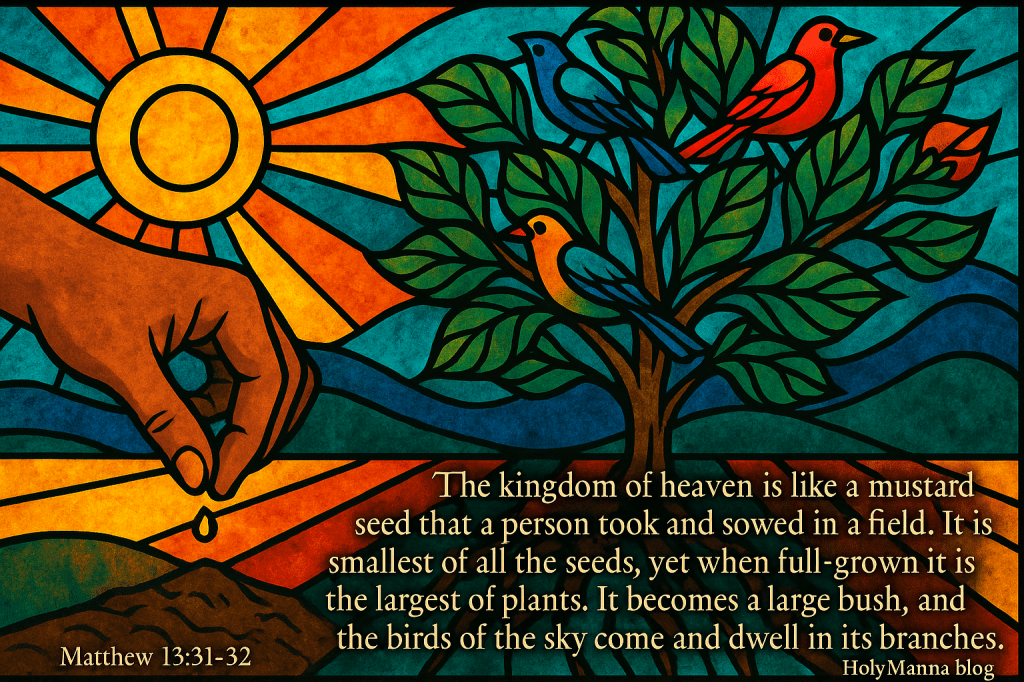
31 He proposed another parable to them. “The kingdom of heaven is like a mustard seed that a person took and sowed in a field. 32 It is the smallest of all the seeds, yet when full-grown it is the largest of plants. It becomes a large bush, and the ‘birds of the sky come and dwell in its branches.’”
The Parable of the Yeast. 33 He spoke to them another parable. “The kingdom of heaven is like yeast that a woman took and mixed with three measures of wheat flour until the whole batch was leavened.”
The Use of Parables. 34 All these things Jesus spoke to the crowds in parables. He spoke to them only in parables, 35 to fulfill what had been said through the prophet:
“I will open my mouth in parables,
I will announce what has lain hidden from the foundation [of the world].”
Detailed Exegesis
Verse 31 – “He proposed another parable to them. ‘The kingdom of heaven is like a mustard seed that a person took and sowed in a field.’”
Parables were Jesus’ preferred teaching method, designed to veil divine truths in ordinary imagery. The mustard seed was the smallest of seeds known to His audience, and its mention here signals the Kingdom’s paradox: it begins in small, seemingly insignificant ways. This mirrors God’s pattern throughout salvation history—using what is weak to shame the strong (1 Cor 1:27).
Verse 32 – “It is the smallest of all the seeds, yet when full-grown it is the largest of plants. It becomes a large bush, and the ‘birds of the sky come and dwell in its branches.’”
This verse draws from Ezekiel 17:23, where the cedar tree symbolizes God’s kingdom providing shelter for the nations. Jesus reimagines that image using a humble mustard plant. The birds signify all peoples—Jews and Gentiles—finding refuge in the Kingdom. It is a stunning reversal: from seed to sanctuary, from obscurity to universality.
Verse 33 – “He spoke to them another parable. ‘The kingdom of heaven is like yeast that a woman took and mixed with three measures of wheat flour until the whole batch was leavened.’”
Yeast, often used negatively in Scripture (as in the “leaven of the Pharisees”), is here redeemed as a symbol of transformation. The woman mixes it with an enormous amount of flour—enough to feed over 100 people. Though invisible once mixed, the yeast works powerfully from within. This reveals the Kingdom’s hidden yet pervasive power. God’s grace, once welcomed, transforms the entire soul—and society—from the inside out.
Verse 34 – “All these things Jesus spoke to the crowds in parables. He spoke to them only in parables,”
Matthew highlights that Jesus consistently uses parables for the crowds. This method invites those with ears to hear to press in further. It conceals truth from the hard-hearted but reveals it to the humble. Parables, then, are not simplistic stories—they are a spiritual filter.
Verse 35 – “to fulfill what had been said through the prophet: ‘I will open my mouth in parables, I will announce what has lain hidden from the foundation [of the world].’”
This quote echoes Psalm 78:2, affirming Jesus as the divine revealer. He speaks what was hidden since creation—truths that even Moses and the prophets only glimpsed. His parables don’t just teach; they unveil mysteries, drawing us into God’s eternal plan. The Kingdom is not an earthly empire, but a divine mystery unfolding in our hearts.
Teachings of the Church
The Catechism teaches us that “The Kingdom of Heaven was inaugurated on earth by Christ… It grows mysteriously in the hearts of those incorporated into Him, until its full eschatological manifestation” (CCC 865). This aligns perfectly with today’s imagery of mustard seed and yeast. God’s work often begins in hiddenness—in the heart, in the womb, in the stillness of prayer. The Kingdom is not measured by spectacle but by silent surrender.
Saint Thérèse of Lisieux lived this parable of hidden growth. In her “Little Way,” she embraced the mustard seed of daily sacrifice and unseen holiness: “To pick up a pin for love can convert a soul.” Her life echoes today’s Gospel truth: the smallest acts, offered in love, become vast trees of grace in God’s Kingdom. Like yeast kneaded into dough, her hidden life leavened the Church.
Saint Gregory the Great noted that Jesus taught in parables because “truths which are plain to the humble are hidden from the proud” (Homilies on the Gospels, 1.7). The Gospel invites us to humility, to trust in the slow work of grace. We may not see the tree or taste the leaven immediately, but the Kingdom is alive, growing even when it feels invisible. This is the antidote to the impatient idolatry of Exodus.
Reflection
In a world that glorifies instant results, public platforms, and visible outcomes, Jesus invites us to plant seeds and trust in hidden growth. What mustard seed has God placed in your hand today? It may be a word of kindness, a prayer prayed in secret, or an act of forgiveness no one sees. Don’t despise its smallness. That is how the Kingdom comes.
Perhaps you’re waiting on a breakthrough or struggling with your own imperfections. The yeast works slowly, silently—but it works. God’s grace is not delayed; it is patient. Are you letting the Kingdom leaven your life from the inside out? Take time today to surrender the need for spectacle. Ask God for faith in the small things, and courage to persevere in the hidden life. Because in the Kingdom of Heaven, what is hidden will one day be revealed in glory.
Trusting the Hidden Work of Grace
Today’s readings walk us through a profound journey—from rebellion and forgetfulness to intercession and hidden transformation. In Exodus 32, we see the Israelites turning from God in impatience, forging a golden calf when His presence seemed delayed. Psalm 106 mourns that failure, yet also celebrates Moses’ heroic intercession—his willingness to stand in the breach, prefiguring the mercy of Christ. And then, in The Gospel of Matthew, Jesus offers us a new vision: the Kingdom of Heaven is not a spectacle or an idol of our own making. It is a seed, a bit of yeast—small, humble, invisible at first, but alive with unstoppable grace.
The through-line is clear: when we forget God’s goodness, we grasp for what is visible and immediate. But when we remember His mercy and trust in His timing, we make space for the Kingdom to grow. It is not our grandeur but our humility that invites the miracle. Moses’ plea, the psalmist’s lament, and Jesus’ parables all echo the same invitation—Return to the Lord. Trust in His slow work. Let Him write His law again on your heart.
What golden calf are you being called to surrender today? What small seed of obedience can you plant in faith? Let this be the day you stop measuring spiritual progress by noise and numbers, and start looking for grace in silence and smallness. The Kingdom is near. It is already at work within you. Will you choose to remember? Will you choose to trust?
Engage with Us!
We’d love to hear how today’s readings spoke to your heart. Share your thoughts, prayers, and reflections in the comments below so we can grow together as a community rooted in Christ. Your voice may be the mustard seed someone else needs today!
Reflection Questions
First Reading – Exodus 32:15–24, 30–34
What “golden calves” have I created in moments of fear or impatience? How can I become more like Moses—willing to intercede boldly for others, even when they fall into sin?
Responsorial Psalm – Psalm 106:19–23
In what ways have I “forgotten” God’s saving work in my life? Who has stood in the breach for me, and how can I show gratitude for their intercession?
Holy Gospel – Matthew 13:31–35
What small, hidden seeds has God planted in my heart recently? Do I trust that God’s grace is at work, even when I don’t see immediate results?
Let’s walk forward today as people of memory, mercy, and mustard seed faith. In every word, every act, every moment—may we remember the God who saves, intercede like Moses, and trust in the quiet unfolding of the Kingdom. Do all things with love, with mercy, and in the name of Jesus, who teaches us that even the smallest yes can bear eternal fruit.
Follow us on Instagram and Facebook for more insights and reflections on living a faith-filled life.

 Holy Manna!
Leave a comment