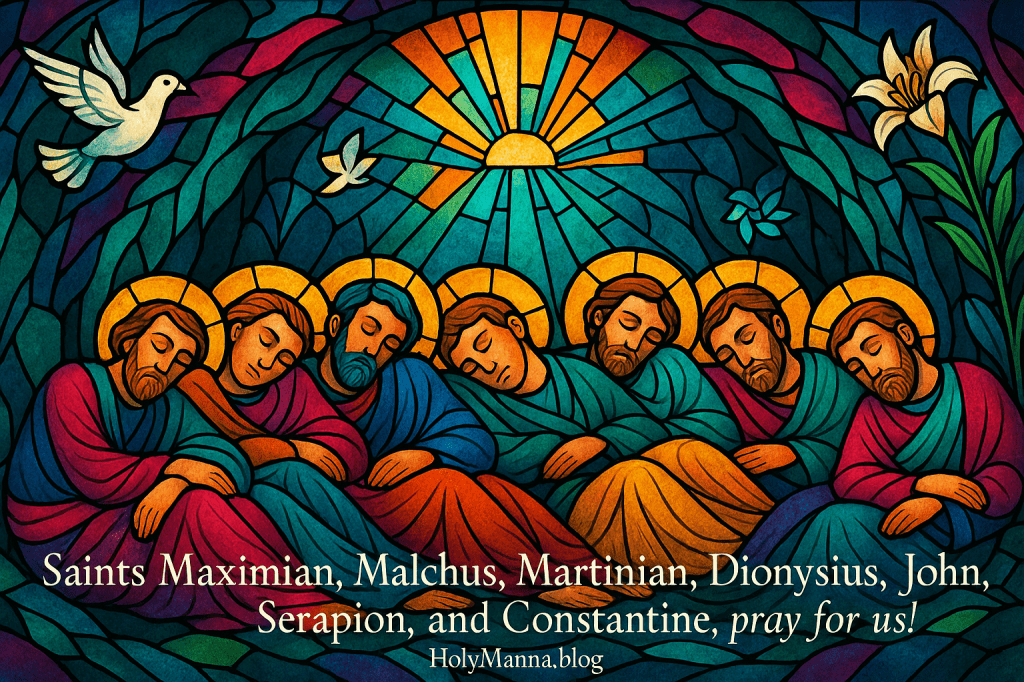
The Seven Sleepers of Ephesus
The tale of the Seven Sleepers of Ephesus is not merely a story—it’s a divine interruption in the normal flow of history, a message from God carved into time itself. Saints Maximian, Malchus, Martinian, Dionysius, John, Serapion, and Constantine are commemorated for their unwavering faith in the resurrection and the power of eternal life. These seven Christian youths became unexpected apologists of the bodily resurrection not by preaching or dying publicly, but by sleeping—and awakening as living proof of God’s promises. Revered by both Eastern and Western traditions, their story stretches across centuries and speaks directly to one of the most profound truths of the Christian faith: that death is not the end, but a doorway into the eternal life promised by Jesus Christ. Their lives and miraculous “second awakening” affirmed a doctrine that was fiercely debated in their time, and continues to be questioned today. Through their silent witness, God powerfully affirmed that faith never dies—it simply waits to be revealed.
Born into Privilege, Awakened to Truth
The Seven Sleepers were born into privilege during the third century, under the rule of Emperor Decius, a man notorious for his ruthless persecution of Christians. These young men came from noble families in Ephesus, a major city of the Roman Empire known for its wealth, temples, and cosmopolitan culture. Surrounded by the trappings of luxury and political influence, they had every reason to conform to the expectations of their society. But in the quiet chambers of their hearts, the light of Christ had begun to shine.
Though we do not know exactly how or when each of them encountered the Gospel, what’s clear is that they embraced it with deep conviction. They were not passive believers. When Decius issued a decree requiring all citizens to perform public sacrifices to the Roman gods under threat of death, these seven men took a dramatic stand: they refused. Their defiance was not loud or rebellious—it was firm, prayerful, and deliberate. Instead of submitting to idolatry, they gave up their titles, status, and comforts, and fled the city to hide in a cave on Mount Anchilos.
This moment was not just an act of physical escape; it was a spiritual conversion. They left behind the old world to seek a higher one. In the eyes of society, they were fugitives. In the eyes of Heaven, they were heroes. Their decision to enter the cave was, in truth, a kind of living martyrdom—a total surrender of their earthly future in exchange for eternal fidelity.
A Holy Slumber
What followed their retreat into the cave was no ordinary rest. According to the tradition preserved by the early Church and later chronicled by writers like Gregory of Tours and Jacob of Serugh, the seven men prayed fervently in the cave before falling asleep, entrusting their souls entirely to God. Emperor Decius, believing he could stamp out their resistance, ordered the cave sealed with great stones, hoping to entomb them alive. Yet, what he intended as an end, God transformed into a holy pause.
The miracle was not just that they fell asleep—it was that they remained asleep for nearly two centuries. Preserved by divine will, their bodies neither decayed nor aged. They were hidden from the world, yet still alive in the mind and plan of God. This was not a passive miracle, but a deeply prophetic one. Their slumber itself became a symbol of the Church waiting in hope for the return of the Lord. Their hidden life in the cave echoed the hidden life of Christ in the tomb—a divine silence filled with promise.
What is especially moving is how ordinary their faith had been. They did not work public miracles or attract crowds. Instead, their greatest miracle was their fidelity and trust. In them, we see the quiet but powerful truth that faithfulness in obscurity can bear fruit in glory. Their lives remind us that not every saint is called to die in fire or speak to thousands—some are called to sleep, to trust, and to rise only when God says, “Now.”
Waking into a New World
Their initial hardship was the persecution that drove them into hiding, but the true marvel lies in the spiritual intensity of their trial. Imagine sealing yourself in a cave, uncertain if you would ever walk freely again. Imagine giving up everything, even your ability to defend your faith publicly, and instead surrendering entirely to God’s providence. This was the hardship of the Seven Sleepers: to live in trust rather than triumph.
After the cave was sealed by order of Decius, the world moved on. Empires shifted. Decius died. The Church was eventually legalized and later defended by imperial power. But theological controversies still raged—chief among them was the nature of the resurrection. Many, even within the Church, began to deny the literal resurrection of the body, reducing it to a mere metaphor.
It was during this theological crisis, under the reign of Theodosius II, that God chose to act. A local shepherd, building a sheep pen near the ancient cave, broke through its seal. Light entered the cave for the first time in nearly 200 years. And the saints awoke, not knowing they had been asleep for centuries.
When Malchus ventured into the city to buy bread, he found a world transformed. Crosses adorned buildings. Churches stood tall. Christianity was no longer feared but embraced. Yet the silver coins he used—bearing the image of Emperor Decius—created confusion. How could this be?
The people brought Malchus before the bishop and the emperor himself. When the other six joined him, and their story was told, the shock gave way to joy. Theodosius II wept with awe and gratitude. These men were not phantoms or apparitions. They were living witnesses to the very doctrine in question.
Shortly after their testimony, the Seven Sleepers lay down once again, and died a final time—not in fear, but in fulfillment. Their mission was complete. They had borne witness not with words, but with their very existence. In this way, they attained a martyrdom not of blood but of patient surrender—a rare and holy form of witness that the Church reveres as “white martyrdom.”
Sanctified in Stillness
The impact of the Seven Sleepers did not end with their final breath. Their cave became a sacred site, a symbol of resurrection, a place of healing and hope. Theodosius II had a church built over their resting place, and pilgrims flocked from every corner of the empire to honor them. It was said that miracles of healing occurred at the site—particularly for those struggling with doubts about the afterlife or facing terminal illness. To look upon the cave was to remember that God is not bound by time, decay, or death.
Their story spread across the Christian world, translated into many languages, preserved in Eastern Orthodox liturgies, and echoed in Western hagiographies. In fact, their fame even crossed religious lines—appearing in Islamic tradition in the Qur’an as the “Companions of the Cave” in Surah al-Kahf. While the theological interpretations differ, the core story remains: seven young believers preserved by divine power, who awoke to affirm the resurrection.
Though their relics are no longer available for veneration, the cave outside Ephesus remains a destination for Christian pilgrims and a place of reflection. It reminds every generation that God’s timing is perfect, that resurrection is real, and that trust—even in the dark—is never wasted.
Timeless Trust
The story of the Seven Sleepers is as relevant today as it was in the fifth century. In our modern world—where faith often feels ridiculed, where truth is seen as subjective, and where death is often treated as the end—their lives become a loud whisper from Heaven: God is real. Resurrection is real. Eternal life is real.
So many of us experience spiritual sleep—moments when we drift, disconnect, or despair. These seven young men show us that God is able to bring new life even from places that seem sealed off and forgotten. Their hidden years were not wasted—they were preparation. Their obscurity was not abandonment—it was grace.
Let us not be afraid of the caves in our own lives. The quiet seasons, the unanswered prayers, the hidden sacrifices—these may be the very places where God is preparing us to awaken with power. As The Catechism reminds us:
“We firmly believe, and hence we hope that, just as Christ is truly risen from the dead… so after death the righteous will live for ever with the risen Christ.” (CCC 989)
May we sleep in hope, rise in faith, and live in the love of Christ, knowing that every moment surrendered to Him—whether in action or stillness—will bear fruit in His perfect time.
Engage with Us!
How does the story of the Seven Sleepers of Ephesus speak to your heart today? Share your thoughts and stories of faith in the comments below!
Reflection Questions:
- Have you ever felt like you were spiritually “asleep”? What woke you up?
- What does belief in the resurrection of the body mean to you personally?
- How can you show unwavering trust in God even when the future feels uncertain or dark?
Let’s continue supporting one another on this pilgrimage of faith. May we all strive to trust like the Sleepers and to do everything with love, as our Lord Jesus did.
Saints Maximian, Malchus, Martinian, Dionysius, John, Serapion, and Constantine, pray for us! 🕊️
Follow us on Instagram and Facebook for more insights and reflections on living a faith-filled life.

 Holy Manna!
Leave a comment