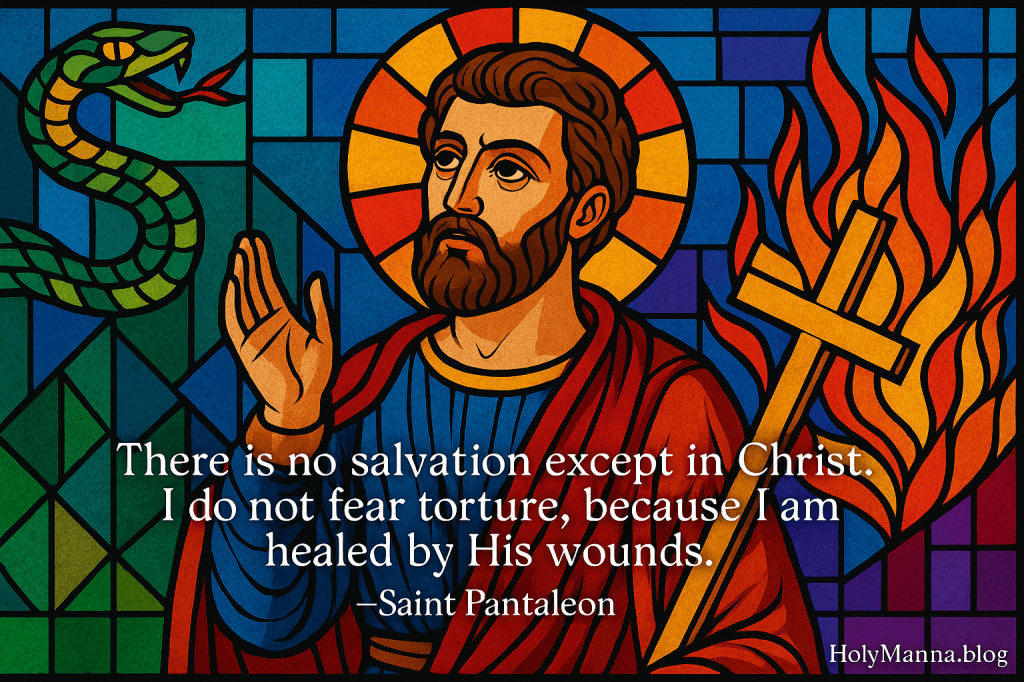
Heaven’s Physician
Among the many early Christian martyrs, few offer such a powerful fusion of skill, compassion, and courage as Saint Pantaleon. Honored as one of the Fourteen Holy Helpers, Pantaleon is best remembered as a brilliant physician who chose Christ over comfort, healing the sick not only with medicine, but through the power of prayer and divine mercy. His name, which means all-compassionate, is more than a title—it is a testimony to the way he lived, served, and died.
He is venerated by both the Roman Catholic and Eastern Orthodox Churches and is a patron of physicians, midwives, and all who seek healing in body or soul. His feast day, celebrated on July 27, is a call to all Christians to live with integrity, to serve without fear, and to place all our confidence in the divine Healer, Jesus Christ. Saint Pantaleon’s life was a beacon of mercy in a darkened empire, and his martyrdom a triumph of faith over tyranny.
A Child of Two Worlds
Saint Pantaleon was born in the prosperous city of Nicomedia in Asia Minor—modern-day Turkey—sometime in the late third century, during a time when Christianity was still an illegal and persecuted faith. His father, Eustorgius, was a wealthy pagan and ensured his son received the finest education, including studies in medicine. His mother, Eubula, however, was a devout Christian who tried to plant the seeds of faith in her son’s heart before passing away while he was still young. Sadly, her early death left Pantaleon to be raised in the world of imperial privilege and pagan philosophy.
Under the renowned physician Euphrosynos, Pantaleon quickly excelled in the medical arts. His fame spread so rapidly that Emperor Maximian appointed him as a personal physician in the imperial court. Despite all the praise and worldly success, Pantaleon remained restless, unsatisfied by prestige or wealth. It was during this time that the elderly priest Hermolaus, a hidden Christian living in Nicomedia, entered his life.
Hermolaus saw in Pantaleon a soul hungry for truth and invited him into deep conversation. Their dialogue gradually turned toward Jesus Christ, the divine Healer who restores not only the body but the soul. Hermolaus challenged him to consider whether his healing abilities were truly his own, or if they came from God. This question haunted Pantaleon.
Then came the moment that changed everything: Pantaleon encountered a man who had been blind for years. With trembling faith, he called on the name of Jesus—and the man’s sight was instantly restored. That miracle was the final sign he needed. Pantaleon embraced Christ with all his heart and was baptized by Hermolaus. From that point on, he began offering free medical care to the poor, healing in both body and spirit through the name of Jesus.
Healing Hands, Heaven’s Power
Saint Pantaleon’s life became a living testimony to God’s mercy. He continued practicing medicine with unparalleled skill, but his approach had changed. He no longer charged for his services, giving freely to those in need, and always attributing healing to the power of Christ. Word of his compassion and miracles spread throughout Nicomedia—and beyond.
One of the most astonishing miracles attributed to him during his life was the resurrection of a child who had died from a viper’s bite. Bystanders watched as Pantaleon prayed over the lifeless body and made the Sign of the Cross. The child stirred back to life, completely healed. In another well-known episode, he cured a man paralyzed for years simply through prayer, demonstrating his total trust in the power of Jesus.
Pantaleon was more than just a doctor; he was a missionary of mercy, bringing the Gospel to his patients as well as healing. Many converted after witnessing these signs. The poor and forgotten found a friend in him, while the powerful saw a threat.
His influence drew the envy of other physicians in the imperial court. They reported his Christian faith to Emperor Diocletian, accusing him of sorcery and treason for honoring Christ above the Roman gods. Pantaleon was summoned to explain himself—and instead of retreating, he boldly proclaimed Jesus as the true God and healer of humanity.
Iron and Fire Could Not Silence Him
Once Pantaleon confessed his faith before the emperor, his path to martyrdom began. But it was a path paved with divine signs. He was offered wealth, promotion, and even his life if he would renounce Christ. But his response was unwavering:
“There is no salvation except in Christ. I do not fear torture, because I am healed by His wounds.”
Infuriated by his defiance, the emperor ordered a series of tortures designed not only to kill Pantaleon, but to humiliate and break him. He was first scourged and burned with red-hot torches, but his body remained unharmed. He was then cast into a cauldron of molten lead, yet emerged untouched, singing praises to God. They tied him to a wheel, pierced him with iron hooks, and even threw him into the sea with a large stone—but the stone floated and Pantaleon walked out of the water unharmed.
Animals released to devour him licked his feet instead. Every attempt to destroy him failed—until, at last, he gave his executioners permission to end his life. As the sword struck his neck, milk, not blood, flowed from his wound, and a heavenly voice was heard saying, “Pantaleon is now one of My beloved.”
His martyrdom, traditionally dated around the year 305 A.D., sealed his testimony and ensured his memory would endure in the Church.
A Saint Who Still Heals
The miracles did not end with Saint Pantaleon’s death. His relics became sources of healing and hope for centuries to come. A vial of what is believed to be his blood is preserved in the Italian town of Ravello, and witnesses report that it miraculously liquefies every year on his feast day, much like the better-known miracle of Saint Januarius.
Throughout Europe and the East, devotion to Pantaleon grew rapidly. Pilgrimages sprang up at sites bearing his name or housing his relics. Numerous reports of physical and spiritual healings have been attributed to his intercession. During the Black Death, he was one of the fourteen saints specifically invoked for protection, and he remains part of that group known as the Fourteen Holy Helpers.
In Spain, France, Italy, and the Eastern Churches, Pantaleon became not only a figure of veneration but also a model for Christian physicians—a holy doctor whose practice was not merely technical, but profoundly spiritual. Churches and chapels across Europe bear his name, and many medical professionals keep his image close as a sign of their vocation’s sacred nature.
To this day, his relics are venerated, and those suffering from illness continue to seek his prayers, confident that he who healed in Christ’s name during life continues to intercede from Heaven.
Living His Legacy
Saint Pantaleon’s story is not just a tale from long ago. It is a powerful challenge to each of us today: Are we using our gifts for the glory of God or for our own advancement? Do we serve others with compassion, or do we seek recognition and comfort?
Pantaleon could have chosen the easy life—wealth, honor, security under the emperor. Instead, he chose Christ, and through that choice, became a vessel of mercy for the world.
If you’re a medical professional, Saint Pantaleon offers you a heavenly patron who understands your mission deeply. But even if you’re not, his example shows us how to be healers of the soul in a wounded world. His life invites us to offer kindness freely, to stand firm in our faith when it’s challenged, and to trust in the healing power of Christ—especially in our own brokenness.
As the Catechism of the Catholic Church reminds us:
“Moved by so much suffering Christ not only allows Himself to be touched by the sick, but He makes their miseries His own… By His passion and death on the cross Christ has given a new meaning to suffering, which can henceforth configure us to Him and unite us with His redemptive Passion.” (CCC 1505)
Let us imitate Pantaleon’s courage. Let us live his compassion. And let us seek to be the kind of people who—like him—bring others to the feet of Jesus, the divine Healer.
Engage with Us!
How has the life of Saint Pantaleon inspired you? Do you know someone who needs healing—physically, emotionally, or spiritually? Let’s pray for them together. Share your reflections in the comments below.
Reflection Questions:
- How can I use my profession or talents to serve others like Saint Pantaleon did?
- What fears or pressures keep me from publicly proclaiming my faith?
- How do I respond when I or a loved one is sick—do I turn to prayer as a source of strength?
Let’s continue to build each other up in love and truth. May we be all-compassionate like Pantaleon, and all-faithful like Christ.
Saint Pantaleon, pray for us! ✝️
Follow us on Instagram and Facebook for more insights and reflections on living a faith-filled life.

 Holy Manna!
Leave a comment