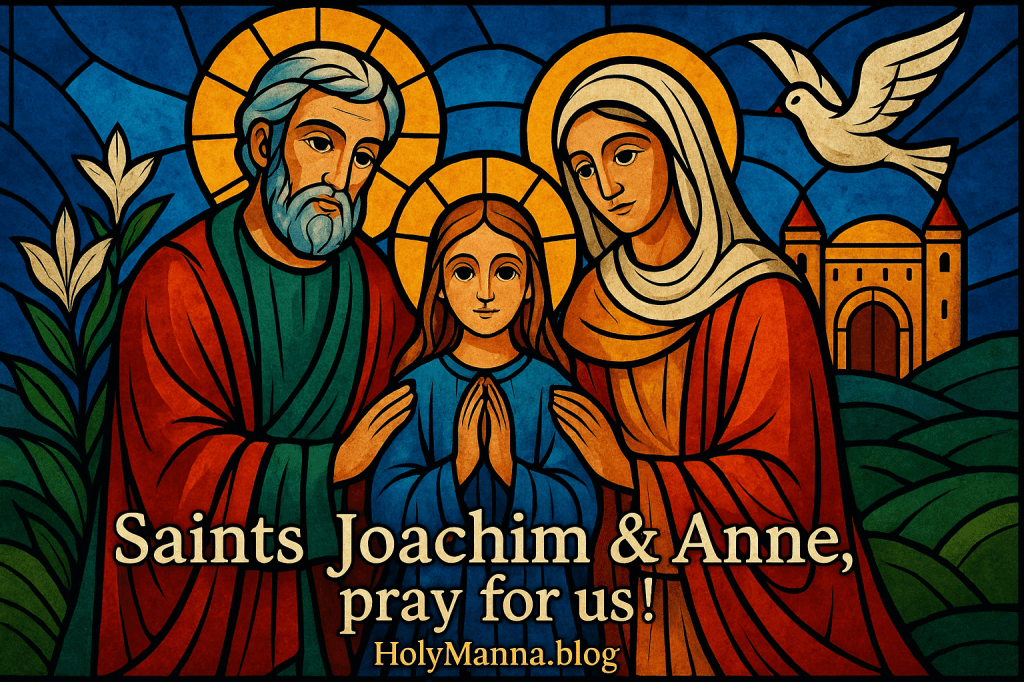
The Holy Grandparents of Jesus
In the sacred unfolding of salvation history, Saints Joachim and Anne are the quiet and steadfast figures who helped prepare the soil from which the flower of redemption would bloom. As the parents of the Blessed Virgin Mary and the grandparents of Jesus Christ, they occupy a deeply revered place in Catholic tradition, even though the canonical Gospels do not mention them by name. Their lives are preserved in the memory of the Church through Sacred Tradition and ancient Christian writings, such as the Protoevangelium of James, which describes them as righteous, generous, and devout.
They are honored not simply because of their biological connection to the Holy Family, but because of their personal holiness, trust in God during adversity, and deep commitment to raising their daughter, Mary, in virtue and faith. Their example has echoed through the centuries, offering a powerful model of prayerful perseverance and sanctified family life. Today, they are the patron saints of grandparents, married couples, and those longing for children—interceding especially for those suffering in silence and waiting patiently on God’s promise.
July 26 is their shared feast day in the Latin Church, a day to honor not only their individual sanctity, but the holy foundation they laid for the Incarnation itself. In a culture that often overlooks the elderly and the hidden labors of family life, Joachim and Anne remind us that the greatest works of God often begin in quiet homes filled with trust and love.
A Prayer in the Desert
Joachim and Anne are believed to have lived in Jerusalem, possibly near the Temple, where they regularly offered sacrifices and gave alms. Though their specific hometowns are not confirmed historically, tradition holds that Joachim was of the tribe of Judah—a descendant of King David—and Anne came from the priestly line of Levi. This lineage would mean that Mary was born of a union that joined both royal and priestly bloodlines, making her the fitting vessel to bear the Messiah.
Despite their devout lives and charitable spirits, Joachim and Anne endured the profound sorrow of infertility. In their time and culture, childlessness was seen as a sign of divine displeasure or a curse. Joachim was once turned away from making a Temple offering because of this stigma. Grieved and humiliated, he withdrew into the desert to fast and pray for forty days, pleading with God to bless him with a child. Meanwhile, Anne also remained in fervent prayer at home, weeping in her garden beneath a laurel tree.
It was in this season of deep sorrow and supplication that heaven responded. According to the Protoevangelium of James, an angel appeared separately to both Anne and Joachim, announcing that their prayers had been heard and that they would conceive a child. The angel declared that their daughter would be blessed among women and serve a special role in the Lord’s plan. With joy and gratitude, Joachim returned from the wilderness and embraced Anne at the Golden Gate of Jerusalem—a moment that has been depicted in sacred art for centuries as the tender and miraculous beginning of Mary’s story.
True to her vow, Anne would dedicate Mary entirely to the Lord, raising her with love, discipline, and devotion until the child would one day say, “Behold, I am the handmaid of the Lord” (Luke 1:38).
The Holiness of Home
Saints Joachim and Anne never sought public recognition or earthly acclaim. Instead, their holiness was lived out in the daily fidelity of marriage, prayer, and parenting. Their home was the first domestic church where Mary learned to love the Scriptures, to serve with humility, and to obey God with a pure heart. In a sense, they catechized the Mother of God, laying the spiritual and moral foundation that allowed her to say yes to the angel Gabriel with full freedom and trust.
This hidden life of holiness is often overlooked, yet it is precisely what makes them so vital to our understanding of God’s ways. As the Saint Paul reminds us, “God chose what is low and despised in the world” (1 Corinthians 1:28) to accomplish His greatest works. Through the seemingly ordinary rhythm of family life, Joachim and Anne cooperated with divine grace to raise the Immaculate Conception—a miracle in and of itself.
While no specific miracles are attributed to them during their earthly life beyond Anne’s miraculous conception of Mary, their entire story is marked by supernatural trust. Their long infertility, followed by the angelic promise and the birth of Mary, echoes the great biblical matriarchs—Sarah, Rachel, and Hannah—whose barren wombs were opened by God’s power. Their lives remind us that divine intervention often comes quietly, in response to persistent prayer and patient suffering.
Their love was not only for each other and for Mary, but for all those whom God placed in their care. Theirs is a model of compassionate, steady faith—the kind that forms saints, sustains generations, and silently transforms the world.
Trials of a Faithful Marriage
The trials Joachim and Anne faced were deeply emotional and spiritual. The societal scorn of being childless weighed heavily on them. In Jewish culture, this often led to isolation and public shame, which they endured for many years. To be denied participation in the Temple offering—an act of public worship and spiritual identity—was a profound humiliation for Joachim.
And yet, they did not turn away from God. They did not become bitter. They chose instead to deepen their faith. Joachim’s retreat into the wilderness and Anne’s solitary prayers at home are not acts of despair, but of radical hope. They trusted that God had not forgotten them—even when it seemed otherwise.
This kind of suffering is a form of spiritual martyrdom. It is the death of pride, of entitlement, of control. And yet, in that spiritual death, something beautiful was born. Their hardship became the soil in which Mary’s holiness would take root. Theirs is not the story of dramatic persecution or physical martyrdom, but of quiet perseverance in love—a different kind of martyrdom that so many married couples, grandparents, and families experience in daily life.
When they offered Mary to the Temple at age three, as tradition holds, they also modeled a stunning act of surrender. They didn’t cling to their long-awaited child, but gave her back to God. In this offering, they mirror Abraham’s faith and foreshadow the ultimate surrender Mary herself would one day make at the foot of the Cross.
A Legacy That Blossomed in Heaven
The early Church quickly recognized the sanctity of Joachim and Anne, even if their names do not appear in the Gospels. Their veneration began especially in the Eastern Churches, where feasts in their honor were celebrated by the 6th century. By the 8th century, their cult had spread to the West, and in 1584, Pope Gregory XIII officially inserted their feast into the Roman Calendar. Though once celebrated separately, they are now jointly honored on July 26, emphasizing the sacred unity of their vocation and their shared holiness.
One of the most famous sites of devotion to Saint Anne is the Shrine of Sainte-Anne-de-Beaupré in Quebec, Canada. This basilica, which houses a relic of Saint Anne, has become a pilgrimage site for millions. The walls are covered in discarded crutches, braces, and canes—testimonies to miraculous healings and answered prayers attributed to her intercession. Anne, in particular, is known as a powerful intercessor for infertile couples, pregnant women, and grandparents seeking healing or strength.
There are also chapels and churches around the world dedicated to Joachim and Anne, particularly in Jerusalem, where tradition places their home near the Sheep Gate—now the site of the Church of St. Anne. Here, pilgrims kneel in reverence to the quiet beginnings of the Virgin Mary’s earthly life and the sacred love of her parents.
Miracles continue to be reported by those who entrust their families, marriages, and hopes to the care of these holy grandparents. Their legacy reminds us that death is not the end, and that the communion of saints is real, active, and powerful for those who call on them with trust.
The Family That Formed the Mother of God
In the lives of Saints Joachim and Anne, we encounter the profound truth that God works in the hidden and the humble. Their story is not one of public preaching or martyrdom, but of steadfast love, patient endurance, and deep faithfulness. They remind us that the family is the first school of holiness—that what we do in the quiet of our homes shapes the future of the Church.
We live in an age that often devalues the elderly and glorifies the visible and immediate. But Joachim and Anne show us that the unseen work of parents and grandparents is essential to the Kingdom of God. Their trust in God’s promises, even in the face of prolonged suffering, speaks to all who feel forgotten, disappointed, or weary from waiting.
Their example invites us to honor our elders, to treasure the bonds of family, and to live each day with the quiet dignity of those who know that love—sacrificial, enduring love—is the greatest gift we can offer.
Let us ask their intercession as we strive to cultivate holiness in our homes, patience in our sufferings, and unwavering trust in the mysterious, beautiful will of God.
Engage with Us!
We’d love to hear how Saints Joachim and Anne inspire you. Have they played a role in your family’s story? Share your thoughts in the comments below and let’s grow together in faith and family!
Reflection Questions:
- In what ways do I honor and learn from the wisdom of the older generations in my life?
- How can I cultivate greater trust in God’s timing, especially in seasons of waiting or silence?
- What are some ways I can pass on the faith within my family—whether to children, siblings, or spiritual sons and daughters?
Let us support each other in prayer, encourage one another in our vocations, and above all, strive to do everything with love—just as Saints Joachim and Anne did in the quiet holiness of their home.
Saints Joachim & Anne, pray for us! ✨
Follow us on Instagram and Facebook for more insights and reflections on living a faith-filled life.

 Holy Manna!
Leave a comment