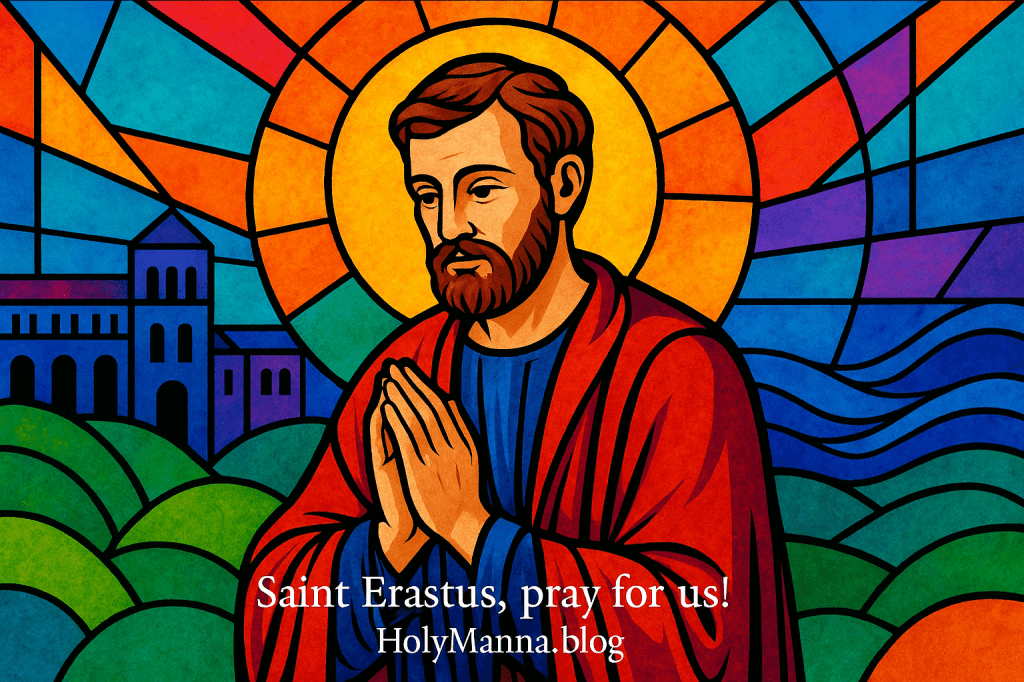
A Hidden Apostle in the Shadows of Giants
In the great symphony of the early Church, certain saints played their parts not with thunderous solos, but with quiet, steadfast harmonies that supported and enriched the whole. Saint Erastus is one of these unsung heroes. Mentioned only a few times in the New Testament, he nonetheless left a lasting impression through his fidelity to Saint Paul and his role as a servant-leader in the life of the Church. Revered as one of the Seventy Disciples commissioned by Christ in Luke 10, Erastus represents the essential but often overlooked ministry of administration and support in the body of Christ.
Tradition holds that he served as the treasurer of the city of Corinth, a powerful and influential post in one of the Roman Empire’s major centers of commerce and pagan culture. His conversion to Christianity—and his decision to align himself publicly with the apostles—was nothing short of courageous. Erastus reminds us that sainthood is not only forged in preaching and martyrdom, but also in the seemingly mundane yet holy decisions to serve, support, and sustain the mission of Christ through one’s daily labor. He stands as a patron for Christian professionals, public servants, and anyone seeking to integrate faith with work.
Treasurer Turned Disciple
Though the Scriptures do not tell us everything about Erastus’ early years, we can piece together a glimpse of his life from the Apostle Paul’s letters and Acts of the Apostles. Most notably, Romans 16:23 introduces him as the “city treasurer”—in Greek, oikonomos tēs poleōs—suggesting a role of great responsibility within Corinth’s municipal government. Corinth was a cosmopolitan and morally complex city, marked by its wealth, its culture, and its reputation for licentiousness. That a city official from such a place would not only convert to Christianity but become an active supporter of Paul speaks volumes about the depth of Erastus’ conversion.
How did such a man come to the faith? While no definitive moment is recorded, Erastus likely encountered Saint Paul during his eighteen-month stay in Corinth, described in Acts 18. During that time, Paul preached fervently, won converts from both Jewish and Gentile communities, and established a thriving Christian presence. Erastus must have heard the Gospel firsthand—perhaps even witnessed the signs and wonders that accompanied Paul’s ministry—and chose to follow the Way, risking status and political favor in the process.
What makes Erastus even more remarkable is his dual identity: a public servant and a disciple. Unlike others who left everything behind, Erastus seemed to remain in his post, using his influence and resources to support the fledgling Church. The call to discipleship did not remove him from public life—it transformed it. His loyalty to Paul is underscored in Acts 19:22, where he is named as one of the two men Paul sends ahead to Macedonia, trusting him to prepare the way. This wasn’t just an errand. It was a mission entrusted to a faithful friend and co-worker in Christ.
Faith in Service
Saint Erastus’ life is a testimony to the sacred dignity of secular work done for the glory of God. As a steward of public resources and a steward of the Gospel mission, he showed how the gifts of administration, order, and financial responsibility could serve the Kingdom. Though no miracles are recorded during his lifetime, his very presence in Scripture—however sparse—is powerful. Think of it: to be named in a letter of Saint Paul’s, to be counted among the few remembered by name, speaks to the deep trust and affection the apostle had for him.
Erastus also exemplifies the virtue of faithful support, a role that often goes unnoticed in the grand narrative of salvation history. But the Church, like a household, needs both the visionary and the steward—the preacher and the provider. Erastus was that steward. His faithfulness enabled others, like Paul, to carry out the work of evangelization. The Catechism of the Catholic Church reminds us in CCC 898 that “[The laity’s] special vocation is to seek the kingdom of God by engaging in temporal affairs and directing them according to God’s will.” Erastus lived this to the fullest.
Some traditions even hold that he later became the first bishop of Philippi or Paneas, transitioning from city treasurer to shepherd of souls. Whether or not this is historically certain, the tradition reflects the Church’s recognition of his enduring contribution and his growth in sanctity.
A Quiet Hero in a Hostile World
Though no formal account of Erastus’ martyrdom exists, his life as a Christian in the Roman Empire—especially in a high-profile public role—would not have been without suffering. The very decision to side with Paul, who was often imprisoned and persecuted, placed Erastus in a vulnerable position socially and politically. Remaining faithful in a context of imperial idolatry and civic paganism required inner strength and conviction.
Early Church martyrologies honor him, including the Roman Martyrology, which lists his feast day on July 26. Eastern traditions affirm that he was one of the Seventy Disciples whom Christ Himself sent out in Luke 10, a role that implies persecution and rejection, for Christ told them: “Behold, I send you out as lambs in the midst of wolves” (Luke 10:3). If he lived to old age, he likely did so under the weight of constant tension between civic duties and spiritual fidelity.
Some sources suggest he may have later relinquished his secular role entirely, either due to persecution or as a final act of dedication to his calling in Christ. Whether he died by natural causes or through martyrdom, the Church venerates him as a saint—a man who bore witness to Christ in a world hostile to the Gospel.
A Legacy That Echoes
Though there are no recorded physical miracles attributed to Saint Erastus after his death, his presence in Christian memory is a kind of miracle in itself. His name endured in Scripture. His service lived on in the Church. His quiet role became a model for laypeople, public servants, and administrators across the centuries.
In Orthodox and Eastern Catholic liturgies, Erastus is commemorated among the Seventy Apostles. Icons of the Seventy often include his likeness, and hymns are sung in his honor. Though his relics are not widely known or venerated, the very inclusion of his name in the sacred texts ensures his eternal remembrance. And that, in the end, is one of the greatest miracles: to live in such a way that your faithfulness is recorded in the Word of God.
The Church celebrates him not for flashy signs but for enduring faith, quiet courage, and steadfast service—virtues that are desperately needed in today’s noisy and chaotic world.
Faithfulness in the Ordinary
Saint Erastus calls us to reflect on the sacredness of our vocations, especially in the realm of secular work and public life. You don’t need to leave your job to become a saint—you need to offer it to God. Whether you work in finance, law, government, or business, you can live your faith with the integrity and courage that marked Erastus’ life.
His example invites us to consider how we use our influence, our time, and our resources to support the mission of the Church. Are we generous? Are we trustworthy? Are we aligned with the Gospel in our dealings? Are we willing to be known as Christians even when it costs us something?
The Catechism tells us that “In work, the person exercises and fulfills in part the potential inscribed in his nature. The primordial value of labor stems from man himself, its author and its beneficiary” (CCC 2428). Erastus is proof that such labor—when joined to Christ—becomes sanctified.
Let us strive to be like him: loyal to our friends in Christ, trustworthy with earthly and spiritual treasure, and willing to live our faith no matter the cost.
Engage with Us!
What a gift it is to have saints like Erastus—hidden yet holy, silent yet strong. His witness challenges us to remain steadfast in our vocations and bold in our faith.
- Have you ever felt like your work or daily duties couldn’t possibly be “holy”?
- What does Saint Erastus teach you about faith in everyday life?
- How can you support your parish or Christian mission like Erastus supported Saint Paul?
Share your reflections in the comments below! Let’s encourage each other to walk the road of faith—quietly, faithfully, and always with love, just like our Lord Jesus Christ.
Saint Erastus, pray for us! 🕊️
Follow us on Instagram and Facebook for more insights and reflections on living a faith-filled life.

 Holy Manna!
Leave a comment