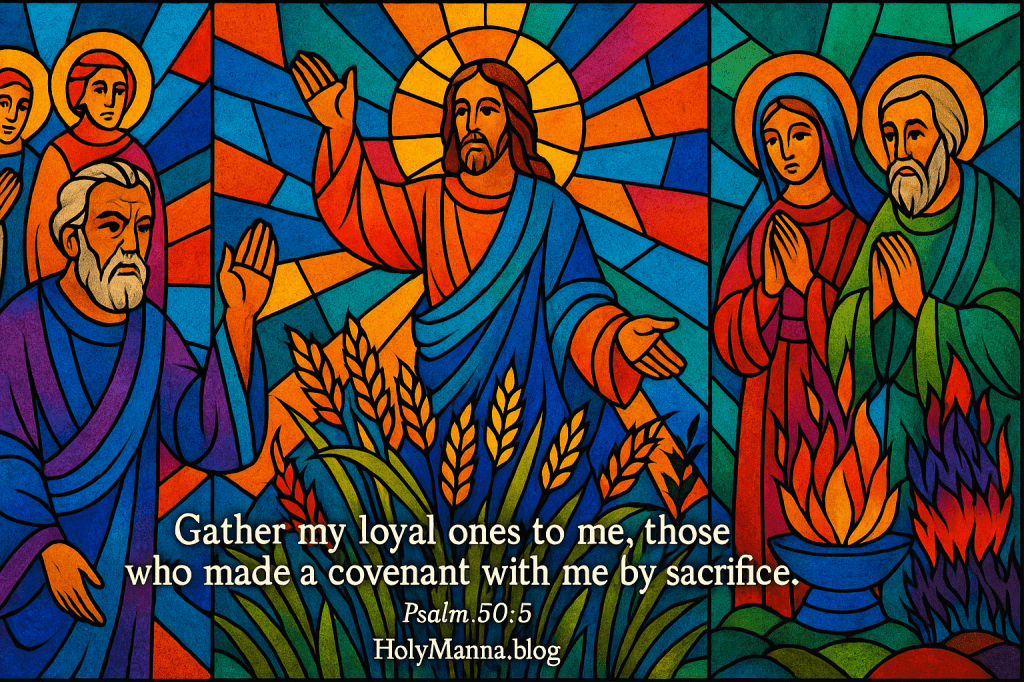
Memorial of Saints Joachim and Anne, Parents of the Blessed Virgin Mary – Lectionary: 400
Harvested in Faithful Soil
In the quiet soil of family life, God’s greatest works often begin. Today, as we celebrate the Memorial of Saints Joachim and Anne, parents of the Blessed Virgin Mary, we are invited to consider the slow, faithful cultivation of holiness across generations. Though Scripture tells us little about these saints, tradition and devotion point to a husband and wife whose trust in God, amid the silence of history, prepared the way for Mary’s yes and ultimately for the Incarnation itself. Their lives were steeped in covenantal fidelity—ordinary, perhaps, in the eyes of the world, but chosen and fruitful in the eyes of God. It is this same fidelity that we see echoed in the readings for today: a deep commitment to God’s word, an offering of praise in the midst of trials, and patient endurance while the field of life grows both wheat and weeds.
Exodus 24 offers us the dramatic moment of covenant ratification at Sinai. Moses speaks the Lord’s commands, the people respond with unity, and blood—symbolizing life—is sprinkled upon the altar and the people, binding heaven and earth in sacred agreement: “This is the blood of the covenant which the Lord has made with you according to all these words” (Exodus 24:8). This is not a casual promise, but a solemn and sacrificial union between God and His people. Psalm 50 then echoes this covenant theme, calling God’s “loyal ones” who have made sacrifice, reminding us that the Lord seeks more than rituals—He seeks hearts that offer “praise as your sacrifice” and trust Him enough to “call on me on the day of distress”. This sets the spiritual posture needed to interpret the Gospel of Matthew, where Jesus warns of a kingdom growing amid the ambiguity of weeds and wheat, calling for patient endurance until the final harvest.
Together, these readings form a mosaic of covenantal living: obedience to God’s Word, sacrificial love, and hopeful perseverance in a fallen world. Saints Joachim and Anne lived this quiet, steadfast faith, planting seeds that they themselves would not see bloom. As we reflect on God’s invitation to fidelity today, we are reminded that holiness is often cultivated in hidden places—in the homes we build, the prayers we whisper, and the trust we pass on to future generations. Are we living lives that prepare good soil for those who come after us?
First Reading – Exodus 24:3–8
Sealed in Blood
This passage from Exodus captures one of the most pivotal moments in salvation history: the ratification of the Sinai Covenant. Taking place after God delivers the Ten Commandments and ordinances to Moses on Mount Sinai, this scene marks Israel’s formal acceptance of their identity as God’s chosen people. In the ancient Near Eastern context, covenants were sacred agreements often sealed in blood, binding two parties—usually a more powerful lord and a weaker subject—in a relationship of loyalty and protection. But unlike pagan treaties, the covenant in Exodus is initiated by God out of love and faithfulness, not domination. The Book of Exodus is foundational for understanding God’s liberating action and the formation of His people. Today’s passage fits beautifully into the theme of covenantal fidelity, reminding us that God’s desire is not simply to give laws, but to enter into an intimate and sacrificial relationship with His people—one that prefigures the New Covenant in Christ.
Exodus 24:3-8
New American Bible (Revised Edition)
3 When Moses came to the people and related all the words and ordinances of the Lord, they all answered with one voice, “We will do everything that the Lord has told us.” 4 Moses then wrote down all the words of the Lord and, rising early in the morning, he built at the foot of the mountain an altar and twelve sacred stones for the twelve tribes of Israel. 5 Then, having sent young men of the Israelites to offer burnt offerings and sacrifice young bulls as communion offerings to the Lord, 6 Moses took half of the blood and put it in large bowls; the other half he splashed on the altar. 7 Taking the book of the covenant, he read it aloud to the people, who answered, “All that the Lord has said, we will hear and do.” 8 Then he took the blood and splashed it on the people, saying, “This is the blood of the covenant which the Lord has made with you according to all these words.”
Detailed Exegesis
Verse 3 – “When Moses came to the people and related all the words and ordinances of the Lord, they all answered with one voice, ‘We will do everything that the Lord has told us.’”
This verse highlights the people’s unanimous response of obedience. Their reply mirrors a liturgical affirmation, similar to how we respond “Amen” at Mass. The Israelites are not simply agreeing to follow rules; they are consenting to live as a people consecrated to the Lord. This sets the tone for a communal commitment, much like the vows of a sacrament.
Verse 4 – “Moses then wrote down all the words of the Lord and, rising early in the morning, he built at the foot of the mountain an altar and twelve sacred stones for the twelve tribes of Israel.”
Writing down the covenantal words shows their permanence and sacred authority—this isn’t casual memory; it’s divine revelation. The twelve stones represent the unity and totality of the twelve tribes, emphasizing that the covenant involves the entire people of God. The altar is the meeting place between heaven and earth, an image later echoed in the Eucharistic altar.
Verse 5 – “Then, having sent young men of the Israelites to offer burnt offerings and sacrifice young bulls as communion offerings to the Lord…”
These sacrifices serve both expiatory and communal purposes. Burnt offerings represent total surrender to God, while communion offerings (also called peace offerings) emphasize shared fellowship. The use of young men may indicate a representative group offering on behalf of the whole people, symbolizing vigor and devotion.
Verse 6 – “Moses took half of the blood and put it in large bowls; the other half he splashed on the altar.”
Blood, the ancient sign of life, becomes the medium of union between God and His people. Splashed on the altar, it consecrates the divine side of the covenant. Blood was never taken lightly in Hebrew culture—it represented the very essence of life, and in covenantal rituals, it marked the seriousness of the relationship.
Verse 7 – “Taking the book of the covenant, he read it aloud to the people, who answered, ‘All that the Lord has said, we will hear and do.’”
The repetition of the people’s promise shows their deliberate, informed assent. This isn’t blind obedience but a consent born of hearing the Word. In the liturgy, the Church also listens to Scripture before making the Creedal proclamation—we, too, are a people who “hear and do.”
Verse 8 – “Then he took the blood and splashed it on the people, saying, ‘This is the blood of the covenant which the Lord has made with you according to all these words.’”
Here is the powerful climax: the blood unites both altar and people. The covenant is now sealed. This verse foreshadows the words of Christ at the Last Supper in Matthew 26:28: “This is my blood of the covenant, which will be shed on behalf of many for the forgiveness of sins.” The Old Covenant prepares us for the New, where Christ Himself becomes both priest and sacrifice.
Teachings from the Church
The Catechism of the Catholic Church draws a direct connection between the Mosaic Covenant and the Eucharist. CCC 613 teaches: “Christ’s death is both the paschal sacrifice that accomplishes the definitive redemption of men, through ‘the Lamb of God, who takes away the sin of the world,’ and the sacrifice of the New Covenant, which restores man to communion with God by reconciling him to God through the ‘blood of the covenant, which was poured out for many for the forgiveness of sins.’” In this way, the ritual of Exodus 24 becomes a type—a shadow—of the New Covenant in Christ. The blood sprinkled on the people finds its fulfillment in the Precious Blood of Jesus, which we receive in the Eucharist as the sacrament of eternal life.
Saint Thomas Aquinas affirmed this typology when he wrote, “All the sacrifices of the Old Law were figures of the one sacrifice of Christ.” (Summa Theologiae, III, q. 22, a. 2). Aquinas understood that every Old Testament act of worship pointed beyond itself to the perfect sacrifice of Calvary. Thus, the covenant at Sinai is not merely a historic event—it is a divine rehearsal of the true and eternal covenant to come. What Israel experienced in symbol, the Church receives in substance.
Saint Augustine echoed this connection when he declared, “The Old Covenant was sealed with the blood of animals, but the New is sealed with the blood of Christ. Therefore, we are bound by an even greater covenant, one that gives life not just to a nation, but to the whole world.” The Church Fathers consistently saw the continuity between the Old and New Covenants as a story of progressive revelation and fulfillment. Today’s memorial of Saints Joachim and Anne reminds us that covenantal faithfulness is often quiet and generational. These two saints may never have seen the fullness of God’s plan, but through their fidelity, Mary—and ultimately Jesus—entered the world.
Reflection and Application
In our daily lives, we are invited to echo that same covenantal commitment. The covenant may no longer be ratified with blood on stones, but every time we say “Amen” at the Eucharist, we re-enter the sacred bond that God has made with us through Christ. Are we truly living as people of the covenant? Do our choices reflect the holiness of the One who calls us? This reading challenges us to examine our loyalty to God—not as a fleeting emotion, but as a concrete and lived reality. To be in covenant with God is to offer Him everything: our work, our families, our sufferings, and our desires. It is to rise each day—like Moses—and renew our yes at the foot of the mountain. Saints Joachim and Anne remind us that even when we do not see the fruits, our fidelity may one day cradle a future saint—or even a Savior.
Responsorial Psalm – Psalm 50:1–2, 5–6, 14–15
The Sacrifice God Desires
Psalm 50 is a powerful liturgical psalm composed by Asaph, one of King David’s chief musicians and a prophet in his own right (1 Chronicles 25:1). Unlike psalms of lament or praise, this one reads like a divine courtroom drama. God summons heaven and earth to witness His judgment—not upon the wicked nations, but upon His own covenant people. This is significant, especially in the context of today’s readings, where we are reflecting on covenantal fidelity. Following the covenant ritual of Exodus 24, this psalm reminds Israel that the heart of covenant worship is not burnt offerings or external rituals but sincere praise, thanksgiving, and trust in God. It reframes what God desires from His people: not just sacrifice, but a life of authentic relationship.
Psalm 50:1-2, 5-6, 14-15
New American Bible (Revised Edition)
The Acceptable Sacrifice
1 A psalm of Asaph.
The God of gods, the Lord,
has spoken and summoned the earth
from the rising of the sun to its setting.
2 From Zion, the perfection of beauty,
God shines forth.
5 “Gather my loyal ones to me,
those who made a covenant with me by sacrifice.”
6 The heavens proclaim his righteousness,
for God himself is the judge.
Selah
14 Offer praise as your sacrifice to God;
fulfill your vows to the Most High.
15 Then call on me on the day of distress;
I will rescue you, and you shall honor me.”
Detailed Exegesis
Verse 1 – “The God of gods, the Lord, has spoken and summoned the earth from the rising of the sun to its setting.”
This verse opens with a formal declaration of divine authority. By naming God as “The God of gods”, the psalm emphasizes His supremacy not only over Israel but over all creation. The summoning of the earth from east to west signals a universal judgment. God is not a tribal deity—He is the righteous judge of all peoples, beginning with His own.
Verse 2 – “From Zion, the perfection of beauty, God shines forth.”
Zion, Jerusalem’s holy hill, is where the Temple resides—the dwelling place of God’s presence. Calling it “the perfection of beauty” highlights its spiritual centrality. From here, God’s glory radiates outward. This imagery ties in with the covenantal theme: Zion is not just the geographic center of Israel but the spiritual heart from which divine truth and justice flow.
Verse 5 – “Gather my loyal ones to me, those who made a covenant with me by sacrifice.”
Now the covenantal context becomes explicit. God is calling those who have entered into relationship with Him through sacrificial worship. The term “loyal ones” implies more than ritual observance—it suggests fidelity of heart. This recalls Exodus 24, where Israel commits, “We will hear and do.”
Verse 6 – “The heavens proclaim his righteousness, for God himself is the judge.”
This verse affirms the cosmic nature of God’s judgment. The heavens are not passive observers; they declare God’s righteousness. As in many prophetic texts, creation itself bears witness to the truth of God’s justice. It reinforces that God’s covenant is not limited to legal obligations but is rooted in divine righteousness.
Verse 14 – “Offer praise as your sacrifice to God; fulfill your vows to the Most High.”
Here God redefines the true nature of sacrifice. It is not burnt animals that please Him, but hearts that offer genuine praise and faithful commitment. This verse echoes the prophetic call in Hosea 6:6: “For it is loyalty I desire, not sacrifice, and knowledge of God rather than burnt offerings.”
Verse 15 – “Then call on me on the day of distress; I will rescue you, and you shall honor me.”
This verse portrays the fruit of covenantal faithfulness: rescue. When the heart is aligned with God through praise and vow-keeping, He promises deliverance. This is not a transactional rescue, but one that flows from relationship. The final line—“you shall honor me”—closes the circle: covenant leads to praise, and praise invites divine response, which leads back to more praise.
Teachings from the Church
The Catechism of the Catholic Church echoes the psalmist’s vision of interior sacrifice. CCC 2100 teaches: “Outward sacrifice, to be genuine, must be the expression of spiritual sacrifice: ‘The sacrifice acceptable to God is a broken spirit…’ The prophets of the Old Covenant often denounced sacrifices that were not from the heart or not coupled with love of neighbor.” This ties directly to today’s psalm, which emphasizes that true offerings to God are spiritual, rooted in praise and integrity, not ritual alone.
Saint Augustine, reflecting on this psalm, wrote: “He who offers praise, honors me—not the man who slaughters many cattle. Let your sacrifice be the flame of your heart. Let your offering be your good will.” (Expositions of the Psalms, Psalm 49/50) His insight reveals how early Christian understanding shifted from physical to spiritual sacrifice in light of Christ’s perfect offering. In the New Covenant, every baptized Christian becomes a priest offering spiritual sacrifices.
Saint Irenaeus also reflected on the transformation of sacrifice in Christ: “The offering of the Church, which the Lord gave instructions to be made throughout the world, is a pure sacrifice… which the Church alone offers, in every place, to God the Father, in the name of Jesus Christ.” (Against Heresies, 4.18.4) This is fulfilled in the Eucharist, the ultimate praise offering, uniting our lives to the once-for-all sacrifice of Christ. As we see in Psalm 50, the faithful heart is what God seeks—one that praises, trusts, and calls on Him.
Reflection
This psalm calls us to reexamine what we truly offer to God. Are our sacrifices external gestures or inner acts of love and praise? In the rush of modern life, it’s easy to fall into routine—going to Mass, praying the Rosary, or serving others—without offering our hearts. What if the sacrifice God desires most is our trust during suffering? What if our most fragrant offering is praising Him in pain or keeping our promises when it costs us something? Like Saints Joachim and Anne, who lived quiet, faithful lives outside the spotlight of Scripture, we are invited to be the “loyal ones” who fulfill our vows and call on God in every distress. When we offer praise—not just with words, but with lives marked by fidelity—we enter into the covenant anew, and God promises: “I will rescue you, and you shall honor me.”
Holy Gospel – Matthew 13:24–30
The Patience of God’s Justice
This passage from The Gospel of Matthew comes from a collection of parables Jesus shares to reveal the mystery of the Kingdom of Heaven. In a culture where farming was a daily reality and the livelihood of most people, Jesus’s imagery of seeds, fields, and harvests was immediately accessible and relatable to His audience. The Parable of the Weeds Among the Wheat, sometimes called the Parable of the Tares, follows the Parable of the Sower and continues the theme of God’s Word taking root in a world where opposition and evil are present. Jesus contrasts divine patience with human eagerness to judge, reminding His listeners—and us—that the final separation between good and evil is God’s to make, not ours. This Gospel ties perfectly into today’s theme of covenantal fidelity amid ambiguity: we are called to be faithful wheat, even when surrounded by weeds, trusting that God will sort the harvest in due time.
Matthew 13:24-30
New American Bible (Revised Edition)
The Parable of the Weeds Among the Wheat. 24 He proposed another parable to them. “The kingdom of heaven may be likened to a man who sowed good seed in his field. 25 While everyone was asleep his enemy came and sowed weeds all through the wheat, and then went off. 26 When the crop grew and bore fruit, the weeds appeared as well. 27 The slaves of the householder came to him and said, ‘Master, did you not sow good seed in your field? Where have the weeds come from?’ 28 He answered, ‘An enemy has done this.’ His slaves said to him, ‘Do you want us to go and pull them up?’ 29 He replied, ‘No, if you pull up the weeds you might uproot the wheat along with them. 30 Let them grow together until harvest; then at harvest time I will say to the harvesters, “First collect the weeds and tie them in bundles for burning; but gather the wheat into my barn.”’”
Detailed Exegesis
Verse 24 – “He proposed another parable to them. ‘The kingdom of heaven may be likened to a man who sowed good seed in his field.’”
Jesus introduces the parable as a way to teach about the Kingdom of Heaven—a reality that is both already present and not yet fully realized. The “good seed” represents truth, grace, and righteousness planted by God. The sower is Christ Himself, and the field is the world. The beginning of the parable invites us to reflect on God’s original intention for goodness in creation.
Verse 25 – “While everyone was asleep his enemy came and sowed weeds all through the wheat, and then went off.”
Here we encounter the presence of evil—an enemy who works in secret and leaves undetected. The “weeds” referred to in Greek are likely zizania, a plant resembling wheat in its early stages, making it difficult to distinguish from the real crop until maturity. This symbolizes how evil can often appear similar to good, especially early on. The act of sowing them is deliberate sabotage, illustrating the enemy’s malice.
Verse 26 – “When the crop grew and bore fruit, the weeds appeared as well.”
Only when growth occurs does the difference between good and evil become visible. This highlights a key spiritual principle: truth reveals itself over time. Fruit is the evidence of authenticity. In our own lives and communities, true fidelity to God manifests in fruit—acts of love, holiness, and perseverance.
Verse 27 – “The slaves of the householder came to him and said, ‘Master, did you not sow good seed in your field? Where have the weeds come from?’”
The workers are perplexed. Their question reveals a natural human instinct—to question the origin of evil in a world made by a good God. Their confusion is ours: Why does evil coexist with good? Why does God allow corruption in the midst of holiness? This verse points to the mystery of divine providence.
Verse 28 – “He answered, ‘An enemy has done this.’ His slaves said to him, ‘Do you want us to go and pull them up?’”
The master’s response reveals that evil is not from God—it is the work of the enemy. The servants offer a practical solution: pull out the weeds. But their desire to act immediately is not in line with the master’s wisdom. This reflects our own tendency to want quick judgment and immediate justice.
Verse 29 – “He replied, ‘No, if you pull up the weeds you might uproot the wheat along with them.’”
This is a profound insight into divine mercy and patience. God allows the good and evil to grow side by side to preserve the good. Judgment too soon may destroy those still growing in grace. God’s timing protects the wheat—even if it means enduring the weeds for now.
Verse 30 – “Let them grow together until harvest; then at harvest time I will say to the harvesters, ‘First collect the weeds and tie them in bundles for burning; but gather the wheat into my barn.’”
Here is the final resolution. The harvest is the end of the age, and the harvesters are angels (as Jesus later explains in Matthew 13:39–43). God will ultimately bring justice. The weeds will be destroyed, and the wheat—the faithful—will be gathered into His Kingdom. Until then, patience and perseverance are required.
Teachings from the Church
The Catechism of the Catholic Church speaks directly to this tension between the present reality of the Church and the final judgment. CCC 827 teaches: “The Church… clasping sinners to her bosom, at once holy and always in need of purification, follows constantly the path of penance and renewal.” This reflects the reality described in the parable: the Church is a field where wheat and weeds grow together, yet God’s plan is unfolding through time and mercy.
Saint John Chrysostom, in his homily on this parable, emphasizes God’s patience: “The Lord forbids the pulling up of the weeds, not to encourage the weeds, but to preserve the wheat. He waits, not because He overlooks evil, but because He looks forward to repentance.” This patience is not passive, but deeply intentional. God waits because He loves—He waits because He wants all to be saved.
Saint Augustine offers another perspective: “Many at first are weeds, but then become wheat. If these are not borne with in patience, they would not attain their true development.” (Sermon 23 on the New Testament) This ties in beautifully with the Memorial of Saints Joachim and Anne. They lived their lives in quiet faithfulness, likely surrounded by Roman oppression, Temple corruption, and spiritual darkness. Yet through them, God raised the Mother of God. Their story reminds us that even when surrounded by weeds, wheat can flourish.
Reflection
This Gospel challenges us to live faithfully in a world that will always contain both good and evil until the final harvest. Are we trying to pull up weeds in others instead of nurturing the wheat in our own souls? Do we trust God’s timing, even when injustice seems to prevail? Jesus calls us to patience—not passive tolerance, but active faithfulness. Like Saints Joachim and Anne, we are called to cultivate goodness even when it goes unnoticed, even when surrounded by confusion, sin, or mediocrity. The true test of covenant fidelity is not just in what we do when things are clear and easy, but in how we live when good and evil are growing together. Our task is to remain rooted, to bear fruit, and to wait for the harvest with hope. In the end, the Judge is just—and His barn is eternal.
Living the Covenant Today
Today’s readings weave together a profound tapestry of covenant, worship, perseverance, and generational faith. From the blood-sprinkled altar in Exodus, to the psalmist’s call to offer “praise as your sacrifice”, to Jesus’ parable of wheat and weeds in The Gospel of Matthew, we are shown the full arc of God’s patient, persistent love. He initiates relationship, invites us into fidelity, and sustains us through the trials of living in a broken world. We are not called to pull up the weeds or demand immediate justice, but to trust in His plan, offer our hearts in thanksgiving, and live as people of the covenant.
The Memorial of Saints Joachim and Anne grounds these spiritual truths in flesh and blood. They were not prophets or kings. They were parents and grandparents. They were faithful in the quiet soil of family life. And through their hidden yes, God brought forth the Immaculate Virgin Mary—the living tabernacle of the New Covenant. Their example reminds us that our everyday sacrifices, our prayers whispered in the dark, our fidelity when no one sees—these are the seeds of wheat in God’s Kingdom. Are we living lives that sow grace for future generations?
As we go forth today, let us renew our covenant with God—not just in word, but in the way we listen, trust, and love. Let us offer Him the sacrifice of praise, even in distress. And when we see the weeds, let us not despair, but remain rooted in hope. For the harvest is coming. And the One who judges is also the One who saves. “Call on me on the day of distress; I will rescue you, and you shall honor me.”
Engage with Us!
We’d love to hear how today’s readings touched your heart. Share your reflections, prayers, or questions in the comments below—your voice may be the encouragement someone else needs today. Let’s grow together in faith and community.
Reflection Questions:
First Reading – Exodus 24:3–8
What promises have I made to God in my life? Have I been faithful to them?
How can I more intentionally live out my covenant with God each day—especially in my family, workplace, or community?
Responsorial Psalm – Psalm 50:1–2, 5–6, 14–15
Am I offering God praise from the heart, or just going through the motions?
What vow or commitment have I made to God that needs renewing?
Holy Gospel – Matthew 13:24–30
Am I focused more on the weeds in others than on bearing fruit myself?
How can I practice patience and trust in God’s timing when faced with injustice or spiritual discouragement?
God is sowing grace in your life even now. Trust His timing, tend to your soul, and live your faith with confidence. Above all, let every act you do today be done with the love and mercy Jesus taught us. You’re not alone in the field—He is with you, and the harvest will be glorious.
Follow us on Instagram and Facebook for more insights and reflections on living a faith-filled life.

 Holy Manna!
Leave a comment