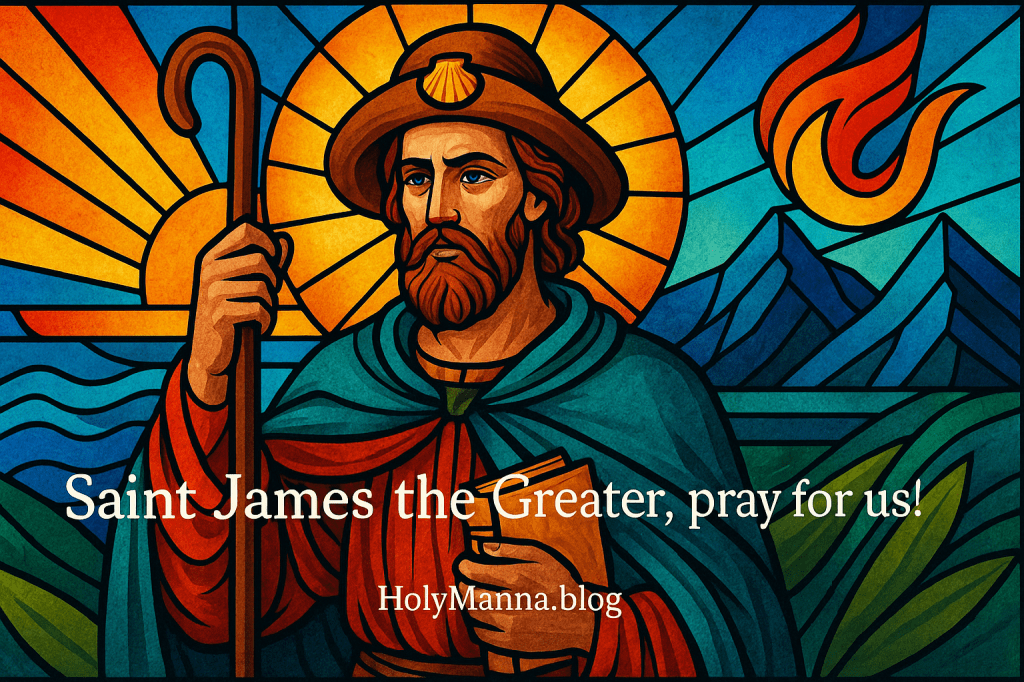
Son of Thunder, Apostle of Fire
Among the great cloud of witnesses that surrounds the Church, Saint James the Greater stands out as a blazing flame of apostolic zeal and martyrdom. One of Jesus’ first disciples, James was among the inner trio—alongside Peter and John—granted access to the most intimate revelations of Christ’s mission. His fiery nature earned him and his brother John the nickname “Boanerges,” or “sons of thunder” (Mark 3:17), a name that captures both his temperament and his boldness in proclaiming the Gospel. He was present for the Transfiguration on Mount Tabor, the healing of Jairus’ daughter, and the agony in Gethsemane. These were not mere coincidences—Christ chose James to see His glory and His sorrow, to be strengthened for the mission ahead.
Saint James is also celebrated as the first apostle to suffer martyrdom, a mark of distinction that sanctifies his fearless witness. His memory is venerated not only in the pages of Scripture but across nations and centuries, especially in Spain where devotion to him birthed the famous Camino de Santiago. His life is a divine invitation to follow Jesus with courage, conviction, and unshakable love—even to the ends of the earth.
From Nets to Nations
Saint James was born in the town of Bethsaida in Galilee, into a humble yet hardworking family. His father, Zebedee, was a fisherman who likely owned a modest family business, and his mother Salome is believed by tradition to have been among the women who followed Jesus and stood by the Cross. James was the elder brother of Saint John the Evangelist, and together they formed a dynamic spiritual duo that would shake the foundations of the early Church.
Like many in Galilee, James likely grew up learning the trade of fishing on the Sea of Galilee, waking up before dawn, casting nets, and navigating the unpredictability of wind and wave. But one day, everything changed. While mending their nets, James and John heard the voice of Jesus: “Follow Me, and I will make you fishers of men”. Without hesitation, they left their father and their livelihood behind (Matthew 4:21–22).
James’ conversion was not from unbelief, but from ordinary life to extraordinary mission. From that moment forward, he walked with Christ, learning not only how to cast nets, but how to cast the Gospel into the deep waters of human hearts. He is most remembered for his intimate proximity to Jesus, witnessing the raising of Jairus’ daughter, standing on Mount Tabor during the Transfiguration (Matthew 17:1–9), and keeping watch—though drowsily—with the Lord in Gethsemane. These moments formed him, not into a man of comfort, but a disciple of the Cross.
Miracles on the Move
After Jesus’ Resurrection and the descent of the Holy Spirit at Pentecost, James was aflame with the fire of mission. Though the Acts of the Apostles gives few details of his post-Pentecost ministry, ancient tradition holds that he traveled to the Iberian Peninsula—what is now modern-day Spain—to evangelize and plant seeds of the faith. Preaching in a foreign land, facing suspicion and rejection, James persevered, igniting the hearts of those who heard the Word of God.
During his time in Spain, James is said to have performed miracles that softened hardened hearts and healed the afflicted. One particularly beautiful tradition tells of a miraculous apparition of the Blessed Virgin Mary, who appeared to James on a pillar in Zaragoza, Spain, encouraging him in his ministry. That site is now home to Our Lady of the Pillar, the first reported Marian apparition, even while Mary was still alive on earth.
James’ boldness and miracles were not for spectacle—they were for salvation. He healed the sick and cast out demons in Christ’s name, not to exalt himself but to draw others into the life-giving truth of the Gospel. His zeal was relentless. His love was fearless. His ministry bore the fruit of repentance and faith wherever he went.
Drinking the Cup
The fiery zeal that led Saint James to preach in foreign lands eventually brought him back to where his apostolic journey began: Judea. After completing his missionary journey to the Iberian Peninsula—what is now modern-day Spain—James returned to Jerusalem. Though the biblical narrative does not give detailed descriptions of this return, ancient Church tradition holds that James’ evangelization in Spain was met with limited success, and he likely returned to the Holy Land to reconnect with the burgeoning Christian community and continue his apostolic ministry amid increasing threats of persecution.
At this point, Christianity was gaining ground in Jerusalem, but so was hostility from both religious authorities and political leaders. Herod Agrippa I, a client king of Rome and a Jew, sought favor with Jewish leaders by cracking down on the early followers of Christ. In this volatile environment, James’ bold preaching and prominent leadership made him a target.
The Acts of the Apostles records the moment starkly: “About that time Herod the king laid violent hands upon some who belonged to the church. He killed James the brother of John with the sword” (Acts 12:1–2). This event occurred around the year 44 A.D., making Saint James the first of the Twelve Apostles to be martyred, a distinction that crowned his life of faith with the ultimate testimony of love.
Church tradition tells us that as he was being led to execution, one of his accusers was so moved by James’ calm and holy demeanor that he repented, confessed Christ, and was executed alongside him. This early tradition, affirmed by some of the Church Fathers, paints a powerful picture of James’ unwavering faith and the divine grace present even in the face of death.
Saint James’ martyrdom fulfilled Jesus’ prophetic words spoken directly to him and his brother: “You will drink my cup” (Matthew 20:23). He had once asked for glory; he received a cross. And through that cross, he entered into eternal glory.
While his ministry in Spain may have seemed to bear little fruit at the time, James’ return to Judea and his martyrdom served as a foundational witness that would ripple outward across the centuries. His blood became seed—not only for the Church in Jerusalem but for the entire Christian world, including the land he once left behind.
A Pilgrim’s Companion
James’ legacy did not die with him. In fact, it only grew. According to tradition, after his martyrdom in Jerusalem, his followers brought his remains back to Spain, burying them in a hidden tomb. Centuries later, in the 9th century, a hermit named Pelayo received a vision revealing the saint’s burial site in Compostela, Galicia. There, a shrine was built, and the Cathedral of Santiago de Compostela would rise as one of the greatest centers of pilgrimage in Christendom.
The Camino de Santiago, or Way of Saint James, became not just a journey of miles but of spiritual transformation. Pilgrims from across Europe traveled by foot, braving treacherous paths, hunger, illness, and solitude, all to arrive at the Apostle’s tomb. Countless miracles of healing, deliverance, and deep conversion have been recorded along this sacred route.
Saint James is also remembered for the miraculous appearance at the Battle of Clavijo in 844, where he is said to have appeared on horseback to rally the Christian soldiers against the invading Moors. Though this event is now interpreted spiritually, not militarily, it reflects the deep trust the people of Spain had in their heavenly protector.
Even today, Santiago de Compostela remains a place where the weary find rest, the broken find healing, and the searching find Christ. Saint James’ intercession continues to echo like thunder across the centuries.
Marching in Fire
What does Saint James teach us today? He teaches us that discipleship is not about comfort, but about courage. It is not about status, but surrender. He shows us that a fiery heart, when handed to Christ, can light up the world.
In a culture of self-promotion, James reminds us that greatness comes through service and sacrifice. His desire to sit at Christ’s right hand was purified by martyrdom. His ambition was not denied—it was redeemed. How might God want to redeem your own desires for greatness, recognition, or impact?
James also teaches us perseverance. His ministry in Spain, largely unreceptive at the time, seemed fruitless. Yet he remained faithful. Centuries later, that same land became one of the great centers of Christianity. Are you willing to sow seeds of faith, even if you don’t live to see the harvest?
And finally, Saint James invites us to journey—with our feet and with our hearts. Whether walking the Camino or navigating the path of daily life, we are all pilgrims. Like James, we are called to walk closely with Jesus, endure hardship, serve boldly, and proclaim with thunderous love: “Jesus is Lord.”
May we walk the Way of Saint James with courage and hope, until we see Him face to face in the glory of the Kingdom.
Engage with Us!
We’d love to hear your reflections and stories of how Saint James has inspired you or your journey of faith. Please share your thoughts in the comments below!
Reflection Questions:
- What “nets” might Jesus be calling you to leave behind today in order to follow Him more fully?
- Have you ever felt a desire for recognition in your spiritual life, and how can you offer that desire to God, like James did?
- Is there someone in your life who needs bold, compassionate witness to the Gospel—how can you be that person for them today?
Let us encourage one another to be courageous witnesses of Christ, just as Saint James was. May we journey together, doing everything with love, as our Lord Jesus did.
Saint James the Greater, pray for us! ⚔️
Follow us on Instagram and Facebook for more insights and reflections on living a faith-filled life.

 Holy Manna!
Leave a comment